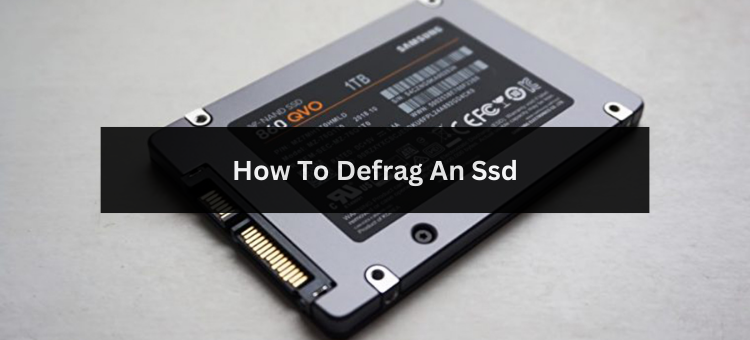
How To Defrag An SSD?
On a hard disk, defragmentation is a technique for best data storage.
How To Defrag An SSD?
On a hard disk, defragmentation is a technique for best data storage.
For mechanical hard drives (HDDs), where fragmented data distributed around the disk could slow down access times, it was historically a crucial chore.
Defragging is not required on Solid-State Drives (SSDs), though, and may even do more damage than benefit.
Let us first dissect the main ideas behind SSD defragmentation and performance before we delve into why that is.
Defragmentation is:
Defragmentation — also known as “defrag” — is the method of reordering scattered data on a storage media.
Files saved at non-contiguous locations across the storage media cause fragmentation, whereby the read/write head of the hard drive works harder to find all the fragments of a file.
HDDs notably find this difficult since their mechanical read/write heads physically move to access data.
Defragmenting the drive helps these scattered files to be combined into one, continuous block of data, therefore enhancing speed and performance.
Why SSDs Not Need Defragmentation
SSDs use flash memory devoid of moving components unlike HDDs.
Data is kept and accessed from an SSD in a fundamentally different manner than from HDDs, hence fragmentation has less effect on performance.
This is the reason:
There are no moving elements.
SSDs use semiconductor-based storage, in which flash memory cells house data.
Accessing scattered data on an SSD is not slower than accessing contiguous data; there is no physical “read/write head” that needs to migrate about.
Wear leveling is a method used by SSDs to guarantee that data is written equally throughout the memory cells, therefore preventing early wear-on-any one specific cell.
By excessively rewriting data, defragmenting an SSD could interfere with wear leveling and cause unneeded wear and maybe lower the SSD’s lifespan.
TRIM Command is: Modern SSDs enable the operating system to manage unneeded data blocks by supporting the TRIM command, therefore enabling the SSD to “clean up” and preserve best performance over time.
By avoiding needless writing of old data and hence lowering the demand for defragmentation, TRIM helps the SSD stay fast.
Should You Optimize Your SSD?
You should not defrag an SSD. Actually, since it creates extra write cycles that have no performance advantage, doing this might shorten its longevity.
Like Windows 10 and 11, most contemporary operating systems immediately find if the device is an SSD or an HD and will avoid running conventional defragmentation methods on SSDs.
Usually running optimization software meant especially for SSDs, they may incorporate the TRIM command among other things.
What else to do instead? Sort Your SSD
Although defragmentation is not required, there are some other actions you can take to maximize the speed of your SSD and guarantee it lasts as long as possible:
Turn on and check TRIM. Check TRIM’s activation.
By helping your SSD control unused blocks, this command preserves the drive in good condition.
Windows should be enabled by default, but you may check it by executing this line in line Prompt:
Graph Query
Copy code with FSutil behavior query Turn off Notify Disable.
Should the output be “0,” TRIM is turned on. Should it is “1,” you will have to turn on it.
Windows and macOS include built-in tools meant to maximize SSD performance.
Run automatically on SSDs, the “Optize Drives” program in Windows will guarantee TRIM is operating as it should.
Likewise, macOS guarantees your SSD is optimized by running a procedure known as “Spotlight indexing”.
Update Your SSD Firmware: Manufacturers of SSDs provide firmware updates meant to increase lifetime, dependability, and performance.
se their own software tools or routinely search for updates on the manufacturer’s website to maintain the drive current.
Steer clear from filling your SSD to capacity. When SSDs have some free space available, they work best. Constant fullness of your SSD could affect performance.
Try to release at least 10–20% of the capacity of the drive.
Use tools like DriveDx (for macOS) or CrystalDiskInfo (for Windows) to routinely check the state of your SSD.
These instruments can track variables such temperature, wear level, and faulty sectors so you may find possible problems before they become significant ones.
Finally, leave defragmentation behind.
Though maintaining HDDs mostly depends on defragmentation, it is not really important for SSDs.
Without conventional defrag tools, these contemporary drives are made to be quick, robust, and effective.
Instead of worrying about defragging, concentrate on using optimization tools as TRIM, keeping firmware updated, and maintaining some free space to guarantee your SSD continues running at its best.
You don’t have to worry about defragmentation if you’re using an SSD. Actually, long-term performance of your drive may suffer from this.
Just rely on the built-in optimization features of your operating system and appreciate SSD’s quick, silent, dependable performance.
메타데이터
- post_id
- b5df162dc1ad
- slug
- how-to-defrag-an-ssd-b5df162dc1ad
- url
- https://medium.com/@guidesarena/how-to-defrag-an-ssd-b5df162dc1ad
- canonical_url
- https://medium.com/@guidesarena/how-to-defrag-an-ssd-b5df162dc1ad
- author_url
- https://medium.com/@guidesarena
- status
- ok
- fetched_at
- 2026-07-21 14:54:35