Literacy Isn’t Just About Reading Books — It’s About Reading the World
One day, I watched a group of children playing in the yard — two little ones who’d been fighting over a toy suddenly paused, looked at each…
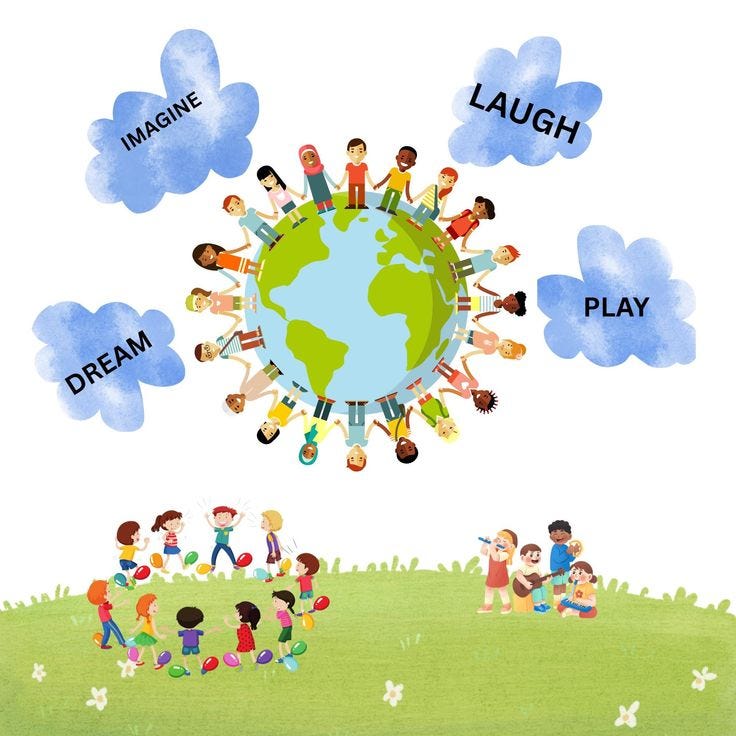
(Source: https://id.pinterest.com/pin/4592616179626199424/)
Literacy Isn’t Just About Reading Books — It’s About Reading the World
One day, I watched a group of children playing in the yard — two little ones who’d been fighting over a toy suddenly paused, looked at each other, and one of them gave in, offering to share. No adult stepped in to mediate. They worked it out themselves — reading facial expressions, reading tone of voice, reading each other’s cues. That small moment made me realize something: children are already “reading” long before they learn the alphabet. And to me, that’s a form of literacy far deeper than simply being able to decode letters on a page.
We’ve grown too used to narrowing what literacy means. We measure it by how fast a child can spell, how fluently they read a textbook, how high their test scores are. But real literacy is the ability to understand, interpret, and respond to the world — an ability that doesn’t only come from sitting still in front of a book, but from experience, observation, and interaction.
The Space That Gets Lost Amid the Pressure
I grew up in an Indonesian environment where literacy, in this broader sense, was still poorly understood. I saw firsthand how parents — with the best of intentions — often pushed their children toward academic achievement above all else. Tutoring sessions stacked from morning to night, as if a fuller schedule guaranteed a better future. Meanwhile, space for play and exploration was almost always the first thing sacrificed.
Then there’s the school system itself, which puts children in far-from-ideal conditions. The teacher-to-student ratio is deeply lopsided — one teacher for nearly 30 to 40 children. In a setup like this, kids are expected to sit still and absorb whatever the teacher says at the front of the room, following the same pace, the same method. Learning becomes one-directional. There’s little room to ask questions, to get things wrong, to figure out one’s own way of learning.
And the inequality cuts even deeper for children from low-income families. For them, forget about play — access to any kind of learning is often nonexistent. The space that should be theirs to grow in instead becomes the dusty streets they walk every day, forced into work at an age that should still be full of curiosity and play.
When Children Lose the Space to “Read the World”
This is why I believe the literacy crisis facing Indonesian children isn’t just about low literacy rates or test scores. It’s also about the disappearing space for children to learn in the most natural way possible: through observation, play, and social interaction. Children learn best precisely when they’re given room to explore — not when they’re forced into silence, passively absorbing one-way information.
When that space disappears — whether from academic pressure or economic necessity — what’s lost isn’t just playtime. What’s lost is the chance to grow into a whole human being: someone capable of critical thinking, empathy, and understanding a world beyond themselves.
Rumah Imaji Anak: An Idea I’m Working to Build
This unease is what pushed me to start working on Rumah Imaji Anak — an initiative I’m currently building as an idea for a non-formal space for children to read, play, and learn, free from curriculum pressure and grades to chase.
In my vision, Rumah Imaji Anak will eventually be run by young volunteers — not teachers in the formal sense, but more like older siblings accompanying children as they explore. I believe this peer-based approach matters, because children tend to feel safer and freer to explore when they don’t feel they’re being “graded” or “taught” within a hierarchical relationship.
Through this space, I hope children will one day truly be able to “read the world” — through stories, play, post-play discussions, and simple observation of their surroundings. Not literacy measured by test scores, but literacy that grows from curiosity that’s nurtured, not extinguished.
Reading the World Isn’t Only a Child’s Task
As a mother, I believe the kind of literacy I’m describing isn’t only about children’s ability. It’s also about how we, as adults, “read” the needs of the children around us. Have we truly seen what they need to grow? Or are we too busy demanding they meet standards we’ve decided are right, without really understanding the world they’re living in?
Have we taught children to read the world — or have we only told them to memorize letters?
Rumah Imaji Anak is, for now, still just a small idea I’m fighting to bring to life. But I believe that from small ideas like this, big change can begin — one step, one plan, one hope at a time.
메타데이터
- post_id
- b5e1e47d8f78
- slug
- literacy-isnt-just-about-reading-books-it-s-about-reading-the-world-b5e1e47d8f78
- url
- https://medium.com/@lisna04w/literacy-isnt-just-about-reading-books-it-s-about-reading-the-world-b5e1e47d8f78
- canonical_url
- https://medium.com/@lisna04w/literacy-isnt-just-about-reading-books-it-s-about-reading-the-world-b5e1e47d8f78
- author_url
- https://medium.com/@lisna04w
- status
- ok
- fetched_at
- 2026-07-29 06:51:31