How to Solve Quadratic Equations Like a Pro
Quadratic equations are one of those Class 10 math topics that students either love or dread. The equations look approachable until the…
How to Solve Quadratic Equations Like a Pro
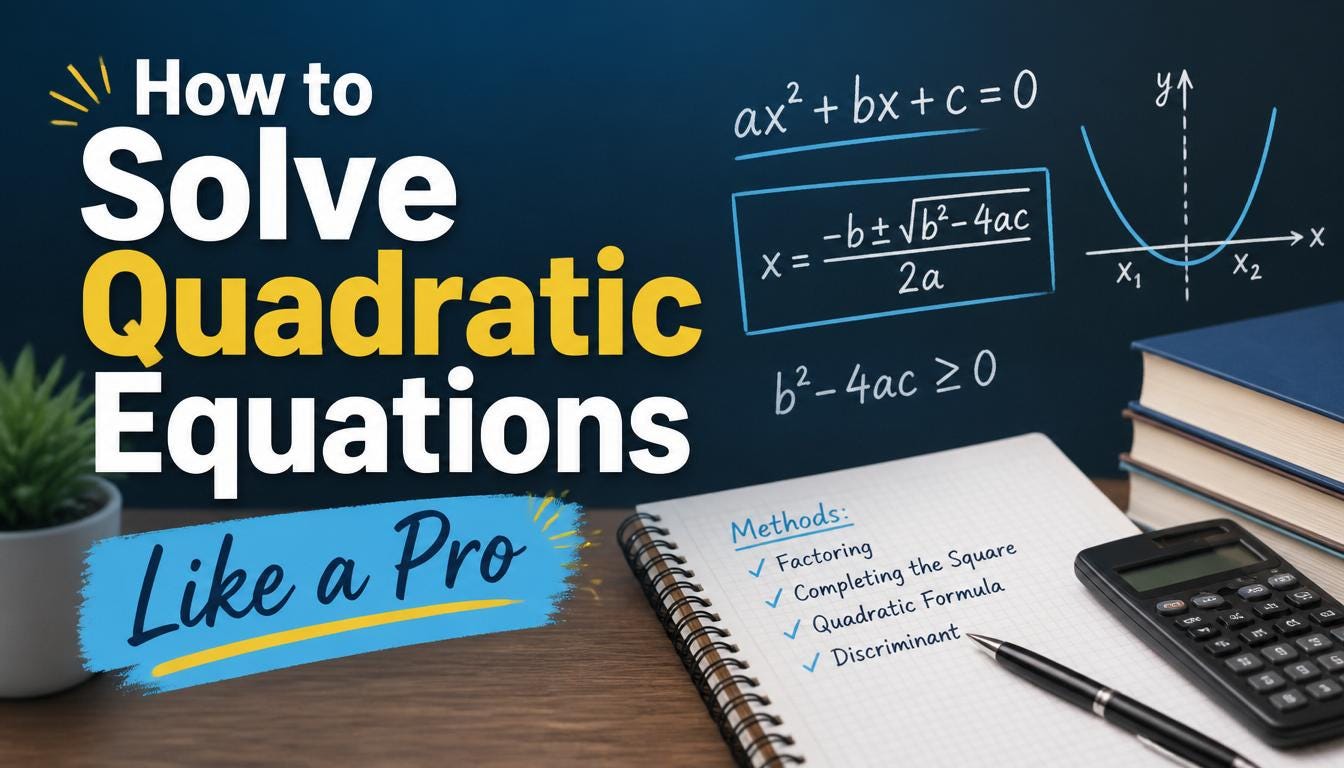
Quadratic equations are one of those Class 10 math topics that students either love or dread. The equations look approachable until the numbers get messy and the methods start blurring together.
Here’s what actually helps: understanding why each method works, not just the steps. When you know the logic, you stop guessing which approach to use. You start making deliberate choices. And the equation in front of you becomes a problem you know how to handle.
By the end of this guide, you’ll know:
- What a quadratic equation actually is
- Three methods for solving them factorization, completing the square, and the quadratic formula
- How to pick the right method for any equation
- How to use the discriminant as a shortcut
What Is a Quadratic Equation?
A quadratic equation follows this standard form:
ax² + bx + c = 0
Where a, b, and c are real numbers, and a ≠ 0. The solutions are called roots every quadratic has exactly two (though they can be equal, or not real at all).
Before solving anything, always rearrange your equation into standard form first. Skipping this step is one of the most common causes of errors.
Method 1: Factorization
Factorization is the fastest method when it works so it should always be your first attempt. The idea is to rewrite the quadratic as a product of two linear factors, then use a simple rule:
If two things multiply to give zero, at least one of them must be zero.
So if (x + p)(x + q) = 0, then x = −p or x = −q.
When to Use It
Use factorization when the coefficients are small, clean integers and you can spot the split quickly. If nothing comes to mind within 30 seconds, move on don’t force it.
For Equations Where a = 1
Example: Solve x² + 5x + 6 = 0
Step 1: Find two numbers that multiply to c (6) and add to b (5). → 2 × 3 = 6 ✓ and 2 + 3 = 5 ✓
Step 2: Write the factors. → (x + 2)(x + 3) = 0
Step 3: Solve each factor. → x = −2 or x = −3
For Equations Where a ≠ 1 (Split the Middle Term)
Example: Solve 2x² + 7x + 3 = 0
Step 1: Multiply a × c = 2 × 3 = 6.
Step 2: Find two numbers that multiply to 6 and add to 7. → 1 and 6
Step 3: Split the middle term. → 2x² + 1x + 6x + 3 = 0
Step 4: Group and factor. → x(2x + 1) + 3(2x + 1) = 0 → (x + 3)(2x + 1) = 0
Step 5: Solve. → x = −3 or x = −½
Watch out for sign errors. When c is positive, your two numbers share the same sign. When c is negative, they have opposite signs. Getting this wrong wastes time on combinations that can’t work.
Method 2: Completing the Square
Completing the square takes a few more steps, but it’s the method that makes the quadratic formula make sense. It’s also tested directly in exams so don’t skip it.
The idea: reshape the equation so one side becomes a perfect square, which you can then solve by taking a square root.
Step-by-Step Example
Example: Solve x² + 6x + 5 = 0
Step 1: Move the constant to the right side. → x² + 6x = −5
Step 2: Add (b/2)² to both sides. Here, (6/2)² = 9. → x² + 6x + 9 = −5 + 9 = 4
Step 3: Write the left side as a perfect square. → (x + 3)² = 4
Step 4: Take the square root of both sides (include ±). → x + 3 = ±2
Step 5: Solve both cases. → x = −1 or x = −5
When a ≠ 1
Divide the entire equation by a first to make the coefficient of x² equal to 1, then follow the same steps.
Example: Solve 2x² − 4x − 6 = 0
Divide by 2: x² − 2x − 3 = 0 → x² − 2x = 3 → Add (−2/2)² = 1 to both sides: (x − 1)² = 4 → x − 1 = ±2 → x = 3 or x = −1
Method 3: The Quadratic Formula
When factorization isn’t working and completing the square feels cumbersome, the quadratic formula delivers every time for any values of a, b, and c.
The formula:
x = (−b ± √(b² − 4ac)) / 2a
Step-by-Step Example
Example: Solve 3x² − 5x − 2 = 0
Step 1: Identify a = 3, b = −5, c = −2.
Step 2: Calculate the discriminant. → D = b² − 4ac = 25 + 24 = 49
Step 3: √49 = 7
Step 4: Apply the formula. → x = (5 ± 7) / 6
Step 5: Solve both roots. → x = 12/6 = 2 or x = −2/6 = −⅓
The Discriminant: Your Shortcut for Root Behavior
The expression D = b² − 4ac inside the formula is called the discriminant. Calculate it first it tells you the nature of the roots before you do any further work.

Many Class 10 exam questions ask about the nature of roots without asking you to find them. Computing D alone answers those questions no full solution needed.
Quick example: For x² − 4x + 4 = 0: → D = 16 − 16 = 0 → Two equal roots. Root = 4/2 = 2.
How to Pick the Right Method
This is where most students get stuck. Here’s a simple decision guide:

The rule: Try factorization first. If no split comes within 30 seconds, go straight to the quadratic formula. Use completing the square when the question specifically calls for it or when the numbers are clean enough to keep it simple.
Always Verify Your Roots
Solving isn’t the last step checking is.
Substitute your answer back into the original equation. If both sides equal zero, you’re done. If not, you’ve caught an error before it costs you marks.
Example check for x² + 5x + 6 = 0, roots x = −2 and x = −3:
- (−2)² + 5(−2) + 6 = 4 − 10 + 6 = 0 ✓
- (−3)² + 5(−3) + 6 = 9 − 15 + 6 = 0 ✓
Thirty seconds. Always worth it.
Tackling Word Problems
Exam papers regularly present quadratic equations inside real-world scenarios. The equation isn’t handed to you you have to build it.
General approach:
- Let x represent the unknown quantity.
- Translate the problem’s condition into an equation.
- Rearrange into standard form.
- Solve using the most appropriate method.
- Check whether both roots make sense in context. Negative age or distance usually doesn’t discard with a brief explanation.
Example: Two consecutive positive integers have a product of 56. Find them.
→ Let the integers be x and x + 1. → x(x + 1) = 56 → x² + x − 56 = 0 → Factorize: (x + 8)(x − 7) = 0 → x = −8 (rejected) or x = 7
The integers are 7 and 8.
Common Mistakes to Avoid
- Skipping standard form. If your equation isn’t in ax² + bx + c = 0 form first, every method breaks.
- Forgetting ± when taking a square root. This is where students lose the second root.
- Sign errors in b when using the formula. If b is negative, −b becomes positive. Write it out carefully.
- Not checking both roots in word problems. Both may be mathematically valid but only one fits the real-world context.
Build Your Understanding Step by Step
Quadratic equations are tested in Class 10 boards and form the foundation of algebra in Class 11 and JEE. Students who understand these methods rather than just memorizing them handle advanced problems significantly better.
The EduAiTutors Class 10 Foundation Program builds exactly this kind of conceptual depth, taking students from core methods through to exam-level application. If you want structured support that goes beyond formulae, the EduAiTutors Foundation Program is worth exploring.
Read: How Foundation Courses Help Students Transition from School to Competitive Exams
Key Takeaways
- Always rewrite the equation in standard form before solving.
- Try factorization first it’s fastest when the numbers cooperate.
- Use the discriminant to understand roots before committing to a full solution.
- The quadratic formula is your reliable fallback for any equation.
- Check both roots by substituting back in especially in word problems.
Master these methods with enough practice and quadratic equations stop being a source of exam anxiety. They become one of the most predictable, straightforward topics on your Class 10 paper.
메타데이터
- post_id
- b6064b196ed2
- slug
- how-to-solve-quadratic-equations-like-a-pro-b6064b196ed2
- url
- https://medium.com/@tutorseduai/how-to-solve-quadratic-equations-like-a-pro-b6064b196ed2
- canonical_url
- https://medium.com/@tutorseduai/how-to-solve-quadratic-equations-like-a-pro-b6064b196ed2
- author_url
- https://medium.com/@tutorseduai
- status
- ok
- fetched_at
- 2026-06-24 16:30:55