How a Brand Appears in Search: The First Stage of a PR Audit Before Launching a Campaign
Before you pitch journalists, plan narratives, or create content, check what people already see when they search for the brand. Search is…
How a Brand Appears in Search: The First Stage of a PR Audit Before Launching a Campaign

Before you pitch journalists, plan narratives, or create content, check what people already see when they search for the brand. Search is not just a technical SEO channel. It is one of the first places where reputation is formed. A potential customer sees an ad, hears a recommendation, reads a post, or notices the company in the media. Then they do the most natural thing: they Google it. And what they find there can either support your PR work or quietly damage it.
Adglobeclients Infographic
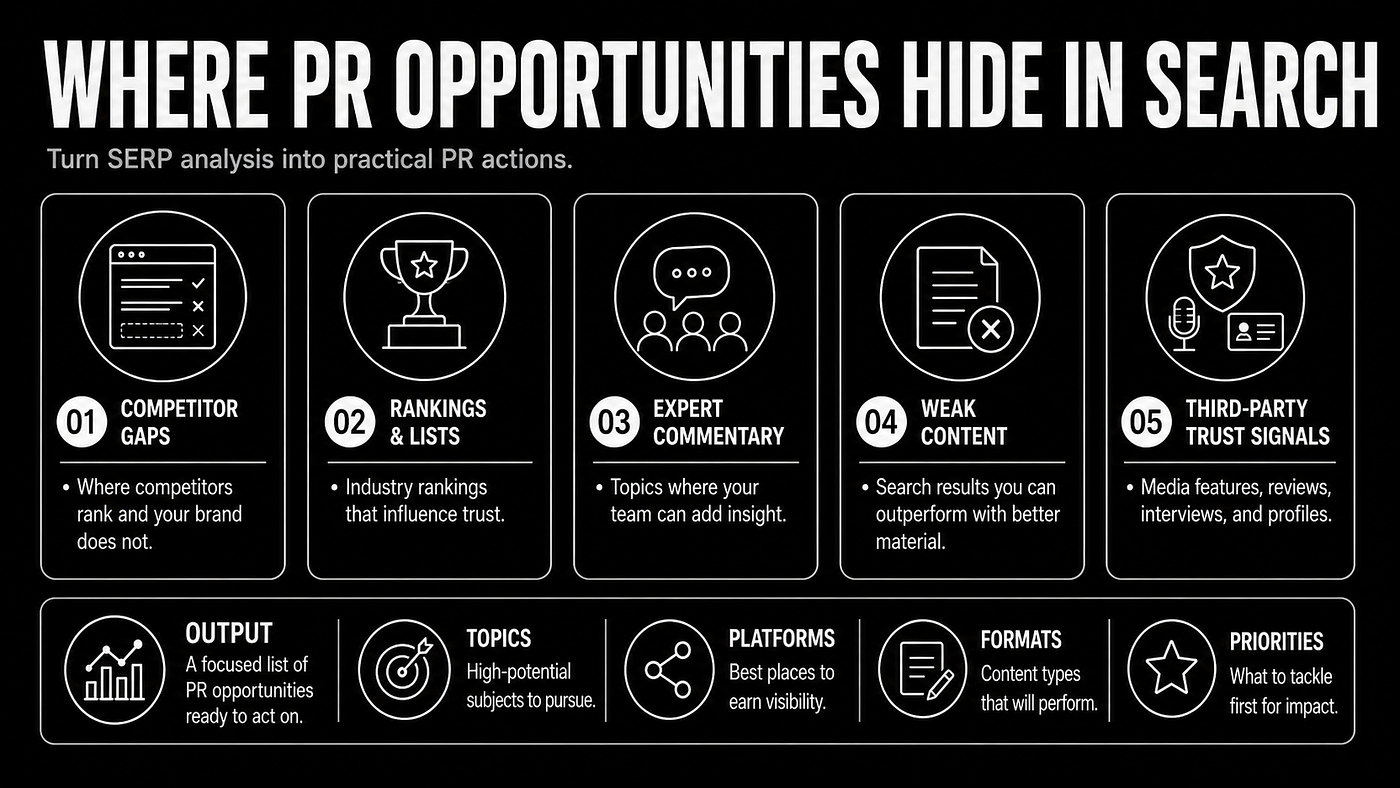
A brand may have a strong product, a talented team, and a clear market position. But if the search results are empty, outdated, full of random directories, or dominated by negative reviews, the audience will not see that strength. They will see what Google shows them. That is why a PR campaign should not start with media outreach. It should start with a search results audit.
Why PR Starts With Search
When a client comes with a PR request, the initial brief often sounds broad: “We want more media coverage.” “We need to improve brand awareness.” “We want to look more credible.” “We need to deal with negative content.” “We want to appear in reputable publications.” “We need to build authority in the market.”
All of these goals are valid. But before deciding what kind of PR activity the brand needs, you must understand how the brand already looks in search. Search results show the current public perception of the company. They reveal what a person sees before becoming a client, partner, investor, candidate, journalist, or stakeholder.
A search audit helps answer several important questions: what appears when people search for the brand, whether the official website ranks first, whether there are negative results on the first page, whether independent media sources mention the company, whether the search results are current or outdated, whether the brand looks credible and active, whether competitors are more visible than the client, and which pages create the first impression.
This is not just an SEO task. It is a reputation task. PR is about shaping perception. Search results are one of the most visible reflections of that perception.
When a Search Audit Is Especially Important
A search audit is useful before almost any PR campaign, but there are situations where it becomes essential.
When the Brand Is Starting PR From Scratch
If a company has not worked with public visibility before, its search results may be weak or random. A typical first page may include the official website, one or two social media profiles, a few business directories, irrelevant pages, old mentions, and no independent media coverage.
Technically, this may not look dangerous. There may be no negative content. But the issue is different: the search results do not build trust. A person who searches the company may not find anything that confirms its expertise, credibility, market position, or real experience. In this case, PR is not only about visibility. It is about creating a proper information layer around the brand.
When the Client Has Negative Content
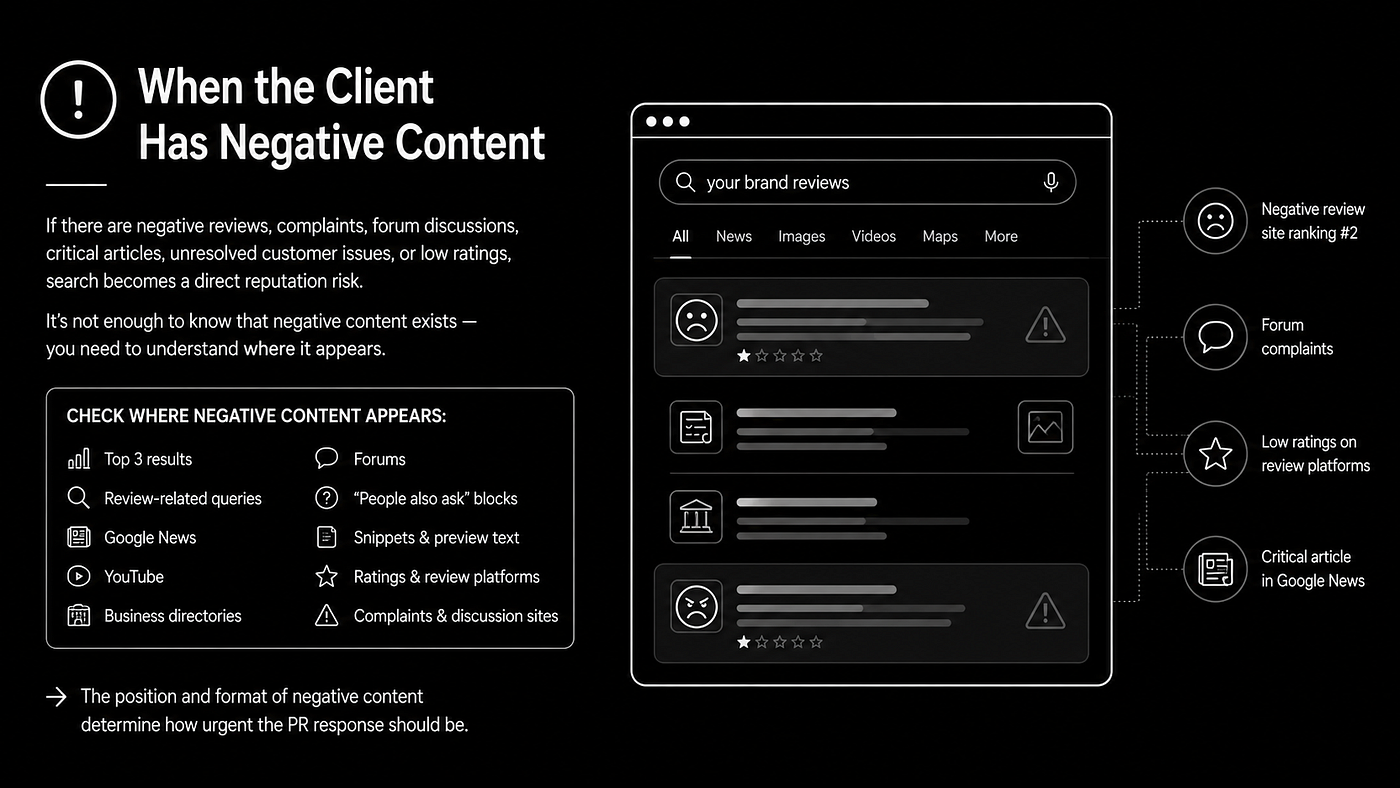
If there are negative reviews, complaints, forum discussions, critical articles, unresolved customer issues, or low ratings, search becomes a direct reputation risk. The key is not only to identify whether negative content exists, but to understand where it appears.
Adglobeclients Infographic 1
Negative content in position two is very different from negative content on page three. A negative review site ranking for “brand name reviews” is different from a single old comment on an inactive forum. During the audit, you need to check whether negative content appears in the top three results, on the first page, in review-related queries, in Google News, on YouTube, in business directories, in forums, in “People also ask” blocks, or in snippets and preview text.
The position and format of negative content determine how urgent the PR response should be.
When the Client Wants to Build Trust
Sometimes there is no obvious negative content, but the brand still looks weak in search. This often happens when the first page is filled with neutral results: website, directory, social media, another directory, another profile, and so on.
Nothing is damaging. But nothing is persuasive either. There are no interviews, no expert columns, no case studies, no industry rankings, no independent articles, no founder visibility, and no thought leadership. For a brand that wants to build trust, this is a problem. The search results do not support the desired positioning.
PR can help fill this gap with media mentions, expert commentary, interviews, case studies, research-based content, and authoritative third-party publications.
When the Brand Enters a New Market
Search results are highly dependent on geography and language. A brand may look strong in one country and almost invisible in another. It may have good search visibility in its native language but weak or empty results in English.
If the client is entering a new market, the search audit must be done for that specific market. You need to check local search results, local language queries, local competitors, local media, local review platforms, local business directories, and local search behavior.
For example, a brand may be well-known in Eastern Europe but completely unknown in the UK. Or it may have strong results in Russian, but almost no results in English. In this case, PR must help the brand become understandable and credible in the new market context.
When the Client Wants to Build a Personal Brand
If PR is focused on a founder, CEO, expert, doctor, lawyer, investor, HR leader, or public spokesperson, you need to audit not only the company name but also the person’s name.
Personal search results can reveal lack of public visibility, outdated professional profiles, old interviews that no longer match the current positioning, confusion with people who have the same name, negative or irrelevant mentions, and missing expert content. A company can have a decent brand presence while its key spokesperson remains invisible. If the PR strategy depends on expert authority, this becomes a problem.
When the Client Runs Paid Campaigns
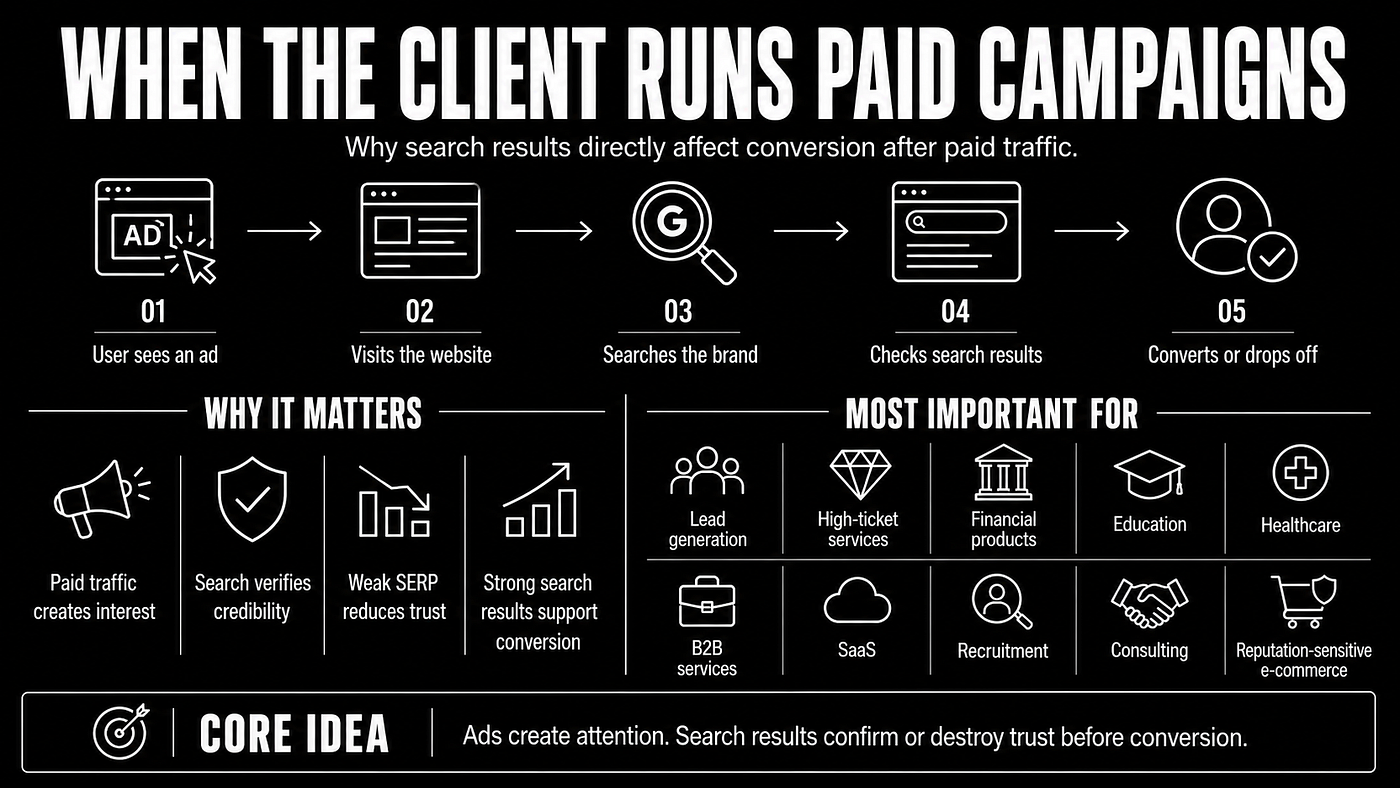
Search results directly influence paid traffic performance. A user may see an ad, visit the website, become interested, and then search the brand before converting. If the search results look weak or suspicious, the conversion may be lost.
Afglobeclients infographic 2
This is especially important for lead generation, high-ticket services, financial products, education, healthcare, B2B services, SaaS, recruitment, consulting, and e-commerce brands with reputation-sensitive products. Paid campaigns can create interest. But search results often confirm or destroy trust.
What to Prepare Before the Audit
Before opening Google, collect the basic information from the client. Otherwise, the audit will be incomplete.
Brand Information
Ask the client for the official brand name, legal company name, short versions of the name, previous names if there was a rebrand, product names, service names, main website domains, landing pages, official social media accounts, main countries and cities of operation, communication languages, and key executives or spokespeople.
This matters because users may not search the brand exactly as the company names itself. They may search a shortened name, a product name, a founder’s name, a misspelled version, an old company name, the brand name plus “reviews,” the brand name plus “scam,” or the brand name plus a country or city.
A good audit should reflect real search behavior, not only the official brand vocabulary.
Business Context
You also need to understand why the client wants PR now. Ask what the main PR goal is, whether the focus is awareness, trust, reputation repair, or market entry, whether there are known reputation issues, which audiences matter most, who makes the buying decision, which markets are priorities, who the main competitors are, whether there are upcoming launches or announcements, whether the company has already had media coverage, which publications matter to the client, and who can speak publicly on behalf of the company.
Without this context, the audit may become too mechanical. You will collect links, but you will not understand what they mean for the business.
Search Geography and Language
Search results vary by location, language, device, and personalization. Before collecting results, define which country to check, which city matters if any, which language the audience uses, whether desktop and mobile should be checked separately, which search engine matters most, and whether local platforms should be included.
For many PR audits, Google is the main starting point. But depending on the market, you may also need to check YouTube, Google Maps, Bing, local directories, review platforms, marketplaces, or industry-specific databases.
Which Queries to Check
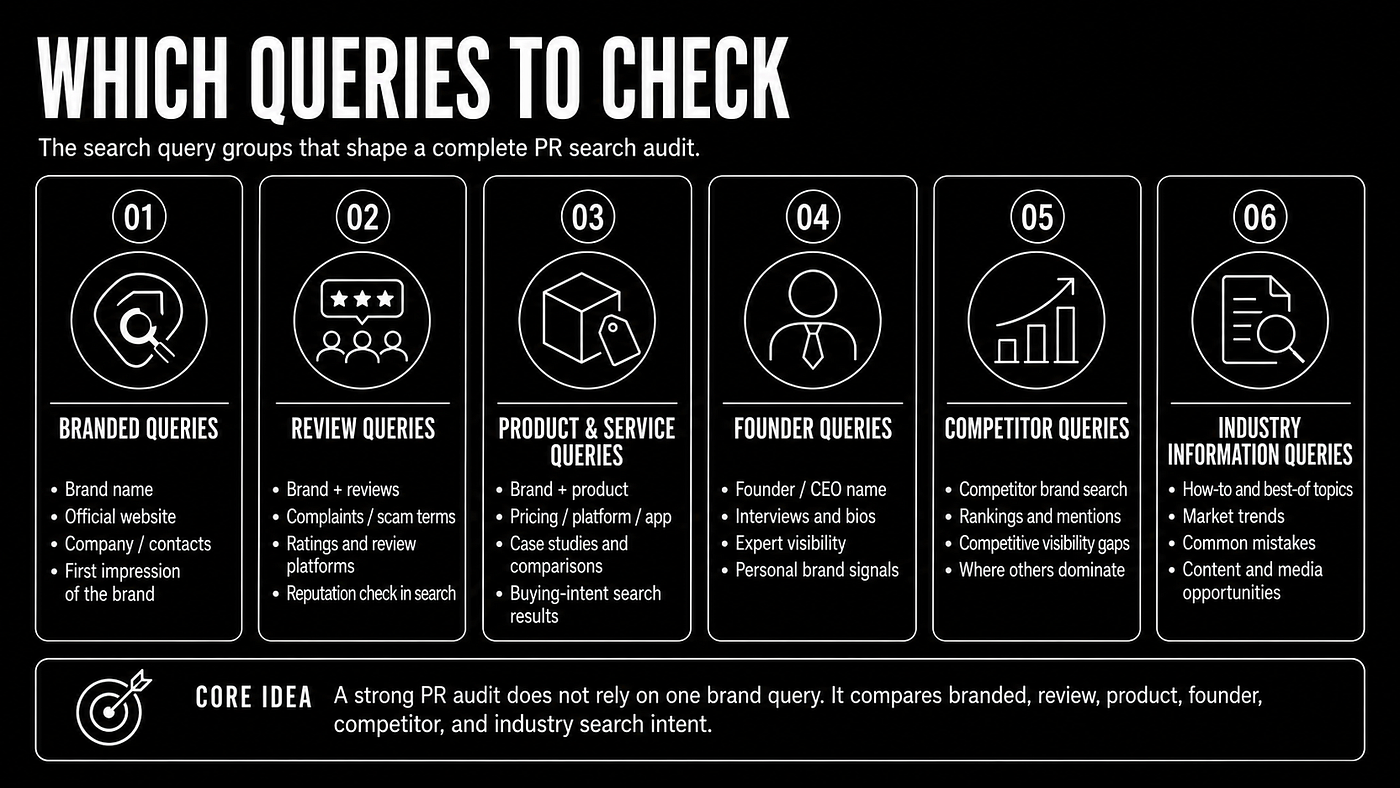
A serious search audit cannot be based on one brand query. You need several query groups.
Adglobeclients Infographic 3
Branded Queries
Branded queries show the basic search picture. Examples include “brand name,” “brand name official website,” “brand name company,” “brand name contacts,” “brand name country,” and “brand name what is it.”
Here you need to check whether the official website ranks first, what appears after the website, whether social profiles are visible, whether there are media mentions, whether there are negative results, whether the brand is confused with another company, and whether there are outdated pages.
The branded query is the first impression. It tells you whether the brand controls its own identity in search.
Review Queries
Review queries are essential for reputation analysis. Examples include “brand name reviews,” “brand name customer reviews,” “brand name complaints,” “brand name scam,” “brand name fraud,” “brand name negative reviews,” and “brand name rating.”
Here you need to check which review platforms rank, whether the ratings are low or high, whether the reviews are recent, whether the company responds, what complaints repeat most often, whether there are suspicious or fake-looking reviews, whether there are positive customer stories, and whether any existing pages can be strengthened.
Even if the client does not mention negative reviews, you should still check review queries. Reputation issues often hide there.
Product and Service Queries
If the brand sells a specific product or service, check queries that combine the brand with its offering. Examples include “brand name pricing,” “brand name product,” “brand name app,” “brand name service,” “brand name case studies,” “brand name platform,” “brand name software,” and “brand name agency.”
Here you need to check whether commercial pages are visible, whether there are third-party reviews, whether there are comparison articles, whether competitors appear, whether there are useful expert materials, and whether PR content can support these queries.
Product-related search results often influence buying decisions more directly than the main brand query.
Founder and Spokesperson Queries
If people are part of the PR strategy, audit their names. Examples include “name surname,” “name surname CEO,” “name surname founder,” “name surname interview,” “name surname biography,” “name surname company,” and “name surname expert.”
Here you need to check whether the person has a clear professional presence, whether there are interviews or expert comments, whether social profiles are visible, whether there are irrelevant or outdated mentions, whether the person is confused with someone else, and whether PR can strengthen their authority.
For expert-led PR, personal visibility is often as important as brand visibility.
Competitor Queries
Competitor search results help reveal the PR landscape. Examples include “competitor name,” “competitor name reviews,” “competitor name interview,” “competitor name case study,” “best companies in the niche,” “top agencies in the niche,” and “best tools for the category.”
Here you need to check where competitors appear, which media mention them, which rankings include them, what topics they own, which pages rank well, and where the client is missing.
Competitor analysis helps identify realistic PR opportunities.
Industry Information Queries
Industry information queries help find topics and publications. Examples include “how to choose a service,” “best tools for a specific need,” “market trends in the niche,” “common mistakes in the category,” “how much the service costs,” “industry problems,” and “best practices.”
Here you need to check which publications rank, what content formats work, whether there are expert comments, whether the client can contribute a column, whether the client can provide data or research, and whether there are content gaps.
This group helps transform the audit into a content and media strategy.
How to Collect Search Results
A proper audit requires documentation. Do not just look at Google and move on.
Set Consistent Conditions
For a neutral view, use a clean browser, no Google login, no personal search history, fixed location settings, the same language settings, and the same device type for each check. If the client works across multiple markets, repeat the process for each location.
Collect the Top 10 and Top 20
The top 10 shows what users see on the first page. The top 20 shows what can potentially be strengthened and moved upward.
For each result, record the query, position, URL, domain, page title, result type, tone, publication date, content format, resource owner, short comment, risk level, and recommended action.
Take Screenshots
Screenshots are important because search results change. They help show the client the real picture, document the audit date, compare changes later, and avoid disputes caused by personalized results.
A useful file structure is: Date / Country / Query / Desktop or Mobile.
Look Beyond Organic Links
Search results are not only blue links. You should also check ads, People also ask, news blocks, images, videos, maps, Google Business Profile, reviews, snippets, social media, YouTube, forums, directories, aggregators, old PDFs, and cached documents.
Sometimes the reputation risk is not in the link itself, but in the snippet, rating, video title, or question block.
The Main Point
A PR audit should begin with search because search shows what the audience already sees. Before creating new narratives, you need to understand the existing one. Before pitching media, you need to know what Google says. Before building reputation, you need to see the reputation that already exists.
Search results are not just a technical layer. They are a public perception layer. And if PR is meant to shape perception, then search is one of the first places to start.
메타데이터
- post_id
- b60f7b3bec53
- slug
- how-a-brand-appears-in-search-the-first-stage-of-a-pr-audit-before-launching-a-campaign-b60f7b3bec53
- url
- https://medium.com/@adglobeclients/how-a-brand-appears-in-search-the-first-stage-of-a-pr-audit-before-launching-a-campaign-b60f7b3bec53
- canonical_url
- https://medium.com/@adglobeclients/how-a-brand-appears-in-search-the-first-stage-of-a-pr-audit-before-launching-a-campaign-b60f7b3bec53
- author_url
- https://medium.com/@adglobeclients
- status
- ok
- fetched_at
- 2026-07-10 12:09:34