Post IV: The Less I Know the Better
Death sucks.
Post IV: The Less I Know the Better
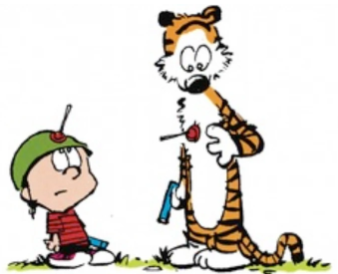
Image courtesy of Bill Watterson, Dart Gun
Death sucks.
Whether you’ve lost a friend, family member, animal, or a celebrity with whom you have a toxic parasocial relationship, death is something that has no explanation.
Age, gender, wealth, political stance, stake in business or community, and — the most unfair for some people— being a good person, all mean absolutely nothing in terms of mitigating our fate.
When it’s our time, unfortunately, it’s our time.

Occult Skull Reaper, Bi Nutz
However, there is something beautiful to be said about the lessons we learn after overcoming our experiences with death. One of which is the ability for us to help others facilitate their own grief.
[embed]Roger Smith, American Dad! (season 13, episode 13 — Widow’s Pique, 2016)
For Post IV, I chose to connect four of Bill Watterson’s Calvin and Hobbes comics due to the linear experience that the titular character Calvin progresses through by the fourth comic.
Dart Gun, begins with Calvin and Hobbes in the throes of a game of war. Before their mutually assured destruction, Hobbes asks Calvin, “[why do] we play war and not peace?” And in response, Calvin states the only rule of the game, “get hit with a dart, you’re dead and the other side wins”. Suddenly, the game starts and results in both of them losing.
One second they were alive, and the next they were both dead.

The Fates Gathering in the Stars, Elihu Vedder (1887)
After discovering a gravely injured raccoon, Calvin tells Hobbes to watch it while he runs to fetch his mom for help.
In About Death 1, both Hobbes and Calvin’s mother have an existential crisis that results in the latter conceding, “you can tell I’m upset when I start talking to you [Hobbes]”. This reaction is really telling about the differing human experience Calvin’s mother and Calvin himself are going through. While Calvin was under the pretext that “[one does not] get to be a mom if you can’t fix everything just right”. Calvin’s mother catches herself venting her uncertainty on how to handle “these things” to a stuffed animal.
The harsh reality is that even parents are capable of reverting back to their childhood vulnerability when faced with mortality.

Afterlife, Anyma and Chris Avantgarde, ADE (2023)
To some degree, our first experience with death is one where we are more concerned with our own feelings of loss than the person who lost their life.
About Death 2, conveys how the inevitability of death is not only hard to comprehend, but also how we can be immature with our entitlement to express our feelings on the death. This manifests in Calvin’s final thought of the comic after discovering the raccoon he had expected his parents to heal had died.
“I know [he’s dead] I’m crying because out there he’s gone, but he’s not gone inside me.”
[embed]The Sending in Kilika, Final Fantasy X (2011)
The final comic, About Death 3, sees Calvin attempt to logically unpack the arbitrary, unfairness of death.
Calvin initially says, “It’s like I found him for no reason. I had to say goodbye as soon as I said hello”. But then he continues by saying, “still… in a sad, awful, terrible way, I’m happy I met him”. A sentiment that some people who were capable of overcoming their grief often say.
It’s better to know someone for a short time than never at all.
At the conclusion of the final comic, Calvin says, “[his mom told him] we don’t really understand [death], but there are many things we don’t understand, and we have to do the best we can with the knowledge we have”.
The overarching theme between the four comics is that death is a subject that can never truly be managed. While our initial ignorance as a child to the subject of death is as trivial as a game of war. The reality is that one day we will all have to learn how to cope with the ramifications of death. And despite some of us having more experience with it than others, it is never an easy task.
Common Themes Dart Gun:
- “Why play war and not peace?”; the immature trivialize death; confirmation bias
About Death 1:
- “Moms [can] fix everything.”; parents don’t always have the answers to why bad things happen and how to handle them, especially death
About Death 2:
- “out there he’s gone, but he’s not gone inside me.”; warmth and safety are the only things we can attempt to control, but uncertainty is part of growing up
About Death 3:
- “We just have to do the best we can with the knowledge we have”; death is something that can’t be figured out, it can’t be made sense of
NOTES
Dart Gun:
- Fearless American Defender vs Godless Communist
- Rule: War = one hit [anywhere on the body] with a dart and you die
- Result: Mutually Assured Destruction; Both are simultaneously hit = they both die
- Realization: war is a stupid game
- Underlying Curiosity: what is reality — Calvin and Hobbes were both able to shoot each other; Hobbes is apparently a stuffed animal
About Death 1:
- People we rely on don’t always have the answers
- Rule: “You don’t get to be a mom if you can’t fix everything just right.”
- Result: Hobbes originally questions whether Calvin’s mother can help; Calvin’s mother is uncertain if she can help; Calvin’s mother vents her frustration to Hobbes, saying “You can tell I’m upset when I start talking to you”
- Realization: socializing children to believe their parents can handle anything is a privilege that affirms ignorance and fantasy
- Underlying Curiosity: Hobbes, a stuffed animal, asks Calvin if the raccoon is “still alive”;
About Death 2: n/a
About Death 3: n/a
메타데이터
- post_id
- b613d702fe6d
- slug
- post-iv-the-less-i-know-the-better-b613d702fe6d
- url
- https://medium.com/@aequinte/post-iv-the-less-i-know-the-better-b613d702fe6d
- canonical_url
- https://medium.com/@aequinte/post-iv-the-less-i-know-the-better-b613d702fe6d
- author_url
- https://medium.com/@aequinte
- status
- ok
- fetched_at
- 2026-07-25 01:35:12