The Space Between a Gigawatt and a Tomato
The most useful number in African energy right now isn’t 4.5 gigawatts. It’s the 30–50% of tomatoes, mangoes, and leafy greens that never…
The Space Between a Gigawatt and a Tomato

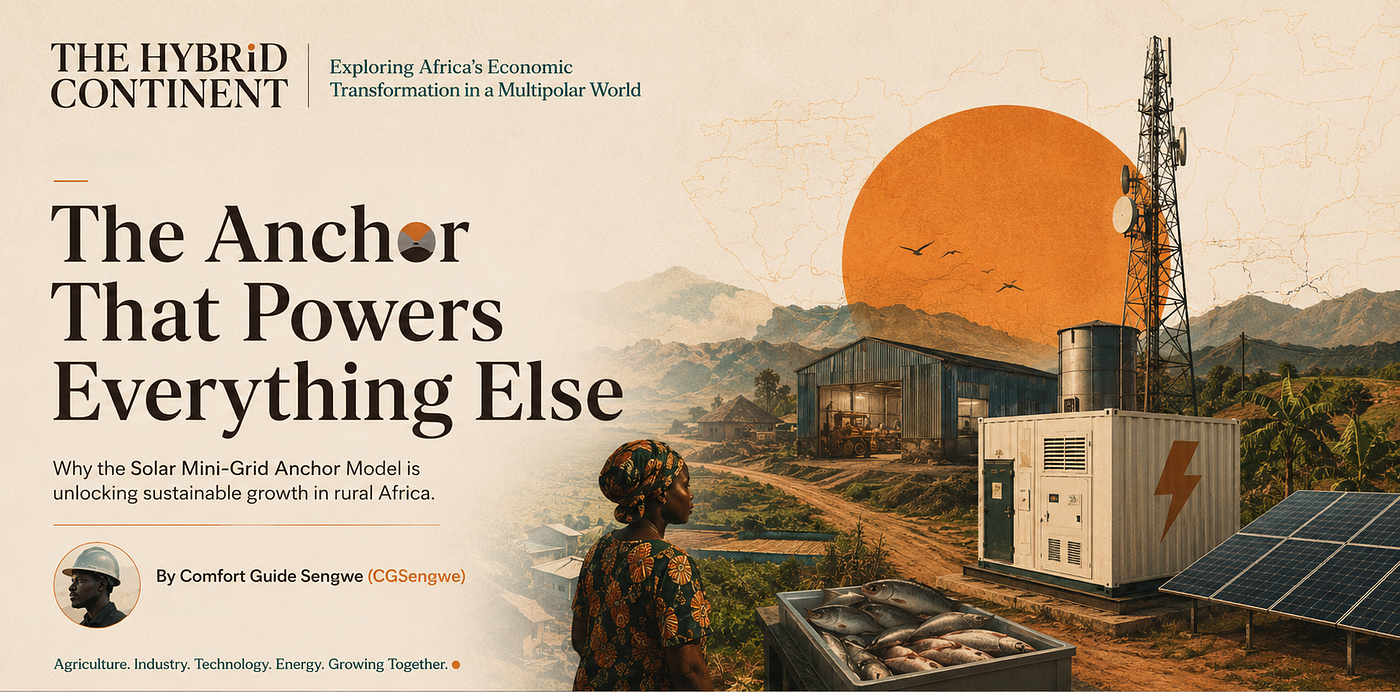
The space between a gigawatt and a tomato. Source: ChatGPT
The most useful number in African energy right now isn’t 4.5 gigawatts. It’s the 30–50% of tomatoes, mangoes, and leafy greens that never make it to a buyer.
If you run a small agribusiness, you don’t need me to explain that figure. You’ve lived it. You know the sound of a diesel generator coughing itself to silence in the middle of a milling run, the quiet panic of a cold room warming up overnight. It’s a particular kind of exhaustion, and it’s been the background noise of small enterprises across the continent for as long as anyone can remember.
Something has been shifting, though, and not loudly. Over the past eighteen months, solar energy has started showing up in places that grids forgot, and generators bankrupted. Africa added roughly 4.5 gigawatts of new solar capacity in 2025, a 54% leap from the year before. I mention that number only because it’s the one that makes headlines. What interests me more is how people are paying for those panels, and where they’re being put to work.
In a growing number of markets, pay-as-you-go solar kits have quietly overtaken cash sales. That might sound like a footnote about consumer finance, but it’s actually a signal.
It means a farmer or a small shopkeeper can get a solar-powered pump or a cooler without emptying a season’s savings, paying in small, mobile-money instalments that match the rhythm of their cash flow. Alongside that, mini-grids are moving beyond demonstration projects.
In Nigeria, I’m seeing developers deliberately anchor their systems to a grain mill or a cassava processor, designing the whole economics around daytime productive load rather than just household lights. Across East Africa, the same pattern is emerging: mini-grids built with the cold room and the irrigation pump in mind from day one. Battery storage is beginning to fill the gaps, too — smoothing out the clouds and the grid outages alike, so the power is actually there when a business needs to run.
Investment patterns tell a similar story of quiet maturation. Scale-up capital is flowing, but it’s flowing to the operators who have proven they can get beyond connection numbers. Mini-grid developers are now being valued, sometimes explicitly, on their ability to hold a high load factor through productive-use customers. A mill that runs six hours a day makes a mini-grid viable in a way that twenty lightbulbs never will. It’s not flashy, but it’s real.
This is where the connection to small and medium enterprises stops being theoretical.
Reliable, decentralised power means a horticulture handler can run a solar cold room instead of praying the diesel holds, cutting post-harvest losses that routinely swallow a third to half of all perishables. It means a grain miller or a welding shop can halve their energy costs — often a 30–50% drop — compared to running a generator. It extends operating hours into the evening, powers the irrigation pump, and keeps the digital tools charged.
Small tourism lodges and last-mile logistics hubs gain the kind of power certainty that makes their whole business model thinkable. Decentralised renewable energy already supports hundreds of thousands of direct jobs in sales, installation, and maintenance, and the multiplier effect in the enterprises that get switched on is only starting to be counted.
Projections that tie renewables to productive use suggest millions of additional livelihoods by 2030, concentrated in labour-absorptive sectors — the industries without smokestacks — rather than in capital-heavy utility builds. Without this shift, the default remains diesel dependency and the downtime that eats ambition.
I don’t want to overstate the pace. Capital costs are still steep, and the gap between a well-designed mini-grid and the main grid’s creaking distribution lines remains a stubborn constraint. In many places, the thing that matters most is not whether the solar farm is built but whether the local transformer can handle the load and the last-mile poles actually reach the business. The ground truth in mid-2026 is that off-grid and mini-grid momentum is genuine wherever it lines up with commercial demand, but it is not yet scaling itself.
We’re still in the messy, promising middle.
If you’re running a small enterprise, a few practical habits are worth carrying forward. When you’re looking at a solar dryer, a cold room, or a new motor, ask whether the equipment is designed to play nicely with a mini-grid or a pay-as-you-go home system. Bundling that equipment with a mobile-money financing plan can turn an intimidating upfront cost into something you can manage alongside your sales cycle. And it’s worth keeping an ear out for mini-grid tenders in your area. Developers are actively searching for anchor loads — businesses that use power during the day — and expressing interest early can put you at the centre of a project rather than on the sidelines.
For those who shape policy or deploy capital, the quiet lesson from the ground is that a headline gigawatt figure means nothing to a business if the last-mile line is a bottleneck. The incentives that work are the ones that de-risk local developers and design tariffs around an anchor load like a cold room or a mill, while insisting that installation and after-sales jobs stay in the community.

The power of solar in agriculture. Source: ChatGPT
The real progress will be measured not by capacity additions alone but by the ability to blend concessionary and commercial finance in ways that a local energy company can actually absorb, and to harmonise equipment standards — through bodies like AMDA and GOGLA — so that a pump from one supplier and a payment platform from another can talk to each other without friction.
Underneath all of that is a single question: can we tie every new energy connection to something you can verify — lower losses, higher output, a new service that sticks?
I’m still watching how this unfolds, and the places I’m watching most closely are the Nigeria and East Africa pilots. They’re the ones that will show, at the settlement scale, whether an energy investment can reliably strengthen a small business rather than just light a home. Next time, I may look specifically at the cold-chain and energy overlaps, because that’s where the quiet hum of a solar panel meets the hard economics of getting food to market.
For now, if you’re curious, maybe just look up whether there’s a mini-grid tender near you. You might find a partner you didn’t know you had.
Comfort Guide Sengwe (CGSengwe)
메타데이터
- post_id
- b6160deb3bfd
- slug
- the-space-between-a-gigawatt-and-a-tomato-b6160deb3bfd
- url
- https://medium.com/@cgsengwe/the-space-between-a-gigawatt-and-a-tomato-b6160deb3bfd
- canonical_url
- https://medium.com/@cgsengwe/the-space-between-a-gigawatt-and-a-tomato-b6160deb3bfd
- author_url
- https://medium.com/@cgsengwe
- status
- ok
- fetched_at
- 2026-06-17 16:37:43