Fighting for the Future of the Movies
The Pitch: Economic Update for July 16th, 2026
Fighting for the Future of the Movies
The Pitch: Economic Update for July 16th, 2026
Friends,
This week, we’re looking into the relationship between your wages and rising prices, digging into a new law in New York City that makes it easier to unsubscribe from unwanted services, and looking at two huge proposals to address the complicated relationship between retirement savings and high housing prices.
But first, we need to look at some news that broke on Monday: “A coalition of 12 Democratic states including California, New York and Washington filed a lawsuit Monday to block Paramount’s $111 billion acquisition of Warner Bros. Discovery,” reports the *New York Times*, which adds that this is “the most serious legal challenge to date for one of the biggest media deals in history.”
The Times explains, “the states argue that the deal would harm movie theaters by damaging the competitive market for distributing films, including blockbusters that generate a large portion of studio revenues.” And additionally, they argue that “the deal would give the combined company anti-competitive power over the market for distributing basic cable TV channels, like CNN.”
The state attorneys general argue that if the Paramount-Warner merger is allowed to go through, only four large movie studios will control 86% of the market for major films, and those four large studios will be responsible for producing 90% of all the highest-grossing blockbusters. The resulting company would also control nearly a third of the standard basic cable bundle.
“After this merger, for every dollar generated by wide-release theatrical films and basic cable channels in this country, the combined company will pocket more than a quarter,” the lawsuit states. “This merger, in short, would create a media behemoth.”
Focusing on the possibility of Paramount-Warner raising prices for movie theaters and cable companies isn’t the most compelling political argument but it’s probably the smartest legal tactic the states could take to fight the merger. It’s an argument based on a successful monopoly-busting suit from four years ago.
The Times explains that this argument “mirrors a tactic that the Justice Department used to successfully block the acquisition of the book publisher Simon & Schuster by Penguin Random House in 2022,” when “a federal judge found the merger would harm competition among publishers that were buying the rights to books they anticipated would be top sellers.”
But this isn’t just about risks to the movie theater industry. It’s hard to grasp how powerful this merger would make the Paramount-Warner entity and its leaders. The Times explains that if it does go through, “David Ellison, who runs Paramount, will control two news networks, CBS News and CNN; two major movie studios, Paramount Pictures and Warner Bros.; and two popular subscription streaming services, Paramount+ and HBO Max.”
During the trickle-down 1980s, failed Reagan Supreme Court nominee Robert Bork created a new understanding of how the government should treat large corporate mergers and acquisitions. Bork argued that larger corporations can lower prices for consumers, and that consumer prices, not market control, should be the most important metric by which government should assess every possible merger.
That argument, of course, is total BS. Study after study shows that when corporations concentrate power, prices go up for consumers. One study showed prices increasing by over 5% after a merger, depending on the total market concentration possessed by the newly merged firm, and other papers found immediate price increases of up to 7% — or even 10%.
While there doesn’t seem to be much long-term research into how prices rise in the years after market consolidation, there is no reason to believe those large short-term price increases would flatten out over time. When there’s less competition in a marketplace, sellers understand that they can raise prices with impunity.
And wages also fall when market concentration rises, which makes complete sense. For instance, if you’re a movie studio PR person who is looking for work, this merger means you have one less potential place to apply for a job. With fewer firms competing for talent, the market price for labor — in other words, paychecks — declines.
That might not mean much for celebrities who earn multimillion dollar paychecks per movie, but it could result in losses of thousands and even tens of thousands of dollars every year for the union employees (electricians, set builders, makeup artists, caterers, etc.) who work behind the scenes to create movie magic. And all this is to say nothing of the likely thousands of workers who will almost immediately lose their jobs if the merger goes through and the combined Warner-Paramount begins a round of layoffs to erase redundancies in the new, larger corporation.
So to sum up, the Paramount-Warner merger will raise prices for movie theater and cable providers by reducing competition among sellers of entertainment. It is all but guaranteed to raise prices for consumers who pay for movie tickets, cable bills, and streaming subscriptions. And it will result in lower wages for the 2.3 million or so working Americans who are estimated to work in the entertainment industry in some fashion.
We could have hours of heady debates about power and media control and what all this means for the future of entertainment and news in America. But for legal purposes, probably the most important argument is the one made in the lawsuit: When one company controls so much of the market, that’s bad news for working Americans. Period.
During the Biden administration, Federal Trade Commission Chair Lina Khan finally directed the federal government to begin to turn away from the Bork argument and toward one that centered the needs of working families before CEO golden parachutes. The Trump administration is trying to roll back the clock to that 1980s merger-and-monopoly boosterism. But this lawsuit from the states helps to keep that middle-out, post-Bork perspective alive, to remind those in power that these mergers should only ultimately serve the interests of the American people, not the rich guys in the boardrooms.
The Latest Economic News and Updates
Prices Dropped in June, but Paychecks Are Treading Water at Best
Tuesday morning, the Bureau of Labor Statistics reported that inflation dipped significantly last month. In his Substack, Jared Bernstein explains, “The Consumer Price Index fell an historically large 0.4% last month, the biggest decline in the monthly index since April of 2020, when pandemic deflation was taking hold.”
“The yearly increase fell sharply from last month’s 4.2% to 3.5%,” Bernstein writes. Those numbers came back far below the expectations of economists. Housing and grocery prices only increased by a fraction of a percentage point, though grocery inflation is still up by a high 2.7% for the year.
The cause of this month’s precipitous drop in the inflation report came from falling gas prices caused by the ceasefire between the United States and Iran. “The retail gas price was down 9.7% in June after rising 7% in May,” Bernstein explains.
If you’ve been paying attention to the headlines, you can probably see what the problem is: The ceasefire between the U.S. and Iran has fallen apart in the past week, and uncertainty has shrouded the Strait of Hormuz again, meaning that the world’s supply of oil and fertilizer might again be cut off for the foreseeable future, which means this month’s inflation report could represent a short-term reprieve if gas prices climb again.
Even with this month’s drop in inflation, Justin Wolfers points out that America’s inflation rate is far above most of our peers in the wealthiest nations on the planet.
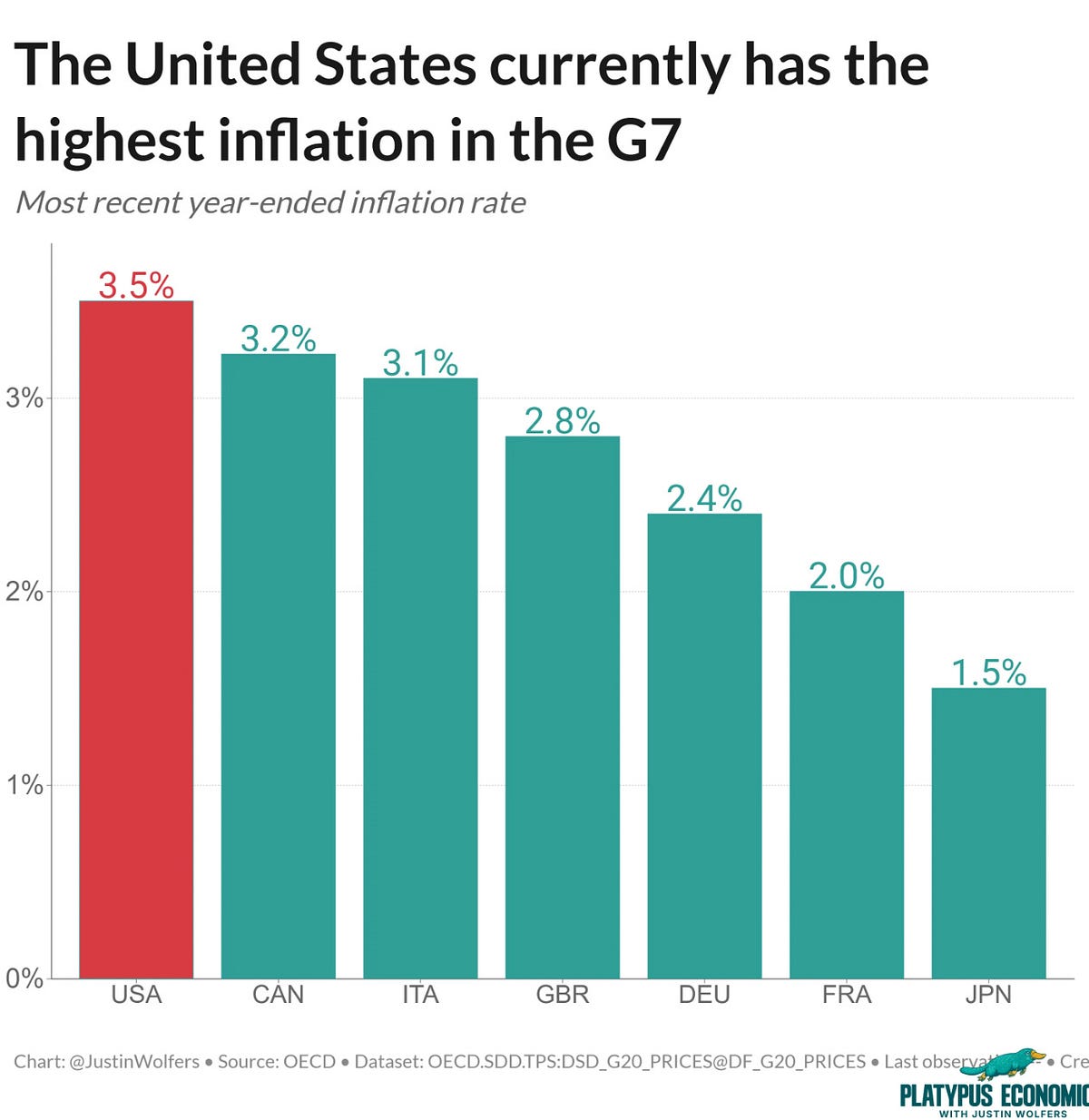
There’s one big reason why our inflation rate is higher than other nations: President Trump. His decisions to levy tariffs on imports from just about every nation and his decision to attack Iran, which shuttered the Strait of Hormuz, are the primary forces pushing inflation higher for the United States (and likely our neighbor and close trading partner, Canada.) Without those voluntary decisions from the president, our inflation rate would be much lower now, as the below chart from Bernstein shows. The real inflation rate is in blue, and the inflation trendline without the pressures of tariffs and the war on Iran is in red:

And most importantly, your wages aren’t rising fast enough to pay for these price increases. Bernstein notes that “real wages for June bounced back to a strong 0.8%, the largest monthly jump since the pandemic wage spikes,” but “On a yearly basis, real wage growth was flat (+0.1%) after declining for the past few months.”
Wolfers charted that recent precipitous decline in paychecks:

So while this report offers some good news, it remains to be seen whether we can expect that good news to continue in the coming months. And even though the White House is crowing over this report, our economy won’t be truly strong until worker paychecks consistently grow faster than prices. Those wages are what matter most, because they’re what make our economy grow.
“Click-to-Cancel” Hits the Big Apple
“New York City became the first municipality in the country to adopt rules that require businesses to make canceling a subscription as easy as signing up for one,” writes Prajwal Bhat at *The Nation*. “Mayor Zohran Mamdani announced the ‘click-to-cancel’ rule July 10, and it takes effect on October 1.”
“Click-to-cancel” requires subscription providers to make it just as easy to cancel a service as it is to subscribe to it in the first place.
“The new rule promises hefty fines and aggressive enforcement for companies that violate them. Companies that do not provide a simple option to cancel subscriptions could pay $525 per user subscription,” Bhat writes. “The rules will extend to all companies that run online subscriptions with customers in New York City including online tools, streaming services, and gym memberships.”
It should be noted that “click-to-cancel” was supposed to be law across the United States right now. President Biden’s Federal Trade Commission was on the way to passing a national “click-to-cancel” law in October of 2024. At the behest of corporate lobbying groups, the Trump administration [killed the rule ](https://truthout.org/articles/trumps-ftc-let-lobbyists-kill-popular-click-to-cancel-rule-advocates-say/)before it could be implemented last summer. It’s also not a coincidence that Lina Khan, the head of the FTC who pushed the Biden administration to pass “click-to-cancel” in the first place, is now an advisor in Mayor Mamdani’s administration.
This is a straightforward, popular policy that addresses a major source of expenses in modern life: The gym membership, cable subscription, or online service that makes it easy to sign up and pay a regular membership fee every month, but makes the unsubscription process so complicated that American workers lose money paying for subscriptions they don’t even use. And that’s also not to mention the fact that they lose precious time and patience trying to figure out how to opt out.
And if enacted properly, this is one of those simple policies that shows people government can be a positive force in the world, which is exactly why trickle-downers hate it. Hopefully, other state and city legislators around the country will follow NYC’s lead and pass legislation that matches New York’s. It would be much harder for corporations to fight “click-to-cancel” if the policy is written into law in states and localities around the country.
This Week in Trickle-Down
- The Federal Reserve recently announced the formation of five task forces to focus on how the Fed interacts with the economy. One of the teams was formed to assess “the economic impact of new general-purpose technologies, including artificial intelligence, to inform the Federal Reserve’s policy judgments.” The members of that task force include Microsoft executive Asha Sharma; economist Charles I. Jones, who has worked for AI firm Anthropic; and Marc Andreessen, the cofounder of Andreessen Horowitz and a vocal advocate for trickle-down economics. So far as I can tell, the Fed has not placed one single working American who is at risk of being replaced by AI on the task force that’s supposed to examine how AI impacts the economy. These omissions are telling.
- “A March report by Cox Automotive found that tariffs drove a 10.4% increase in the average suggested retail price of a new car. Sticker prices rose by an estimated $5,000 to $8,900 for imported vehicles and about $1,600 to $2,000 for U.S.-made cars,” writes the editorial board of the Wall Street Journal in a surprising broadside against Trump’s international trade policies. “Dealers have shed 6,100 jobs since Mr. Trump became President. Cause and effect? Manufacturers have also added fees to avoid raising base prices. Cox says GM and Ford charge “destination fees” of $2,795 for full-size trucks and SUVs. GM has increased such fees by 40% (about $800) on its Chevrolet Silverado. Call it the Trump tax.”
- After bipartisan outrage led to Ohio Governor DeWine vetoing a bill that would have loosened child labor regulations on teens in the workforce, Ohio State Senator Tim Schaffer snuck some of those same pro-child-labor policies into an unrelated bill that then passed into law.
- More Perfect Union made a great video explaining why it’s a big deal that so-called fintech providers like PayPal, Venmo, and Wealthfront promise customers that they have FDIC protection for online accounts. It turns out, many of these firms are operating without a banking charter and if the firm should fail you might not be eligible for a refund. This is all thanks to lobbying from big-money Silicon Valley types like Peter Thiel and Marc Andreessen, who are all heavily invested in fintech firms.
[embed]
This Week in Middle-Out
- While economists are signing a letter warning about the future of an unregulated artificial intelligence industry, “Demis Hassabis, Google DeepMind co-founder and CEO, is calling on the U.S. to establish an AI watchdog with the power to screen the world’s most advanced models — and coordinate an industry-wide slowdown if dangers mount,” reports *Axios*.
- New polling from *Navigator Research* finds that the American people trust Democrats more on issues like affordability and health care. I was especially surprised to see how popular some progressive healthcare policies are with voters — particularly a public healthcare option, which is approved by 65 percent of voters and is even positive among MAGA Republicans:

Real-Time Economic Analysis from Civic Ventures
On this week’s episode of Pitchfork Economics, Nick and Goldy chat with political economist Clara Mattei, author of *The Capital Order: How Economists Invented Austerity and Paved the Way to Fascism*, about how austerity is a central pillar of trickle-down economics, and why creating an environment of budget cuts and slashed investments in the majority of the population ultimately can weaken democracy and even pave the way for the rise of fascism.
[embed]
Closing Thoughts
In his roundup of this week’s inflation news that I quoted earlier, former White House economist Jared Bernstein wrote that there was one good piece of news: “Housing, which accounts for about a third of the [inflation] index, rose a low 0.1% for the overall shelter index and also 0.1% for rent.” Unlike the turbulent gas prices in this month’s report, housing prices have been on a steady downward slope: “On a yearly basis, both measures are cruising at around pre-pandemic rates, which will help keep the overall index in check,” Bernstein said.

It does indeed seem as though housing prices have declined from their pandemic highs and returned to something resembling the normalcy of 2019. But we have to remember that housing prices were prohibitively high in 2019, too. Even before the pandemic, America’s housing was wrapped up in a very complex problem that was raising prices higher than many working families could afford.
For the *New York Times*, economic commentator Kyla Scanlon explains the core of the problem: “A home has stopped being just a place to live — it has also become an asset that has to appreciate in value to underwrite the homeowner’s retirement,” Scanlon writes, adding, “Homeownership became, in short, the typical American retirement plan.”
That creates a host of problems: If a home is damaged or if local property values plummet, that means the owner might not be able to afford retirement. And those older homeowners need home prices to stay so high that younger, less wealthy families just starting out can’t afford them.
“Housing was not always this way,” Scanlon writes. “It was once an enormous opportunity, built on purpose in the aftermath of World War II, by a country that was actively defining the American dream through home ownership.”
But during the Reagan administration, employers started to scrap the pension plans that allowed most Americans to retire comfortably in exchange for 401(k)s. “A pension bet on rising markets, too,” she writes, “but the employer carried much more of the risk. The 401(k) handed the downside to the worker.”
As a result, house value became central to the retirement plans of many Americans, and older Americans started to jealously guard their investments. “Since 2010, Americans 55 and older added roughly $20 trillion in real estate wealth. Americans under 40 added $3.5 trillion,” Scanlon writes. “Of the housing wealth America added since then, two of every three dollars now sit with Americans 55 and older.”
Civic Ventures senior fellow David “Goldy” Goldstein wrote about exactly this problem in *Democracy Journal *last year. “In 2019, housing wealth accounted for between 50 and 65 percent of the total assets of middle-income households,” Goldy wrote. “Yes, it’s better to have housing wealth than not, but America’s overreliance on homeownership as our primary tool for building middle-class wealth has locked up the bulk of our wealth in our homes.”
Both Goldy and Scanlon agree that the solution to the housing affordability crisis is relatively simple: We need to build a lot more housing — housing of all types — pretty much everywhere. But the problem of those families expecting their homes to finance their retirements is much more complex.
Goldy’s solution to the problem is to make renting more affordable through a “social housing” program through which government builds housing and then rents it at market rate to working-class families. They then hold the rent essentially flat, meaning that the housing gets more and more affordable as the tenants age, giving them more opportunity to build their wealth for homeownership — or retirement.
Scanlon proposes another solution: “give both retirees and the young a nest egg that isn’t a house,” she writes.
Specifically, she calls on Congress to create a fund “seeded from the A.I. boom and invested broadly, the way Norway took oil money and bought diversified shares of the world economy — so the floor can come from the boom without entirely depending on it.”
“The returns should flow to households as dividends, similar to the Alaska model,” Scanlon writes. “A fund like this would give Americans a floor — on top of Social Security, which was never enough to carry the weight alone.”
These are two big, bold middle-out proposals that invest in working Americans. And they’re exactly the kind of big ideas that we need to address the complicated, thorny issue of housing affordability in America. I’m excited to see people finally begin to propose solutions that recognize the size of the problem and respond with solutions which meet that scale.
These are the kinds of civic conversations we need to have as we start down the long, slow road to the 2028 presidential election, so that the American people can choose between two very different visions of the American future. I’m willing to bet that one side will be arguing for austerity and slashing benefits, so it’s important that the other side has an arsenal of big, transformational policies at the ready. Now is the time to test those ideas with public debate.
Be kind. Stay strong.
Zach
메타데이터
- post_id
- b622ebc6fc31
- slug
- fighting-for-the-future-of-the-movies-b622ebc6fc31
- url
- https://medium.com/civic-skunk-works/fighting-for-the-future-of-the-movies-b622ebc6fc31
- canonical_url
- https://medium.com/civic-skunk-works/fighting-for-the-future-of-the-movies-b622ebc6fc31
- author_url
- https://medium.com/@civicventures
- status
- ok
- fetched_at
- 2026-07-30 13:41:11