Eclipses and Stock Market Volatility: Can Eclipse Seasons Warn Investors?
Eclipses and Stock Market Volatility in Financial Astrology
Eclipses and Stock Market Volatility: Can Eclipse Seasons Warn Investors?
Eclipses and Stock Market Volatility in Financial Astrology
Eclipses have always carried a powerful symbolic meaning in astrology. They represent interruption, exposure, acceleration, and sudden change. In financial astrology, eclipses are often studied as timing windows when markets may become more sensitive to hidden risks, emotional reversals, sudden news events, or changes in investor sentiment. This is why the topic of eclipses and stock market volatility attracts serious interest among traders, investors, and market-cycle researchers.
A stock market does not move only because of earnings, interest rates, inflation, or central bank policy. It also moves because of expectations. It moves because investors become confident, doubtful, greedy, fearful, or defensive. Sometimes the emotional shift happens before the news becomes clear. Prices may begin weakening before analysts downgrade earnings. A sector may lose leadership before the public understands why. A market correction may start before the headlines turn negative.
Eclipse seasons are important because they may coincide with these moments of changing perception. They do not guarantee a crash. They do not guarantee a rally. They should not be used as a standalone trading signal. However, they can be useful as high-attention windows. When eclipse periods align with stretched valuations, weak market breadth, liquidity pressure, geopolitical tension, central bank uncertainty, or fragile investor sentiment, investors may need to watch markets more carefully.
In a professional investment process, eclipses should be treated as timing markers. They tell investors when to pay closer attention, not what to buy or sell blindly. Their value increases when they are combined with technical analysis, macroeconomic data, earnings trends, volatility indicators, and portfolio risk management.
What Is an Eclipse Season?
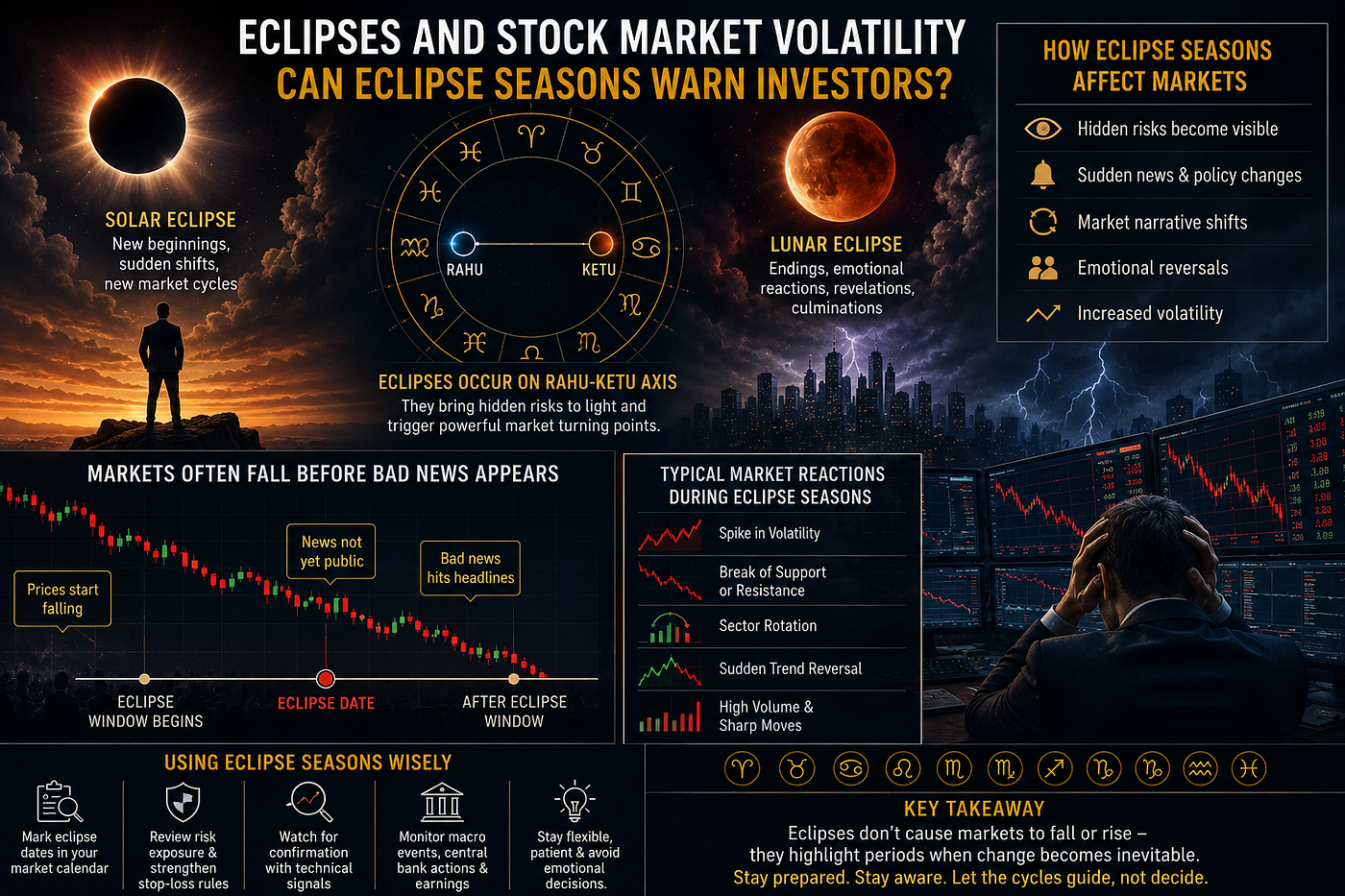
An eclipse season is a period when solar and lunar eclipses occur close together. Eclipses happen near the lunar nodes, known in Vedic astrology as Rahu and Ketu. These nodes are deeply associated with karmic turning points, sudden shifts, hidden forces, and major changes in direction. In financial astrology, this symbolism is often applied to market psychology, hidden risks, and turning points in investor behavior.
A solar eclipse occurs during a New Moon when the Moon passes between the Earth and the Sun. Symbolically, solar eclipses can indicate new beginnings, sudden disruptions, fresh cycles, or the emergence of new themes. A lunar eclipse occurs during a Full Moon when the Earth comes between the Sun and the Moon. Symbolically, lunar eclipses can represent culmination, emotional intensity, public reaction, endings, or revelations.
For financial markets, the exact eclipse date is important, but the wider season matters more. Investors often watch the weeks before and after an eclipse because market behavior can begin shifting before the event and continue developing afterward. A sudden move may not happen on the eclipse day itself. Instead, the eclipse may act as a symbolic center point in a broader window of volatility.
This is why eclipse analysis should not be narrow. A responsible investor does not say, “The market must fall on the eclipse date.” A better approach is to say, “This period may carry higher sensitivity, so I should watch confirmation signals more carefully.”
Why Eclipses Matter for Market Psychology
Financial markets are emotional systems. Prices reflect expectations, confidence, liquidity, and collective behavior. Even the most data-driven investor must accept that fear and greed shape market movement. Eclipses matter because they are associated with shifts in awareness. They can symbolize moments when something hidden becomes visible or when investors suddenly reinterpret existing information.
Before a correction, markets often ignore risks. Investors may focus only on bullish narratives. They may assume that earnings will remain strong, central banks will stay supportive, or liquidity will continue flowing. During an eclipse window, the emotional tone may change. A risk that was present all along may suddenly become important. A weak data point may receive more attention. A central bank comment may trigger a stronger reaction. A company’s guidance may be interpreted more negatively than before.
This does not mean the eclipse causes the event. The event may already be developing beneath the surface. The eclipse season may simply coincide with the moment when the market becomes ready to notice it.
For example, if a market is already overextended and investor confidence is too high, an eclipse window may highlight vulnerability. If the market is already deeply oversold and fear is extreme, the same eclipse window may coincide with emotional exhaustion and a possible reversal. The direction depends on the market condition. The eclipse marks sensitivity, not certainty.
Eclipses and Hidden Risks Coming to the Surface
One of the strongest themes of eclipses in financial astrology is exposure. Hidden risks can become visible during eclipse seasons. This may happen through earnings surprises, regulatory news, geopolitical developments, banking stress, debt concerns, inflation data, or sudden changes in central bank communication.
Markets often carry hidden risks for months before the public reacts. A company may have weakening margins before investors notice. A sector may become overcrowded before momentum breaks. A bank may face credit stress before headlines appear. A currency may weaken before confidence officially shifts. A speculative theme may become fragile before the narrative collapses.
Eclipse seasons are useful because they remind investors to ask what the market may be ignoring. Is there too much optimism in one sector? Are valuations too stretched? Is liquidity weakening? Are investors too dependent on central bank support? Is there hidden leverage? Are retail traders chasing late-stage momentum?
These questions are more valuable than a simple prediction. Financial astrology works best when it improves awareness. An eclipse window can become a reason to review risk before the crowd reacts.
Solar Eclipses and New Market Narratives
Solar eclipses often symbolize new beginnings, hidden forces, and the start of fresh cycles. In financial astrology, solar eclipses may coincide with the emergence of new market themes or a sudden shift in leadership. Sometimes this may appear as the start of a new sector trend. At other times, it may mark the beginning of a decline in an overextended theme.
A solar eclipse may signal that investors are entering a new phase of interpretation. The same market facts may begin to look different. For example, high interest rates may have been ignored during a bullish phase, but after a solar eclipse window, investors may begin seeing them as a serious pressure. A technology theme may have been celebrated for months, but the market may begin questioning whether valuations are realistic. A defensive sector may begin gaining strength as investors prepare for uncertainty.
Solar eclipses are especially important when they occur near major economic events, central bank meetings, earnings seasons, or geopolitical turning points. When a solar eclipse aligns with a major market catalyst, investors should watch closely. Again, the eclipse does not guarantee direction. It increases the importance of context.
A practical investor can mark solar eclipse windows on a market timing calendar and compare them with price trends, volatility, liquidity, and sector rotation. If a new market narrative begins forming around the same period, the eclipse may become a useful timing reference.
Lunar Eclipses and Emotional Reversals
Lunar eclipses are connected with Full Moon symbolism, which often represents emotional peaks, visibility, culmination, and public reaction. In market psychology, lunar eclipses may coincide with emotional extremes. Investors may become overly fearful, overly optimistic, or suddenly reactive.
A lunar eclipse during a strong rally may coincide with a sentiment peak. Investors may become too confident. Headlines may become extremely bullish. Traders may assume that the trend can only continue. If the market is technically overbought, a lunar eclipse window may increase reversal risk.
A lunar eclipse during a decline may coincide with panic, capitulation, or emotional exhaustion. If fear becomes extreme and technical support begins to hold, investors may watch for a possible stabilization phase. This does not mean every lunar eclipse creates a bottom. It means emotional pressure may become visible.
Lunar eclipses are useful for studying the psychology of crowds. Markets often reverse when emotions become one-sided. When everyone expects the same outcome, the market becomes vulnerable to the opposite. A lunar eclipse can highlight such emotional imbalance.
Eclipses, Rahu-Ketu, and Speculative Market Behavior
In Vedic astrology, eclipses are connected with Rahu and Ketu. Rahu represents desire, obsession, ambition, illusion, foreign influence, technology, sudden rise, and speculative hunger. Ketu represents detachment, separation, sudden withdrawal, loss of interest, and spiritualization. Together, they describe powerful shifts in attachment and detachment.
In financial markets, Rahu can be linked with speculative manias. It may represent the hunger for quick gains, the attraction toward new technology, the obsession with disruptive themes, or the belief that old valuation rules no longer matter. Rahu can help explain why investors chase narratives even when risk is high.
Ketu, on the other hand, can symbolize sudden disconnection. Investors may quickly lose interest in a once-popular theme. A crowded trade may unwind. A market that seemed unstoppable may suddenly feel empty. This shift from Rahu-style obsession to Ketu-style detachment can be dramatic.
Eclipse seasons involving Rahu-Ketu symbolism can therefore be useful for studying speculative markets. Crypto, artificial intelligence stocks, high-growth technology, meme stocks, and volatile momentum themes may become especially sensitive when investor desire is already extreme.
The responsible takeaway is not that Rahu or Ketu guarantees market movement. The takeaway is that eclipse periods can highlight the psychology of obsession and withdrawal. Investors should watch whether speculative enthusiasm is supported by real fundamentals.
Eclipses and Sudden News Events
Many investors associate eclipses with sudden news. In financial astrology, eclipse seasons may coincide with unexpected announcements, policy changes, earnings shocks, geopolitical developments, or public revelations. This association comes from the eclipse theme of visibility. Something that was hidden or underestimated may suddenly become part of the market conversation.
However, investors must be careful not to exaggerate this idea. Not every eclipse brings dramatic news. Many eclipse periods are quiet. The significance of an eclipse depends on the broader market environment and how it connects with other planetary cycles.
If an eclipse occurs during a period of stable liquidity, healthy earnings, and balanced sentiment, the market impact may be limited. If it occurs during a period of high leverage, weak breadth, policy uncertainty, or geopolitical stress, news events may create stronger reactions.
This is why professional eclipse analysis should include confirmation. Investors should track whether volatility rises, whether support or resistance breaks, whether leadership changes, and whether the market reacts strongly to information that it previously ignored.
The eclipse may be the timing window. The market reaction is the confirmation.
Eclipses and Central Bank Sensitivity
Central banks are among the most powerful forces in modern markets. Interest rates, liquidity, inflation expectations, and policy communication can shift investor behavior quickly. Eclipse seasons may become especially important when they occur near major central bank meetings or inflation data.
During uncertain policy periods, investors may be highly sensitive to language. A single phrase from a central bank official can change expectations around rate cuts, rate hikes, liquidity, or recession risk. If this communication occurs near an eclipse window, the market may react more strongly than usual.
For example, if investors expect supportive policy but the central bank signals restraint, sentiment can turn defensive. If markets fear a slowdown but the central bank hints at future support, risk appetite may recover. The eclipse does not determine the policy. It may simply coincide with a period when the market is ready to reinterpret policy direction.
Investors using financial astrology should therefore combine eclipse dates with an economic calendar. Inflation reports, employment data, central bank meetings, bond auctions, and earnings seasons can make eclipse windows more significant.
Eclipses and Market Narrative Shifts
One of the most powerful uses of eclipse analysis is identifying narrative shifts. Markets run on stories. A bull market may be driven by a technology story, a liquidity story, a growth story, a commodity story, or a central bank story. As long as the story remains strong, investors may continue buying. When the story weakens, prices can change direction quickly.
Eclipse seasons can coincide with moments when the story changes. A market that was focused on growth may suddenly focus on inflation. A market that was focused on rate cuts may suddenly worry about recession. A sector that was viewed as unstoppable may suddenly face questions about valuation. A defensive asset that was ignored may suddenly attract attention.
Narrative shifts are important because they often happen before formal data changes. Investors may begin selling growth stocks before earnings weaken. They may buy gold before fear becomes visible. They may rotate into defensive sectors before recession headlines dominate.
Financial astrology can help investors become more aware of these shifts. If an eclipse window appears and the market narrative begins changing, it may be a meaningful signal. The investor should then look for confirmation in price action, volume, sector rotation, and volatility.
How Investors Can Build an Eclipse Market Calendar
A practical way to use eclipses is to build an annual eclipse market calendar. Investors can mark all solar and lunar eclipses for the year, then add a watch window around each event. A common approach is to observe two to three weeks before and after the eclipse, although some investors may use wider or narrower windows depending on their strategy.
The calendar should include the eclipse type, zodiac sign, nearby planetary aspects, and major financial events around the same period. Investors can also note whether the eclipse connects with important points in the charts of major indices, countries, central banks, or key companies if they use advanced financial astrology methods.
After marking the dates, investors should track market conditions. Is the market trending strongly? Is it overbought or oversold? Is volatility rising? Are yields moving sharply? Is market breadth improving or weakening? Are defensive sectors gaining strength? Are speculative sectors losing momentum?
This approach turns eclipse astrology into a structured process. Instead of reacting emotionally, investors observe. Over time, they can review which eclipse windows coincided with meaningful market changes and which did not. This builds experience and prevents overclaiming.
Combining Eclipse Timing With Technical Analysis
Eclipse timing becomes more useful when combined with technical analysis. If an eclipse window appears while an index is near major resistance, investors may watch for reversal signals. If it appears near major support after a sharp decline, they may watch for stabilization. If the market breaks a key trendline during an eclipse window, the signal may become more important.
Technical indicators can include moving averages, support and resistance, RSI, volume, trendlines, volatility indexes, and market breadth. None of these tools is perfect, but together they help confirm whether the eclipse window is active.
For example, if a market is overbought and a lunar eclipse occurs near resistance while breadth weakens, investors may become cautious. If a market is oversold and a solar eclipse occurs near support while breadth improves, investors may look for opportunity. The eclipse does not create the trade. It helps identify when to watch more carefully.
This balanced approach is more credible for serious investors. It avoids sensational predictions and focuses on probability, discipline, and confirmation.
Combining Eclipse Timing With Macro Data
Macroeconomic data is equally important. Eclipses may highlight timing, but macro conditions shape the market’s vulnerability. Investors should watch inflation, interest rates, central bank policy, liquidity, unemployment, credit spreads, currency moves, and economic growth.
An eclipse during a strong liquidity environment may produce only short-term volatility. An eclipse during tightening liquidity and rising credit stress may carry more risk. An eclipse near major inflation data or a central bank decision may create a stronger reaction because investors are already sensitive.
This is especially important for recession risk. If economic data is weakening and an eclipse season arrives, investors may watch whether the market begins pricing slower growth. If inflation remains sticky and central banks stay restrictive, an eclipse window may highlight policy stress.
Financial astrology becomes more professional when it respects macro reality. Eclipse timing should not be separated from economic context.
What Eclipses Can Warn Investors About
Eclipses can warn investors about periods of higher sensitivity. They can signal when hidden risks may become visible, when market narratives may shift, when investor emotion may peak, and when sudden news may create stronger reactions. They can also help investors prepare for volatility around important dates.
Eclipses can be especially useful for reviewing portfolio risk. Investors may check whether they are overexposed to one sector, too dependent on a single market narrative, or holding positions with weak fundamentals. They may avoid adding large new exposure without confirmation during eclipse windows. They may prepare a watchlist of quality assets if volatility creates opportunity.
Eclipses can also help traders become more patient. Instead of chasing every move, traders can watch whether the eclipse window aligns with technical setups. If there is no confirmation, they can wait.
The strongest warning from eclipses is not always “sell.” Sometimes the warning is “pay attention.”
What Eclipses Cannot Warn Investors About
Eclipses cannot guarantee market crashes. They cannot predict exact tops or bottoms. They cannot replace earnings analysis, valuation research, technical analysis, or macro study. They cannot tell investors the precise news event that may occur. They cannot remove uncertainty.
A major mistake is treating every eclipse as a dramatic market event. This creates fear and reduces credibility. Some eclipse windows may produce strong volatility. Others may pass quietly. The difference depends on market context, investor positioning, and external catalysts.
Another mistake is forcing hindsight. After a market move, it is easy to connect it to an eclipse and claim perfect prediction. Serious financial astrology should be tested in advance. Dates should be marked before events happen, and market behavior should be reviewed afterward.
The responsible view is clear: eclipses are timing windows, not certainty signals.
How Long-Term Investors Should Use Eclipse Seasons
Long-term investors do not need to trade every eclipse. Instead, they can use eclipse seasons as portfolio review periods. They can check exposure, valuation, liquidity needs, sector concentration, and risk tolerance. They can ask whether they are holding quality assets or simply following a popular narrative.
If markets become volatile during an eclipse window, long-term investors can avoid emotional decisions. They can wait for confirmation. They can use volatility to identify stronger assets. They can also avoid panic selling if the larger investment thesis remains intact.
For long-term investors, eclipse seasons are useful reminders that markets move in cycles. Confidence rises and falls. Narratives change. Hidden risks become visible. A disciplined investor prepares rather than reacts.
How Traders Should Use Eclipse Seasons
Traders may use eclipse seasons more actively. They can mark high-volatility windows and watch for technical setups. They may reduce position size during uncertain periods, avoid overleveraging, and wait for clearer confirmation before entering trades.
Eclipse windows may be useful for watching reversals, failed breakouts, support tests, and sudden changes in momentum. However, traders should avoid assuming direction. A volatile window can move either way.
The best trading approach is to combine eclipse timing with price action. If the market confirms weakness, traders can respond. If the market confirms strength, they can adapt. Flexibility matters more than prediction.
Conclusion: Can Eclipse Seasons Warn Investors?
Eclipse seasons can warn investors about timing sensitivity, but they cannot guarantee exact market outcomes. In financial astrology, eclipses are powerful because they symbolize exposure, acceleration, emotional turning points, and hidden information becoming visible. These themes often match the way markets behave during periods of volatility.
Eclipses may coincide with sudden news events, market narrative shifts, emotional reversals, and changing investor sentiment. They become especially important when they align with weak market breadth, stretched valuations, central bank uncertainty, liquidity pressure, or fragile risk appetite. However, they must be used with discipline.
The best way to use eclipse seasons is to mark them on a market timing calendar, watch the broader window around them, and confirm signals through price action, macro data, technical indicators, and portfolio risk rules. Used this way, eclipses become a practical timing tool rather than a prediction shortcut.
Financial astrology works best when it improves awareness. Eclipse seasons remind investors that hidden risks can become visible quickly and that market narratives can change before the crowd is ready. For investors who value preparation, that awareness can be a meaningful advantage.
For a deeper understanding of how astrology tracks fear, panic, and market corrections, read this related guide: How Astrology Tracks Fear, Panic, and Market Corrections
메타데이터
- post_id
- b6233ca26fd9
- slug
- eclipses-and-stock-market-volatility-can-eclipse-seasons-warn-investors-b6233ca26fd9
- url
- https://medium.com/@astro.techit/eclipses-and-stock-market-volatility-can-eclipse-seasons-warn-investors-b6233ca26fd9
- canonical_url
- https://medium.com/@astro.techit/eclipses-and-stock-market-volatility-can-eclipse-seasons-warn-investors-b6233ca26fd9
- author_url
- https://medium.com/@astro.techit
- status
- ok
- fetched_at
- 2026-06-09 15:37:30