“Pleasant things work better.”
The consequences of privacy in public restrooms
“Pleasant things work better.”
The consequences of privacy in public restrooms

HomeHarmonizing.com
You don’t think about them until you have to use one. And then, you just try to forget.
Public restrooms, beyond all other conventions of civilization, are the consummate unifier of the classes. From nobility to the no-class, we all share this basic need. Yet, unlike other public spaces, both in form and function, public restrooms are largely lacking in the kind of vision we have come to appreciate and expect in contemporary design.
Oddly, some of the history and evolution of society can be traced to the need for public restrooms and the invention of — stand back (but not too far back) — the urinal.
In the post-Civil-War industrial boom, people flocked to northern cities. Sewer systems were overwhelmed and had to be re-designed. In factories and workplaces, the installation of urinals along with restrooms in close proximity was a way of increasing the efficiency of the workers and forever changed corporate architecture. Outside the workplace, sanitation and fear of disease in crowded urban areas became the catalyst for creating public restrooms. With increasing numbers of women in the workplace, the urinal actually became a gender issue, which continued through the 70s and into the aughts with ERA and the notion that its passing might bring about…horror of horrors…same-sex marriage and unisex bathrooms!
ERA did not pass. But thanks to the slow but inexorable spread of tolerance and the need to eliminate discrimination in all its ugly forms, the subject of gender equality keeps rearing its ugly/pretty head. Which brings us back to the sad state of public restrooms.


PlacesJournal.org
Alexander Kira’s 1966 book, “The Bathroom” offers a thorough examination of every aspect of design and function in both public and private bathrooms.
From the historical, to the socio- and psychological, to design, ergonomics and urine trajectory, Kira’s unabashed scrutiny reveals that everything about restroom and fixture design needs a major overhaul. According to Kira, bathroom fixtures are basically containers with a water supply and a drain, and are “only one step up the evolutionary ladder from a container without supply and drain fittings.”
He compares the antiquated design of bathrooms to kitchen design “forty or fifty years ago when a stove, sink, and icebox sat in splendid isolation against opposite walls of a room…” and laments that “no one as yet offers a truly comprehensive bathroom system.” Kira’s study reveals that restrooms and their fixtures are badly designed for the way people use them. And this was half a century ago! Yet, fifty years later, here we are:
From doors that open the wrong way, to privacy issues, to abysmal function, to ill-conceived layout and overall atmosphere, visiting a public restroom is at best a necessary evil. In fact, some fixture technology, like the flush toilet, hasn’t really evolved much since it was first invented. In the 16th century.
[embed]
A Korean paper on restroom improvement cited by the American Restroom Association (“…advocates for the availability of clean, safe, well designed public restrooms.”) sums up the public restroom as a reflection of the society in which it exists:
“…how much restroom design considers neglected people…tells us the level of human rights of the given country. The users’ manners and etiquettes are the slice of the people’s morality and the spiritual culture of that country.”
By law, public restrooms in the U.S. must conform to the 2010 American Disabilities Act standards for accessible design. Bobrick, a 100+-year-old washroom accessories and partitions company headquartered in North Hollywood, California, shows the breakdown in this planning guide. It’s mostly based on minimum standards for offering one disabled person at a time access to a stall, a sink and dry hands.
But, other than compliance with the ADA (except for when they don’t), if our restrooms reflect how evolved we are as a society as far as manners, morality, cultural spirit and human rights, America fails miserably.
Cognitive scientist Don Norman is the director of the brand-new Design Lab at the University of California, San Diego. He’s also co-founder of the Nielsen Norman Group, an executive consulting firm specializing in human-centered products and services, and the author of several books on design.
“All design,” says Norman, “whether of a product, a company, a service or an experience is ultimately aimed at satisfying human and societal needs.” These needs, according to Norman, are both practical and emotional.
In his books and talks, Norman discusses his theory of emotional design. He sums it up by saying that effective design involves both engineering and psychology, and satisfies our most basic human needs: to be safe, happy, and in control.
[embed]Don Norman on CNN
In stark contrast to Norman’s theory though, the feelings evoked in public restrooms are more akin to paranoia, disgust, embarrassment and a prevailing desire to flee the scene.
Design guru Rob Walker writes about technology, business, branding, the arts, and of course, design. His column, The Workologist, appears in the Sunday Business section of The New York Times, and he is a contributing writer to Design Observer. Walker is also a faculty member of the School of Visual Arts MFA program in Products of Design.
“Designers aren’t in the artifact business anymore, they’re in the consequence business.” That’s the mission statement of the SVA MFA program, which goes on to say:
“We see new urgencies in the need to reconcile the material, energy, environmental, and cultural consequences of design…and a great expansion in the participants of design — from anthropologists and behavioral psychologists to materials experts and systems specialists.”
I asked Rob Walker to talk further about the consequences of design, in particular how we might apply these concepts to public restrooms. Listen to an excerpt from the interview here:
[embed]
The concept of design being more about consequence than artifacts, Walker explains, is “…consistent with a lot of the more sort of forward-thinking ideas about what design is right now, which is that I think for a long time, the idea was, you know, you think of a beautiful object and you’re done. And if the consequence is that the beautiful object eventually gets outdated and goes to landfill and you know kills dolphins or whatever it does, you as a designer have to think about those consequences…”
Public restrooms seem to be all about artifacts, rather than consequences.
Walker observes that the bathroom is “a wasteland of bad design,” and that we tend to perceive public restrooms as “somebody else’s problem.” This may be one reason why nobody wants to champion their design. The bathroom is “a huge deal, but it’s not…sexy as a subject.” Designers “want to do the park, not the bathroom…there’s more glory.” It’s hard to imagine a designer wanting to include public restroom design on their portfolio website. “But that’s their fault,” Walker says. “If someone did have a substantial idea for how to create public bathrooms, they’d be a hero.”
As Norman said in his Ted Talk, “3 Ways Good Design Makes You Happy,” “Pleasant things work better.”
So, how do we make public restrooms pleasant? What if, as Don Norman suggests, we envision our emotional well-being as a critical factor — a consequence — of successful restroom design? What if public restrooms were designed the way other public spaces are, with the idea that they are functional, enjoyable spaces for all, and a unique privilege? What if we entered a public restroom, not as a last resort, but with the expectation that we would be treated to a pleasant experience, encompassing both beauty and function as well as an empty bladder?
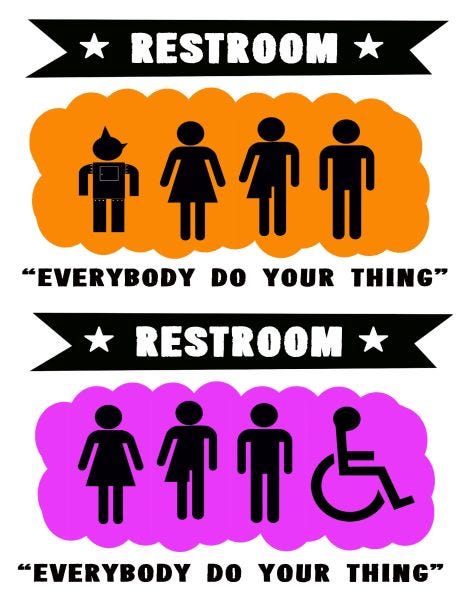
The public restroom is unique in that it’s a public space where a certain amount of privacy is a necessity. But somehow this requisite became a blunt instrument for restroom design centered on the overarching concept of segregating the sexes. (Hmm…there’s that gender issue again…)
In 1596 the world rejected the flush toilet. But eventually reason and necessity prevailed. Some states are passing gender-neutral ordinances, but it isn’t just about letting people choose which restroom they use according to their gender identity.
What if we didn’t have to choose?
observer.com
In an article in Jacobin, Imagining the Socialist Bathroom, Roger Lancaster says, “Unisex design squares socialist aims with queer principles. At the wide door of the unisex restroom, everyone is welcome and no one has to explain themselves.”
He goes on to describe the public restroom at the anthropological museum in Oaxaca in Monte Alban as a model of a successful unisex facility:
“In place of two separate rooms designated for men and women, the Monte Alban museum bathroom features a large opening that permits a partial view of the restroom from a busy hallway outside. Thus, no one need fear being trapped in an enclosed space with a menacing stranger. Along the long right wall is arrayed a series of secure enclosed stalls for anyone to use. Along the left wall are faucets and mirrors.
“The design is at once unsegregated, child-friendly, and handicapped accessible. Accommodating a section of urinals behind a partition would also be simple enough.”
Architect Matt Nartella of Moss Design in Chicago has started to become known for taking some initiative in unisex restroom design. It’s been slowly catching on in Europe and in some U.S. cities. Even the White House now has a gender neutral bathroom.
The need for privacy in public restrooms is twofold: allow for the process of elimination without exposing your genitalia to others, and offer some way of masking embarrassing and unpleasant sounds and smells. The rest of what we do in the bathroom is assisting children, looking in the mirror, washing our hands — no big mystery there, so why the need for segregation?
In most public spaces, we enter and use them with the expectation that we are enjoying a privilege, and therefore share some accountability for stewardship of the space. There’s no such expectation in a public restroom. Making these areas more open and public would make them safer, and create more accountability for our behavior there.
And if they could be beautiful as well as peaceful and functional, like some of these award-winning restrooms, so much the better.
These designs all consider the aesthetics of the space itself. But a really excellent restroom “system” would also need to incorporate changes in fixture design.
Stall doors — What in the name of John is stopping restroom designers from using stall doors that open outward? And while we’re at it, why can’t stall doors just be spring-loaded, like saloon doors, so they open with a push, and swing shut automatically? Then nobody has to touch door latches and handles.
The lack of privacy — Bobrick has a solution to the gaps around the doors: a unique, interlock feature that allows the door to function but blocks the gap. But any kind of sensor with an “occupied” display at eye-level would be an improvement on stooping to check for feet under the door, or peeping through the cracks.
With regard to privacy issues concerning noise, in Japan, there’s a box with a button you push when you want some masking noise — it makes the sound of a toilet flushing, without your having to waste water on an extra flush (or two, or however many you need to get the job done…) But who really wants to hear toilets flushing? Ocean waves, maybe? Or perhaps a few choices would be optimum: wind in the branches, for those who just need to feel like it’s not dead silent; a waterfall, for some medium-intensity background-noise; and for those who really crave absolute discretion, how about a good two- to three-minute rocket launch?
Smell issues — We might be ok with our own smells, but…if they can filter out the smoke in casinos, there ought to be a way to handle it in restrooms. (Bill Gates, apparently, is working on that with a Swiss perfume company that’s engineering noxious-odor-receptor blocking counter-chemicals.)
Toilet paper — Please. Just install them higher. You’re making us work here.
The flush factor — Let’s just put a sensor near the toilet paper dispenser that accepts a hand-wave gesture whenever you are ready to flush. And a back-up handle or button (or, heck, how about an old-fashioned pull chain?) for manual override. Up high. Who really wants to use their foot?
For kids — How about a tiny toilet/urinal and low-level sink in every restroom? And, in at least some of the stalls, a little seat kind of like those baby bucket-style swings, where you can safely stash your toddler sans-stroller while you get things done?
Sinks — Let’s design them so they produce the right amount of water — no blouse-dousing gush, or feeble dribble — without your touching anything, but without having to figure out which magic gesture makes them work. Or having to wash one hand at a time. And while we’re at it, put a shelf above to set things down on, and hooks below to hang bags on. (Unisex design usually includes the wash-up area outside the toilet area.)
Paper towel dispensers and hand dryers — Put the trash cans at the exit. Make air dryers that do more than just move the water around on your hands in an interesting way, and don’t cause hearing damage.
Restroom entrance/exit — Specs already exist for this in large public venues, but, why not everywhere? The best design is an opening, not a door. Taking into account sight lines from a privacy and safety standpoint, and wheelchair access, open entryways work great. If you have to have a door, it should open out. Or again, spring-loaded saloon doors that open either way with a push. That way people exiting the restroom don’t have to touch (or avoid touching) a door handle at all.
This one’s not beautiful at all, but it wins on some other levels: “A Hands-Free, Self-Cleaning Bathroom for Transit Stations”
It’s unpleasant, so nobody wants to think about it, so we avoid it, so it stays unpleasant…it’s this chicken-and-egg thinking that allows stagnant, outdated, tech-resistant ideology to endure.
Let’s embrace the potential for the public restroom as a pleasant and functional shared space, and imagine the consequences. If we begin to think of the restroom and fixtures as more than just a segregated space to use toilet artifacts, we open up new possibilities. Consider “I Am an Avant-Garde Bathroom Designer.”, by Joslyn and Justin Sklar:
“I’m all about bringing nature into my work…My last client told me he liked fish and I said, “Of course you do. How could you not?” He left for a week and when he returned I had finished his bathroom. It is probably my best work. His toilet now stands proudly on a pedestal in the middle of a 3-foot deep koi pond. He loves it. He asked, “Where did the tub and sink go?” but they’re irrelevant I told him…His bathroom is art now. Everyone deserves to use a toilet surrounded by art.”
[embed]
메타데이터
- post_id
- b628d5fe92ef
- slug
- pleasant-things-work-better-b628d5fe92ef
- url
- https://medium.com/@allisonestes/pleasant-things-work-better-b628d5fe92ef
- canonical_url
- https://medium.com/@allisonestes/pleasant-things-work-better-b628d5fe92ef
- author_url
- https://medium.com/@allisonestes
- status
- ok
- fetched_at
- 2026-08-29 07:45:59