Anything Goes: Feyerabend and How Science Really Works
Somewhere in the popular imagination there lives a tidy little robot called The Scientific Method. It wears a lab coat, it never guesses…
Anything Goes: Feyerabend and How Science Really Works
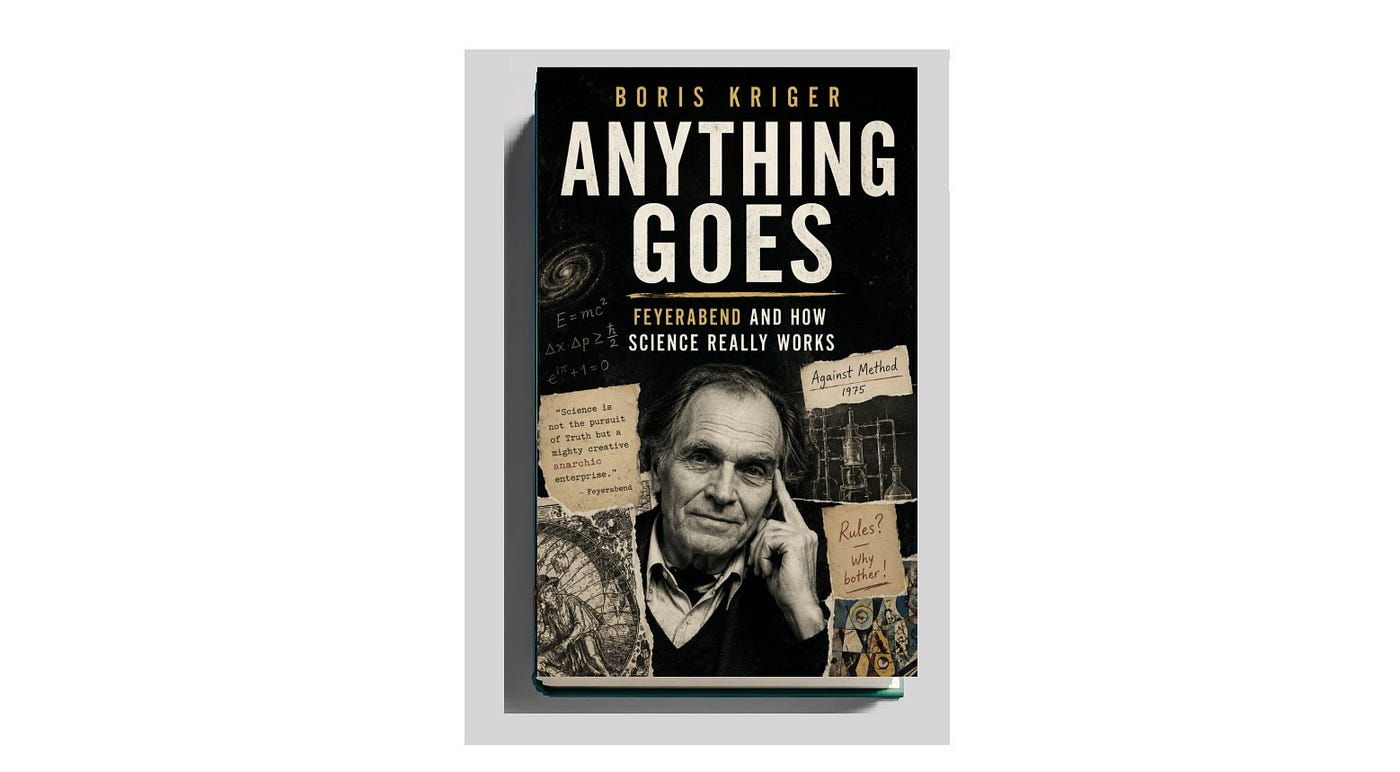
Somewhere in the popular imagination there lives a tidy little robot called The Scientific Method. It wears a lab coat, it never guesses, it never sulks, and it grinds out truth by turning a logical crank. Paul Feyerabend spent his life arguing that this robot is a fairy tale — and that the real story of how we come to know things is far stranger, far messier, and far more human than anyone wants to admit.
Anything Goes follows the most provocative philosopher of science of the twentieth century — a former soldier who took three Soviet bullets and walked on crutches for the rest of his days, a man who declared that in science “anything goes” — as our guide through the genuine machinery of discovery. Here is penicillin found in a contaminated dish, uranium glowing on a cloudy day, continents that refused to stay put, and a famous eclipse expedition whose inconvenient photographs were quietly set aside. Here, too, is the darker register of human knowledge: science conscripted as a weapon, dressed up as ideology, gamed by metrics, and occasionally faked outright.
But this is not a book that sneers at science. Its central insight is that knowledge is wildly uneven — stretching from outright obscurantism at one end to the proven, testable triumphs of applied science that are already building the twenty-second century at the other. Learning to tell the difference is the great task. With wit, narrative verve, and not a single equation, this book offers three companions for that task: chaos as the engine of discovery, vigilance as the duty of a free society, and humility as the beginning of wisdom.
Keywords: philosophy of science, Paul Feyerabend, scientific method, epistemology, discovery, skepticism, knowledge
[embed]
Contents
Chapter One — Against the Myth of Method. 16
Chapter Two — The Mold on the Petri Dish. 24
Chapter Three — When the Data Lead the Way. 31
Chapter Four — The Stubborn Glow of Uranium.. 38
Chapter Five — The Voice in the Dark Forest 44
Chapter Six — Copernicus and the Argument from Beauty. 50
Chapter Seven — The Telescope and the Forbidden Sky. 56
Chapter Eight — Throwing Away the Ether 63
Chapter Nine — The Plates Eddington Set Aside. 70
Chapter Ten — The Continents That Refused to Sit Still 77
Chapter Eleven — There Is No Single Method. 83
Chapter Twelve — What “Anything Goes” Actually Means. 89
Chapter Thirteen — The Tyranny of the One True Answer 95
Chapter Fourteen — Science Wears the Clothes of Its Age. 101
Chapter Fifteen — The Uneven Map of Knowledge. 107
Chapter Sixteen — Why Engineers Sleep Soundly. 114
Chapter Seventeen — The Long Patience of Theory. 120
Chapter Eighteen — Falsification and Its Limits. 126
Chapter Nineteen — Hard Cores and Protective Belts. 132
Chapter Twenty — Paradigms and the Quiet Between Revolutions. 138
Chapter Twenty-One — When Science Becomes a Weapon. 145
Chapter Twenty-Two — The Green Paradox. 151
Chapter Twenty-Three — The New Aristocracy. 158
Chapter Twenty-Four — The Republic of Peer Review.. 164
Chapter Twenty-Five — Counting What Cannot Be Counted. 170
Chapter Twenty-Six — The Honest Liars. 176
Chapter Twenty-Seven — The Preprint Rebellion. 182
Chapter Twenty-Eight — Who Should Pay for Truth?. 188
Chapter Twenty-Nine — Should the Crowd Decide?. 194
Chapter Thirty — The Soldier on Crutches. 200
Chapter Thirty-One — Science in a Free Society. 206
Chapter Thirty-Two — The Telescope Pointed at the Impossible. 212
Chapter Thirty-Three — Chaos, Vigilance, and Humility. 218
1. Penicillin and the Contaminated Dish. 231
2. The Cloudy Week That Revealed Radioactivity. 232
3. Marie Curie and the Tons of Pitchblende. 232
4. Ramanujan’s Unproven Notebooks. 233
5. Copernicus and the Argument from Beauty. 233
6. Galileo’s Untrusted Telescope. 234
7. The Ether That Was Never There. 235
8. Eddington’s Inconvenient Plates. 235
9. Wegener and the Continents That Moved. 236
10. The Discovery of Neptune. 236
11. The Hiss That Was the Universe. 237
12. Lysenko and the Ruin of Soviet Harvests. 237
13. The Calipers of Prejudice. 238
14. The Flash in the Desert 239
15. The Industry That Manufactured Doubt 239
16. The Replication Crisis. 240
17. The Skull That Fooled a Generation. 240
18. The Nuclear Shutdown Paradox. 241
19. Preprints in an Emergency. 241
20. The Telescope Pointed at the Impossible. 242
Primary works by Paul Feyerabend. 266
On how science really works. 268
Science, power, and the swamp. 269
A note on sources and reading order 269
Preface
There is a machine that lives in the back of almost everyone’s mind, and it is a very reassuring machine. It is called The Scientific Method, and it works like this. A scientist observes the world. The scientist forms a hypothesis. The scientist tests the hypothesis with a clean, repeatable experiment. If the experiment agrees, the hypothesis survives; if it disagrees, the hypothesis is thrown out, and a better one is built. The machine never gets bored, never falls in love with a bad idea, never fudges its data to make a deadline, never bullies a younger machine out of a grant. It simply turns its logical crank, and out comes truth, warm and certain, like bread from an oven. We are taught about this machine in school, usually by the third week, usually with a diagram involving arrows.
The trouble with this machine is that it does not exist, and there is reason to think it never has. The history of how human beings have actually discovered things — about stars, about diseases, about the deep structure of matter — looks nothing like the orderly diagram with the arrows. It looks instead like a long, chaotic carnival of accidents, hunches, stubborn quarrels, lucky contaminations, beautiful guesses with no evidence behind them, and convenient blindness to data that did not fit. The real story is messier, and far more interesting, and this book is about that real story.
Our guide through it will be a man almost perfectly designed to annoy the guardians of the tidy machine. Paul Feyerabend was an Austrian philosopher of science who, in 1975, published a book called Against Method whose central slogan was two words long: anything goes. By this he did not quite mean that any idea is as good as any other, though he enjoyed letting his readers think he might. He meant something sharper and more unsettling: that if you study the great episodes in the history of science — the ones we celebrate, the ones in the textbooks — you will not find a single rule of method that was not, at some crucial moment, gloriously broken by the very people we now call heroes. There is no recipe. There never was. The cook improvises, and sometimes the improvisation is genius and sometimes it is poison, and telling the two apart afterward is most of the work.
Feyerabend is worth following partly because his own life refused to sit neatly inside any category. He served in the German army during the Second World War, took three bullets on the Eastern Front, and spent the rest of his life walking with the help of crutches and, often, in pain. He was by turns a physicist, a singer, a theater enthusiast, a provocateur, and a philosopher who seemed to delight in setting fire to his own previous opinions. He called himself an epistemological anarchist, which is a magnificent phrase to put on a business card and a deeply inconvenient thing to actually be. He was never expelled from the academic world he kept insulting, which tells us something hopeful about that world, and which we will come back to near the end.
But let me be clear about what this book is not. It is not a demolition of science. We are living, after all, inside science’s most spectacular results. The screen or page in front of you, the vaccine in your arm, the airplane that did not fall out of the sky, the strange fact that a doctor can photograph the inside of your skull without opening it — these are not the achievements of a discredited fairy tale. They are real, and they are staggering, and any philosophy that cannot account for them is not worth your time. The point of taking Feyerabend seriously is not to tear science down. It is to see it as it actually is, which turns out to be more impressive, not less, than the propaganda version.
And here we arrive at the idea that holds this whole book together, the idea I would ask you to carry with you from the first chapter to the last. Science is not one thing, and it is not uniform in quality. It is wildly, almost scandalously uneven. At one end of the spectrum sits genuine obscurantism — Lysenko’s murderous nonsense about genetics, the racial pseudoscience that justified atrocity, the eugenics that fed forced sterilizations — work that wore the lab coat and carried none of the substance. At the other end sits applied science of extraordinary reliability, the engineering that puts a robotic laboratory on Mars and lands the booster back on its pad, work so thoroughly tested that the people who build it can sleep at night. And the reason these two ends differ so much comes down, more than to anything else, to one homely word: testability. The bridge either holds or it does not. The drug either cures or it does not. Where reality can talk back quickly and unambiguously, error gets caught and knowledge compounds. Where reality answers slowly, or ambiguously, or not at all, the door swings open for fashion, ideology, ego, and self-deception to walk right in.
This is why the prickliest theoretical disputes and the most confident engineering can coexist under the same word. Applied science, the kind that has to work on Tuesday, is forced into honesty by the world itself. Theoretical science, reaching out toward questions that may not be answerable for a generation, lives much more on intuition, beauty, and faith — and history shows that those guesses are sometimes triumphant and sometimes embarrassing, and that you frequently cannot tell which is which while it is happening. A grown-up relationship with science means holding both facts in your head at once: that some of it is as solid as the chair you are sitting on, and that some of it is a brilliant hunch wearing the costume of certainty.
To help you hold those facts together, the book moves through four stages, and it may help to know the shape of the journey before we set out. The first stage is a celebration of chaos. We will watch discovery happen the way it really happens — the mold on the petri dish, the uranium that glowed without sunlight, the data that led the scientists rather than the other way around — and we will learn to love the disorder rather than be embarrassed by it. The second stage is humility. We will look hard at the uneven map of knowledge, at why engineers can be confident where theorists must be patient, and at the honest limits of even our best tools for telling sense from nonsense. The third stage is vigilance. Here the mood darkens, because science is not only a method of finding things out; it is also a form of power, and power gets abused. We will examine science turned into a weapon, into an ideology, into a new aristocracy of experts, into a numbers game that rewards quantity over insight. The fourth and final stage is synthesis, where the three companions — chaos, vigilance, and humility — are brought together into something you can actually live by.
A word about how the book is written. There is no mathematics in these pages, not one equation, not because mathematics is unimportant — it is the native language of much of the science we will discuss — but because the ideas that matter here can all be carried by ordinary words, stories, and metaphors, and because a book that demands you remember calculus from high school is a book most people quietly close. Everything will be explained in plain language. Where a technical idea appears, it will arrive dressed as a picture you can see in your mind rather than a symbol you have to decode.
You will also notice that the book has a certain tone — skeptical, occasionally absurd, willing to laugh at human folly including its own. This is deliberate. The subject is serious, but solemnity is a poor instrument for examining the pretensions of any institution, and science, for all its glories, is run by human beings, and human beings are reliably ridiculous. A little laughter is not disrespect. It is a way of staying awake.
I should warn you that you will not leave this book with a comfortable formula. There is no five-step program at the end, no checklist for sorting good science from bad, because if there were such a checklist Feyerabend’s entire life’s work would be wrong, and it is not wrong. What you will leave with instead is something better than a formula and harder to use: a sharpened instinct. You will be better at smelling the difference between a finding that has been kicked hard by reality and survived, and a claim that has merely been repeated confidently by people in impressive coats. You will be slower to worship and slower to dismiss. You will understand why the same word can name both Lysenko’s lethal fantasy and the spacecraft now drifting between the stars, and why keeping those two things straight is one of the more important skills a citizen of this century can possess.
It is worth pausing on why the tidy machine has such a grip on us, because the grip is the thing we are trying to loosen. We love the machine because it promises that knowledge can be made impersonal, and impersonal knowledge feels trustworthy in a way that human judgment does not. If a procedure produced the result, then the result does not depend on anyone’s bias, ambition, or bad mood. This is a deep and ancient longing — the longing for an authority that is not merely another fallible person telling us what to believe. Religion once supplied it; for many people now, a certain image of Science supplies it. The difficulty is that the image is false, and a trust built on a false image is brittle. When people discover, as they inevitably do, that scientists disagree, change their minds, chase fashions, and occasionally cheat, the brittle trust shatters, and they swing to the opposite error of trusting nothing at all. A more honest picture of science, one that never promised an impersonal machine in the first place, is also a more durable basis for trust, because it cannot be disillusioned by the discovery that scientists are human.
This swing between blind faith and blind cynicism is, I think, the characteristic disease of our moment, and it is exactly what a clear-eyed view of science is meant to cure. The person who worships science cannot understand how it could ever be wrong, and so is defenseless when it is. The person who despises science cannot understand how it could ever be right, and so is defenseless against every charlatan who whispers that the experts are all frauds. Both have mistaken the same fairy tale — one by believing it, the other by being betrayed by it. The way out is not to pick a side but to abandon the fairy tale, to see that science is a human enterprise of uneven quality, capable of both the spacecraft and the sterilization law, and that the whole art lies in learning to tell which is which. That art cannot be outsourced to a machine, and it cannot be replaced by an attitude, whether reverent or contemptuous. It has to be practiced.
A short note on Feyerabend’s reputation, since you may have heard of him already and what you heard may have been alarming. He has been called an enemy of reason, a friend of astrology, a relativist who thought all opinions equally valid, a man whose ideas, if taken seriously, would dissolve the difference between medicine and magic. Some of this caricature he earned through sheer love of provocation; he wrote things he half-believed simply to watch the reaction. But the caricature misses the seriousness underneath, and this book will try to recover it. Feyerabend was not against knowledge. He was against a particular fantasy about knowledge — the fantasy of the one true method — and he was for the only thing that has ever actually worked, which is a free and pluralistic and argumentative search in which many approaches are allowed to compete and reality is given every chance to settle the contest. If that sounds less like anarchy than like a noisy democracy, you are beginning to understand him.
That, finally, is who this book is for. It is for the intelligent non-specialist — the reader who is curious about science, suspicious of being told what to think, and unwilling to choose between naive faith and lazy cynicism. It is for people who suspect that the truth about how we know things is more tangled than the diagram with the arrows, and who would rather have the tangled truth than the tidy lie. Feyerabend would have liked you. He spent his whole career trying to free exactly that reader from a machine that was never real in the first place. Let us go and meet the carnival.
Chapter One — Against the Myth of Method
Picture a courtroom in which science itself is the defendant, and the charge is impersonation. The accusation reads: that for several centuries this institution has gone about claiming to follow a fixed and rational procedure, a single Method with a capital M, when in fact it has followed no such thing. The prosecution does not deny that the defendant has produced miracles. It denies only that the defendant produced them the way it says it did. And the prosecution’s star witness, limping to the stand on his crutches, is Paul Feyerabend, who is about to argue that every glorious moment in the history of science was achieved by someone breaking the very rules the textbooks now pretend were sacred.
This is the heart of his book Against Method, and it is worth understanding precisely, because it is so often misquoted. Feyerabend’s claim is not that science does not work. His claim is that there is no single set of rules that scientists have always obeyed and that explains why it works. When you go looking for The Method — the universal recipe that separates real science from everything else — you cannot find it. What you find instead is a long history of brilliant rule-breaking, in which the people we most admire reached their conclusions by ignoring the standards of their own day, trusting intuition over evidence, preferring an elegant idea to an ugly fact, and sometimes simply getting lucky.
Consider what the standard story promises. It promises that science begins with neutral observation, proceeds to careful hypothesis, and submits every hypothesis to ruthless experimental test. Reality is the judge; the scientist is merely a clerk recording the verdict. It is a beautiful picture, and it has the additional virtue of making science sound humble: the scientist does not impose ideas on nature, the scientist listens to nature. The problem is that almost none of the great turning points actually happened this way, and Feyerabend’s gift was to march through them one by one and show the seams.
Take the most famous turning point of all, the moment the Earth was pried loose from the center of the universe. We will look at Copernicus more closely later, but notice the shape of it now. When Copernicus proposed that the Earth moves around the Sun, the available observations did not demand it. The old Earth-centered system, refined over centuries, actually predicted the positions of the planets quite well. If you were a strict, data-respecting scientist of the early sixteenth century, the rational move was to keep the old system, because it fit the evidence and the new one introduced as many complications as it removed. Copernicus did not win on evidence. He won, eventually, on something closer to beauty — the sense that a Sun-centered cosmos was simpler and more harmonious — and on the willingness to hold an idea that the facts of the day did not yet support. By the textbook’s own rules, he should have been told to come back when he had better data.
This pattern repeats with almost comic regularity. Again and again, the people who advanced knowledge did so by refusing to be good empiricists at the crucial moment. They clung to theories that clashed with the measurements. They invented entities no one could see. They threw out concepts everyone regarded as obvious. And we honor them for it, while simultaneously teaching our children that science means never doing any of those things. Feyerabend’s point is that you cannot have it both ways. Either the rule-breaking was a regrettable lapse, in which case our heroes were bad scientists, or the rule-breaking was essential, in which case the rules are not what makes science work.
He pushes the knife in further by pointing out that the rules, when strictly enforced, would have strangled the very ideas we now treasure. Imagine a committee of perfectly rational, method-following gatekeepers evaluating a young theory in its infancy — when it is clumsy, when it explains less than the established view, when it bristles with unsolved problems. Every powerful new idea looks like this at birth. Heliocentrism looked like this. The atomic theory looked like this. Continental drift looked like this. A method that demanded immediate empirical superiority would have killed all of them in the cradle. The infant theory needs protection from the rules precisely so that it can grow strong enough to challenge them. Feyerabend’s anarchism is, in part, a plea for that protection: let the strange new idea live a while, even against the evidence, and see what it becomes.
Now, the moment people hear anything goes, they reach for the obvious objection, and it is a good one, so let us state it plainly. If there are no rules, then is astrology as good as astronomy? Is the rain dance as good as the weather satellite? Feyerabend was accused of exactly this, of opening the door to every form of nonsense, of leveling the difference between knowledge and superstition. And it must be said that he enjoyed the accusation a little too much; he liked to provoke, and he sometimes wrote sentences designed mainly to make sober professors choke on their coffee. But his serious position is more careful than his slogans. He is not saying all ideas are equally true. He is saying there is no method-rule, fixed in advance, that reliably tells you which ideas will turn out to be true. The sorting happens, but it happens messily, in hindsight, through a long tangle of argument and test and luck — not through a clean procedure you could write on an index card.
It helps to see what he is reacting against. Feyerabend came of age intellectually among philosophers who dreamed of putting science on a perfectly rigorous footing, of finding the logical engine that would crank truth out of data automatically. This dream is seductive because it would make knowledge safe. If we had The Method, we would never again have to rely on fallible human judgment; we could simply run the procedure. Feyerabend’s whole life was a rebellion against this fantasy of safety. Knowledge, he insisted, is a human activity, and human activities cannot be made safe by procedure. They require judgment, taste, courage, and the willingness to be wrong in interesting ways.
There is something almost moral in this, beneath the mischief. A scientist who believes in The Method can disown responsibility: the procedure decided, not I. A scientist who knows there is no Method must own every choice. The decision to pursue this theory and not that one, to trust this anomaly and dismiss that one, to keep faith with an idea the evidence does not yet reward — these are choices, made by a person, who can be praised or blamed for them. Feyerabend’s anarchism is not a license to be sloppy. It is a refusal to hide behind a machine.
And yet we should not let him off too easily either, and this book will not. The danger in his view is real. If you tell people there is no method, some of them will hear permission to believe whatever flatters them, and they will quote a philosopher to justify it. We live now in a world full of confident nonsense that drapes itself in the language of open-mindedness and brave rule-breaking. The cure for bad science, it will turn out, is not more rules and not no rules, but something harder: the patient, case-by-case discipline of asking whether reality has actually been allowed to push back. That question — has the world been given a real chance to say no? — will be our compass through everything that follows.
It is worth dwelling for a moment on the word anarchism, because Feyerabend chose it carefully and most readers misread it. In ordinary speech, anarchism conjures chaos, bomb-throwing, the collapse of all order into a free-for-all. That is not what he meant, any more than a political anarchist means he wants your house burned down. The anarchist, in the serious sense, distrusts not order but imposed authority — the claim of any single rule, any single ruler, to dictate from above what everyone must do. Feyerabend’s epistemological anarchism is a distrust of any single method claiming the authority to dictate from above what counts as real knowledge. He is not saying there should be no standards. He is saying that no one fixed set of standards should be allowed to rule the whole enterprise forever, because the standards themselves keep changing as we learn, and the moment we freeze them we lose the ability to learn anything that the frozen standards cannot see. It is, paradoxically, an argument for openness in the name of progress, not against it.
Consider what this means in practice, with a homely analogy. Imagine a city that decreed a single, official, scientifically optimal way to cook, and forbade all others. The recipes would be tested, rational, defensible — and the cuisine would die, because cooking advances through countless cooks ignoring the rules, substituting ingredients, burning things on purpose, and stumbling onto combinations no committee would ever approve. The health of the cuisine depends on the freedom to deviate. Feyerabend’s claim is that the health of knowledge depends on the same freedom. A science governed by one mandatory method would be a science incapable of the deviations from which its greatest dishes have always come. The rule-breaking is not a bug to be tolerated; it is the mechanism of advance. This is why he can sound, by turns, like science’s fiercest critic and its truest friend. He is defending the conditions under which it actually flourishes against the official story of how it is supposed to work.
For now, hold onto the central demolition. The tidy machine with the arrows, the universal Scientific Method that grinds out truth by procedure, is a story we tell because it comforts us. The real history is a carnival of inspired rule-breaking, and the rules that the carnival breaks were never the source of its magic. Once you have absorbed this, you cannot un-see it, and the rest of the journey becomes possible. We are no longer asking what is the method. We are asking the better, stranger question: how, in the absence of any method, does anything true ever get found at all? The first surprising answer is that quite a lot of it gets found by accident.
Chapter Two — The Mold on the Petri Dish
In the late summer of 1928, a Scottish bacteriologist named Alexander Fleming returned from holiday to a laboratory that, by his own cheerful admission, was a mess. He was not a tidy man. Among the stacks of culture dishes he had left out was one growing colonies of staphylococcus, and on this dish something had gone wrong. A blob of mold had drifted in from somewhere — an airborne spore, a contaminant, the kind of accident that ruins an experiment — and settled on the surface. Around the invading mold, in a clear halo, the bacteria had died. A meticulous scientist with a clean bench would never have seen it, because a clean bench would never have grown it. A scientist following the rules would have thrown the spoiled dish away. Fleming looked at the halo and got curious. That halo became penicillin, and penicillin went on to save more human lives than perhaps any other discovery in history.
The story is told so often that its real lesson gets worn smooth, so let us recover it. The lesson is not simply that Fleming was lucky, though he was. Accidents like that one drift through every laboratory all the time. The lesson is what he did with the accident. The official method has no instruction for this moment, because the official method assumes you already know what you are looking for. You form a hypothesis, then you test it. But Fleming was not testing a hypothesis about mold; he had no hypothesis about mold; the mold was an intruder, an error, a thing the procedure would classify as noise to be discarded. What the procedure cannot teach is the instinct to stop, to notice that the error is interesting, and to ask why instead of reaching for the trash.
Louis Pasteur famously said that chance favors the prepared mind, and the phrase is usually quoted to reassure us that luck is really just disguised competence. But look closer at what preparedness means here, because it is not what the tidy machine would predict. A mind perfectly prepared in the textbook sense — disciplined, focused, hypothesis-driven — is exactly the mind most likely to throw the contaminated dish away, because it is busy testing something else and the mold is in the way. The preparedness that matters is almost the opposite: a kind of loose, wandering attention that is willing to be distracted by the wrong thing, a readiness to abandon the planned experiment when the unplanned one turns out to be more interesting. This is not rigor. It is something more like play, and it is essential, and no methodology can manufacture it.
History is generous with examples once you start looking. Consider Henri Becquerel, who in 1896 was studying whether uranium salts, after being charged up by sunlight, would emit penetrating rays. His procedure required sunny days: expose the salts to the Sun, then lay them on a wrapped photographic plate, then develop the plate and look for the marks the rays had made. Then Paris clouded over. With no sunlight to charge his samples, Becquerel did the sensible thing and shoved everything in a drawer to wait for better weather. Days later, for reasons that remain slightly mysterious — impatience, curiosity, the urge to check on something — he developed the plates anyway, expecting at most a faint smudge from whatever weak emission had survived. Instead the images were strong, sharp, fully formed. The uranium had been radiating powerfully the whole time, in total darkness, with no sunlight involved at all. His entire hypothesis was wrong, and the wrongness was the discovery. He had stumbled onto radioactivity, an energy welling up out of the atom itself, owing nothing to the Sun.
Notice the structure shared by both stories. In each, the scientist set out to study one thing, the experiment failed to behave, and the failure was more important than any success would have been. The mold was not supposed to be there. The radiation was not supposed to appear without sunlight. The whole logic of the planned experiment was overturned, and the overturning was the prize. If these men had been faithful servants of method — if they had treated the deviation as mere error, cleaned up, and tried again under proper conditions — they would have erased the very thing they are now famous for.
There is an engineer’s version of the same phenomenon, and it is gloriously undignified. In the 1940s, a man named Percy Spencer was working near an active radar device when he noticed that a chocolate bar in his pocket had turned to goo. A different person feels the warm mush, swears mildly, and changes pants. Spencer wondered why. He held other foods up to the equipment — popcorn, which burst, and an egg, which exploded onto a colleague — and reasoned his way to the conclusion that the microwaves were heating the food directly. The result was the microwave oven, now humming in kitchens across the planet, born from a ruined candy bar and a man who refused to treat a stain as merely a stain.
What unites Fleming, Becquerel, and Spencer is a habit of mind that the legend of method actively discourages. The legend says that the good scientist controls the experiment, eliminates variables, isolates the question, and listens only for the answer to that question. But discovery, over and over, comes from the answer to a question nobody asked — from the variable that was supposed to be controlled and instead ran wild, from the noise that turned out to be a signal. The contaminated dish, the cloudy week, the melted chocolate: these are the experiment going wrong, and going wrong is, astonishingly often, where the new thing lives.
This does not mean that mess is a virtue in itself, and here we must be careful, because it would be easy to romanticize sloppiness. Most contaminated dishes are just contaminated dishes. Most failed experiments are just failures, teaching nothing, leading nowhere. For every Fleming there are ten thousand researchers whose cultures also got moldy and who learned only that they should wash their glassware. The accident is necessary but not sufficient; it must meet a mind willing to chase it. And that willingness cannot be reduced to a rule, because the rule would have to specify in advance which accidents are worth chasing, and the whole point is that you cannot know that in advance. If you could, it would not be a discovery.
This is precisely the kind of thing Feyerabend wanted us to see. The official method, by treating every deviation as error, would systematically destroy the conditions under which the greatest discoveries occur. A laboratory run with perfect procedural discipline, in which nothing unexpected was ever allowed to survive long enough to be noticed, would be a laboratory in which penicillin was thrown out with the dishwater. There has to be room for the unplanned, the contaminated, the embarrassing, the chocolate in the pocket. There has to be room for play.
It is tempting to treat these as quaint tales from a heroic past, before science became the vast, professionalized, instrument-heavy machine it is today, as if accident had been engineered out of the modern laboratory. The opposite is closer to the truth. The bigger and more automated science becomes, the more surprises it generates, because instruments see things human senses never could, and an instrument has no expectations to protect. Cosmic background radiation, the faint afterglow of the universe’s birth, was found by two engineers who spent months trying to eliminate a persistent hiss in their antenna — checking the wiring, evicting nesting pigeons, scrubbing away what they delicately called a white dielectric substance — convinced the hiss was a fault. The hiss was the sky. They were not looking for the origin of the universe; they were trying to fix their equipment, and the malfunction turned out to be one of the most important measurements ever made. The accident did not disappear with the lone tinkerer. It simply moved into the machinery.
What this teaches, beyond the charm of the anecdotes, is something about the proper attitude toward error. The official method treats error as the enemy, the thing to be minimized, controlled, and ultimately eliminated. And in the final, applied stages of science — when you are building the bridge that must not fall — this is exactly right; we will praise that ruthlessness later. But in the early, exploratory stages, treating every anomaly as mere error to be cleaned away is a recipe for learning nothing new, because the new always arrives first as an anomaly, as something that does not fit, as a result that looks at first exactly like a mistake. The skill that cannot be proceduralized is the skill of holding judgment in suspense: of looking at the thing that went wrong and asking, before reaching for the eraser, whether it might instead be the world trying to tell you something you did not know to ask.
And so we arrive at the first of our companions for the journey, the one this book will call chaos as the engine. A great deal of what we know was not deduced, not predicted, not cranked out by procedure. It was tripped over, by curious people who happened to look down. Any honest account of how science works has to make peace with this, and any society that wants more discovery has to protect the conditions — the freedom, the slack, the tolerance for the unplanned — in which tripping over things remains possible. But accident is only one of the ways the carnival surprises us. Sometimes the surprise comes not from a single ruined dish but from a flood of data so vast that the scientists stop asking questions altogether and simply let the numbers lead them somewhere no one intended to go.
Chapter Three — When the Data Lead the Way
Suppose you wanted to make a map of every galaxy in a great swath of the sky — not to prove anything in particular, just to know where they all were. You would point your telescope at one patch of darkness after another, night after night, measuring the position and distance of every faint smudge of light, and you would pour the results into an enormous catalog. You would not begin with a theory about how galaxies are arranged. You would begin with the modest ambition of writing everything down. And then, somewhere in the writing-down, the map would start to speak. The galaxies, you would discover, are not scattered evenly through space like sugar stirred into tea. They are strung along immense filaments and sheets, wrapped around vast empty voids, forming a structure that looks, from far enough away, like a cosmic web or the branching of neurons. Nobody put that structure into the catalog. The catalog revealed it.
This is a second way that knowledge gets made, and it is different in spirit from both the tidy machine and the happy accident. Call it the data leading the way. Instead of starting with a hypothesis and testing it, the researcher starts with a great mass of observations and goes hunting through it for patterns nobody anticipated. The hypothesis, if one ever appears, comes at the end rather than the beginning. The question is not asked in advance; it is discovered, lying hidden in the numbers, after the numbers have been gathered for their own sake.
For most of history this approach was barely possible, because gathering and sorting that much data was hopelessly laborious. A lone astronomer with a notebook can catalog only so many stars before dying of old age. But our age is different. We have built instruments that vomit data in quantities no human could ever read, and machines that can sift those quantities for regularities. Telescopes survey the whole sky automatically. Gene sequencers read the chemical text of life faster than anyone can interpret it. Particle detectors record millions of collisions a second. We are drowning, gloriously, in measurement, and a new style of science has grown up to swim in the flood: collect first, ask questions later, and trust that the patterns will surface if you gather enough.
The strength of this approach is that it can find things no one would have thought to look for. A hypothesis is, by its nature, a guess about what might be true, and a guess can only point you toward what you already suspect. If the truth lies somewhere you never suspected, no amount of careful hypothesis-testing will steer you there, because you will never form the hypothesis in the first place. The structure of the cosmic web was not something anyone had a theory about; it emerged only because people mapped galaxies without a prior conviction about how they should be arranged. When a phenomenon is genuinely strange, when it lies outside everything our current ideas would predict, letting the data lead may be the only way to stumble into it at all.
But the approach has a shadow, and it is a serious one, serious enough that it deserves a name. If you go rummaging through a large enough pile of data, you will always find patterns, whether or not they mean anything. This is not a flaw in any particular study; it is a brute fact about numbers. Randomness, in large quantities, throws up shapes that look meaningful — clusters, trends, coincidences — the way clouds throw up faces. Stare long enough at the static and you will see a galloping horse. A researcher hunting for patterns in a vast dataset is in constant danger of finding the horse and announcing a new species. The more variables you have, the more ways there are to slice them, and the more spurious connections will surface looking exactly like discoveries.
Here is where the uneven quality of science begins to show itself, foreshadowing a theme that will dominate the middle of this book. Data-led research can be magnificent or it can be a machine for generating sophisticated nonsense, and the difference lies almost entirely in what happens after the pattern is found. A pattern noticed in the data is not yet knowledge; it is a candidate, a suspect, a thing that must now be tested against fresh data it has never seen. If the cosmic web shows up only in the original catalog, it might be a fluke of that catalog. If it shows up again, and again, in independent surveys made with different instruments by different teams, it earns the right to be called real. The hunt through the data proposes; only the test against new data disposes. Skip the second step, and you have not done science — you have done pattern-matching with extra steps.
This is why the same powerful technique can sit at both ends of our spectrum of quality. In the hands of researchers who treat their patterns as suspects to be tested, data-led science has produced some of the deepest results of our time, mapping the structure of the universe and the structure of the genome. In careless or motivated hands, the very same flood of data becomes a way to dredge up whatever conclusion you were hoping for and dress it in the authority of numbers. The data did not lead these researchers anywhere; they led the data, by choosing which patterns to keep and which to ignore, and the result has the shape of science without the substance.
There is a deeper point here, one that Feyerabend would have relished. The dream of the tidy machine was, in part, a dream of removing the human being from the process — of making knowledge so procedural that no judgment, no taste, no fallible decision was required. The flood of data was supposed to bring that dream closer: surely, with enough measurement and enough computing power, the patterns would simply announce themselves, objectively, with no human guesswork involved. But it has not worked out that way. The flood has made human judgment more important, not less. Someone has to decide which patterns are worth pursuing, which are likely to be flukes, which deserve the expensive follow-up test. The numbers do not interpret themselves. The data lead the way only in the sense that a trail leads the way: you still have to choose, at every fork, which footprints to follow, and that choice is irreducibly a matter of judgment.
It is worth noticing how this third face of discovery quietly rebukes both of the others, and is rebuked by them in turn, which is precisely why no single one can be crowned the true method. The lone theorist trusting an unsupported idea would find the data-trawler’s caution maddening; the data-trawler would find the theorist’s faith reckless; and the lucky accident mocks them both by belonging to no plan at all. Each is indispensable in some situations and disastrous in others. The theorist’s leap is what you need when the data are thin and the question is deep; the trawl is what you need when the data are vast and the question is hidden; the openness to accident is what you need always, because you never know when the chocolate will melt. A working scientist switches among these modes the way a carpenter switches tools, and the choice of which to use when is itself a judgment that no rulebook can make for her. This is the deep reason there is no single method: the world presents too many different kinds of problem for any one approach to solve them all.
So we have now seen three faces of discovery, and not one of them matches the school diagram. There is the inspired rule-breaking of the lone theorist who trusts an idea the evidence does not yet support. There is the lucky accident, the mold and the cloudy week, seized by a curious mind. And there is the vast trawl through data, in which the question is found rather than posed. What all three have in common is that they cannot be reduced to a procedure. Each one demands a human judgment that no rule can make in advance: which idea to trust, which accident to chase, which pattern to believe. The carnival is run by people, and people cannot be replaced by a crank.
This is liberating, and it is also a little frightening, and it should be both. It means science is more creative, more open, more alive than the propaganda version admits. It also means science is more fallible, more vulnerable to fashion and self-deception and outright fraud, because wherever human judgment enters, human weakness can enter too. Holding both of these truths at once is the beginning of wisdom about science, and it is the reason we needed a guide as comfortable with paradox as Feyerabend. Having watched how discovery actually happens, we are ready to return to the specific cases — the great revolutions of the past — and see, in detail, just how thoroughly the heroes broke the rules. We begin with the man who dared to move the Earth.
Chapter Four — The Stubborn Glow of Uranium
We have already met the glow once, in passing: the uranium salts that radiated in the dark of a cloudy week and overturned Becquerel’s tidy hypothesis. But the glow has a second chapter, and it is the opposite of an accident. It is a story of obsession so extreme that no rational method would ever recommend it, and it belongs to a woman who spent four years stirring a steaming cauldron of radioactive sludge in a leaky shed because she refused to believe the universe would not eventually give up its secret. If the previous chapters showed us discovery as a stroke of luck, this one shows us discovery as a feat of almost unhinged endurance, and it raises a question the legend of method cannot answer: what tells a scientist that a thing is worth four years of grinding labor, before there is any proof that it exists at all?
Marie Curie, working with her husband Pierre, had noticed something in the numbers that Becquerel had not pursued. Certain uranium ores radiated more intensely than the amount of uranium in them could possibly explain. To Marie, this small discrepancy was not noise; it was a signpost. She reasoned that the ore must contain some other substance, present in tiny quantities, far more radioactive than uranium itself — an unknown element, hiding. This was a hypothesis, in the textbook sense. What was not in any textbook was the staggering physical ordeal required to test it.
To isolate the suspected element, she had to process the ore in bulk — tons of it, a black, heavy waste material called pitchblende, hauled in by the sackful. In a converted shed with a bad roof and no proper ventilation, she boiled, dissolved, filtered, and precipitated batch after batch, stirring vats of corrosive liquid with an iron rod nearly as tall as herself, breathing fumes we now know were poisoning her. From a literal ton of ore she might extract a fraction of a gram of the concentrated substance. The work was closer to that of a laborer in a mine than that of the gentleman-scientist of legend. And there was no guarantee, through all of it, that the element she was chasing existed at all. The entire enterprise rested on a stubborn faith that the discrepancy in the numbers meant something.
Out of this ordeal came not one new element but two, polonium and radium, and radium in particular announced itself with the eerie, faint blue light that gives this chapter its name — a glow visible in the dark, a substance that poured out energy with no apparent source, seeming to violate the deepest law physics had, the conservation of energy. The discovery remade our picture of matter, opened the door to nuclear physics, and eventually to both the bomb and the cancer ward. It earned Curie two Nobel Prizes. And it was achieved by a method that no methodology would ever prescribe: pick a faint anomaly, stake years of brutal labor on the conviction that it matters, and refuse to stop.
Here is the point that the tidy machine cannot accommodate. Nothing in the rules of proper procedure tells you which anomalies deserve four years of your life and which deserve a shrug. The discrepancy Curie chased was small, easily dismissed, the sort of thing a sensible researcher might attribute to measurement error and move past. Most such discrepancies are exactly that — nothing. The judgment that this one was different, that it was worth an enormous and possibly futile investment, was not a deduction from evidence. It was something closer to a wager, placed by a particular mind with a particular intuition about where the gold was buried. Curie bet her health and years of her life on a feeling about a number, and she happened to be right. The method cannot make that bet for you, and it cannot tell you in advance whether you are Curie or merely stubborn.
This is worth sitting with, because we tend to honor persistence only in hindsight, once it has paid off. The world is full of researchers who staked years on an anomaly that turned out to be nothing, who stirred their own cauldrons for their own four years and emerged with empty hands. We do not write books about them, but they followed exactly the same procedure as Curie; the only difference is that the universe did not happen to be hiding anything where they dug. From the inside, at the moment of decision, dogged persistence in a doomed cause and dogged persistence that will win a Nobel Prize look identical. There is no rule that distinguishes them, because the distinction lies entirely in a fact about the world that no one yet knows.
And yet persistence is not the same as mere stubbornness, and the difference matters, because this book is committed to the idea that quality in science is real even when method is not. Curie’s persistence was disciplined by measurement at every step. Each batch was assayed; the radioactivity was tracked; the concentration was checked. She was not simply believing harder; she was steadily forcing the hidden element to concentrate, watching the numbers climb, letting reality confirm at each stage that she was on the trail. Her faith was a hypothesis under continuous test, not an article of religion. This is the crucial line between fruitful obsession and crankery: the fruitful obsessive keeps offering reality the chance to say no, and keeps going only because it keeps saying yes. The crank stops listening.
Feyerabend would have seized on this example for a particular reason. It shows that what we call the engine of discovery cannot be reduced to clever reasoning or lucky accident; it sometimes requires a sheer force of character, a willingness to suffer and persist that has more in common with the temperament of an artist or a saint than with the cool rationality the legend prizes. Science advances, in part, because some people are constitutionally unable to let a puzzle go, and this trait is not a method, not a rule, not a procedure — it is a passion, and passions are precisely what the impersonal machine was supposed to remove. You cannot remove the passion without removing the radium.
There is a darker coda, and honesty requires it. The same glow that won the prizes was killing the woman who found it. Curie worked for decades with no protection against radiation whose dangers were not yet understood; her notebooks remain so radioactive that they are kept in lead-lined boxes, and her body, in the end, was poisoned by the very substance she had pulled out of the earth. The engine of discovery, the magnificent stubbornness, is not free. It exacts a price, sometimes from the one who runs it, and the same fearless disregard for limits that made the discovery possible is what allowed the harm. This is our first glimpse of a theme that will grow heavier as the book goes on: the qualities that drive science forward are not safe qualities, and the institution that channels them carries real dangers along with its gifts.
For now, though, let us keep the gift in view. The stubborn glow of uranium teaches that discovery sometimes wears the face not of inspiration or accident but of endurance — of a person who looks at a number nobody else finds interesting and decides to spend years proving it means something. No method told Curie to do this. A passion did, disciplined by measurement, rewarded by reality. We have now seen luck, and we have seen labor. We turn next to the strangest engine of all, the one that operates in the silence where both evidence and effort run out: the quiet, inexplicable voice of intuition, which has guided some of the greatest minds to truths they could not yet prove and, in at least one famous case, did not live long enough to understand.
Chapter Five — The Voice in the Dark Forest
In 1913, a clerk in a shipping office in Madras, India, sent a letter to a famous mathematician in Cambridge, England. The letter was full of mathematical formulas of such strangeness and beauty that the recipient, G. H. Hardy, at first suspected a hoax. The clerk, Srinivasa Ramanujan, had almost no formal training. He had arrived at his results, he explained, not through the long chains of proof that mathematics demands, but through something he could not fully describe — flashes of insight he sometimes attributed to a goddess who, he said, wrote equations on his tongue while he slept. Hardy, a militant atheist and a stickler for rigor, found the theology absurd. He also found that the formulas, when he could check them, were largely correct, and some of them were results no living mathematician had imagined.
Ramanujan is the patron saint of a faculty that the legend of method cannot explain and would prefer to ignore: intuition, the capacity to arrive at a true conclusion without being able to say how you got there. We are trained to distrust this faculty, and for good reason, because it is also the source of every confident delusion, every gut feeling that turns out to be wrong, every hunch that leads off a cliff. And yet the history of discovery is so thick with intuition that to deny its role is to falsify the record. Over and over, the great results arrived first as a feeling, a conviction, a sense that something must be so, and only afterward — sometimes long afterward — were they fitted out with the proof or the evidence that made them respectable.
The thing to understand about intuition is that it operates precisely where method runs out. Method is a procedure for moving from what you already know to what follows from it. But the deepest problems are exactly those where what you already know is not enough, where the next step does not follow from the previous ones, where the path simply ends and there is nothing ahead but dark forest. At that edge, logic falls silent, because logic can only extend a chain that already exists; it cannot conjure the first link of a new one. What speaks in that silence, when it speaks at all, is intuition — a guess that feels less like a guess than like a perception, as though the mind had glimpsed the answer directly before it could explain it.
Einstein, who is sometimes held up as the very model of rigorous theoretical reasoning, was eloquent about this. He insisted that the truly creative step in his work was not logical at all. The decisive ideas came to him, he said, in a form closer to feeling or image than to argument; the logic and the mathematics were assembled afterward, to justify and communicate a conclusion he had already reached by other means. He spoke of a musical, almost physical sense of rightness that guided him toward certain ideas and away from others. If even Einstein located the heart of discovery in intuition rather than deduction, we should be suspicious of any account of science that pretends deduction is the whole story.
But intuition raises an uncomfortable problem, and we must not slide past it, because sliding past uncomfortable problems is precisely the sin this book is trying to cure. The problem is that intuition feels exactly the same whether it is right or wrong. Ramanujan’s conviction that his formulas were true felt, from the inside, no different from the conviction of a thousand cranks that they have squared the circle or overturned relativity. The goddess who wrote true equations on Ramanujan’s tongue is indistinguishable, in the moment of inspiration, from the inner voice that fills the world’s filing cabinets with confident nonsense. Intuition is a faculty that produces both genius and madness, and it does not label its outputs.
So how is the difference ever sorted out? Not by intuition itself, which is the whole point. The difference is sorted out afterward, by the slow, unglamorous work of checking — by proof, in mathematics, and by evidence, in the empirical sciences. Ramanujan’s intuitions earned their place in the canon only because they could be verified, because the formulas, once written down, turned out to survive the test of rigorous examination. The intuition was the engine; the verification was the brake and the steering. Remove the engine and nothing moves; remove the verification and you have no way to keep from driving into the sea. Both are necessary, and neither is the other.
This gives us a more exact picture of how the carnival actually works, and it is a picture in two phases. There is a phase of conjecture, wild and free and irreducibly intuitive, in which new ideas are born by means no method can capture — dreams, hunches, analogies, flashes, goddesses on the tongue. And there is a phase of test, disciplined and skeptical and as rigorous as we can make it, in which those ideas are forced to prove themselves against proof or against the world. The legend of method describes only the second phase and pretends it is the whole of science. Feyerabend’s contribution was to insist on the reality and the necessity of the first. Anything goes, in the phase of conjecture; very little goes, in the phase of test. Confuse the two phases and you get either sterile rule-worship or credulous nonsense.
There is a haunting epilogue to Ramanujan’s story that captures the relationship between the two phases better than any argument. He died young, at thirty-two, leaving behind notebooks crammed with formulas he had never proved, intuitions he had not lived long enough to justify. Among them were strange functions that seemed to mimic certain deep mathematical objects without quite being them — patterns whose meaning was opaque. For decades they sat there, beautiful and unexplained, a dead man’s hunches. Then, more than ninety years after his death, mathematicians finally proved what those functions were and how they behaved, vindicating an intuition its author could never demonstrate. The voice in the dark forest had spoken true, but it took nearly a century of rigorous labor by others to confirm that it had.
Reflect on what that delay means. For ninety years, Ramanujan’s mock theta functions were, by the strict standards of the legend, not knowledge at all — unproven, unjustified, the orphaned guesses of an untrained clerk. And yet they were true the whole time, waiting. Had the mathematical community insisted on throwing out every unproven conjecture as worthless, those treasures would have been swept away. Something had to protect the unproven intuition, to keep it alive in the notebooks, long enough for proof to catch up. This is exactly the protection for infant ideas that we met in the first chapter, now seen from the inside. The intuition needs shelter from the demand for immediate justification, or it dies before it can be vindicated.
None of this is a license to trust your gut and call it science, and the distinction is worth stating bluntly because it is so easily abused. The point is not that intuition is reliable; it is wildly unreliable, a faculty that lies as often as it tells the truth. The point is that intuition is indispensable anyway, because it is the only thing that operates at the frontier where method falls silent, and that the unreliability is handled not by suppressing intuition but by subjecting its outputs to merciless test afterward. A culture that honored only proof would never generate the conjectures worth proving. A culture that honored only intuition would drown in beautiful falsehoods. Science, when it works, honors both, in their proper order.
We have now assembled the engine of discovery in its three main forms — accident, persistence, and intuition — and in every case found the same shape: a creative, lawless, irreducibly human leap, followed, when things go well, by a disciplined confrontation with reality that sorts the gold from the dross. With this picture in hand, we are finally ready to do what the first chapter promised, and walk through the great revolutions of science one at a time, watching exactly how the rules were broken. The pattern will be everywhere. And there is no better place to begin than with the man who looked at the most obvious fact in the world — that the Earth stands still beneath an moving sky — and decided, against all the evidence his eyes could offer, that it was an illusion.
Chapter Six — Copernicus and the Argument from Beauty
Walk outside at dusk and watch. The Sun sinks in the west, the stars wheel overhead through the night, the whole bright machinery of the heavens turns around you while the ground stays solidly, obviously still beneath your feet. Every sense you possess testifies that the Earth does not move and that the sky goes around it. This is not stupidity; it is evidence, the plain report of observation, exactly what a good empiricist is supposed to trust. For most of human history the Earth-centered cosmos was not a superstition to be embarrassed about. It was the conclusion best supported by the data, and anyone who told you otherwise was contradicting the testimony of your own eyes. Keep this firmly in mind, because it is the key to understanding why what Copernicus did was so strange.
The old system, perfected by Ptolemy in antiquity, was not crude. It was a magnificent piece of mathematical machinery that took the apparent wanderings of the planets — including their baffling habit of occasionally stopping and moving backward against the stars — and reproduced them with real accuracy. To do this it used an intricate arrangement of circles upon circles: each planet rode on a small circle, called an epicycle, whose center rode in turn on a larger circle around the Earth. By tuning these wheels-within-wheels, astronomers could predict where a planet would appear with impressive precision. The system worked. It made successful predictions. By the standard that the legend of method holds highest — agreement with observation — it was a success, and it had been a success for fourteen centuries.
When Copernicus proposed, in the early sixteenth century, that the Sun stood at the center and the Earth was just another planet swinging around it, he was not responding to some new flood of observations that the old system could not handle. The data did not demand the change. This is the fact that startles people when they first grasp it. We imagine that the Earth-centered model must have been failing, accumulating errors, contradicted by new measurements, and that Copernicus rode to the rescue with a theory that fit the facts better. None of that is quite true. At the moment he proposed it, his Sun-centered model did not predict the heavens any more accurately than Ptolemy’s did. In some respects it was just as cumbersome, because Copernicus, still wedded to the ancient conviction that heavenly motion must be built from perfect circles, was forced to keep using epicycles of his own.
So if the evidence did not favor him, what did Copernicus actually have? He had an argument from beauty. His system, he believed, was more harmonious, more unified, more elegant than the tangle of Ptolemaic wheels. In the old scheme, certain coincidences had to be imposed by hand, planet by planet, with no explanation; in his scheme, those same facts fell out naturally from the single assumption that the Earth, like the other planets, orbits the Sun and spins on its axis. The backward loops of the planets, which Ptolemy had to engineer with dedicated machinery, became in Copernicus a simple consequence of our own motion overtaking theirs, the way a faster train seems to push a slower one backward. The universe, seen his way, made a deeper kind of sense. It was not that the new system fit the data better. It was that it was more beautiful.
Now, the legend of method has no room for this. Beauty, elegance, harmony, simplicity — these are aesthetic criteria, matters of taste, exactly the sort of subjective human preference that objective science is supposed to exclude. A strict empiricist, confronted with two systems that fit the data equally well, has no business preferring one because it is prettier. And yet the entire Copernican revolution, the founding event of modern science, turned on precisely such a preference. The thing we celebrate as the birth of the scientific worldview was, at its origin, an act of choosing the more beautiful theory over the equally accurate but uglier one, in the faith that beauty was a clue to truth.
Was that faith justified? This is the deep question, and it has no easy answer. Sometimes the beautiful theory turns out to be true, and we congratulate the scientist on his refined aesthetic sense, his ability to perceive the elegance of nature. Sometimes the beautiful theory turns out to be false, and we shake our heads at how a seductive idea led a clever person astray. The trouble is that you cannot tell, at the moment of choosing, which case you are in. Beauty is a real and powerful guide in science — physicists speak constantly of elegant theories and ugly ones, and they mean it as praise and blame — but it is a guide that sometimes lies. Copernicus bet on beauty and won. Others have bet on beauty and lost. The aesthetic sense is another engine of discovery, and like all the engines we have met, it is creative, indispensable, and unreliable.
What rescued the Copernican bet, in the end, was not its beauty but what came after. The Sun-centered idea, once it was allowed to live despite its lack of evidential advantage, became the seed of something far greater. Kepler, working with the most precise observations yet made, discovered that the planets move not in perfect circles but in ellipses, which let him throw out the epicycles entirely and achieve an accuracy the old system could never match. Galileo turned his telescope on the sky and found phenomena that made sense only if Copernicus was right. Newton, finally, showed that a single law of gravitation could explain why the planets move as Kepler said they do. The beautiful guess was vindicated, but only by generations of work that the guess made possible. Beauty opened the door; evidence, eventually, walked through it.
This is the pattern we keep meeting, and it is worth naming clearly now that we have seen it several times. A new idea is born by some lawless means that the legend of method forbids — an accident, an obsession, an intuition, an aesthetic preference. The idea, in its infancy, does not yet earn its keep by the strict standard of fitting the evidence better than its rivals. It is protected, nurtured, developed, often by people willing to defy the methodological rules of their day. And then, if it is one of the lucky ones, the evidence catches up, and what began as a beautiful guess hardens into established knowledge. The lawless birth and the rigorous vindication are not opponents. They are partners, separated in time.
Feyerabend used the Copernican story as one of his sharpest weapons, and we can now see why. It shows that the founding event of modern science violated the very rules that modern science claims to live by. If a methodological committee had been in charge in 1543, applying the principle that one should always prefer the theory better supported by the evidence, it would have told Copernicus to keep Ptolemy and come back when he had something the old system could not do. It would have killed the revolution to protect the method. The revolution happened only because Copernicus ignored the rule and trusted his sense of beauty instead. The hero of science was, by science’s own official standards, doing it wrong.
And here, gently, we must also keep our balance, because this book refuses to let Feyerabend have the last word unchallenged. The Copernican story shows the power and necessity of lawless, aesthetic, intuitive theory-choice. It does not show that anything goes in the sense the cranks would like. Copernicus was not freed by his story to believe whatever pleased him; his beautiful guess still had to face the tribunal of Kepler’s ellipses and Galileo’s telescope and Newton’s gravity, and had it failed those tests it would have joined the long list of beautiful errors history has forgotten. The freedom to make the lawless leap is real, but it is the freedom to enter the contest, not to win it. Reality remained the final judge. With that balance in mind, we follow the story forward to the man who pointed the new instrument at the sky and saw things that, according to everyone, could not possibly be there.
Chapter Seven — The Telescope and the Forbidden Sky
There is a thought experiment worth performing before we tell the story, because it exposes a difficulty most people have never noticed. Imagine someone hands you a strange brass tube and tells you that if you look through it, you will see mountains on the Moon and four tiny moons circling Jupiter. You look, and you do see specks of light arranged as promised. Now: how do you know the tube is showing you the real sky, rather than producing illusions of its own — reflections, distortions, flaws in the glass? You have never used such a device. There is no established science of what it does. The very instrument that is supposed to deliver new evidence is itself an unknown quantity. To trust what you see through it, you must first trust the tube, and you have no independent reason to do so. This is the genuine problem that faced anyone asked to believe Galileo, and it is far more serious than the cartoon version in which stubborn fools simply refused to look.
Galileo did not invent the telescope, but in 1609 he improved it and turned it on the heavens, and what he reported was a scandal. The Moon, supposed by ancient doctrine to be a perfect, polished sphere, was pocked with mountains and craters and shadows, as rough and broken as the Earth. Jupiter had four points of light that moved with it night after night, plainly circling the planet — a miniature system that contradicted the doctrine that everything in the heavens revolves around the Earth. Venus showed phases, like the Moon, waxing and waning in a pattern that made no sense if it orbited the Earth but perfect sense if it orbited the Sun. The Milky Way, a smear of light to the naked eye, dissolved into countless individual stars. The sky, it seemed, was not what fourteen centuries of authority had said it was.
The reaction is usually told as a morality play: brave Galileo with his evidence against the blind dogmatists who would not look through his telescope. There were certainly dogmatists, and some did refuse to look. But the deeper resistance was not stupidity, and pretending it was lets us off the hook of understanding something important. The honest objection was the one in our thought experiment. The telescope was a new and untested device, and there were real reasons to wonder whether its strange revelations were artifacts of the instrument rather than features of the sky. Optical glass in that era was full of flaws; the images shimmered and distorted; the device worked beautifully on distant ships and steeples, which could be checked, but the heavens could not be walked over and verified. A careful skeptic could reasonably ask why the tube should be trusted for the Moon when no one could climb up to confirm.
This brings us to one of the most unsettling ideas in the philosophy of science, and Galileo’s telescope is its perfect illustration. We like to think of observation as the bedrock, the neutral foundation on which everything else rests: theories may be disputed, but at least we can see what we see. The trouble is that what we see is never simply given. It is always shaped by what we already believe — about the world, and about the instruments we use to look at it. To accept the craters on the Moon, you had to accept a theory of how the telescope works, which meant accepting an optics that did not yet fully exist. Observation and theory are tangled together; you cannot peel them apart and stand on the observation alone. The supposedly neutral bedrock turns out to rest on assumptions of its own.
Feyerabend made a great deal of this, and it is one of his most defensible points. He argued that Galileo did not win by the straightforward force of observation, because the observations were exactly what was in dispute. Galileo won, in part, by persuasion, by rhetoric, by brilliant propaganda, by getting people to adopt a whole new way of seeing in which the telescope’s reports made sense. He had to sell the package — the instrument, the theory of the instrument, and the Sun-centered cosmos — all together, because no piece of it could be established independently of the others. This was not cheating. It was the only way such a radical shift could ever happen. But it means the legend of the lone observer simply reading the truth off the sky is a fiction. There was argument, salesmanship, and the building of a new consensus about what counts as seeing.
And yet — here is the balance this book keeps insisting on — Galileo was right. The craters are there. Jupiter does have moons; we have visited them. Venus does show phases. The telescope, untrustworthy as it reasonably seemed in 1609, was in fact delivering true reports of a real sky, and the skeptics who doubted it, however reasonable their doubt, were wrong about the matter of fact. This is the crucial thing that a lazy reading of Feyerabend misses. To say that observation is theory-laden, that Galileo won partly by persuasion, that the telescope had to be trusted before it could be verified — none of this means the Moon’s craters were a matter of opinion, or that the doubters were as correct as Galileo. The tangle of theory and observation makes knowledge harder to establish; it does not make every claim equally good. Reality settled the question, eventually and decisively. It just did not settle it by the simple mechanism the legend describes.
What settled it was the accumulation of independent confirmations, each using the suspect instrument but in ways that could be cross-checked against one another and against things on Earth. The telescope that revealed Jupiter’s moons also resolved distant terrestrial objects that could be approached and confirmed, building confidence that it did not simply invent detail. The phases of Venus, the moons’ regular timetable, the consistency of the observations across different telescopes and different observers — all of it wove together into a web too coherent to be an artifact. No single observation was self-certifying, but the whole fabric became impossible to dismiss. This is how trust in a new instrument is actually earned: not in a single decisive look, but through a slowly tightening mesh of mutually supporting evidence.
There is a lesson here that reaches far beyond Galileo, into every frontier where science depends on instruments we cannot directly check. We do not see atoms, black holes, viruses, or the interiors of stars; we see the readings of devices, and we believe those readings because we have theories of how the devices work, theories that are themselves products of science. The whole towering edifice of modern knowledge rests on instruments interpreting instruments, with no naked observation anywhere at the bottom. This sounds alarming, as though the edifice might be hollow. It is not hollow, because the instruments check one another, and because the predictions made through them keep coming true in ways that would be miraculous if the instruments were lying. But it does mean that observation is never the simple, innocent thing the legend pretends, and that a degree of trust, of theory accepted in advance, is built into the very act of looking.
It is worth pausing on the human drama, because it carries its own warning for later chapters. Galileo, in the end, did not merely face honest skeptics; he faced an institution with the power to silence him, and it did. The Church, threatened by where his ideas led, compelled him to recant and confined him for the rest of his life. The new way of seeing was not defeated, but the man who championed it was broken, and the lesson that authority can crush even correct ideas when they threaten its position is one we will need when we turn, later, to the ways science itself can become an authority that crushes. For now, note only that being right was not enough to protect Galileo. It rarely is.
So the telescope teaches us two things at once, and we must hold them together without letting either cancel the other. It teaches that observation is not the neutral bedrock we imagine, that seeing is shot through with theory and trust and even persuasion, and that the heroes of science won their cases by messier means than the legend admits. And it teaches that, for all that messiness, reality is still there, still firm, still capable of being right when the doubters are wrong, still the final court from which there is no appeal. The craters did not become real because Galileo persuaded people; they were real, and persuasion was merely how the truth made its difficult way into human minds. Keeping both of these in view — the tangled, human path to knowledge and the unyielding reality at the end of it — is the whole art. We turn now to a revolution that depended even less on observation and even more on a daring act of pure thought: the moment a young clerk in a patent office decided that an invisible substance everyone knew must exist did not exist at all.
Chapter Eight — Throwing Away the Ether
Toward the end of the nineteenth century, physicists were confident that they understood light. Light was a wave, and waves, everyone knew, are disturbances in some medium: sound waves in air, ocean waves in water, vibrations in a stretched rope. A wave is a ripple in a thing. So if light is a wave, there must be a thing for it to ripple in — some substance filling all of space, invisible, weightless, frictionless, through which light propagates the way sound propagates through air. This substance was called the ether, and its existence was not regarded as a speculation. It was a necessity, a logical requirement. You cannot have a wave without a medium, and you can see light from distant stars, so the medium must fill the entire universe. The ether was as solid a fixture of educated belief as anything in physics.
There was only one problem: no one could detect it. If the Earth is hurtling through a stationary ocean of ether as it orbits the Sun, then there should be an ether wind, and light should travel at slightly different speeds depending on whether it moves with that wind or across it, just as a swimmer is faster going downstream than across the current. A famous and exquisitely careful experiment was built to measure this difference. It measured nothing. No matter the direction, no matter the season, light moved at exactly the same speed. The ether wind that had to be there could not be found. This was deeply uncomfortable, and the response of most physicists was to save the ether by adding complications — perhaps moving objects shrink in just the right way to hide the wind, perhaps the Earth drags the nearby ether along with it. The instinct was to patch the theory, to protect the entity everyone knew must exist.
Then, in 1905, a young man working as a clerk in a Swiss patent office took a different path, and the difference in path is the whole point of this chapter. Albert Einstein did not try to save the ether. He proposed, instead, that it simply was not there — that there is no medium, that light needs none, that the question of its speed relative to the ether is meaningless because there is no ether to be relative to. And he took the stubborn experimental fact that light always travels at the same speed not as a paradox to be explained away but as a fundamental principle to be built upon. If the speed of light is always the same for every observer, no matter how they move, then our deepest intuitions about space and time must be wrong. From this single audacious assumption flowed the theory of special relativity, in which time runs slower for the moving, lengths contract, and the simultaneous becomes a matter of perspective.
Notice what kind of move this was, because it is the opposite of what the legend of method describes. The legend says theory follows from observation: you gather the facts, and the theory emerges to fit them. But the ether was not abandoned because some observation revealed its absence; you cannot observe the absence of a thing. It was abandoned by an act of theoretical courage, a decision to stop assuming it, to reorganize the whole of physics around a different starting point. Einstein did not discover that the ether did not exist. He decided to do physics without it, and showed that the physics worked better. The discarding of the ether was a creative leap, a choice about how to think, made in advance of and even against the settled intuitions of the field.
It was also a leap against common sense, and we should not understate how violent the offense to intuition was. That time should pass at different rates for different observers, that two events could be simultaneous for one person and not for another, that a moving meter stick is genuinely shorter — these claims contradict everything daily experience teaches. A strict empiricist, trusting the evidence of ordinary life, would reject them out of hand as absurd. Einstein trusted instead a chain of reasoning from a single principle, following it past the cliff edge of common sense into territory that felt impossible. And the impossible territory turned out to be where we live. Clocks on fast aircraft and orbiting satellites really do run slow, by exactly the predicted amounts; the satellite navigation in your pocket would fail within minutes if engineers did not correct for it. The absurd theory is confirmed every time you find your way to a new address.
Feyerabend pointed to relativity as a prime exhibit, and his point was about the relationship between theory and the evidence of the senses. Progress here did not come from respecting the obvious; it came from overriding it, from trusting a theoretical structure over the direct testimony of intuition and ordinary observation. Had Einstein bowed to common sense, or insisted on saving the entity that everyone agreed was logically necessary, relativity would not have been born. The advance required a willingness to throw away something that seemed not merely true but required, to treat a logical necessity as an optional assumption that could be dropped. This is precisely the kind of rule-breaking that no methodology prescribes and that the legend of cautious, evidence-led science cannot account for.
But we must, as always, complete the thought, because the story is often told as if Einstein simply imagined a prettier physics and was rewarded for his imagination. He was not rewarded for imagination alone. Special relativity made specific, testable, quantitative predictions — about how moving clocks behave, about the relationship between mass and energy, about the behavior of fast particles — and those predictions were checked, again and again, and they came true with extraordinary precision. The famous equivalence of mass and energy is not a poetic flourish; it is the principle behind the energy of the stars and, more grimly, the bomb. The leap was lawless in its origin, a free creation of the mind unconstrained by the evidence of the day. It earned its place in physics only by surviving a brutal subsequent confrontation with reality. The two phases again: the wild conjecture, then the merciless test.
There is a subtle point worth drawing out, because it sharpens the central theme of this book. The ether was not a stupid idea. It was the reasonable, evidence-respecting position of its time, and the people who clung to it were not fools; they were doing exactly what good scientists are supposed to do, defending a well-established framework against an upstart. The lesson is not that they were dim and Einstein was bright. The lesson is that the very rules of good, careful, conservative science — respect the established framework, save the well-confirmed entity, distrust the wild new idea — are sometimes precisely what stands in the way of the next advance. Good method and progress can point in opposite directions. The careful conservatism that usually protects us from error occasionally protects us from truth as well, and there is no rule for telling, in the moment, which one it is doing.
This is genuinely hard, and the book will not pretend otherwise. Most upstart theories that defy the established framework are wrong; the framework is established because it works, and the safe bet is almost always to defend it. For every Einstein who is right to throw away the ether, there are a hundred cranks who throw away well-confirmed physics and produce only nonsense. So the conservative instinct is usually correct, and a science that abandoned its frameworks at every provocation would dissolve into chaos. The difficulty is that usually correct is not always correct, and the rare exceptions are exactly the moments that matter most. The skill of knowing when to defend the framework and when to overturn it cannot be reduced to a rule, because a rule that said always defend would have kept the ether, and a rule that said always overturn would destroy everything. It is, once more, a matter of judgment, made by fallible people, with no procedure to make it for them.
So the ether teaches the converse of the lesson we usually draw from science. We are taught that progress means trusting the evidence and discarding what cannot be observed. But the ether could not be observed, and discarding it still required an act of theoretical daring that ran ahead of the evidence and against the intuitions of the entire field. Progress came not from humble obedience to the facts but from a bold reorganization of thought, vindicated only afterward by facts it predicted in advance. The clerk in the patent office did not find the truth lying in the data. He invented a new way of seeing and then discovered that reality had been waiting there all along. We turn now to the experiment that was supposed to confirm his great theory — and to the awkward fact that the confirmation, when it came, involved a scientist quietly setting aside the data that did not agree.
Chapter Nine — The Plates Eddington Set Aside
Here is a confession that does not appear in the inspirational version of the story. In 1919, when the astronomer Arthur Eddington led an expedition to test Einstein’s grandest prediction, he came home with photographic plates, and some of those plates disagreed with the theory he was hoping to confirm. He did not include them in his triumphant announcement. He set them aside, citing technical problems with the instruments that had produced them, and reported the results from the plates that agreed. The expedition is remembered as one of the great confirmations in the history of physics, the moment Einstein became world-famous. It is less often remembered that the confirmation rested, in part, on a judgment about which data to keep and which to throw away — a judgment that happened to favor the theory the astronomer already believed.
Let us set the scene, because the prediction itself was magnificent. Einstein’s general theory of relativity, his extension of the earlier work to include gravity, made an astonishing claim: that gravity is not a force pulling objects across space but a curvature of space and time itself, caused by mass. One striking consequence was that light, passing near a massive object, should bend, following the curved geometry around it. Starlight grazing the edge of the Sun should be deflected by a precise, calculable amount — about twice what older physics predicted. The trouble is that you cannot see stars near the Sun, because the Sun is blindingly bright. Except during a total solar eclipse, when the Moon blocks the disk and the stars near the Sun’s edge briefly appear. Eddington traveled to an island off the coast of Africa to photograph exactly such an eclipse, to measure whether the stars had shifted.
The measurement was at the very limit of what the equipment could do. The deflection was tiny, the conditions were difficult, the plates were affected by heat, by the warping of equipment, by clouds, by all the gremlins that plague delicate observation in the field. Different plates from different instruments gave different results. Some agreed beautifully with Einstein’s prediction. Some agreed better with the older, smaller value. Some were a mess. Eddington had to decide which plates were trustworthy and which were corrupted by technical faults, and the decisions he made — rejecting one instrument’s results as unreliable, weighting another’s heavily — pointed the final answer toward Einstein. Critics, then and since, have asked the obvious question: did he reject the inconvenient plates because they were genuinely faulty, or because they disagreed with the theory he admired?
This is exactly the kind of episode the legend of method would prefer to bury, and it is exactly the kind this book wants to drag into the light. The legend says the scientist is a neutral servant of the data, who reports what the instruments show and lets the chips fall. But here is a great scientist, at a defining moment, exercising personal judgment about which data to believe, and exercising it in a way that conveniently confirmed his prior conviction. If we are honest, this looks uncomfortably like the thing we condemn as bias, even as cooking the books. And it produced one of the most celebrated results in the history of science. We cannot simply wave it away.
Feyerabend would press the point hard, and on the surface it seems to support him completely. Look, he might say: even the sacred confirmations are not clean. Even Eddington, the careful astronomer, decided what counted as good data partly on the basis of what he wanted the data to show. There is no neutral procedure here, no machine that reads the verdict off the plates. There is a human being making a judgment under uncertainty, shaped by his theoretical commitments, and that judgment is woven into the very result we hold up as objective. The confirmation of relativity, the founding triumph of modern physics, was not the impersonal vindication the legend describes. It was a human decision that could have gone otherwise.
And yet, once again, we have to follow the story to its end, because the end changes everything. The end is that Einstein was right. In the century since Eddington’s eclipse, the bending of light by gravity has been measured over and over, by many methods, with steadily improving precision — by radio telescopes, by the warping of distant galaxies into rings and arcs, by the exquisite tracking of spacecraft. Every clean modern measurement confirms general relativity to a precision Eddington could only dream of. Whatever the flaws in his judgment about the plates, the theory he favored turned out to be a true description of how gravity works. He bet on the right horse, and reality, given a century to weigh in, has ratified his bet a thousand times over.
So what do we make of this? Two readings tempt us, and both are wrong. The first is the cynical reading: Eddington fudged his data, science is just bias dressed up, the emperor has no clothes. This is wrong because the theory was confirmed, decisively, by later evidence that Eddington had nothing to do with. His judgment turned out to track the truth, and a process that keeps arriving at the truth cannot be dismissed as mere bias, however imperfect any single step. The second tempting reading is the whitewash: Eddington was simply a good scientist exercising sound technical judgment, and the inconvenient plates really were faulty, end of story. This is also wrong, because the judgment was genuinely entangled with his hopes, and a less fortunate scientist making the same kind of judgment could have entrenched a false theory just as confidently.
The truth is more interesting than either, and it is the truth this whole book is circling. Individual scientific judgments are fallible, biased, shaped by hope and theory and the desire to be right. Eddington’s were. The objectivity of science does not live in the individual judgment, which can never be made perfectly clean. It lives in the long, collective, self-correcting process — in the fact that Eddington’s claim did not stand as final, that it provoked decades of independent checks, that the theory had to keep earning its confirmation against new data from people with no stake in his reputation. A single confirmation, even a famous one, is never the bedrock. The bedrock, insofar as there is one, is the repeated, independent, cumulative verdict of many fallible judgments that happen to converge. Eddington could have been wrong. The hundred experiments that followed are why we know he was not.
This reframes the worry about bias in a way worth holding onto, because it is the antidote to cynicism. Yes, every scientist is biased; yes, judgment is everywhere; yes, the inconvenient data sometimes get set aside by people who want a particular answer. If science depended on individual scientists being unbiased, it would be hopeless, because no human being is. What rescues it is not the purity of individuals but the structure of the community — the demand for replication, the existence of rivals eager to overturn your result, the slow grinding requirement that a claim survive challenge from people who would love to see it fail. Eddington’s bias was real, and it did not poison the result, because the result had to run a gauntlet that no single biased judgment could control. The system is built to be more honest than the people in it.
We will return to this idea, and complicate it, when we examine peer review and the darker corners of scientific practice, because the self-correcting community is an ideal that real institutions only imperfectly achieve, and sometimes betray. But the Eddington story gives us the ideal in its clearest form, and a warning attached. The ideal: that science is honest not because scientists are saints but because they check one another. The warning: that any single result, however celebrated, however confidently announced, rests on human judgments that could be wrong, and deserves the modest skepticism we reserve for all human things until the independent confirmations pile up. The plates Eddington set aside are a permanent reminder that the line between sound judgment and self-deception is thin, that even the heroes walk it unsteadily, and that our trust should rest on the chorus of confirmation, never on a single voice, no matter how distinguished. With this lesson in hand, we are ready to leave the gallery of great revolutions and ask the question they have been quietly forcing on us all along: if every one of these triumphs broke the rules, is there any single method left to believe in at all?
Chapter Ten — The Continents That Refused to Sit Still
Take a map of the world and look at the Atlantic Ocean, at the eastern coast of South America and the western coast of Africa. They fit. The bulge of Brazil slots into the hollow of the African coast like two pieces of a torn photograph. Children notice this. It is one of the most obvious patterns on the globe, and for centuries people saw it and shrugged, because the idea it suggested — that the continents had once been joined and had somehow drifted apart — was too absurd to take seriously. Continents are not boats. They do not sail across the planet. The obvious pattern was dismissed as coincidence, and the man who insisted it was not spent his life being told, politely and impolitely, that he was a crank.
Alfred Wegener was a meteorologist, not a geologist, which did not help his standing among geologists. Early in the twentieth century he assembled a case for what he called continental drift. The coastlines matched. More than that, the rock formations on facing coasts matched, as if a geological seam had been ripped apart. Fossils of the same extinct creatures turned up on continents now separated by oceans those creatures could never have crossed. Bands of ancient climate — the scars of glaciers, the deposits of vanished deserts — lined up across present-day continents in ways that made sense only if the landmasses had once sat in entirely different positions, huddled together in a single supercontinent. The evidence was abundant, varied, and pointed in one direction. Wegener concluded that the continents had once been one and had since drifted to their present places.
The scientific establishment rejected him, and it is important to understand that the rejection was not simply prejudice, because the easy version of this story flatters us into thinking we would have known better. Wegener had a fatal gap in his case: he could not explain how. What conceivable force could shove a continent through the solid rock of the ocean floor? His own suggestions were weak and easily refuted, and to the physicists of his day the whole idea seemed to violate what was known about the strength of rock. A continent plowing across the seabed was, on the physics of the time, impossible. So the geologists faced a genuine dilemma: a large body of suggestive evidence pointing toward drift, and a seemingly decisive physical objection saying drift could not happen. Confronted with this, most of them sided with the physics and dismissed the evidence as a collection of coincidences and land bridges and other ad hoc explanations.
This is a textbook case of the legend of method working exactly as designed, and producing the wrong answer for decades. The rule says: do not accept a radical theory that lacks a mechanism and conflicts with established physics. By that rule, rejecting Wegener was correct. He could not say how continents move, and the best physics said they could not. A responsible, methodical scientist, following the standards of good practice, would reject continental drift — and would thereby reject what we now know to be true. The continents do move. The map does not lie. Wegener was right, and the careful, methodical, evidence-respecting majority was wrong, and they were wrong precisely because they followed the rules of good method.
What broke the deadlock was something neither Wegener nor his critics possessed: new evidence, of a kind no one had imagined, arriving decades later. After the Second World War, the exploration of the ocean floor revealed a vast mountain range running down the middle of the Atlantic, and along its crest, fresh rock welling up from below, spreading outward to either side, carrying the continents along with it like cargo on a slow conveyor belt. The mechanism Wegener could not supply turned out to be the seafloor itself, manufactured at the ridges and consumed at the trenches, the surface of the planet endlessly recycled. This was the missing how. With it, continental drift was reborn as plate tectonics, and within a few years the geology that had ridiculed Wegener reorganized itself entirely around the idea it had spent a generation rejecting.
Feyerabend would draw a precise and uncomfortable moral from this, and it is the hinge on which this whole book turns from celebration toward humility. The rule that led the geologists to reject Wegener — demand a mechanism, respect the established physics — is a good rule. It usually protects us from error. Most theories that lack a mechanism and conflict with known physics really are wrong, and dismissing them is the right call ninety-nine times out of a hundred. But the hundredth time, the rule rejects a truth, and there is no way to know in advance which time you are in. The very methodological discipline that makes science reliable is the same discipline that, on rare and crucial occasions, blinds it to its greatest discoveries. You cannot have the protection without the blindness; they are the same thing seen from two sides.
This is the deep reason Feyerabend distrusted any single, fixed method, and we are now in a position to feel the force of it rather than just hear the slogan. It is not that rules are useless. It is that any rule rigid enough to reliably exclude nonsense will also, sometimes, exclude truth, because nonsense and revolutionary truth often look identical at the moment they appear — both lack mechanisms, both conflict with established knowledge, both are championed by outsiders the establishment regards as cranks. The rule cannot tell them apart, because the difference between them is not visible yet; it lies in future evidence that has not arrived. To rigidly enforce the rule is to guarantee that you will occasionally strangle a Wegener. To abandon the rule entirely is to drown in cranks. There is no clean escape from this dilemma, and pretending there is one is the central dishonesty of the legend of method.
But notice, too, what eventually settled the matter, because this is where the book parts company with the cynics. It was not that Wegener shouted louder, or that fashion changed, or that a new generation simply preferred his story. It was new, hard, physical evidence — the spreading seafloor, the magnetic stripes recording the reversals of the Earth’s field, the measured motion of the plates. Reality, given enough time and better instruments, delivered a verdict that no amount of rhetoric could have forced. The rejection of Wegener was a decades-long error, but it was an error the scientific process eventually corrected, because the process kept looking, and the world kept its own records, waiting to be read. The correction was slow and unjust to one man’s life, but it came.
So the moving continents leave us with a chastened, double lesson, and it is the proper threshold to the second part of this book. The first half of the lesson is humbling: good method, faithfully applied, can be confidently and durably wrong, and the people enforcing it are not villains but conscientious scientists doing exactly what they were trained to do. The second half is steadying: the error was not permanent, because the enterprise as a whole remained answerable to evidence, and evidence finally arrived to overturn the consensus. Science is not infallible, not even when it is being careful; that is the humility. But it is self-correcting over the long run, in a way that ideology and dogma are not; that is the ground for not collapsing into despair. Holding those two halves together is the task of the chapters ahead, and we begin by stating plainly the conclusion that all these broken rules have been pointing toward: that there is, and can be, no single method of science at all.
Chapter Eleven — There Is No Single Method
Imagine someone asked you for the single correct method of making art. Not a useful technique, not a school or a tradition, but the method — the one universal procedure that, if followed, reliably produces good art, and whose violation reliably produces bad. You would recognize the question as confused. Art is made in countless ways; the rules of one form are irrelevant to another; the masters routinely break the rules of their own form to make something new. There is no method of art, only a vast plurality of practices, and the demand for a single one betrays a misunderstanding of what art is. Feyerabend’s central claim is that the demand for a single method of science betrays the same kind of misunderstanding. We have now seen enough broken rules to take this claim seriously rather than as mere provocation.
Look back over the cases. Copernicus advanced by preferring beauty to evidence. Galileo advanced by trusting a new instrument before its trustworthiness could be established, and by sheer persuasion. Einstein advanced by discarding a logically necessary entity and overriding common sense. Curie advanced by brute persistence on a faint anomaly. Ramanujan advanced by intuition he could not justify. Fleming and Becquerel advanced by seizing on accidents their procedures would have discarded. Wegener was right and was rejected by good method; the establishment was wrong by following the rules. In not one of these cases was there a single procedure being faithfully applied. Each advance came by a different route, and several came by routes that directly contradicted the routes of others. What rule could possibly cover them all?
The point is not merely that scientists sometimes break the rules. It is stronger and more interesting than that. It is that there is no rule which has not, at some decisive moment, been the wrong rule to follow — no methodological principle so sound that obeying it always leads toward truth and disobeying it always leads away. Prefer the theory with more evidence: this would have killed Copernicus. Demand a mechanism: this killed Wegener for a generation. Trust the direct evidence of observation: this would have kept the ether and rejected relativity. Distrust untested instruments: this would have dismissed Galileo. Every plausible rule of method is, somewhere in the history of science, exactly the principle that the eventual winner had to violate. A rule that is sometimes right and sometimes catastrophically wrong, with no way to know in advance which, is not a method. It is a rule of thumb, and rules of thumb are not what the legend promised.
Different sciences, moreover, work in genuinely different ways, and this is not a defect to be ironed out but a feature of their different subjects. The physicist isolates variables in a controlled experiment and runs it again and again; the astronomer cannot rerun a supernova and must take the universe as it is given; the geologist reads a history written in rock over billions of years; the field biologist watches creatures that will not cooperate with controls; the epidemiologist studies populations that cannot ethically be experimented upon; the historian of deep time reconstructs events from traces and cannot test by repetition at all. To insist that all of these obey one method is to insist that the study of earthquakes and the study of subatomic particles and the study of animal behavior are all secretly the same activity, which they manifestly are not. They share an aspiration — to understand, and to remain answerable to evidence — but the shape of evidence, and the means of confronting it, differ from field to field.
This pluralism is, in fact, a strength, though the legend treats it as an embarrassment to be tidied away. A single method would be a single point of failure. If all of science marched in lockstep behind one procedure, then whatever that procedure could not see, no one would see; whatever blind spot it had, the whole enterprise would share. The plurality of methods means that different approaches have different blind spots, and what one misses another may catch. The astronomer’s patient observation catches what the experimentalist’s controlled trial cannot reach; the field biologist’s messy naturalism catches what the laboratory sterilizes away. A science of many methods is a science with many eyes, and many eyes see more than one. Feyerabend’s pluralism is not a counsel of chaos. It is a recognition that the world is too varied for any single way of looking to exhaust it.
What, then, holds science together, if not a shared method? This is the question the legend was invented to answer, and we owe an answer of our own, because saying there is no method is not the same as saying there is nothing. What holds science together is not a procedure but an attitude and a constraint. The attitude is a willingness to be wrong, a readiness to let reality have the final word, a refusal to protect any belief absolutely from challenge. The constraint is that, however a claim is arrived at — by accident, intuition, beauty, persistence, or trawling through data — it must eventually face the test of evidence, and must be given up if it fails. The how of discovery is wide open; the must-survive-the-test is non-negotiable. This is not a method in the sense the legend meant, a recipe for finding truth. It is something looser and more honest: a commitment to keep the search answerable to the world.
Notice how this preserves the central thesis of the book without collapsing into the relativism Feyerabend was accused of. There is no single method, and discovery is gloriously lawless — that is the truth in anything goes. But the lawlessness is in the phase of conjecture, not in the phase of test; the must-survive-the-test constraint is exactly what keeps astronomy from being astrology, medicine from being magic. The uneven quality of science, which is this book’s recurring theme, tracks precisely how seriously a field takes that constraint. Where claims are forced to survive hard, repeated, honest tests, the field is reliable. Where the constraint is weak — because the subject resists testing, or because the testing is corrupted by incentive or ideology — the field drifts toward the obscurantist end of the spectrum, no matter how scientific its vocabulary. The constraint, not any method, is what makes the difference.
Feyerabend himself sometimes blurred this distinction, and we should be franker about it than his admirers usually are. In his eagerness to demolish the legend of method, he occasionally wrote as though the test phase, too, were just another negotiable convention, as though the difference between science and myth were merely a matter of cultural preference. This is the overreach that earned him his worst reputation, and it is a genuine flaw, not a misunderstanding by his critics. There is a real and important difference between a belief that has survived serious attempts to refute it and one that has not, and that difference is not a matter of taste. Feyerabend was magnificently right that there is no single method of discovery. He was wrong, or at least dangerously careless, when he let that truth slide into the suggestion that there is no real difference in quality between beliefs at all. This book keeps the first insight and rejects the second.
So we arrive at the position that will carry us through the rest of the journey, and it is a position of humility rather than either worship or contempt. There is no master key, no procedure, no method with a capital M that separates science from non-science and guarantees progress. Discovery is a wild, plural, irreducibly human business, and the attempt to reduce it to a recipe has always failed and always will. And yet quality is real, the difference between knowledge and nonsense is real, and what makes the difference is not a method but a discipline of submitting our beliefs to the verdict of a reality that does not care what we hope. To hold both of these at once — the lawlessness of finding out and the strictness of checking — is the mature view, and it is worth defending against the two armies that would simplify it: the worshippers who want a method, and the cynics who want no difference. But before we can defend it, we have to face squarely the slogan that has caused all the trouble, the two words that made Feyerabend famous and infamous at once, and ask what they really mean.
Chapter Twelve — What “Anything Goes” Actually Means
Two words have done more to make Paul Feyerabend famous, and more to get him misunderstood, than anything else he wrote. Anything goes. They sound like a manifesto for chaos, a declaration that in science one idea is as good as another, that the trained physicist and the backyard prophet stand on equal ground, that there is no such thing as getting it wrong. Read that way, the phrase is obviously absurd, and Feyerabend’s critics read it that way and concluded he was an enemy of reason. But Feyerabend was not a stupid man, and a careful reader should pause before accepting that the most provocative philosopher of his century built his life’s work on a slogan a child could refute. The words mean something more precise, and recovering that meaning is the work of this chapter.
Start with what the phrase is answering. Feyerabend had spent a book demonstrating that no proposed rule of method survives contact with the actual history of science — that for every rule, there is a celebrated case where breaking it was essential to progress. Having shown this, he asks: is there any single principle that holds up across the whole history, that a methodologist could honestly recommend in all cases? And his answer is that the only principle which fits the entire record, the only rule with no exceptions, is the empty one: anything goes. He does not mean this as enthusiastic advice. He means it almost as a joke at the expense of the methodologists. You wanted a universal rule, he says; very well, here is the only one that is actually universal, and notice that it tells you nothing. The phrase is not a doctrine he is preaching. It is the reductio he is performing on the whole project of finding a universal method.
This is a crucial distinction, and missing it is the root of nearly every misreading. Anything goes is not Feyerabend’s recommendation for how to do science. It is his demonstration that no substantive recommendation works universally. The difference is the difference between a man who says you should eat anything you like, with no concern for nutrition, and a man who says no single diet is right for everyone in all circumstances. The first is reckless; the second is merely observing the limits of dietary rules. Feyerabend is the second man, dressed in the costume of the first because he could not resist the costume. He genuinely believed there was no universal method; the provocative phrasing was the showman’s flourish on a serious philosophical point.
What, then, does he actually recommend, beneath the showmanship? Mainly a single positive principle, which he called proliferation: the deliberate multiplication of theories, including theories that contradict the reigning view and theories that conflict with some of the evidence. Do not, he urges, allow one theory to monopolize a field and suppress its rivals, even if it is currently winning. Encourage the development of alternatives, because you cannot know in advance which infant idea will grow into the next revolution, and because even a true theory is better understood when it has vigorous competitors forcing it to prove itself. This is not chaos; it is something closer to a competitive ecosystem, a marketplace of ideas in which many approaches are kept alive precisely so that the contest among them can do its work. Anything goes, properly understood, means let many things compete, not believe anything you please.
He pairs this with a related idea he called counterinduction — a deliberately ugly word for a genuinely useful move. Where ordinary thinking says build your theory to fit the accepted facts, counterinduction says it is sometimes fruitful to develop theories that conflict with the accepted facts, because the accepted facts may themselves be wrong, or may be artifacts of the reigning theory rather than features of the world. We saw this with the ether: the accepted fact that waves require a medium was exactly the thing relativity had to defy. A theory that respectfully accommodates all current facts can never reveal that some of those facts are illusions. Sometimes you have to back the theory against the facts long enough to discover that the facts were lying. This is risky, usually wrong, and occasionally the only road to a great advance.
Now we can address the objection that has been waiting since the first chapter, the one every reader rightly raises: does this not put astrology on a level with astronomy? Feyerabend flirted with saying yes, partly out of mischief and partly out of a real concern that science had become arrogant toward other traditions. And here this book must, in fairness, mark where it parts from him, because this is where his showmanship curdles into genuine error. To say that astrology should be allowed to compete, that it should not be suppressed by decree, that science has no business using state power to silence it — this is defensible, even admirable. But to suggest that astrology is therefore as good as astronomy, that the competition has no winner, that the two stand equal after centuries of testing — this is false, and the falseness matters. Astronomy has survived ruthless testing that astrology has failed. The marketplace of ideas has a scoreboard, and the scoreboard is reality, and on that scoreboard the contest was settled long ago.
This is the line, and it is worth drawing in bold, because everything in this book depends on it. Anything goes in the sense that any idea may enter the contest, may be developed, may be defended, may be given its chance — the freedom of conjecture is total. Anything does not go in the sense that all ideas survive the contest equally, for the contest is judged by evidence, and evidence is no respecter of feelings. Feyerabend’s lasting contribution is the first half: his defense of the open door, his insistence that no authority be allowed to decide in advance which ideas deserve a hearing. His characteristic failure is the occasional suggestion that because the door is open, the room beyond has no floor — that because all may enter, none may be judged. The door is open; the floor is real; people fall through it all the time. Both halves are true, and a serious reader keeps them both.
There is a generous way to read even his excesses, and it is worth offering, because Feyerabend’s heart was in a better place than his worst sentences suggest. He lived through an age in which science had been conscripted into horror — into the gas chambers’ chemistry, into the eugenicist’s calipers, into the bomb — and into a postwar arrogance that treated the scientific worldview as the only legitimate way to understand anything, dismissing every other human tradition of meaning as primitive superstition. Against that arrogance, his insistence on humility, pluralism, and the dignity of other ways of knowing was a moral stance, not just an epistemological one. He overstated it, as polemicists do, because he was fighting something real and dangerous. We can honor the fight while correcting the overstatement, and that is exactly what a fair reading requires.
So anything goes turns out to be the gateway to the second movement of this book, the movement of humility. It does not mean that knowledge is impossible or that all claims are equal. It means that the search for knowledge cannot be reduced to a method, that the door of inquiry must be kept open to ideas that look like nonsense because some of them are revolutions in disguise, and that the proper attitude toward our own current beliefs is one of held confidence rather than absolute certainty. We keep the floor — the discipline of test, the reality of quality, the scoreboard that separates astronomy from astrology. We open the door — the freedom of conjecture, the protection of infant ideas, the refusal to let any authority pre-judge what may be thought. With the slogan finally understood, we can turn to the first great danger that the closed door creates: the tyranny of the one true answer, the conviction that we already possess the method and the truth, which is the precise attitude that strangles the next discovery in its cradle.
Chapter Thirteen — The Tyranny of the One True Answer
There is a particular kind of confidence that has done more damage to human knowledge than any amount of ignorance, and it is the confidence of those who are certain they already have the answer. Ignorance, at least, knows it is looking; certainty has stopped. The most dangerous moment for any field of inquiry is not when it is confused but when it believes it is finished — when a single account of things has won so completely that questioning it seems not merely wrong but unnecessary, even faintly disreputable. At that moment the door of inquiry, which Feyerabend spent his life trying to keep open, swings quietly shut, and it shuts not from outside, by censors and inquisitors, but from inside, by the very people who think of themselves as the guardians of reason.
We tend to locate the enemies of free thought outside science — in religion, in superstition, in political dogma — and there is truth in that, as later chapters will show. But the history of science is also full of suppression from within, of established theories used to silence challengers, of the reigning consensus wielded as a weapon against the heretic. The geologists who dismissed Wegener were not priests; they were scientists, certain they knew how the Earth worked, and their certainty made them deaf for a generation. The physicists who patched the ether rather than abandon it were defending what every competent person knew to be true. Dogmatism is not the opposite of science. It is a disease science is perpetually vulnerable to, because the more successful a theory becomes, the more it tempts its holders to mistake success for finality.
Feyerabend’s word for the healthy alternative was proliferation, which we met in the last chapter, and the tyranny of the one true answer is precisely what proliferation guards against. A field with many competing theories cannot easily fall into dogmatism, because every theory has rivals reminding it that it might be wrong. A field with a single triumphant theory has no such reminders; it can drift into treating its current picture as simply the way things are, and into regarding anyone who questions that picture as a nuisance or a fool. The tyranny is not usually imposed by force. It is imposed by atmosphere — by what gets funded and what does not, by what a young researcher can safely propose without ending her career, by which questions are considered live and which are considered settled and therefore embarrassing to raise.
Consider how this operates on the ambitious young scientist, because the mechanism is subtle and rarely involves anyone behaving like a villain. She has ideas, some of them heterodox, some of them probably wrong but a few perhaps not. She also has a career to build, grants to win, senior colleagues whose approval determines her future. The heterodox idea is a gamble: if it fails, and most do, she has wasted years and marked herself as unreliable; if she instead works within the reigning framework, refining and extending what everyone already accepts, she is rewarded with publications, funding, and advancement. The rational choice, for almost everyone, is conformity. No one forbids the heretical idea. The incentives simply make it foolish to pursue, and so it goes unpursued, and the field congratulates itself on its consensus, never noticing the revolutions it has quietly priced out of existence.
This is the tyranny of the one true answer in its real, modern form — not a bonfire of forbidden books, but a structure of incentives that makes orthodoxy safe and heresy expensive. It is far more effective than censorship, because it requires no censor and provokes no martyrs. The heretic is not burned; she simply does not get tenure, and after a few such examples, the heresies stop being proposed. The field remains, by its own lights, perfectly free — anyone may think anything — while in practice converging on a narrow band of acceptable thought policed by nothing more sinister than the desire to eat and to be respected. Feyerabend saw this clearly, and it is one of his most enduring warnings: that freedom of thought can be extinguished without anyone intending to extinguish it, simply by arranging the rewards so that thinking freely is a luxury few can afford.
And yet, as always, we must resist the slide into pure cynicism, because the consensus is not always wrong, and skepticism of consensus is not the same as wisdom. Most of the time, the reigning theory reigns because it is the best account we have, having earned its position by surviving exactly the tests its challengers have failed. The young scientist who conforms is usually conforming to something true, and the heretic is usually a crank. A field that treated every consensus as a tyranny to be overthrown would be a field incapable of ever building on settled knowledge, condemned to relitigate its foundations forever. The danger of dogmatism does not mean that established science is dogma; it means that established science is perpetually at risk of hardening into dogma, and must be watched, especially by itself.
So how does a healthy field tell the difference between a consensus that has earned its confidence and one that has merely calcified into orthodoxy? There is no formula, but there is a test, and it is the test that runs through this entire book: how does the consensus respond to challenge? A living consensus, confident because it is well-tested, can afford to engage its critics, to fund the occasional heretic, to treat anomalies as interesting rather than threatening, because it trusts that it will survive the encounter. A calcified orthodoxy responds to challenge with contempt, with exclusion, with the policing of reputations, because at some level it suspects it could not survive a fair fight. The willingness to be questioned is the vital sign. A science that welcomes its heretics, even while mostly proving them wrong, is alive. A science that needs to silence them is already sick, whatever the truth of its doctrines.
There is a deeper irony here that Feyerabend relished, and it sharpens the warning for our own age. The institutions most prone to the tyranny of the one true answer are often the ones most proud of their rationality, most confident that they have left dogma behind. The religious dogmatist at least knows he is taking things on faith; the scientific dogmatist believes he is simply following the evidence, and this belief makes him more dangerous, because it disguises his dogmatism as its opposite. A man who knows he might be biased can guard against it; a man certain he is perfectly objective cannot, because he sees no need. The certainty that one has transcended dogma is itself a form of dogma, and perhaps the hardest to detect, because it wears the mask of the very virtue it lacks.
This brings us to the threshold of an idea that the next chapter will develop and that the dogmatist most resists: the idea that science is never as pure, as detached, as free of its time and place as it imagines. The tyranny of the one true answer feeds on the belief that the current answer is simply Reality speaking, untouched by human interest or cultural fashion. But no answer is ever quite that. Every science is done by people, in a society, with concerns and assumptions and blind spots they have absorbed from their age without noticing. The reigning theory is never only the voice of nature; it is always also, in part, the voice of its makers and their moment. To see this is not to dismiss science as mere social construction — that is the cynic’s overreach again — but to hold it accountable, to remember that even our best knowledge wears the clothes of its age, and that the clothes can be mistaken for the body. It is to that wardrobe that we now turn.
Chapter Fourteen — Science Wears the Clothes of Its Age
The ancient Greeks gave us the atom, and the story of how they did it is more revealing than the triumphant version usually told. We celebrate the atomists as prophets who, by sheer reason, anticipated modern physics two thousand years early, guessing that matter is made of tiny indivisible particles. But look at why they reached that conclusion, and a different picture emerges. They had no microscopes, no experiments, no instruments capable of probing matter at any small scale at all. Their atom was not a discovery wrung from observation. It was a solution to a philosophical problem — the puzzle, posed by Zeno, of whether matter could be divided forever, which seemed to lead to logical absurdities. An indivisible smallest unit dissolved the paradox. The atom was born not from the evidence of the senses but from the values of a culture that prized logical tidiness and sought a single rational principle beneath the chaos of appearances.
This is the uncomfortable truth that the legend of pure, objective science would rather not face. Science is done by human beings, who are not blank recording instruments but creatures of their time, soaked in the assumptions, values, anxieties, and intellectual fashions of the society that made them. These do not merely color the presentation of scientific results; they shape, at a deeper level, which questions get asked, which possibilities seem worth considering, which explanations feel satisfying, and which feel absurd before any evidence is gathered. The Greek atom felt right because Greek culture wanted reality to be rational and unified. The choice of what counts as a good explanation is never culturally neutral.
Think of how thoroughly the priorities of a society determine what its science even studies. In an age terrified of plague, vast resources flow toward the understanding of disease; in an age locked in military rivalry, toward the physics of weapons and the chemistry of propellants; in an age anxious about its food supply, toward the biology of crops. The questions a science pursues are not handed down by nature in order of cosmic importance. They are chosen, funded, and prioritized by people responding to the fears and hopes and power struggles of their moment. A great deal of what we know, and the shape of what we know, reflects not the structure of reality but the structure of human concern — what we cared about enough to investigate, and what we left in the dark because no one thought to look or no one would pay.
And the influence reaches further than the choice of questions, into the interpretation of answers, especially in the human sciences where the investigator and the subject are the same kind of thing. When we study societies, minds, economies, histories, the assumptions we bring shape what we find with extraordinary force. A researcher convinced that human beings are fundamentally selfish will design studies that detect selfishness and read ambiguous results as confirming it; one convinced of human cooperativeness will find cooperation in the same data. This is not always dishonesty. It is the inescapable fact that we see through frameworks, and the framework determines what is visible. The clothes of the age are not a costume the scientist can simply remove before entering the laboratory. They are, to a degree, the eyes through which the laboratory is seen.
Feyerabend pressed this point hard, and it is among his most important and most abused. He argued that science is a part of culture, not a transcendent activity standing outside and above it, and that its claims to special, culture-free objectivity are overblown. He is right about this, and the evidence is everywhere, not least in the catalog of confident scientific claims that later ages recognized as nothing but the prejudices of their time wearing a lab coat — of which we will see grim examples in the chapters on science as ideology. The detached, view-from-nowhere objectivity that science claims for itself is an ideal it approaches unevenly at best and, in some fields and some eras, abandons entirely while still claiming the prestige of the name.
But here is where the abuse begins, and where this book plants its flag firmly against a fashionable error that borrows Feyerabend’s authority. From the true premise that science is shaped by culture, some have drawn the false conclusion that science is nothing but culture — that its findings are mere social constructions, that the laws of physics are no more objective than the etiquette of dinner parties, that reality is whatever a community agrees to say it is. This does not follow, and it is important to see exactly why it does not follow. That culture shapes which questions we ask and how we interpret ambiguous answers does not mean culture determines the answers themselves. The Greeks’ cultural preferences led them to propose the atom; they did not make the atom real. Atoms either exist or they do not, and the question of which is not settled by Greek values or by any values. Culture aims the telescope. It does not paint the sky.
The distinction is everything, and it maps directly onto the uneven spectrum of quality that organizes this book. Where a science studies things that can be probed, tested, and forced to answer — where reality can push back hard and unambiguously — the cultural clothing matters less, because the world keeps correcting our culturally-induced errors. The atom, once it became testable, stopped being a Greek philosophical preference and became a measured fact, and no culture’s wishes could alter the measurements. But where a science studies things that resist clean testing — the deep human sciences, the historical reconstructions, the vast claims that cannot be put to a decisive trial — the cultural clothing matters enormously, because there is no firm reality pushing back to strip it away. This is precisely why physics is more reliable than the sciences of the human, and why both are called science: the difference is not the method but how thoroughly reality is permitted to overrule the prejudices of the age.
So we should neither dismiss science as mere social construction nor pretend it floats free of its time. The honest position is the harder middle one. Science is a human activity, dressed in the clothes of its age, asking the questions its society funds, interpreting through frameworks it inherited, and therefore always partly a mirror of its makers. And science is, at the same time, answerable to a reality that exists independently of all of this, a reality that, where it can be made to speak, eventually corrects even the most culturally entrenched errors, however long it takes. The clothes are real, and they distort; the body beneath the clothes is also real, and it is not infinitely malleable. The art of reading science well is the art of telling, in any given case, how much we are seeing of the body and how much only of the clothes.
This sets up directly the central claim toward which the whole book has been building, and which the next chapter will make its explicit subject. If science is uneven in exactly this way — reliable where reality pushes back hard, vulnerable where it pushes back weakly — then science is not one thing to be trusted or distrusted as a whole. It is a vast, varied terrain, ranging from regions as solid as anything human beings have ever known to regions as soft as fashion and as dangerous as prejudice. The single most important skill in thinking about science is not deciding whether to believe it but learning to read its map — to know which region of that terrain a given claim comes from, and therefore how much weight it can bear. We have been circling this map for thirteen chapters. It is time to draw it.
Chapter Fifteen — The Uneven Map of Knowledge
Imagine the whole of science laid out as a single vast landscape, and imagine walking across it from one end to the other. At one extremity you find a swamp — a region of confident claims dressed in scientific language that are simply false, sometimes monstrously so: the racial pseudoscience that measured skulls to justify atrocity, the agricultural dogma that starved millions because it flattered an ideology, the confident nonsense that has worn the lab coat in every age. At the far opposite extremity you find something like a gleaming city already half-built into the next century — the applied sciences and engineering so thoroughly tested that the people who practice them can stake lives on their reliability every single day, and do. Between the swamp and the city stretches everything else, in every gradation of solidity. This is the uneven map of knowledge, and learning to read it is, I will argue, the single most valuable thing a thinking person can take from a book like this one.
The first and most important fact about this landscape is that it is not flat. We are constantly invited to treat science as a single thing — to be, in the slogans of our day, either a person who believes the science or a person who doubts it, as though science were one uniform substance you could accept or reject in a single gulp. This is a catastrophic confusion, and it sits at the root of much of the foolishness on all sides of our public arguments. Science is not uniform in quality. A claim from the heart of well-tested physics and a claim from the speculative fringe of a young, untested field are both called scientific, and they could not differ more in how much they deserve to be believed. To trust them equally is as absurd as to doubt them equally. The skill is not trust or doubt wholesale; it is calibration.
What determines where a given piece of science sits on this map, between the swamp and the city? More than anything else, one thing: how hard, how often, and how cleanly reality has been allowed to push back against it. This is the single most useful idea in the book, so let me state it as plainly as I can. A claim becomes reliable not by being produced through the right method — we have spent the whole book dismantling the notion of the right method — but by surviving serious, repeated, independent attempts to prove it wrong, in conditions where, if it were wrong, the failure would be obvious. Where such testing is possible and is actually done, knowledge hardens toward the city. Where such testing is impossible, or possible but not done, or done but corrupted by interest or ideology, the claim drifts toward the swamp, no matter how impressive its credentials or how confident its proponents.
This is why applied science and engineering sit closest to the gleaming city, and it is worth being concrete about why, because the contrast illuminates everything else. The engineer who designs a bridge, an aircraft, a microchip, a vaccine operates under the most merciless testing regime humanity has ever devised: the thing either works or it does not, and the failure is immediate, visible, and often catastrophic. A bridge that embodies a false theory falls down. An aircraft built on bad aerodynamics crashes. A chip designed with wrong physics does not compute. There is no hiding, no reinterpreting, no waiting a generation for the verdict. Reality renders judgment on the next test flight. This relentless, unforgiving feedback is what makes applied science the most reliable knowledge we possess — not its method, but the fact that it cannot escape being checked. The booster that lands itself back on its pad, the probe that arrives at a planet after a journey of years and billions of miles, hitting a target window measured in seconds — these are not promissory notes. They are knowledge that has been tested to destruction and survived, and they are already building the twenty-second century while the rest of us argue.
At the opposite end, in the swamp, sit claims that were never genuinely tested, or that were shielded from testing by the very interests they served. The pseudoscience of race did not survive hard testing; it was never subjected to it, because it existed to justify a conclusion already desired, and the desire protected it from the reality that would have destroyed it. The agricultural dogma that devastated harvests under a hostile ideology was not a tested theory; it was a politically convenient belief enforced by power, with anyone who tested it honestly branded an enemy. The swamp is not where science goes when it is merely uncertain. It is where the scientific name is borrowed to dignify a conclusion that interest, ideology, or wishful thinking reached in advance, and then shielded from the only thing that could have corrected it. The swamp is defined not by being wrong — all science is sometimes wrong — but by being insulated from correction.
Between these extremes lies the vast and interesting middle, and most of the science that shapes our lives and our arguments lives here, which is why the middle deserves the most care. Here are the sciences that study things real but hard to test cleanly — the deep past, the human mind, complex systems with too many variables to control, phenomena that unfold over timescales no experiment can span. Here reality does push back, but slowly, ambiguously, with long delays and much room for interpretation. A claim in this middle country may be perfectly true, or a culturally-induced illusion, or somewhere between, and telling which is genuinely hard. This is not a criticism of these sciences; the questions they tackle are among the most important we have, and difficulty of testing is not a reason to abandon a question. It is a reason for calibrated humility — for holding their findings with a confidence proportioned to how thoroughly reality has actually been allowed to speak.
Now we can see why the two reflexes that dominate public life are both forms of map-blindness, and why this book has refused both from the start. The worshipper, who believes the science as a single block, makes the error of granting the speculative middle the solid confidence that only the tested city has earned, and so is shocked and disillusioned when the middle, as it must, sometimes turns out wrong. The cynic, who doubts the science as a single block, makes the opposite error of denying the tested city the confidence it has overwhelmingly earned, and so disbelieves the bridge that will hold and the vaccine that will work, on the grounds that scientists have sometimes been wrong about other things entirely. Both have failed to read the map. Both treat a varied landscape as a single point. The worshipper trusts the swamp because it shares a name with the city; the cynic distrusts the city because it shares a name with the swamp.
And here, at last, Feyerabend and his critics can be reconciled, because the uneven map is what both halves of the truth require. Feyerabend was right that there is no single method, that discovery is lawless, that science is shaped by its culture and prone to dogmatism and capable of monstrous error — everything he said applies, with full force, to the swamp and to much of the difficult middle. His critics were right that science achieves real, objective, reliable knowledge that no other human enterprise can match — everything they said applies, with full force, to the gleaming city. They were not contradicting each other. They were describing different regions of the same uneven landscape and each mistaking his region for the whole. The map dissolves the quarrel. There is no single answer to is science reliable, because science is not a single thing, and the only honest answer is: which part, tested how, pushing back how hard?
This map will be our instrument for the rest of the book, and it is worth fixing in mind before we descend into the darker territory ahead. In the chapters to come we will visit the swamp in earnest — science turned into a weapon, into an ideology, into a tool of power — and we will visit the troubled institutions of the middle, where peer review, metrics, and fraud distort the search for truth. It would be easy, amid all that darkness, to forget the gleaming city at the other end, to slide into the cynic’s error and conclude that it is swamps all the way down. It is not. The same human enterprise that produced the skull-measuring pseudoscience also produced the spacecraft now drifting beyond the edge of the solar system, still calling home. Both are science. The whole task, the task this map exists to serve, is never to confuse the one with the other — to give the city its due trust and the swamp its due contempt, and to walk the difficult middle with our eyes open and our confidence honestly earned. With the map drawn, we turn to the place on it where the contrast is sharpest: to the engineers, and the reason they sleep soundly while the theorists lie awake.
Chapter Sixteen — Why Engineers Sleep Soundly
An engineer who designs a bridge does a strange and rarely noticed thing every night: she sleeps. She does not lie awake wondering whether gravity will reverse, whether steel will forget its strength, whether the arithmetic of loads and stresses that she trusted yesterday will betray her by morning. She sleeps because she is standing on the most solid ground human knowledge offers, and somewhere beneath her confidence lies a fact worth examining closely, because it explains why one region of science is so much firmer than the rest. The engineer sleeps soundly because, if she were wrong, she would already know. The bridge would have told her.
This is the deep secret of applied science, the quality that places it nearest the gleaming city on the uneven map: it cannot escape being tested, and the test is swift, public, and merciless. A theory in cosmology may wait a century for a verdict; a bridge delivers its verdict the first time a truck drives across it. This relentless, immediate feedback is not a minor administrative feature of engineering. It is the very thing that makes engineering knowledge so reliable, more reliable, in a real sense, than the grand theoretical physics from which it borrows. The physics tells the engineer how the world should behave; the bridge tells her whether the physics was right, and it tells her now, with no appeal.
Consider what this does to error over time. In a field where mistakes announce themselves immediately and catastrophically, error cannot accumulate. Every failure is a lesson written in consequences too severe to ignore, and the field reorganizes itself around each failure to prevent its recurrence. The history of engineering is, in large part, a history of disasters studied obsessively — collapsed bridges, fallen buildings, crashed aircraft, failed dams — each one dissected until its cause is understood and designed out of all future work. The knowledge ratchets in one direction, toward greater reliability, because reality keeps amputating the errors. A field that is forced to confront its failures this honestly cannot help but become trustworthy, whatever its method, because the untrustworthy parts keep killing people and getting removed.
This is why the language of certainty, which is dangerous almost everywhere else in this book, is nearly appropriate here. When an aircraft manufacturer certifies that a wing will not fail, this is not a hopeful theory or a fashionable consensus; it is a claim that has been tested by bending real wings until they break, by flying real aircraft through real storms, by accumulating millions of hours of real flight in which the prediction was confirmed or, on the rare terrible occasions it was not, corrected at enormous cost. The confidence is earned in the hardest currency there is. The engineer trusts her tables and codes not because authorities told her to but because those tables encode the surviving residue of a century of things that did and did not break.
There is a beautiful irony in this, one that should make us reconsider where the real authority of science lies. We tend to rank the sciences by glamour, putting the grand theorists at the top — the cosmologists, the particle physicists chasing the ultimate laws — and the engineers somewhere below, as mere appliers of others’ discoveries. But by the standard of reliability, the standard of how thoroughly reality has been allowed to push back, the ranking inverts. The humble engineer, applying well-worn principles to a concrete problem with an immediate test, stands on firmer epistemic ground than the brilliant theorist spinning a speculation that may not be testable for decades. The applied is not the poor relation of the theoretical. In the currency of certainty, it is the wealthy one.
None of this means engineers are infallible or that applied science is free of catastrophe; the disasters are real, and some are gross failures of competence or honesty rather than honest surprises. But notice even here how the system reveals its character: when an aircraft falls or a bridge collapses, the response is not to shrug and move on but to convene investigations, recover the wreckage, reconstruct the failure in pain-staking detail, and change the codes so it cannot happen the same way again. The failures are treated as intolerable and as information. This is the behavior of a field that has internalized the merciless test, that knows reality will not be argued with and so does not try. The disaster is not evidence that engineering is unreliable; the reaction to the disaster is evidence of exactly why it is reliable.
We can now state precisely what applied science teaches about the whole of the uneven map, because it is the clearest specimen of the principle that organizes everything. Reliability is not a function of method, prestige, mathematical sophistication, or the brilliance of practitioners. It is a function of testability actually exercised — of how directly, how often, and how unforgivingly a body of claims is forced to confront a reality that can prove it wrong. Where that confrontation is constant and consequential, as in engineering, knowledge approaches certainty. The lesson is not that everyone should become an engineer; it is that we should locate any scientific claim by asking how engineer-like its relationship to reality is, how swiftly and harshly it would be corrected if it were false.
This also quietly answers the worry that the earlier chapters, with all their talk of lawless discovery and broken rules, might have left a reader feeling that science is hopelessly soft. It is not. The lawlessness lives in the phase of conjecture, in the wild birth of ideas; the engineer reminds us how hard the phase of test can be, how absolute reality’s veto, how real the difference between what works and what does not. Feyerabend’s anarchism applies to how we dream up theories. It does not touch the bridge. The bridge stands or falls regardless of anyone’s philosophy, and in that indifference of the world to our cleverness lies the whole foundation of reliable knowledge. The engineer sleeps soundly because she has made her peace with that indifference and built accordingly.
And yet the engineer’s enviable certainty is purchased at a price that the next chapter must examine, because it is the price of staying close to the testable and the immediate. The engineer sleeps soundly precisely because she does not reach very far beyond what can be checked tomorrow. The questions that keep the theorist awake — the origin of the universe, the deepest constituents of matter, the nature of time — cannot be settled by a test flight next week, and may not be settled within the lifetime of anyone now living. Knowledge that reaches that far cannot enjoy the engineer’s swift verdict, and must instead endure something harder: the long patience of theory, the willingness to hold a belief for decades or generations without the comfort of knowing whether reality will, in the end, say yes or no.
Chapter Seventeen — The Long Patience of Theory
There is a kind of scientist who may work her entire life on an idea and die without ever learning whether it was true. Not because she was lazy or unlucky, but because the idea she chose to pursue lies so far beyond the reach of any possible test in her lifetime that the verdict simply cannot arrive in time. She is the opposite of the engineer who sleeps soundly. She lies awake, and she will go on lying awake until she dies, and the question that troubles her may be answered only by people not yet born, using instruments not yet imagined. This is the long patience of theory, and it is one of the strangest and most demanding conditions in all of intellectual life.
We met the seed of this in earlier chapters: Ramanujan’s intuitions waited ninety years for proof; continental drift waited decades for its mechanism; the heliocentric idea waited generations for Newton to vindicate it. But those cases all eventually resolved. The deeper difficulty arises with theories that may not resolve at all within any foreseeable horizon — grand frameworks reaching toward the ultimate structure of reality, which make few or no predictions that current technology can check, and whose confirmation or refutation may lie centuries away, or may never come. What is a scientist to do with such an idea? Abandon it because it cannot be tested now? Or pursue it on faith, in the hope that the test will someday become possible?
This is a genuine dilemma, and the legend of method has no honest answer to it. By the strictest standard, an idea that makes no testable prediction is not yet science at all; it is speculation, however mathematically gorgeous. And some of the most celebrated theoretical work of recent times hovers uncomfortably near this line — frameworks of great beauty and ambition that have, so far, resisted decisive experimental test, dividing physicists into those who regard them as profound and those who regard them as elegant castles built on air. The disagreement is not really about the mathematics, which both sides can follow. It is about how long, and on what grounds, one may keep faith with a theory that reality has not yet had the chance to judge.
What sustains a scientist through this long patience, if not evidence? The honest answer is the same set of lawless engines we met at the book’s beginning, now operating without the eventual rescue of a timely test. Beauty sustains her — the conviction, which guided Copernicus, that a theory of sufficient elegance is unlikely to be wholly wrong. Intuition sustains her — the inner sense, which guided Einstein, that a structure feels right in a way that precedes and exceeds proof. Coherence sustains her — the way a good theory knits together things that seemed unrelated, explaining in one stroke what previously required many. These are real guides, and they have led to triumphs. They are also exactly the guides that have led, in other cases, to decades of brilliant labor on ideas that turned out to be mirages. And the agony is that, while you are inside the long patience, you cannot tell which you are living.
This is the home of the most difficult region of the uneven map, the speculative theoretical frontier, and it is important to be fair to it rather than dismissive. It would be easy, in the spirit of the engineer’s hard-nosed certainty, to wave away all untestable theorizing as mere self-indulgence, castles in the air unworthy of the name science. This would be a mistake, and an ahistorical one. The frontier of testability is not fixed; it moves. Countless ideas that were untestable speculation when first proposed became testable, and were confirmed, generations later, when technology caught up. The existence of atoms was once metaphysics; the bending of starlight was once beyond any instrument; gravitational waves, predicted a century ago, were detected only recently, when we finally built machines sensitive enough to feel the universe ring. The patient theorist is betting that today’s untestable speculation is tomorrow’s confirmed fact, and history shows the bet sometimes pays.
But fairness cuts both ways, and the same history that vindicates some patient theorists is a graveyard for others. For every speculation that ripened into confirmed knowledge, there are many that withered — elaborate, beautiful, internally consistent theoretical structures that commanded the devotion of brilliant people for years and then quietly evaporated, never confirmed, never quite refuted, simply abandoned as the field’s attention moved on. These do not get monuments, and we forget them, which distorts our sense of the odds. The patient theorist likes to imagine herself as a Copernicus awaiting her Newton. Statistically, she is more likely to be one of the forgotten, whose beautiful idea reality never ratified and never will. This is not a reason to forbid the work. It is a reason to hold it with the humility its uncertain status demands.
The danger specific to this region is a particular kind of self-deception, and it deserves a name because it recurs. It is the temptation, when reality declines to provide a test, to lower the standard of what counts as success — to begin treating mathematical elegance, internal consistency, or the mere absence of contradiction as if they were confirmation. They are not. A theory can be beautiful, consistent, and false; the universe is under no obligation to be as elegant as we would like. When a community of theorists, denied the verdict of experiment, begins to reward one another for sophistication and beauty alone, it risks drifting, without noticing, from the gleaming city toward the swamp — not through fraud or stupidity, but through the slow substitution of internal criteria for the external test that alone confers reliability. The mathematics stays rigorous while the connection to reality quietly frays.
So the long patience of theory must be practiced with a doubled mind, and this is the discipline the honest theorist accepts. On one side, the willingness to pursue a beautiful idea for years without the comfort of confirmation, because that pursuit is sometimes the only path to the deepest truths and because the frontier of the testable keeps moving outward. On the other side, an unrelenting honesty about the idea’s actual status — a refusal to mistake elegance for evidence, a clear-eyed acknowledgment that an untested theory, however gorgeous, has not yet earned the confidence we grant to the tested, and may never earn it. The patient theorist keeps faith and keeps doubt at once, pursuing the idea wholeheartedly while never forgetting that wholehearted pursuit is not the same as truth.
This brings us, by a natural path, to the man who tried to draw a sharp line between real science and mere speculation, who offered the world a simple and powerful criterion for telling the one from the other. If the long patience of theory raises the question of when a belief is genuinely scientific, then we must finally confront the most famous answer ever given to that question. It comes from Karl Popper, and it can be stated in a single sentence, and it is one of the most useful ideas in the whole philosophy of science — and also, as we shall see, one of the most overrated. We turn to falsification, and to its limits.
Chapter Eighteen — Falsification and Its Limits
Suppose I tell you that an invisible, undetectable dragon lives in my garage. You go and look; you see no dragon. Ah, I say, but the dragon is invisible. You spread flour on the floor to catch its footprints; none appear. The dragon floats, I explain. You try to detect its warmth with a heat sensor; nothing. The dragon’s fire is heatless. For every test you propose, I adjust my claim so that the dragon survives, perfectly insulated from any possible disproof. At what point do you conclude that there is no dragon? The philosopher Karl Popper built an entire vision of science around the intuition behind this story: that a claim which cannot, even in principle, be proved wrong by any conceivable observation is not a claim about the world at all, and certainly not a scientific one.
Popper’s criterion is called falsifiability, and once you grasp it you see its power everywhere. A scientific statement, he argued, is one that sticks its neck out — that forbids something, that says not merely here is what I expect but here is what would prove me wrong. Einstein’s theory predicted that starlight would bend by a specific amount; had it bent by a different amount, the theory would have been refuted. That willingness to be refuted, that vulnerability to evidence, is for Popper the very mark of the scientific. By contrast, a claim so flexible that it can absorb any result, explaining every possible outcome after the fact, tells you nothing, because a statement that is compatible with everything forbids nothing, and a statement that forbids nothing says nothing about how the world actually is.
This gives us a wonderfully practical tool, and it is worth carrying out of this book and into daily life, because it is the single most useful weapon against nonsense that philosophy has produced. When you encounter a grand claim — about the cosmos, the mind, the market, the future — ask it Popper’s question: what would prove this wrong? What observation, if you made it, would force the claim’s defender to admit defeat? If there is a clear answer, you are dealing with something that has at least entered the arena where reality can judge it. If there is no answer, if every conceivable outcome can somehow be folded back into the claim as further confirmation, then you are in the presence of the invisible dragon, and no amount of impressive vocabulary changes what it is. The test does not tell you the claim is false. It tells you the claim is empty, which is often worse.
Popper wielded this criterion most famously against certain sweeping theories of history and the mind that claimed the status of science — theories that, he argued, could explain any event whatsoever and therefore explained nothing, because they had quietly arranged to be compatible with every possible course of events. Whether or not one accepts his particular targets, the underlying move is permanently valuable. A theory that predicts everything predicts nothing. A prophet who is never wrong, because his prophecies are vague enough to fit any outcome, is not a successful prophet but an empty one. Falsifiability is the demand that a claim pay the price of meaning, which is the risk of being wrong.
But Popper’s criterion, for all its power, is not the magic wand it is sometimes taken to be, and this book would be dishonest if it sold you the wand without the warning. The trouble is that real scientific theories almost never face reality alone, in a way that allows a single clean refutation. A theory makes its predictions only in concert with a host of additional assumptions — about the instruments, the background conditions, the absence of interfering factors, the correctness of a dozen other theories used to interpret the result. When the prediction fails, logic alone cannot tell you whether the theory is wrong or one of the auxiliary assumptions is wrong. We saw exactly this with continental drift and the ether: an apparent refutation can always, in principle, be deflected onto some other part of the system. The neat picture of a single experiment cleanly killing a single theory is, in practice, almost never available.
This is not a minor technicality; it dismantles the dream of falsification as an automatic procedure, and returns us to the book’s central theme. If any failed prediction can be blamed on an auxiliary assumption rather than the main theory, then no theory is ever strictly forced to its death by evidence. There is always a logically respectable way to save it — adjust an assumption, question the instrument, posit an unseen interfering factor. Sometimes saving the theory this way is exactly right; that is how the planet Neptune was discovered, when an anomaly in Uranus’s orbit was attributed not to the failure of gravitational theory but to an unseen planet, which was then found. And sometimes saving the theory this way is exactly the disreputable dodge of my invisible dragon. The maddening truth is that the logic is identical in both cases. What differs is judgment — the scientist’s sense of whether she is rescuing a good theory from a misleading result or merely protecting a dying one from the evidence that should kill it.
And so falsification, which promised to replace fallible human judgment with a clean logical rule, turns out to require fallible human judgment at exactly the crucial point. Popper wanted a criterion that would mechanically sort science from non-science, theory from speculation, without anyone having to exercise the unreliable faculty of judgment. He gave us something genuinely useful — the demand that claims be riskable, the alarm bell of the unfalsifiable dragon — but he could not give us the automatic machine, because the moment a real theory meets a real refutation, someone has to judge whether the theory or its surroundings deserve the blame. The legend of method dies here one more time, even in the work of one of its most rigorous defenders. There is no escape from judgment. There never was.
What survives, and it is a great deal, is falsifiability as an attitude rather than an algorithm. The scientific spirit, in this chastened understanding, is not the possession of a method that mechanically eliminates false theories. It is a willingness — a settled disposition to specify in advance what would change your mind, to treat your own cherished beliefs as riskable, to regard a theory that has been exposed to serious danger and survived as more trustworthy than one that has been carefully kept safe. The unfalsifiable dragon-keeper and the honest scientist are distinguished not by a rule but by a stance toward their own claims: the one arranges to be unrefutable, the other volunteers to be refuted. That volunteering, that exposure of one’s beliefs to reality’s veto, is the closest thing to a mark of science that survives all our demolitions.
We have now spent the better part of this movement learning humility — learning that there is no method, that observation is theory-laden, that even falsification needs judgment, that theory must sometimes wait generations for a verdict, and that the map of knowledge is steeply uneven. But humility about method is not the only humility a thinking person needs. There are rival accounts of how science works, offered by Popper’s great contemporaries and critics, that capture parts of the truth he missed, and we cannot leave this movement without meeting them. They will not give us the magic wand either. But Lakatos, with his research programmes, and Kuhn, with his paradigms and revolutions, each saw something real about the strange, halting, all-too-human way that knowledge actually advances, and to them we now turn.
Chapter Nineteen — Hard Cores and Protective Belts
Imagine a castle with a keep at its center and rings of outer walls around it. When the castle is attacked, the defenders do not abandon the keep at the first breach; they sacrifice the outer walls, falling back, trading the expendable for the essential, and only if the keep itself finally falls is the castle lost. A Hungarian philosopher named Imre Lakatos proposed that scientific theories are defended in exactly this way, and his picture repairs the worst weakness of falsification while preserving its insight. Lakatos had watched the dragon-keeper problem destroy Popper’s clean criterion — the way any theory can be saved by blaming an auxiliary assumption — and he asked a sharper question: not whether a theory can be saved, since any theory always can, but whether saving it keeps leading somewhere new, or merely keeps it alive.
His key idea is that scientists do not really work with single theories at all. They work with what he called research programmes — large, long-lived enterprises with an inner keep he named the hard core, the central assumptions the programme is built on and will not surrender, and an outer ring he called the protective belt, made of adjustable secondary hypotheses. When evidence threatens the programme, the scientists modify the protective belt, never the hard core. They blame the instrument, adjust an auxiliary assumption, posit an unseen factor. This is exactly the move that looked disreputable when Popper considered it, the move of the dragon-keeper. Lakatos’s insight was that the move is not always disreputable, and that there is a way to tell the honest version from the dishonest one.
The test is whether the programme is progressing or degenerating, and the distinction is one of the most useful in all of this book’s territory. A progressive programme, when it adjusts its protective belt to handle a problem, does so in a way that predicts new things — the adjustment is not merely a patch but a fertile move that leads to fresh discoveries, that tells us where to look and finds something there. The discovery of Neptune was like this: faced with an anomaly in a planet’s orbit, astronomers protected their theory of gravity by positing an unseen planet, and that protective adjustment predicted exactly where to point the telescope, and the planet was there. The patch paid for itself with a new world. A degenerating programme, by contrast, adjusts only to survive — its patches predict nothing new, explain only the very anomaly they were invented to absorb, and pile up as a growing heap of excuses that lead nowhere. It is busy, but only with self-defense.
This gives us something Popper could not: a way to judge the dragon-keeper that does not pretend judgment can be avoided. The invisible dragon in the garage is a degenerating programme of one. Every adjustment — the dragon is invisible, floats, has heatless fire — is pure protective belt, predicting nothing, discovering nothing, existing only to absorb the latest failed test. Compare the honest physicist saving a good theory by positing an unseen planet that then turns out to exist. The logical form is identical; both protect a core by adjusting the belt. What differs is fertility. One adjustment opens new territory; the other only patches a leak. Lakatos teaches us to ask not is the theory being protected, since the answer is always yes, but is the protection buying us anything, leading anywhere, finding anything new.
Notice how this maps onto the uneven landscape of knowledge that organizes this book. A progressive research programme, generating novel predictions that keep coming true, is migrating steadily toward the gleaming city of reliable knowledge; each fulfilled prediction is reality pushing back and saying yes. A degenerating programme, accumulating excuses that predict nothing, is sliding toward the swamp, even if its practitioners are sophisticated and sincere and its mathematics impeccable. The slide is gradual and easy to miss from the inside, because each individual patch can be justified, and only the pattern over time — the long drought of novel predictions, the mounting pile of after-the-fact adjustments — reveals that the programme has stopped discovering and started merely surviving.
Lakatos also rescued something precious that strict falsification would have thrown away: the right of a young or struggling programme to be protected while it finds its feet. We saw, again and again in the early chapters, that infant theories are weak, that they explain less than their established rivals and bristle with anomalies. A rigid falsificationism would kill them at birth, the moment they met their first contrary evidence. Lakatos says: no, a programme may be allowed to fall back on its protective belt, may be granted time and patience, may be defended against early refutation, precisely because it might be in a temporary trough before a progressive surge. The judgment of whether a programme is progressing or degenerating cannot be made in an instant; it requires watching the programme over time, and that watching demands patience with apparent failure.
But — and Lakatos was honest about this in a way that does him credit — his criterion does not deliver instant verdicts either, and so it does not restore the magic wand. You can only tell that a programme is degenerating after it has degenerated for a while; you cannot tell, at the moment of a given anomaly, whether the programme is about to surge progressively or sink into excuses. The judgment is retrospective, and it is a judgment, made by fallible people who may call the trend too early or too late, who may abandon a programme just before its breakthrough or cling to one long past its death. Lakatos sharpened our vision; he did not give us prophecy. Once again, what the legend of method promised — a rule to replace judgment — dissolves into a tool that informs judgment without ever replacing it.
Where does Feyerabend stand against his friend Lakatos, for the two were close, and their argument is one of the great exchanges in the field? Feyerabend admired the research-programme picture but pushed it toward his own conclusion: if even Lakatos’s refined criterion only works in hindsight and cannot tell you what to do now, then in the present moment, facing a live decision about which programme to back, you are once again free — anything goes, because no rule constrains the live choice. Lakatos held that his criterion still offered rational guidance; Feyerabend teased him that it offered only the appearance of a rule with the substance of free choice. The truth, this book suggests, lies between them. Lakatos’s distinction is real and useful, a genuine guide to which programmes have been earning their keep; but it guides rather than dictates, and the living choice always retains the irreducible element of judgment that Feyerabend insisted on. They were both partly right, which is the usual condition of interesting thinkers.
With Lakatos we have the most refined account of how a single line of research lives, defends itself, and is judged over time. But there is a rival vision, larger and stranger, that asks not how one programme fares but how whole communities of scientists think together, conform together, and occasionally convulse together into something unrecognizable. It comes from Thomas Kuhn, and where Lakatos gives us castles and sieges, Kuhn gives us something closer to the rise and fall of entire civilizations of thought. To understand why scientists spend most of their lives not testing their deepest assumptions but quietly taking them for granted, and why those assumptions sometimes collapse all at once, we turn to paradigms, and to the strange quiet between the revolutions.
Chapter Twenty — Paradigms and the Quiet Between Revolutions
Most scientists, most of the time, are not trying to overturn anything. This simple observation, so obvious once stated, was the starting point for the most influential book about science written in the twentieth century, and it cuts against everything the heroic legend implies. We imagine the scientist as a perpetual revolutionary, forever questioning, forever testing the foundations, forever ready to overthrow the established order. Thomas Kuhn looked at what scientists actually do all day and saw something entirely different: people working contentedly within a settled framework they have no intention of challenging, solving puzzles whose terms are already fixed, taking for granted the very assumptions the legend says they should be perpetually testing. He called this ordinary, un-revolutionary activity normal science, and he argued that it is what science mostly is.
The framework that normal science takes for granted, Kuhn called a paradigm — a word he used so variously that critics complained he meant a dozen things by it, but whose central sense is clear enough. A paradigm is the whole inherited package a scientific community shares: its fundamental theories, its standard methods, its sense of which problems are interesting and which questions are legitimate, its examples of good work that students learn to imitate. The paradigm is the water the fish swims in, mostly invisible precisely because it is everywhere. Within a paradigm, scientists do not argue about foundations; they get on with the work, extending the theory, measuring constants more precisely, applying the framework to new cases, cleaning up the puzzles the paradigm defines as worth solving. This is not a criticism. It is, Kuhn insisted, how the detailed, cumulative, productive work of science gets done.
What makes Kuhn’s picture electrifying is what he says happens next. Normal science, going about its puzzle-solving, keeps bumping into anomalies — results that do not fit, problems that resist solution, measurements that stubbornly refuse to come out right. For a long time these are set aside, blamed on experimental error or filed away as puzzles to be solved later, because the paradigm is too useful and too entrenched to abandon over a few discrepancies. But the anomalies accumulate. Eventually, in some fields at some moments, they reach a critical mass, and the community enters a period of crisis, in which confidence in the paradigm cracks and scientists begin, reluctantly, to question the foundations they had taken for granted. And then, sometimes, a new paradigm appears, and the community converts to it, and the world the scientists inhabit is remade. This is a scientific revolution, and the shift from the old paradigm to the new is the convulsion Kuhn made famous.
The unsettling part of Kuhn’s account — the part that made him, to his own discomfort, a hero of those who wished to relativize science — is his claim about what these revolutions are like. He argued that competing paradigms are in some sense incommensurable, that they cannot be fully compared by neutral standards, because each paradigm carries its own sense of what counts as a good problem, a good solution, even a relevant fact. The shift from one to another, he suggested, is less like a calculation and more like a conversion, a gestalt switch in which the same data suddenly mean something entirely different, the way an ambiguous drawing flips between a duck and a rabbit. Scientists do not coldly compute that the new paradigm is superior; they come to see the world through it, often only as the old guard who cannot make the switch gradually die off and a new generation grows up inside the new framework.
You can see why this thrilled the relativists and alarmed the defenders of scientific objectivity. If paradigm shifts are conversions rather than rational calculations, if competing frameworks cannot be neutrally compared, then it seems to follow that science does not progress toward truth but merely changes its fashions, swapping one incommensurable worldview for another with no objective sense in which the new is better than the old. This is the reading that made Kuhn a darling of those who wished to see science as just another belief system, no more privileged than any other. And it is here that Kuhn must be carefully distinguished from the caricature, because he spent much of his later life protesting that this was not what he meant, that he did believe later science was better, that incommensurability was a difficulty of comparison and not the abolition of all standards.
This is the natural place to set Kuhn beside Feyerabend, since they are constantly lumped together as the twin destroyers of scientific rationality, and the comparison clarifies both. They shared the insight that science is a human, historical, community activity rather than the impersonal application of a method, and both stressed that scientists cling to frameworks and resist refutation. But their temperaments and conclusions diverged sharply. Kuhn was a reluctant radical, a careful historian who was dismayed to find his work conscripted into attacks on science he did not endorse; he wanted to describe how science actually changes, not to demote it. Feyerabend was a gleeful radical who relished the demotion, who pushed every insight to its most provocative extreme and enjoyed the scandal. Kuhn gave the relativists their ammunition by accident and regretted it; Feyerabend handed it over deliberately, with a grin. One was a describer who found himself a revolutionary; the other was a revolutionary who used description as a weapon.
What should we keep from Kuhn, read through the chastened, balanced view this book defends? A great deal, once we strip away the relativist overreach. The distinction between normal and revolutionary science is real and illuminating: most science is indeed conservative puzzle-solving within an unquestioned frame, and this conservatism is largely healthy, the very thing that lets knowledge accumulate rather than dissolving into endless foundational squabbling. The role of accumulating anomalies in triggering change is real, echoing what we saw with the ether and with continental drift. And the observation that scientists resist abandoning a paradigm, often past the point the evidence warrants, is a permanent and valuable warning, connecting directly to the tyranny of the one true answer. Kuhn mapped the social and psychological machinery of how communities hold and change their deepest beliefs, and that machinery is real whether or not one accepts his more radical claims about incommensurability.
What should we reject, or at least firmly qualify? The suggestion, however hedged, that paradigm shifts are mere conversions with no rational core, that competing frameworks cannot be compared, that there is no objective sense in which post-revolutionary science is better. The uneven map gives us the resources to reject this cleanly. Across the great revolutions, something does improve, and it is measurable in the currency this book trusts: predictive and practical power, the ability to make reality push back and say yes. The new paradigm lets us do things the old one could not — predict the eclipse more precisely, build the device that works, cure the disease that was incurable. That is not a change of fashion. It is movement toward the gleaming city, and it is as objective as the bridge that stands. Kuhn was right that revolutions feel like conversions from the inside and that communities resist them; he was wrong, or his admirers were wrong on his behalf, to let that feeling obscure the real and cumulative gain in power that distinguishes the science we keep from the science we discard.
We have now assembled the full toolkit of the second movement — Popper’s falsifiability, Lakatos’s progressing and degenerating programmes, Kuhn’s paradigms and revolutions — and in every case found the same shape: a genuine insight into how science works, paired with an overreach that, if swallowed whole, would dissolve the real difference in quality between knowledge and nonsense. Humility, yes; the abolition of all standards, no. But thus far we have treated science largely as a search for truth, examining how well or badly that search is conducted. We have said little about the fact that science is also power — that knowledge is force, that to understand the world is to gain the ability to change it and to control others, and that this force, like all force, is fought over, abused, and turned to ends that have nothing to do with truth. The mood of this book is about to darken. We leave the seminar room for the battlefield, and we begin with the moment science stops being a way of knowing and becomes, instead, a weapon.
Chapter Twenty-One — When Science Becomes a Weapon
On a desert morning in the summer of 1945, a group of brilliant physicists stood in the predawn dark and watched the thing they had built turn night into day. The first atomic bomb worked. In that flash, the most abstract and beautiful science of the century — the deep theory of matter and energy, the elegant equations relating mass to energy, the patient unraveling of the atom that had occupied Curie and Einstein and a generation of theorists — became, in an instant, the most destructive force ever placed in human hands. The man who led them later recalled a line that floated into his mind from an ancient scripture: now I am become death, the destroyer of worlds. Science had crossed a threshold from which there is no returning. It had become, undeniably and forever, a weapon.
We have spent this book treating science primarily as a way of knowing, and asking how reliably it knows. But knowledge is never only knowledge. To understand how the world works is to gain the power to manipulate it, and power is the most contested thing there is. Every advance in understanding is also an advance in capability — to heal or to harm, to build or to destroy, to liberate or to control — and the same discovery that lets us cure a disease lets us, in other hands, engineer one. This double nature is not a regrettable side effect of science that better ethics could remove. It is intrinsic. Knowledge is power in the most literal sense, and that is precisely why science can never be the pure, disinterested, above-the-fray activity the legend imagines. Too much is at stake. Wherever there is power, there are people fighting to control it, and science is power of the highest order.
The atomic bomb is the starkest case, but it is far from the only one, and the pattern it reveals runs through the whole history of organized knowledge. Consider how much of science has been funded, directed, and shaped by the appetites of war. The need for better cannon shaped the study of motion; the need for navigation shaped astronomy; the demands of the two world wars and the long nuclear standoff that followed poured unimaginable resources into physics, chemistry, computing, aviation, and rocketry, accelerating some fields by decades while bending them toward destruction. The rockets that carried warheads became the rockets that carried satellites and then human beings beyond the atmosphere; the computing built to break codes and calculate weapons yields became the machine on which this sentence is read. Science and the machinery of violence have been entangled from the beginning, each feeding the other, and to pretend otherwise is to misunderstand where much of our knowledge actually came from.
This entanglement creates a specific and corrosive danger, distinct from the honest errors and methodological troubles of earlier chapters. When science becomes an instrument of state power and military rivalry, the search for truth acquires a master with no interest in truth as such, but only in advantage. Research is classified, hidden behind walls of secrecy that directly contradict the openness on which the self-correcting process depends. Whole fields are pursued or abandoned not because of their scientific promise but because of their utility to power. Scientists become assets to be recruited, controlled, and sometimes silenced. The famous openness of science — the publication, the replication, the free exchange that lets the community check itself — is precisely what secrecy destroys, and a science conducted in secret, answerable only to a state’s appetite for power, has lost the very feature that made it trustworthy. It can still be technically brilliant. It can no longer be fully self-correcting, because the checkers have been locked out.
There is a subtler corruption too, beyond secrecy, and it reaches into the content of belief itself. When a society is organized around a struggle for power — a war, an ideological rivalry, a contest between nations or systems — it develops a powerful appetite for science that supports its side, and a corresponding hostility to science that does not. The pressure need not be crude; it rarely takes the form of explicit orders to lie. It works through funding, through prestige, through the thousand small signals that tell researchers which conclusions will be welcomed and which will end careers. A science embedded in a power struggle drifts, often without any individual intending it, toward the conclusions its masters want to hear. This is how the scientific name comes to be attached to convenient falsehoods — not usually through outright fraud, but through the slow bending of an entire enterprise toward the answers that power finds useful.
This is the mechanism that, at its worst, produces the swamp we glimpsed in the chapter on the uneven map — the regions where science becomes pure ideology wearing a lab coat. The bomb is in some ways the cleaner case, because the physics was real even as its application was terrible; the equations did not lie, only the use was monstrous. Far more insidious are the cases where the science itself is corrupted to serve power, where the conclusions are dictated in advance by what the regime needs to be true, and the apparatus of research is conscripted to manufacture the appearance of confirmation. We will examine the most lethal of these in the chapters ahead. For now, note the general principle: the more tightly a science is harnessed to a struggle for power, the more its findings should be regarded with suspicion, because the master it serves cares about winning, not about truth, and over time the science learns to give its master what he wants.
Feyerabend, who had himself been a soldier, who had worn a uniform and been broken by the war that left him on crutches, understood the marriage of knowledge and power in his body, not merely in theory. Part of what drove his lifelong suspicion of scientific authority was exactly this: he had seen the most advanced civilization, the most scientific, produce the most efficient barbarism, and he refused ever after to grant science the innocent, above-it-all status it claimed. His insistence that science is not a transcendent activity but a human, fallible, interested one was not merely an epistemological point about method. It was a warning, learned the hard way, that an enterprise this powerful must never be exempt from suspicion and democratic control, precisely because its power makes it dangerous in a way that a mere belief system could never be. A false religion can mislead you; a weaponized science can incinerate a city.
And yet — the balance this book insists on must be kept even here, in the darkest territory yet — the entanglement of science with power does not make science worthless or its knowledge false. The physics that built the bomb is the same physics that powers cities and treats cancer; the rocketry of warheads is the same rocketry that mapped the planets; the truth of the underlying knowledge is independent of the morality of its use. The danger is not that weaponized science is false — often it is terrifyingly true, which is exactly what makes it dangerous. The danger is that science harnessed to power loses its openness and its self-correction, and that the appetite of power bends the search for truth toward the convenient. To recognize this is not to reject science but to refuse it the blank check of unconditional trust, to insist that an enterprise this powerful be watched, questioned, and held to democratic account. That insistence — vigilance — is the companion this third movement is named for.
Having seen science become a weapon in the most literal sense, we must now follow the corruption into a subtler and in some ways more troubling domain, where the issue is not the destructive use of true knowledge but the manufacture of false knowledge to serve a cause. We turn to a case where the stakes are the future of the planet itself, where genuine science and ideological passion are so thoroughly tangled that honest people struggle to separate them, and where both the worshipper’s credulity and the cynic’s denial lead to disaster. We turn to the green paradox.
Chapter Twenty-Two — The Green Paradox
Here is a question designed to make almost everyone uncomfortable, which is exactly why it is worth asking. A solar panel generates clean electricity for twenty-five years or so, and then it stops working, and someone has to do something with it. It contains materials that are difficult and toxic to recycle, and at the scale the world is now installing them, the coming tide of dead panels is enormous. A wind turbine’s great blades, likewise, are nearly impossible to recycle and are being buried in their thousands. The batteries that store renewable energy and power electric vehicles depend on minerals torn from the earth in mines whose human and environmental costs are severe. None of this means renewable energy is a fraud or that the alternatives are better. It means that the simplest version of the story — clean energy good, everything else bad — is too simple, and that here, more than almost anywhere, the science and the ideology have become so tangled that honest thinking is genuinely hard.
The green paradox, as we might call it, is this: the environment is one of the places where science is most solid and most necessary, and also one of the places where it is most thoroughly colored by passion, politics, and moral fervor. Both halves are true at once, and most people can only hold one of them. On one side stand those for whom environmental science is a sacred cause, who treat every finding as gospel and every doubt as heresy, and who experience any discussion of trade-offs or complications as an attack on the planet itself. On the other stand those for whom the whole edifice is a political conspiracy, who seize on every complication and uncertainty as proof that the science is fraudulent and the alarm manufactured. Each side mistakes a region of the uneven map for the whole.
Let us use the map, because it cuts through the noise with surprising precision. Some environmental science sits very close to the gleaming city of reliable knowledge. That the climate is warming, that human activity is the principal cause, that carbon dioxide traps heat — these rest on physics understood since the nineteenth century, on measurements taken in countless independent ways by countless independent teams, on a convergence of evidence so broad and so consistent that it has been tested as hard as almost anything in the earth sciences can be. To treat these core findings as if they were mere opinion, or a political fashion, is to make the cynic’s error in its purest form: to deny the tested city its earned confidence because one dislikes the people delivering the message. The basic physics does not care about anyone’s politics.
But other parts of the territory sit far out in the contested middle, and these are systematically confused with the solid core, by both sides, to the detriment of clear thought. Precisely how much warming will occur by a given date, exactly which regional effects will follow, what the full consequences will be for harvests and storms and seas decades hence — these involve modeling complex systems with many interacting variables over long timescales, and they carry real, irreducible uncertainty, ranges rather than points, scenarios rather than prophecies. And further still into the soft territory lie the questions that are not really scientific at all, though they are constantly dressed in science’s authority: what we should do about it, how to weigh present costs against future benefits, whose interests to favor, how much to spend, which technologies to back. These are questions of value and politics and economics, on which science can inform but cannot dictate, and on which reasonable people who accept every word of the core physics may still profoundly disagree.
The trade-offs of the solutions are where the paradox bites hardest, and where ideology most distorts the science. Consider the decision, made by several wealthy nations, to shut down their nuclear power plants in the name of environmental virtue. Nuclear power produces almost no carbon emissions; closing the plants meant, in practice, burning more fossil fuel to replace the lost electricity, increasing the very emissions the environmental cause exists to reduce. Here a policy adopted under the banner of green values worked directly against the green goal, because the decision was driven less by a clear-eyed weighing of evidence than by an older fear and a moral aesthetic about what counts as clean. A genuinely scientific environmentalism would have weighed the measured risks of nuclear power against the measured costs of the fossil fuels that replaced it. An ideological environmentalism followed its feelings and made the problem worse.
This is not an argument for any particular energy policy, and it is important to be clear about that, because the topic is so charged that any example is read as advocacy. The point is methodological, and it applies regardless of which side one favors. Every real solution to an environmental problem involves trade-offs — costs as well as benefits, harms as well as goods, winners as well as losers — and an honest accounting names all of them. The solar panel is genuinely cleaner in operation and genuinely creates a disposal problem. The electric vehicle genuinely reduces tailpipe emissions and genuinely depends on destructive mining. Nuclear power is genuinely low-carbon and genuinely carries real, if often exaggerated, risks. The ideologue, on either side, suppresses half of every such ledger — the green partisan hides the costs of the green solution, the denier hides the costs of inaction — and a suppressed ledger is not science, however much data it cites.
Feyerabend’s warning about science as a form of power is directly relevant here, in a way that should unsettle partisans of every stripe. When a cause becomes morally sacred, it acquires the ability to bend science toward its needs, and the bending is hard to see from the inside because it feels like virtue. Researchers who question the consensus on any point, even a narrow technical one, may find themselves treated as enemies of the planet rather than as scientists doing their job, which is precisely to question. Uncertainties get downplayed because admitting them feels like giving ammunition to the enemy. Inconvenient trade-offs go unmentioned because naming them seems disloyal. None of this requires conspiracy or dishonesty; it requires only that good people care so much about the outcome that they lose the capacity to hear that their preferred solution has costs. This is the tyranny of the one true answer, returned in the costume of moral urgency, and it is no less corrosive for being well-intentioned.
The mirror-image corruption, equally real, operates on the other side, and the book owes it equal mention. Those whose interests or ideology are threatened by environmental findings have every incentive to manufacture doubt, to inflate the genuine uncertainties of the contested middle into a fog that obscures the solid core, to fund the production of confusion. Here the swamp is fed deliberately, by parties who understand that they cannot refute the core physics and so instead work to make the public believe that nothing is known, that the experts merely disagree, that it is all politics. This too is science bent by power — not the power of a sacred cause but the power of threatened interest — and it produces its own swamp of confident, well-funded, scientific-sounding falsehood. The citizen is caught between two distorting fields, the fervor of the cause and the cynicism of the threatened, each pulling the science toward its own convenience.
So how does the map-reader navigate the green paradox? By doing the hard thing both sides refuse: separating the solid from the soft, granting the core physics the high confidence it has earned while holding the projections and especially the policy choices with the calibrated humility their uncertainty demands, and insisting, always, on the full ledger of trade-offs that ideology on every side wants to hide. This is unsatisfying. It gives no one a banner to march under. It denies the cynic his comforting conspiracy and the zealot her uncomplicated crusade. But it is the only honest stance, and it is the stance this whole book has been training us for: not belief, not denial, but the patient discrimination between what reality has firmly established and what remains a matter of judgment, value, and choice. The environment is where that discipline matters most, because the stakes are real and the temptation to abandon it, in the name of urgency or interest, is greatest.
The green paradox shows science being bent by the passion of a cause and the cynicism of threatened interests. But there is a more permanent distortion built into the very structure of the scientific enterprise, one that operates regardless of any particular issue: the simple fact that science is run by a relatively small group of credentialed experts, and that this group, like every group with knowledge others lack and rewards others want, tends to behave like an aristocracy. To the closed and self-protecting character of the expert class we now turn.
Chapter Twenty-Three — The New Aristocracy
In the old order, before the revolutions that swept it away, society was ruled by an aristocracy — a hereditary class that held power, prestige, and privilege, that guarded its membership jealously, that decided among itself who would rise and who would not, and that justified its position by claiming a special fitness to rule. We abolished the aristocracy of blood with great effort and much bloodshed, congratulating ourselves on building societies where status is earned rather than inherited. And then, almost without noticing, we built a new aristocracy, one that governs the kingdom of knowledge, and that displays nearly every feature of the old one save the part about blood. It is the aristocracy of credentialed expertise, and Feyerabend regarded it with a suspicion that the rest of us would do well to borrow.
Consider how one becomes a member. Entry into the scientific class requires a long and expensive apprenticeship, a decade or more of training accessible mainly to those with the resources and connections to pursue it, culminating in credentials granted by the existing members to the aspiring ones. The senior members decide who advances — who is admitted to the programs, who receives the degrees, who is hired, who is funded, who is promoted, who is published. The class largely reproduces itself, selecting newcomers who resemble the existing members in temperament and outlook, and the gates are guarded at every stage. This is not a conspiracy; it is simply how a guild works, and science, for all its rhetoric of openness, is in its institutional reality very much a guild, with the guild’s characteristic interest in controlling entry and protecting the status of those within.
The privileges of this aristocracy are real, even if they are not measured in castles and titles. Members enjoy a presumption of authority: when an accredited expert speaks within her field, her word carries a weight that no outsider’s can, however well-reasoned the outsider’s argument. They control vast public resources, directing where research money flows. They enjoy social prestige, deference, and a near-monopoly on legitimate pronouncement in their domains. And like every privileged class, they have an interest — usually unconscious, occasionally not — in maintaining the arrangements that grant them these privileges, in defending the boundary between the credentialed and the rest, in treating challenges to their authority as challenges to knowledge itself rather than as challenges to their power.
The danger here is precise, and it is not the crude one the anti-elitists usually allege. The danger is not that experts know less than they claim; mostly they know a great deal, and the deference to expertise is mostly justified, a point the cynics forget at their peril. The danger is that an aristocracy of expertise, like any aristocracy, can come to confuse the defense of its privileges with the defense of truth, and to use the genuine authority it has earned in its domain as a cudgel beyond that domain. The expert in a narrow field speaks with borrowed authority on matters where she is no more qualified than anyone else, and the prestige of the credential lends weight to opinions the credential does not actually support. The aristocracy’s real expertise becomes a license for an expanded authority it has not earned, and questioning that expanded authority is made to feel like questioning expertise as such.
Feyerabend’s response to this was radical, and it is the part of his thought most easily abused and most needful of careful handling. He argued that science should not enjoy a privileged position in society — that it should not, in particular, have the power of the state behind it, should not be the official, mandatory worldview taught as truth and protected from challenge by public authority. He compared the entanglement of science and state to the old entanglement of church and state, and called for their separation. In a free society, he argued, the citizen should be able to choose among ways of understanding the world, and science should have to compete for allegiance rather than command it by official decree. The expert should advise, not rule.
This is the point at which Feyerabend is most often quoted by people whose purposes he would have despised, and the book must handle it with great care, because the misuse is so tempting and so dangerous. His argument against the official privilege of science has been seized upon to justify a general assault on expertise — to claim that since science is just one belief system among many, the layperson’s opinion is as good as the specialist’s, that vaccines and their denial deserve equal standing, that the credentialed climate scientist and the paid skeptic are merely two voices in a debate. This is a grotesque distortion, and it leads straight into the swamp. Feyerabend’s point was about the political privilege of science, about whether the state should enforce a single worldview — a question about freedom and power. It was emphatically not the claim that all opinions are equally true, which we have seen he flirted with rhetorically but which the uneven map decisively refutes. The expert’s view and the amateur’s are not equally likely to be right; they are merely equally entitled to be heard and tested, which is a different thing entirely.
The honest position, the one this book defends, threads between two errors that dominate our public life, and it is uncomfortable because it gives neither tribe what it wants. The first error is the worship of expertise — the demand that the layperson simply defer, that to question the consensus of the credentialed is illegitimate, that the aristocracy of knowledge should rule unchallenged because it knows best. The second error is the populist rejection of expertise — the claim that the experts are merely a self-serving elite, that their credentials are a con, that ordinary intuition is as reliable as trained knowledge. Both are false. Expertise is real and usually deserves deference within its domain; that is the truth the populists deny. And expertise is also a form of power, exercised by an interested class, that must be subject to scrutiny, challenge, and democratic accountability; that is the truth the worshippers deny. The aristocracy of knowledge should be respected and watched, deferred to and questioned, exactly as we should treat anyone who holds power we cannot directly check.
There is a particular mechanism by which this aristocracy guards its borders and enforces its consensus, a mechanism so central to modern science that it has become almost synonymous with scientific legitimacy itself. It is the process by which the members of the guild judge one another’s work and decide what shall count as a contribution to knowledge — the process by which the gate is actually, day to day, kept. It is held up as the very thing that makes science trustworthy, the quality control that separates real findings from mere claims. And like everything else we have examined, it is genuinely valuable and genuinely flawed, a real safeguard and a real instrument of conservative power at the same time. We turn to the republic of peer review.
Chapter Twenty-Four — The Republic of Peer Review
When a scientist believes she has discovered something, she does not simply announce it to the world. She writes it up and submits it to a journal, where an editor sends it to a handful of anonymous experts in the same field, who scrutinize it, demand changes, and recommend whether it should be published or rejected. Only if these unnamed peers approve does the work enter the official record of science. This process, called peer review, is held up as the gold standard, the mechanism that guarantees scientific quality, the thing that separates a real finding in a respected journal from a crank’s pamphlet or an unverified claim on the internet. To say a result is peer-reviewed is, in common usage, to say it is trustworthy. The reality is considerably more complicated, and understanding the complication is essential to reading the map of knowledge honestly.
Begin with what peer review genuinely does well, because the cynics underrate it and the book is committed to fairness in both directions. At its best, peer review catches errors — flawed methods, faulty reasoning, unsupported conclusions, overlooked alternative explanations, statistical mistakes. A competent reviewer who knows the field can see problems the author missed, can demand that claims be backed by adequate evidence, can force a sloppy argument to become rigorous or die. This filtering has real value. It raises the average quality of what gets published, it imposes a discipline of justification, and it provides at least a first line of defense against obvious nonsense. A world without any such filter — where every claim entered the record unexamined — would be a noisier and less reliable world. Peer review is a genuine, if imperfect, instrument of quality control, and to dismiss it wholesale, as the anti-expert populists do, is to make the cynic’s error again.
But peer review also has deep and well-documented flaws, and the guild has been slow to admit them because they are embarrassing. It is, first, surprisingly bad at catching fraud: reviewers generally assume good faith and examine the argument, not the raw data, and a determined fabricator can sail straight through, as the history of major scientific frauds repeatedly shows. It is inconsistent: studies in which the same paper is sent to multiple reviewers find alarming disagreement about whether it should be published at all, suggesting that acceptance depends heavily on the luck of the draw. It is slow, often taking many months or years, delaying the spread of genuine discoveries. And it is performed, usually for free and in haste, by busy people with their own work to do, who cannot possibly give each manuscript the exhaustive scrutiny the gold-standard reputation implies.
The flaw that matters most for this book, though, is the one Feyerabend would have seized upon: peer review is inherently conservative, and its conservatism is precisely the kind that strangles the infant ideas we have spent the book learning to protect. The reviewers are, by definition, the established experts in the field — the keepers of the current paradigm, the members in good standing of the aristocracy of knowledge. They judge new work by how well it fits the existing framework, how properly it cites the accepted literature, how comfortably it sits within current assumptions. A paper that challenges the consensus, that proposes something genuinely radical, that threatens the reviewers’ own work or worldview, faces reviewers who are the least likely people in the world to welcome it. The gatekeepers are exactly those with the strongest stake in the gate staying where it is.
The consequences are documented and sobering, and they connect directly to the great revolutions of the book’s first half. A striking number of the most important discoveries of modern science were initially rejected by peer reviewers, dismissed by the experts of the day as wrong, trivial, or unpublishable — papers that later won their authors the highest honors, ideas that later reorganized whole fields. The reviewers were not stupid or malicious; they were doing exactly what reviewers are supposed to do, judging the radical newcomer by the standards of the established framework, and by those standards the revolutionary idea looked like an error. This is the tyranny of the one true answer, built directly into the machinery that decides what counts as science. The very process held up as the guarantor of quality is structurally biased against precisely the breakthroughs that matter most, because a breakthrough, by definition, violates the standards the gatekeepers enforce.
We can see now why peer review occupies such an ambiguous place on the uneven map, and why treating peer-reviewed as a simple synonym for true is a serious misreading. Peer review pushes the average paper toward reliability, weeding out the grossly flawed and enforcing a baseline of rigor — that is its real contribution, and it is valuable. But it does so at the cost of a systematic bias against the revolutionary, and with a near-blindness to determined fraud, and with an inconsistency that means the label peer-reviewed certifies far less than its reputation suggests. A peer-reviewed paper is more likely to be sound than an unreviewed one, which is something; but it is not certified true, and the most important truths have often had to fight their way past the reviewers rather than through them. The label is a weak signal, not a guarantee, and to treat it as a guarantee is to grant the contested middle the confidence that only the tested city deserves.
What is the alternative, then? Feyerabend’s instinct was toward openness — toward letting more ideas into the arena and trusting the longer, broader process of the whole community, over time, to sort them out, rather than empowering a small panel of gatekeepers to decide in advance what may be seen. There is wisdom in this, and the modern world has begun, haltingly, to move in that direction, as we will see when we examine the rebellion of the preprint, the practice of sharing work openly before any reviewer has passed judgment. But there is also danger in it, the danger of the swamp, for a world with no filter at all is a world in which nonsense and fraud spread as freely as truth, dressed in the same scientific costume, with nothing to distinguish them but the reader’s own discernment. The choice between the conservative gate and the open flood is not a choice between a bad system and a good one. It is a choice between two different distributions of error.
And this is the recurring shape of everything in the book’s darker movement, the lesson the institutions of science keep teaching in different forms. There is no arrangement that gives us reliability without cost. The conservative gate of peer review buys average quality at the price of suppressed revolution and undetected fraud. The open flood buys freedom and speed at the price of unfiltered nonsense. Every mechanism for organizing the search for knowledge embodies a trade-off, protecting against some errors by becoming vulnerable to others, and the people who run these mechanisms are themselves interested parties, an aristocracy with privileges to defend. The vigilance this movement is named for is the refusal to accept any of these mechanisms as a guarantee, the habit of asking, always, what this particular filter lets through and what it keeps out, and whose interests it serves. We have examined the gate; we turn next to a subtler corruption, the one that creeps in when we try to measure the unmeasurable and reward scientists by counting their output.
Chapter Twenty-Five — Counting What Cannot Be Counted
There is an old story, possibly true, about a colonial administration that wished to reduce the number of venomous snakes in a city. It offered a bounty for every dead snake brought in. Enterprising citizens promptly began breeding snakes to collect the bounty, and when the scheme was abandoned, they released their now-worthless snakes, leaving the city with more snakes than before. The story survives because it captures a law of human affairs so reliable it deserves to be called iron: when you reward a measure, people optimize the measure, and the measure parts company with the thing it was meant to track. Science, in our time, has run headlong into this law, because it has tried to manage the search for truth by counting it, and the counting has begun to corrupt the very thing it counts.
The pressures that produced this are understandable, even sympathetic. Science grew enormous, with far too many researchers for anyone to judge each one by carefully reading their work. Decisions had to be made — who to hire, who to fund, who to promote — and the people making them could not possibly be expert in every field they were judging. So they reached, as harried administrators always do, for numbers. How many papers has this researcher published? In how prestigious a journal? How many times has her work been cited by others? These numbers could be gathered without reading anything, compared across fields no one understood, and defended as objective. And so the careers of scientists came to depend on quantities that can be counted rather than on qualities that must be judged.
The phrase that captures the result has become grimly familiar inside the academy: publish or perish. A researcher’s survival depends on a steady stream of publications, and this single fact has reshaped the behavior of the entire scientific class, mostly for the worse. The rational response to a quota of papers is to produce papers, and the easiest way to produce more papers is to make each one smaller, to slice a single piece of work into the maximum number of publishable fragments, to pursue safe incremental results that are sure to be publishable rather than risky ambitious ones that might fail, and to chase fashionable topics where publication is easy rather than important problems where it is hard. The incentive rewards quantity, and quantity is what it gets, at the direct expense of the depth, ambition, and risk from which real discovery comes.
Consider what this does to the lawless, patient, intuition-driven discovery we celebrated in the book’s first half. Curie’s four years of grinding labor on a single anomaly would be career suicide under a regime that demands a paper a quarter. Ramanujan’s unprovable intuitions would never have been published at all. The patient theorist, betting a decade on an idea that may not pay off, cannot survive in a system that counts her output every year. The metrics systematically punish exactly the behaviors that produce the greatest advances — the long gamble, the risky leap, the obsessive deep dive — and reward exactly the behaviors that produce reliable mediocrity — the safe, small, fashionable, frequent paper. We have built an incentive structure that selects against genius, and we did it with the best of intentions, simply by trying to measure productivity.
The corruption deepens when the metrics themselves become targets, because then the snake-breeding begins in earnest. Once citations are what matter, citation-gaming appears: researchers cite themselves excessively, form cartels to cite one another, pad their reference lists. Once the prestige of the journal matters, effort flows into the politics of placement rather than the quality of the work. Whole industries arise to serve the metrics — journals of dubious quality that will publish anything for a fee, services that promise to inflate one’s numbers. The measure, richly rewarded, is optimized with ingenuity, and as it is optimized it separates further and further from the underlying reality of good science it was supposed to represent. The number goes up; the knowledge does not.
There is a deeper problem beneath the gaming, and it is the one named in this chapter’s title: the most important qualities of science cannot be counted at all. How do you put a number on the depth of an insight, the importance of a question, the elegance of an explanation, the courage of a leap into the unknown? You cannot, and so the metrics do not even try; they count the countable — papers, citations, grants — and quietly let the uncountable drop out of the accounting altogether. But the uncountable is precisely what matters most. A single profound paper that reorganizes a field is worth more than a thousand competent fragments, and no metric registers the difference; in the arithmetic of publication counts, the thousand fragments win. By measuring what is easy to measure and ignoring what is hard, we have not made the judgment of science objective. We have replaced the judgment of science with the judgment of a bookkeeper.
Feyerabend would have recognized this instantly as a new and especially insidious form of the tyranny he fought. It is the rule of method returned in numerical disguise — the dream of removing fallible human judgment from science, of replacing the messy, contestable, irreducibly qualitative assessment of worth with a clean, objective, quantitative procedure. And it fails for exactly the reason all such dreams fail: the thing being judged, the value of a contribution to knowledge, is not the kind of thing a procedure can assess. It requires judgment, taste, expertise, the very human faculties the metrics were meant to bypass. By pretending to measure what can only be judged, the metrics do not eliminate fallible human judgment; they merely hide it, badly, behind a screen of false objectivity, and corrupt the enterprise in the process.
The defenders of metrics are not without their reply, and fairness requires hearing it, because the alternative is not obviously better. Pure judgment, they note, is itself corruptible — prone to favoritism, prejudice, old-boy networks, the promotion of the well-connected over the deserving. The numbers, for all their faults, are at least transparent and comparable; they offer the unconnected outsider a way to demonstrate worth that pure judgment, dominated by the aristocracy of knowledge, might never grant her. This is a real point. The choice, once again, is not between a corrupt system and a clean one, but between different corruptions: the tyranny of the metric and the tyranny of the clique. Acknowledging this is more honest than pretending that abolishing metrics would restore some lost paradise of pure merit, for the era before metrics had its own grim hierarchies of patronage.
But to say that judgment is also corruptible is not to say the two are equal, and the map-reader can weigh them. Judgment, however flawed, is at least trying to assess the right thing — the actual quality of the work. The metric is not even trying; it is assessing a proxy, and rewarding the optimization of the proxy. A corrupt judge may still occasionally recognize genius; a metric cannot recognize genius even in principle, because genius is not among the things it counts. The honest path, here as everywhere in this book, is not to find the system that removes human judgment but to build systems that support and discipline judgment while keeping its corruptions in check — and above all to remember that the number is never the thing, that the citation count is not the insight, that what can be counted is rarely what counts. We have seen how the pressure to produce distorts science. Now we must face what happens when that pressure, or simple ambition, pushes a scientist past distortion into outright deception.
Chapter Twenty-Six — The Honest Liars
The most unsettling thing about scientific fraud is not the rare monstrous case of a researcher who fabricates everything from nothing. It is how ordinary, how gradual, and how self-justifying most of it is — how the people who commit it are frequently not cynical con artists but sincere believers who slid, by small and forgivable-seeming steps, from honest science into something else, often without ever quite admitting to themselves that they had crossed a line. The title of this chapter is meant as a paradox that is not really a paradox: many of the liars are, in their own minds, honest, which is precisely what makes them so dangerous and so hard to catch. The deliberate fraud is the smaller problem. The larger one is the vast gray territory of self-deception, where good scientists fool themselves long before they fool anyone else.
Let us start with the deliberate end, because it is real and more common than the comforting image of science admits. When researchers are surveyed anonymously and asked whether they have themselves fabricated, falsified, or modified data, a small but disturbing fraction admit to it outright — and when asked whether they have witnessed such behavior among colleagues, a much larger fraction, in some surveys a substantial majority, say yes. These are confessions and observations, not proven cases, and the true rate is unknowable, but the numbers demolish any notion that fraud is vanishingly rare. The record of retracted papers grows steadily; whole watchdog efforts now exist solely to track the discoveries that turned out to be fabrications, and the list is long and includes work that was celebrated, funded, and built upon before it collapsed. Fraud is not an exotic aberration at the margins of science. It is a persistent presence, woven through the enterprise at every level of prestige.
But the deliberate fabricator, the person who knowingly invents data, is the easy case morally, however hard to catch in practice. The harder and more pervasive problem is the spectrum of practices that shade from sloppiness through wishful thinking into something that functions like fraud while never feeling like it to the person doing it. A researcher runs an experiment that does not give the hoped-for result, decides the experiment must have gone wrong, and quietly excludes it. She tries many analyses and reports only the one that reached significance. She forms a hypothesis after seeing the data and presents it as if she had predicted the result in advance. She rounds in the favorable direction, interprets ambiguity charitably toward her thesis, sees the pattern she wants to see. None of these feels like lying. Each can be rationalized as reasonable judgment. And together they can manufacture a completely false result that the researcher sincerely believes is true.
This is the honest liar, and the phenomenon is far more corrosive than outright fraud precisely because it is sincere and therefore invisible to the person committing it. We met this faculty long ago, in the chapter on intuition: the human mind is a magnificent engine for finding patterns and confirming what it already believes, and this engine does not switch off when the believer puts on a lab coat. The scientist who hopes her theory is true will, without any conscious dishonesty, make a thousand small judgment calls that all happen to favor it, and the accumulated weight of those innocent-seeming choices can be enough to produce a confident, published, completely wrong result. She has not lied in any sense she would recognize. She has simply let her hope steer her judgment at every fork, which is the most natural thing in the world, and the hardest to detect in oneself.
Recall Eddington and his inconvenient plates, set aside as faulty. We used that story earlier to make a point about how the self-correcting community rescues us from individual bias, and that remains true. But seen from the angle of this chapter, Eddington is also a study in the honest liar’s dilemma. He may have been entirely right that the discarded plates were technically corrupted — or he may have been an honest liar, sincerely convinced of a technical fault that happened, conveniently, to remove the data disagreeing with the theory he admired. The terrifying thing is that from the inside these two situations are indistinguishable. The honest liar does not experience herself as choosing the convenient interpretation; she experiences herself as exercising sound judgment. And she may even be right. The line between legitimate judgment about which data to trust and self-serving rationalization is not a line one can reliably see from one’s own side of it.
If individual scientists cannot be trusted to catch their own self-deception — and they cannot, because self-deception is by definition invisible to its host — then the integrity of science cannot rest on individual integrity at all. This returns us, with new force, to the idea that surfaced with Eddington: the honesty of science is not a property of scientists but of the system, of the structures that check the individual from outside. The single most important of these is replication — the requirement that a result be reproducible by other people, in other places, who do not share the original researcher’s hopes. The honest liar can fool herself indefinitely; she cannot so easily fool a rival in another country who repeats her experiment and gets nothing. Replication is the immune system of science, the mechanism by which the community catches the errors that individuals cannot catch in themselves.
Which is why the most alarming scientific news of recent years is not any particular fraud but the discovery that, across several fields, a large fraction of published results cannot be reproduced — that when researchers systematically attempt to replicate well-known findings, a dismaying proportion simply fail to reappear. This is the immune system itself faltering, and it follows directly from everything in the preceding chapters. The metrics reward publication, not replication; there is little glory and less funding in repeating someone else’s experiment, so it is rarely done. The pressure to publish encourages the honest-liar practices that generate false positives. Peer review cannot catch what it does not check. And so false results enter the literature and stay there, uncorrected, cited, built upon, because the one mechanism that could expose them — independent repetition — has been allowed to wither for want of reward. The swamp, here, is fed not by villains but by a system that has stopped doing the checking on which its reliability depends.
And yet, holding the balance this book has insisted on through all its darkness, the replication crisis is not only bad news, and the cynic who reads it as proof that science is worthless misreads it badly. Consider who discovered the crisis: scientists, applying scientific methods, checking their own house and reporting the alarming results publicly. The very existence of the crisis as a known problem is the self-correcting process working, painfully and belatedly, but working. A field incapable of self-examination would never have found the crisis; it would simply have continued, serenely confident, on a foundation of unreproducible results. That science could turn its skepticism on itself, measure its own unreliability, and begin — haltingly, incompletely — to reform is precisely the feature that distinguishes it from the swamp, where no such self-correction ever occurs. The honest liars are real, the crisis is real, and the capacity to expose them is also real, and that capacity is the thin thread on which the whole enterprise’s claim to reliability finally hangs.
The deepest response to the honest liar, then, is not better detection of fraud but a structural recommitment to the thing that catches self-deception: openness, replication, the exposure of work to hostile and independent eyes. And this points toward a transformation already underway in how science is conducted and shared — a rebellion against the slow, closed, gatekept old order of the journals, toward something faster, more open, and more chaotic, in which work is shared with the whole world before any reviewer has blessed it. It is a development Feyerabend would have cheered, with characteristic caveats, and it carries both the promise of a healthier openness and the peril of an unfiltered flood. We turn to the rebellion of the preprint.
Chapter Twenty-Seven — The Preprint Rebellion
For most of the modern era, the path of a scientific finding to the world ran through a narrow and heavily guarded gate. You did your work, you wrote it up, you submitted it to a journal, and then you waited — months, often years — while anonymous reviewers deliberated and editors decided, and only at the end of that long passage, if you were lucky, did your work appear, often behind a paywall that put it out of reach of anyone without an expensive institutional subscription. The journals sat at the center of science like medieval toll-keepers on a river, controlling the flow of knowledge, extracting their fees, deciding what passed and what did not. And then, with the arrival of the open internet, scientists began simply to go around them.
The mechanism of the rebellion is disarmingly simple. A researcher finishes a paper and, instead of waiting for a journal, posts it immediately to a public online repository where anyone in the world can read it for free, at once. This version, shared before the blessing of formal peer review, is called a preprint, and in some fields the practice has become so universal that the preprint, not the eventual journal publication, is how science is actually communicated; the journal version, appearing much later, is an afterthought, a formality for the record. The toll-keepers have been bypassed. The work reaches the community in days rather than years, reaches everyone rather than only subscribers, and reaches them before any small panel of gatekeepers has had the chance to suppress it.
It is not hard to see why Feyerabend’s spirit hovers approvingly over this development, for it embodies much of what he argued for. Here is the open door made real — the multiplication of ideas in public, the refusal to let a small set of gatekeepers decide in advance what may be seen, the trust in the broad community over time rather than the narrow panel in the moment. The conservative bias of peer review, which we saw systematically disadvantages the radical and the revolutionary, is at least loosened: the heterodox idea that reviewers would have killed can now reach the wider field directly, and be judged by many eyes rather than three. The aristocracy of knowledge loses some of its power to police the boundaries of the acceptable. Proliferation, Feyerabend’s central positive principle, is exactly what the preprint enables. Let many things be said, in the open, and let the contest among them play out before the whole community.
The benefits have been real and, on occasion, dramatic. When a fast-moving crisis demands that knowledge be shared urgently — a new disease, an unfolding emergency — the old pace of journal publication is worse than useless; a finding that takes two years to appear is a finding that arrives after it could have helped. Preprints let researchers share urgent results in real time, building on one another’s work at a speed the old system could never match, and this acceleration has measurably aided collective responses to genuine emergencies. Beyond the emergencies, the simple democratization is a good in itself: a researcher at a poor institution in a poor country, who could never afford the journal subscriptions, can now read the frontier of her field for free and contribute to it directly. The river of knowledge, so long dammed and tolled, has been partly set free.
But the open door, as this book has insisted from the start, opens onto a room whose floor must still be real, and the preprint rebellion has made that floor harder to find. The whole value of the old gate, for all its conservative faults, was that it filtered — that it imposed at least a minimal check before a claim entered the record. Remove the gate, and everything floods through together: the brilliant and the worthless, the careful and the fraudulent, the revolutionary truth and the confident nonsense, all wearing the same format, all equally available, with nothing to distinguish them but the reader’s own discernment. The honest liars of the previous chapter now reach the public directly, their unreviewed self-deceptions indistinguishable in form from sound work. And the public, including journalists and decision-makers who do not know how to read the map, cannot tell the difference, and routinely mistake a raw, unchecked preprint for an established finding.
This is the swamp’s opportunity, and the rebellion has enlarged it. During recent emergencies, the same preprint flood that accelerated genuine discovery also spread alarming quantities of bad work — flawed studies, premature claims, outright errors — that reached the public and shaped behavior before they could be checked and, often, refuted. A preprint claiming some dramatic result can circle the world, drive policy, and frighten or falsely reassure millions before anyone has verified it, and the later quiet correction never catches up with the initial sensation. The very speed and openness that are the rebellion’s virtues are also its dangers, for nonsense travels at the same speed as truth, and through the same open door, and arrives looking exactly the same.
So the preprint rebellion is neither the liberation its champions proclaim nor the catastrophe its critics fear, but another instance of the iron trade-off this whole movement has been documenting. The closed gate of the journals bought a minimal filtering at the price of slowness, expense, exclusion, and the suppression of the radical. The open flood of preprints buys speed, access, and openness at the price of an unfiltered torrent in which the reader must do all the discriminating herself. Neither distribution of error is simply better; they are different, suited to different needs, dangerous in different ways. The mature response is not to cheer or to condemn but to understand what each arrangement lets through and keeps out, and to read each accordingly — to know that a preprint is a claim entering the arena, not a finding that has survived it, and to grant it exactly the provisional, untested status that the unreviewed deserve.
What the rebellion ultimately reveals is that the burden of judgment, which the gate once carried for us, however imperfectly, has shifted onto the reader, and there is no giving it back. In the old world, you could half-trust that what reached you had passed some check; in the new world, you cannot, and the discernment that the gatekeepers once exercised on your behalf you must now exercise yourself. This is, in a sense, exactly the condition Feyerabend wanted us to accept: there is no authority that will do our thinking for us, no method, no panel, no institution that can relieve us of the responsibility to judge. The open door he championed turns out to demand the very skill this book has tried to teach — the reading of the uneven map, the calibration of confidence to the hardness of the test a claim has actually survived. The rebellion has not abolished the need for that skill. It has made it, for the first time, everyone’s job.
We have now traced the corruptions and transformations of science as an institution — its capture by power, its hardening into an aristocracy, the conservatism of its gates, the distortion of its metrics, the self-deceptions of its practitioners, the wild opening of its channels. These are the troubles of the third movement, the reasons vigilance is required. But vigilance is only one of the three companions this book set out to gather, and we have not yet faced the questions of who should govern this powerful, flawed, indispensable enterprise, who should pay for it, and what role the ordinary citizen should have in directing a thing too important to leave entirely to the experts and too technical to hand entirely to the crowd. To those questions of governance, the last of the vigilance movement, we now turn.
Chapter Twenty-Eight — Who Should Pay for Truth?
Truth, it turns out, is expensive. The image of the lone genius thinking great thoughts at a desk belongs to an earlier and cheaper age; modern science runs on money, vast quantities of it, for instruments that cost more than warships, for laboratories that consume the budgets of small nations, for armies of researchers who must be paid, housed, and equipped. A single great telescope or particle accelerator can cost billions; a major research university spends fortunes; the global scientific enterprise consumes a measurable slice of the wealth of nations. And this raises a question that the legend of pure, disinterested science would prefer to ignore, but that determines, more than almost anything else, what science actually gets done: who pays, and what does the payer want in return?
For whoever pays for science inevitably shapes it, and not subtly. Money does not flow at random; it flows toward the purposes of those who control it, and those purposes are rarely the disinterested pursuit of truth for its own sake. The question of what to study, which we touched on in the chapter about science wearing the clothes of its age, is in practice mostly settled by the question of what will be funded, and that question is answered by governments, corporations, foundations, and the occasional wealthy patron, each with its own agenda. The direction of the entire scientific enterprise — which questions are pursued with billions and which are starved of pennies — is determined less by the inner logic of discovery than by the interests of those with the resources to pay.
Consider the major funders in turn, because each bends science toward its own ends in a characteristic way. Governments fund science for national advantage — for military power, for economic competitiveness, for prestige, for the health of their populations and thus the strength of their states. This produces magnificent results, but it bends the enterprise toward what serves the state, and we have already seen, in the chapter on science as a weapon, how dark that bending can become. Corporations fund science for profit, which means they pursue what can be sold and, more troublingly, suppress or distort what threatens their products — the long, grim history of industries funding research to manufacture doubt about the harms of their own goods is a catalog of science corrupted by the profit motive. The tobacco companies who funded studies to obscure the dangers of smoking, the industries that paid for science to muddy the evidence of pollution’s harms, are the swamp’s own laboratories, science bought to produce a predetermined conclusion.
There are subtler patrons too, whose influence is no less real for being less commercial. Political movements fund and favor science that supports their causes, on every side, finding researchers whose conclusions flatter the program and elevating them while ignoring those whose findings inconvenience it. Ideological and even religious interests have, in various times and places, directed resources toward the science they wished to be true and away from the science they feared. And the foundations and wealthy donors who fund so much research, however benevolent their intentions, inevitably channel it toward their own visions of what matters, their own enthusiasms and blind spots, so that the priorities of the very rich come to shape the priorities of knowledge itself. In every case the principle holds: the payer’s interest becomes, over time, the enterprise’s bias.
This does not mean funded science is worthless, and the cynic who concludes that all research is bought misreads the situation as badly as the worshipper who imagines it pure. Most funded science is honest; the bias usually operates at the level of which questions get asked, not whether the answers are faked, and an honest answer to a self-interestedly chosen question is still knowledge. The government that funds physics for weapons still gets real physics; the corporation that funds chemistry for profit still discovers real chemistry. The bending of the agenda is a serious distortion, but it is a different and lesser sin than the outright manufacture of false conclusions, and the two must not be confused. The point is not that funded science is fraudulent but that the shape of our knowledge — what we know much about and what we have barely studied — is a fossil record of who held the purse, and reflects their interests rather than the intrinsic importance of the questions.
The deepest distortion may be the one that is hardest to see, because it concerns not the research that is corrupted but the research that is never done at all. For every question that some funder finds worth paying to answer, there are countless questions no funder cares about, which therefore go uninvestigated — not because they are unimportant, but because no one with money stands to gain from the answer. Diseases that afflict the poor receive a fraction of the research lavished on the ailments of the rich, not because they matter less but because the poor cannot pay. Whole regions of possible knowledge lie dark, not because they are uninteresting but because they are unprofitable and politically unappealing. The map of what we know is shaped as much by these silences as by the funded discoveries, and the silences are invisible precisely because they are absences — we do not miss the knowledge we never gained, and so we never notice the questions our funding structure decided, on our behalf, were not worth asking.
Feyerabend’s concern with the entanglement of science and power applies directly to this question of money, and it sharpens into a concrete worry about concentration. When the funding of science is controlled by a small number of powerful interests — a few governments, a few giant corporations, a few great foundations — then those few interests effectively decide what humanity will and will not come to know. This concentration is a danger precisely analogous to the concentration of any power: it narrows the range of what is pursued, it suppresses what threatens the funders, and it makes the entire enterprise an instrument of a few rather than a common inheritance of all. The diversity of funding sources is, like the diversity of methods, a protection — a way of ensuring that no single interest can wholly determine the direction of knowledge, that the questions one funder ignores another might pursue, that the science one power suppresses another might support.
What follows from all this is not a clean solution — this book has promised none and will keep that promise — but a discipline of attention, a question to carry. When you encounter a scientific finding, especially one that bears on contested matters of policy, profit, or power, the map-reader’s instinct must include the question: who paid for this, and what did they want? This is not cynicism; it is not the assumption that the finding is therefore false, which would be the cynic’s error. It is the calibration the whole book has been teaching, applied to the question of funding. A result that serves the interest of its funder deserves more scrutiny than one that cuts against it; a field dominated by a single source of money deserves more suspicion than one funded from many directions; and the questions no one has funded deserve to be remembered, lest we mistake the funded portion of knowledge for the whole of what could be known. Follow the money, not to dismiss the science, but to read it accurately.
If the funders distort science by pursuing their own interests, an obvious remedy suggests itself, one that fits the democratic instincts of our age: let the people decide. Let the public, rather than a narrow elite of governments and corporations, determine what science is pursued and paid for, so that knowledge serves the common good rather than private power. It is an appealing idea, and a dangerous one, and it deserves its own examination, because the crowd, it turns out, is no more a disinterested judge of truth than the corporation, and may in some ways be a worse one. To the question of whether the crowd should decide, we now turn.
Chapter Twenty-Nine — Should the Crowd Decide?
There is a seductive democratic logic that runs as follows. Science is funded by the public, serves the public, and shapes the public’s life as profoundly as any government; therefore the public should have a say in directing it, deciding which research to pursue, which technologies to develop, which questions deserve the resources that ultimately come from ordinary people’s labor. Why should a narrow elite of experts and funders decide what humanity investigates? Why should the people who pay for science and live with its consequences have no voice in its direction? The instinct is noble, rooted in the same democratic values that abolished the aristocracy of blood, and Feyerabend himself, with his calls for science to answer to a free society rather than rule it, gave the instinct philosophical weight.
And yet the moment we try to put it into practice, we run into difficulties so severe that they threaten to discredit the whole idea, and honesty requires facing them squarely rather than waving the democratic banner and hoping. The first difficulty is competence. Most scientific questions are technical to a degree that makes informed public judgment nearly impossible; to have a useful opinion about which line of physics or biology deserves funding, one must understand the field deeply, and almost no member of the public does, through no fault of their own. A vote on which research to pursue, taken among people who cannot evaluate the alternatives, is not the wisdom of the crowd; it is the aggregation of ignorance, and there is no reason to expect ignorance, however democratically gathered, to point toward truth.
The second difficulty is that the crowd, even setting aside competence, is a poor judge of what matters, because it judges by criteria that have little to do with the importance or promise of research. The public, understandably, favors science that is exciting, frightening, or immediately useful, and neglects science that is abstract, slow, or whose payoff lies decades away. Left to popular enthusiasm, funding would flow toward the dramatic disease, the spectacular space mission, the technology that promises an immediate benefit, and away from the obscure foundational research that often turns out, in the long run, to matter most. Some of the most consequential discoveries in history came from research that no public, asked in advance, would ever have funded, because its importance was invisible until long after the fact. The crowd cannot fund what it cannot see the value of, and the deepest value is often the least visible.
The third difficulty is that the crowd’s judgment is not its own. The public does not form its views about science in a vacuum; it forms them through media that systematically distort, through sensational headlines that inflate every preliminary finding into a breakthrough or a menace, through the amplification of fear and wonder that drives attention and profit. A public whose understanding of science comes from sensationalized reporting, from the breathless coverage of the dramatic and the neglect of the careful, is a public whose judgment has been pre-corrupted by exactly the forces least interested in truth. To hand the direction of science to such a public is not to liberate knowledge from the elite but to hand it to a different and less accountable master: the machinery of attention, which rewards the alarming and the marvelous over the true.
There is a fourth difficulty, subtler and more troubling, which is that the crowd is susceptible to precisely the swamp this book has warned against. Popular enthusiasm does not distinguish reliably between the gleaming city and the swamp; it is moved by what feels true, what flatters existing beliefs, what frightens or comforts, and these feelings are no respecters of the uneven map. A public empowered to direct science might well fund the pseudoscience that flatters its prejudices and defund the real science that challenges them, might elevate the charlatan who tells it what it wants to hear over the expert who tells it what it does not. The history of popular movements against vaccines, against well-established findings that happen to be unwelcome, against the patient corrections of expertise, is not encouraging about the crowd’s reliability as a judge of scientific truth. Democracy is the right way to govern many things; the truth of a scientific claim is not among them, for reality does not hold elections.
So we arrive at a genuine tension, and this book will not pretend to dissolve it, because it is one of the real and unsolved problems of our civilization. On one side stands the democratic principle, and the real danger, documented in the preceding chapters, of leaving science entirely to a self-interested aristocracy of experts and funders who bend it to their own ends. On the other side stands the brute fact that the crowd is incompetent to judge technical questions, biased toward the spectacular and immediate, corrupted by sensational media, and susceptible to the swamp. Pure expert rule risks tyranny and self-dealing; pure popular rule risks incompetence and the triumph of comforting nonsense. Neither extreme is tolerable, and there is no formula that splits the difference perfectly.
What Feyerabend actually argued, properly understood, was not that the crowd should make technical decisions it cannot understand, but something more limited and more defensible: that science should not be exempt from democratic accountability, that its role in society — its funding priorities, its applications, its claims to authority over public life — is a legitimate matter for citizens to deliberate, even as the internal technical judgments remain with those competent to make them. The distinction is crucial and easily lost. Whether a vaccine works is a question for evidence, not a vote; how a society chooses to deploy vaccines, weighing the values at stake, is a question in which the public has every right to a voice. The crowd should not decide what is true. The crowd has every right to decide, through legitimate democratic means, what a society does with what is true, and to demand that the powerful enterprise of science answer to it rather than rule over it.
This is the mature position, and it requires something difficult of everyone involved. It requires experts to accept democratic accountability for the social role of their enterprise while retaining their proper authority over its technical content — to advise without ruling, to inform the public’s value-judgments without usurping them, and to earn rather than demand the public’s trust. And it requires a public educated enough to know the difference between the questions it is competent to decide and those it is not — to defer to expertise on matters of fact while asserting its rights on matters of value, to resist both the worship that hands experts unchecked power and the populism that imagines every opinion equal. Neither of these is easy, and a society that achieves neither — that has experts who will not be accountable and a public that will not be educated — is in serious trouble, which describes more of the present world than one would wish.
We have now completed the long, dark passage of the third movement, the survey of science as power and the troubles of its governance, and the questions it leaves us with are heavy. But the time has come to gather the threads, and to do so we must finally meet, in full, the strange and broken man who has been our guide — to understand how a soldier shot three times on the Eastern Front, a man who walked the rest of his life in pain on crutches, came to write the most provocative philosophy of science of his century, and what his own ruined and remarkable life can teach us about the synthesis toward which this whole book has been moving. We turn at last to the soldier on crutches.
Chapter Thirty — The Soldier on Crutches
In the final winter of the Second World War, a young Austrian officer named Paul Feyerabend was directing traffic during a retreat when he was struck by three bullets from a low-flying aircraft. One of them lodged in his spine. He survived, but he would never walk normally again; for the rest of his long life he moved with the help of crutches, often in considerable pain, sometimes unable to make love to the women he loved, his body a permanent reminder of the war that had broken it. It is worth beginning his story at this moment of injury, because the man who would spend his career arguing that knowledge is fragile, fallible, and irreducibly human knew those things first in his own flesh, and his philosophy can be read, in part, as the work of someone who had learned the hard way that no system, however confident, is to be wholly trusted.
His path to that battlefield is itself instructive, and uncomfortable, and this book will not sanitize it. Feyerabend was a young man in Austria when it was absorbed into the Third Reich, and he served in the German army, rising to officer rank on the Eastern Front. He was, by his own later account, not a believer in the regime’s ideology but a young man swept along by events, doing what was expected, not asking the questions he would later build his life around. He even, briefly and almost absent-mindedly, looked into joining the most notorious organization of that regime, an inquiry that came to nothing but that he never tried to hide in his memoirs. He was not a hero of the resistance. He was an ordinary young man who went along, and who spent much of his later life reckoning, implicitly and explicitly, with what going along can mean.
This biography matters for how we read the philosophy, and it is worth being careful here, because a thinker’s life can illuminate his ideas without excusing his failures or determining his conclusions’ truth. Feyerabend had seen, from the inside, the most scientifically advanced society in the world harness its knowledge and its rationality to barbarism. He had watched a culture that prided itself on reason and science and method commit, with bureaucratic efficiency, monstrous crimes. And he had himself experienced what it was to defer to authority, to go along with a system, to suspend one’s own judgment in favor of the expected. When such a man spent the rest of his life attacking the pretensions of authority, warning against the worship of method and reason, insisting that no system be granted unconditional trust and that the individual never surrender judgment to the institution, he was not theorizing in the abstract. He was drawing on the deepest and most painful experience a person can have.
It is illuminating to set him beside two other figures whose relationship to that catastrophe shaped the century’s thought. The philosopher Martin Heidegger, one of the most influential thinkers of the age, embraced the regime and never honestly recanted, a brilliant mind that placed itself in the service of horror and largely refused, afterward, to reckon with what it had done. The physicist Werner Heisenberg, one of the architects of the new physics, remained in his country and worked on its wartime nuclear program, his exact intentions debated to this day, a man of genius entangled with a regime in ways he spent his later life explaining and perhaps excusing. Feyerabend was neither the unrepentant collaborator nor the compromised genius, but a third type: the ordinary participant who survived, was broken, and turned his whole later life into a sustained argument against the very deference and authority-worship that had made the catastrophe possible. The contrast is not to his moral credit exactly — he too went along — but it shapes the meaning of his thought.
For what is epistemological anarchism, seen in this light, but the philosophy of a man determined that no one should ever again surrender his judgment to a system claiming the authority of reason? The insistence that there is no method that can be trusted to deliver truth automatically; the warning that science, like any powerful institution, can be captured by power and turned to evil; the refusal to grant any authority the right to decide in advance what may be thought; the defense of the individual’s freedom to dissent against the consensus of the experts — all of it reads, against the backdrop of his life, as the considered response of someone who had seen where the worship of system and authority leads. He spent his life keeping the door open because he had seen, in the most terrible way, what happens when it is locked.
This does not make his philosophy correct, and we must not commit the error of thinking that a moving biography settles a philosophical question; the truth of his ideas stands or falls on their merits, not on his suffering. We have spent this book agreeing with much of what he said and firmly correcting his overreach — keeping his open door while insisting on the real floor beneath it, honoring his attack on the legend of method while refusing his occasional slide into the suggestion that all beliefs are equal. The biography explains the man without validating every argument. But it does help us read him generously, to see that beneath the provocations and the deliberate scandals there was a serious moral vision, forged in catastrophe, about the danger of any system that asks human beings to stop thinking for themselves. The showman who said anything goes was also the soldier who had learned what it costs to go along.
There is something fitting, too, in the fact that he was never silenced for his heresies, and it speaks to the very thing he both attacked and depended upon. Feyerabend spent decades insulting the scientific establishment, attacking the philosophy of science from within its most prestigious institutions, calling reason itself into question from a university chair — and he was not expelled, not imprisoned, not destroyed, but argued with, published, debated, and ultimately honored. The open society he sometimes seemed to take for granted was the very thing that allowed his dissent to flourish, and the contrast with the closed society of his youth, which would have crushed such a voice without a second thought, is the strongest possible argument for the values he championed. The freedom to attack science was itself a fruit of the kind of free, plural, self-questioning civilization that good science both requires and helps sustain.
And so the soldier on crutches brings us to the threshold of synthesis, his broken body and his unbroken voice embodying the lesson the whole book has been circling. He knew that systems fail, that authority lies, that method is a myth, that the most rational-seeming institutions can serve the most irrational ends — this is the vigilance and the humility. He also knew, in the end, that the open society which let him speak was worth defending, that the free contest of ideas was the only thing that had ever reliably corrected human error, that for all its dangers the enterprise of questioning and testing and arguing was humanity’s best hope — this is the faith in chaos as the engine, in the generative power of the open door. He held the darkness and the hope together, as this book has tried to, and the holding-together is the synthesis we now must finally state. We turn to the second of his great books, and to the vision of science taking its proper place not as the ruler of a free society but as one honored citizen among many.
Chapter Thirty-One — Science in a Free Society
Four years after the book that made him famous, Feyerabend published another with a title that states a whole political philosophy in four words: science in a free society. If the first book was a demolition — the dismantling of the myth of method — the second was an attempt to say what should stand in the ruins, to describe the proper place of science in a society of free people. And his answer was as provocative as anything he ever wrote, because it denied science the one thing it had come to take for granted: its privileged position as the official arbiter of truth, backed by the authority of the state and taught to every child as simply the way things are.
His central proposal was an analogy that still has the power to startle. Once, he reminded his readers, church and state were one; the official religion was taught in the schools, enforced by the law, and granted a monopoly on legitimate truth, and dissent from it was not merely error but crime. We came to see this entanglement as a danger to freedom, and we separated church from state, not because religion was worthless but because no single account of ultimate things should wield the coercive power of the state over free minds. Feyerabend argued that science now occupies precisely the position the church once held — the official worldview, taught as mandatory truth, backed by state authority, granted a monopoly on legitimate knowledge — and that for the same reasons of freedom, science and state should likewise be separated.
It is essential to understand what this does and does not mean, because it is the most misunderstood proposal in his work and the one most eagerly abused. It does not mean that science is no better than other ways of knowing, that astrology deserves equal time with astronomy in the laboratory, that the findings of science are mere opinion. We have spent this entire book refuting that reading, and Feyerabend’s serious argument does not require it. What the proposal means is political, not epistemological: that the state should not enforce a single worldview, even a true one, upon free citizens; that science should have to earn its authority through persuasion rather than command it through official privilege; that the citizen should retain the right to dissent, to choose, to be wrong, without the coercive machinery of the state deciding in advance what she must believe. It is an argument about freedom and power, not about truth.
The distinction matters enormously, and getting it wrong leads straight into the swamp this book has warned against at every turn. There is a world of difference between saying the state should not coercively enforce scientific orthodoxy and saying scientific findings are no more reliable than their alternatives. The first is a defensible, even admirable, principle of a free society; the second is the cynic’s error, the denial of the gleaming city’s earned authority. Feyerabend himself blurred this line, to his discredit, with provocations suggesting the two were the same — and his careless admirers have blurred it ever since, citing science in a free society to justify teaching nonsense as if it were knowledge. The book’s argument survives the correction: keep the political principle of freedom from coerced belief, discard the epistemological suggestion that freedom from coercion means equality of truth. A free society lets you believe the Earth is flat; it does not thereby make the Earth flat.
Why should a free society prefer this arrangement, given the obvious risk that people, left free, will believe foolish things? The answer connects to the deepest theme of the book, the self-correcting power of the open contest. A worldview enforced by the state, protected from challenge by official authority, loses the very thing that makes knowledge reliable: its exposure to dissent, test, and correction. The church that ruled by decree did not have to be right, because it could not be challenged; the science that rules by decree faces the same corruption, the same hardening into dogma, the same tyranny of the one true answer that we saw strangling discovery throughout this book. Paradoxically, science is healthiest when it is not granted official monopoly, because the monopoly removes the pressure that keeps it honest. The open society that lets error be voiced is also the society in which error is most reliably exposed and corrected. Freedom is not the enemy of truth but its precondition.
There is, too, a humility in Feyerabend’s vision that the synthesis of this book embraces, a recognition that science, for all its power, does not exhaust the legitimate concerns of human life. A society that made science its official and exclusive worldview would be a society that had decided, by decree, that the only questions worth taking seriously are the ones science can answer, and that every other tradition of meaning — the moral, the spiritual, the artistic, the inherited wisdom of cultures science cannot validate — was mere superstition to be swept aside. Feyerabend, who had seen a scientific civilization commit atrocity, refused this arrogance. Science is supremely authoritative within its domain, the domain of testable claims about how the world works; it is not the only domain of human value, and a free society keeps it in its place not by demoting its knowledge but by refusing it dominion over questions it was never equipped to answer.
But the synthesis must, as always, hold the other half too, lest Feyerabend’s humility curdle into the relativism he flirted with. To say that science is not the only domain of value is not to say it has no special authority where it does apply. On the testable questions — does this medicine cure, does this bridge hold, is the climate warming and why — science is not one voice among many but the only reliable voice we have, and a free society that let other traditions override science on these questions would be a free society marching into the swamp. The proper arrangement is not the leveling of science with all other claims but a careful division: supreme deference to science on the questions it can test, genuine humility about the questions it cannot, and freedom, always, from any authority that would coerce belief rather than earn it. Science in a free society is science neither worshipped nor dethroned, but located — granted its real and enormous authority, denied the false and dangerous authority it has sometimes claimed.
This vision of science properly located — powerful, fallible, free, and answerable — is the political expression of everything this book has argued, and it sets the stage for the final synthesis. But before we gather the threads, we need one last illustration of why humility before reality must never harden into the closed certainty that the open society exists to prevent. We need to see science doing the thing it does at its very best, the thing that distinguishes the gleaming city from the swamp more sharply than any other: confronting evidence that its own confident theories are wrong, and being willing, however reluctantly, to change. And there is no better recent example than what happened when humanity built its most powerful eye and pointed it at the edge of time, and the universe sent back an answer that no one had expected and no one was prepared to believe.
Chapter Thirty-Two — The Telescope Pointed at the Impossible
When humanity finished building the most powerful space telescope ever made and sent it a million miles from Earth to stare into the deepest past, the scientists who built it knew, more or less, what they expected to see. Their theories of how the universe evolved made clear predictions about the early cosmos: in the first few hundred million years after the beginning, galaxies should have been small, faint, primitive, just beginning to assemble themselves from the raw material of creation. The new telescope, able to see further and therefore further back in time than anything before it, would confirm this picture, filling in the details of the infant universe the theories had sketched. And then the images came back, and some of them showed something that, according to those theories, simply should not exist.
There, in the deep past, when the universe was very young, the telescope found galaxies that were too big, too bright, too mature, too developed — galaxies that looked like they had no business existing so soon after the beginning, that seemed to have grown up far faster than any theory allowed. It was as if a photograph of a kindergarten had turned up adults. The headlines, with their usual restraint, proclaimed that the discoveries might break cosmology, that the standard model of the universe was in crisis, that everything we knew might be wrong. And whatever the eventual resolution — for science is still working through what these observations mean, and the early excited claims are being tested, revised, and in some cases tempered — the episode is a near-perfect illustration of the thing this book has been trying to teach about how good science actually behaves when reality refuses to cooperate.
Consider what did not happen, because the absence is the lesson. The cosmologists did not, on seeing galaxies their theories forbade, suppress the images, explain them away with desperate excuses, or excommunicate the astronomers who reported them. They did not behave as the swamp behaves, protecting a cherished belief from inconvenient evidence by any means necessary. Instead they did the thing that defines the gleaming city: they took the anomaly seriously, published it, argued about it openly, and began the hard work of figuring out whether their instruments were misleading them, whether their measurements of distance and age were off, whether their theories needed adjustment, or whether something deeper was wrong. The confident model was exposed to evidence that threatened it, and the response was not defense but investigation. Reality had pushed back, hard and unexpectedly, and science leaned in to listen.
This is the behavior we have praised throughout the book, now seen at the frontier, and it is worth naming precisely what makes it admirable. A theory had made a prediction; reality had apparently contradicted it; and rather than save the theory at all costs, the scientists treated the contradiction as the most interesting thing in the world, as information rather than threat. This is the falsifiability we discussed not as a clean logical rule, which we saw it cannot be, but as an attitude, a settled willingness to let the world prove you wrong. It is the openness to revolution that the geologists eventually showed Wegener, the readiness to abandon a confident framework that the defenders of the ether finally managed. It is the door kept open, the floor still firmly underfoot. The cosmologists held their theory with confidence but not with the closed certainty that would have made them deaf, and when reality spoke they heard it.
But the episode teaches the other half of the synthesis just as clearly, the half the sensational headlines got wrong, and the map-reader must hold both. To say the scientists took the anomaly seriously is not to say they immediately concluded their theories were destroyed, or that anything was now possible, or that the standard model of cosmology should be thrown out on the strength of some surprising images. That would be the credulous error, the swing from confidence to chaos that mistakes a single anomaly for the collapse of everything. The careful response was precisely careful: to investigate whether the surprise was real before deciding what it meant, to check the instruments and the measurements and the assumptions, to treat the breaking cosmology headlines with exactly the skepticism that any dramatic claim deserves. Reality had raised a question; it had not yet delivered a verdict; and the honest scientist holds the question open without rushing to either the defense of the old theory or its abandonment.
This double movement — taking the anomaly seriously without overreacting to it, holding the theory with confidence without holding it with closed certainty — is the very balance the whole book has been building toward, enacted in real time at the edge of the knowable. It is neither the worshipper’s refusal to question the model nor the cynic’s eagerness to declare it shattered. It is the mature posture of held confidence: believing what the evidence has established, while remaining genuinely open to the evidence that might overturn it, and refusing to confuse a provocative new observation either with proof that all is well or with proof that all is lost. The telescope pointed at the impossible found, perhaps, not the impossible at all, but a puzzle — and the right response to a puzzle is neither panic nor dismissal but patient, open, rigorous work.
There is something fitting in ending the book’s long argument at the literal edge of human knowledge, gazing back toward the beginning of everything, because it is precisely at such frontiers that the lessons of this book matter most and are hardest to apply. Here, where the theories are grandest and the evidence is thinnest, the temptation to closed certainty is strongest on one side and the temptation to total skepticism strongest on the other. Here the long patience of theory and the merciless demand for testing are in their most acute tension. And here, more than anywhere, the health of science depends on its practitioners holding the synthesis — keeping faith with their best theories while keeping the door open to their overthrow, demanding evidence without demanding the impossible, neither worshipping the model nor abandoning it at the first surprise. That the cosmologists, by and large, managed this balance is the strongest possible evidence that the gleaming city is real, that there exists a way of confronting reality that is neither dogma nor chaos.
And so we have followed science from the contaminated dish to the edge of time, from the lone theorist’s beautiful guess to the great telescope’s confrontation with the unexpected, and everywhere we have found the same shape beneath the surface. We have seen the engine of discovery in its lawless creativity and the merciless test that disciplines it; we have seen the uneven map from swamp to city; we have seen science as power, captured and corrupted, and science as self-correction, painfully exposing its own errors. It remains only to gather these threads into the single vision they have been forming all along, to name the three companions this book set out to find and to say, finally and plainly, what they ask of us. We turn to the synthesis: chaos, vigilance, and humility.
Chapter Thirty-Three — Chaos, Vigilance, and Humility
We began with a machine that does not exist — the tidy Scientific Method, grinding out truth by procedure — and we have spent a whole book watching it dissolve. In its place we have found something stranger and more human: a carnival of accident, obsession, intuition, and beauty, disciplined by the merciless test of reality, conducted by a flawed and powerful institution across a landscape of wildly uneven quality. The question that remains is the practical one, the one a reader has every right to demand after so long a journey. Given that there is no method, no machine, no formula — given all this glorious mess — how should a thinking person actually relate to science? The answer this book offers is not a formula, because a formula would betray everything we have learned. It is three companions, three dispositions to carry, and their names are chaos, vigilance, and humility.
The first companion is chaos, by which this book has meant the recognition that discovery is irreducibly lawless, and the embrace of that lawlessness as the engine of everything new. We saw it in the mold on the dish and the uranium glowing in the dark, in Curie’s obsessive labor and Ramanujan’s voice in the dark forest, in Copernicus choosing beauty over evidence and Einstein throwing away the ether. None of these came from method; all came from the free, creative, rule-breaking leap that no procedure can capture or replace. To honor chaos is to understand that knowledge advances through the protection of strange new ideas in their vulnerable infancy, through the freedom to deviate, through the tolerance of the unplanned and the heretical. It is to keep the door open, as Feyerabend insisted, because some of what looks like nonsense is revolution in disguise, and a world that locks the door against the nonsense locks it against the revolution too. Chaos is the engine. Without it, nothing new is ever found.
The second companion is vigilance, by which this book has meant the unsleeping awareness that science is not only a way of knowing but a form of power, and that power is always at risk of corruption. We saw it in science become a weapon, in the aristocracy of expertise guarding its privileges, in the conservative gate of peer review and the snake-breeding distortions of metrics, in the honest liars deceiving themselves and the funders bending knowledge toward their interests. To be vigilant is to refuse science the blank check of unconditional trust, to ask always who paid for this and what they wanted, to remember that the most rational-seeming institution can serve irrational ends, that the gleaming city and the swamp wear the same lab coat. Vigilance is not cynicism; it does not conclude that science is worthless because it is corruptible. It is the duty of the free citizen to watch the powerful, especially the powerful who claim to speak for truth. Vigilance is the price of keeping the city from sliding into the swamp.
The third companion is humility, by which this book has meant the calibrated, honest acknowledgment of how much and how little we actually know — the reading of the uneven map. We saw it in the recognition that there is no single method, that observation is theory-laden, that even falsification needs judgment, that theory must sometimes wait generations for a verdict, that good method confidently rejected Wegener and the careful defenders clung to the ether. To be humble is to hold our beliefs with confidence proportioned to how hard reality has actually been allowed to push back against them — to grant the tested city its enormous earned authority while holding the speculative middle with appropriate doubt and treating the swamp with appropriate contempt. Humility is what saves us from both the worshipper, who grants the speculation the confidence only the tested deserves, and the cynic, who denies the tested the confidence it has overwhelmingly earned. Humility is the wisdom to know which part of the map you are standing on.
These three are not separate virtues to be practiced in turn but a single integrated posture, each correcting the others, and their interdependence is the heart of the synthesis. Chaos without vigilance is dangerous — the open door, unwatched, lets in not only revolution but fraud, ideology, and the swamp. Vigilance without humility curdles into cynicism — the watching of the powerful, untempered by the recognition of what science genuinely knows, becomes the denial of everything. Humility without chaos becomes timid conservatism — the calibrated respect for tested knowledge, without the embrace of lawless discovery, would freeze science into the defense of what is already known. Each companion needs the other two. Together they form the mature relationship to science that this book has been building toward: open to the new, watchful of the powerful, honest about the limits of what we know.
Feyerabend gave us mainly the first of these, the embrace of chaos and the open door, and he gave it to us magnificently; his demolition of the myth of method is permanent, and his defense of the lawless creativity of discovery is among the great achievements of twentieth-century thought. His critics gave us, in effect, the corrective — the insistence that the open door opens onto a room with a real floor, that quality is real, that the tested city deserves its authority. This book has tried to keep both, to honor Feyerabend’s insight while refusing his overreach, and the synthesis of chaos, vigilance, and humility is the result. It is not a compromise that splits the difference; it is a higher position that sees why each side was partly right. There is no method, and quality is real. The door is open, and the floor is firm. Discovery is lawless, and reality is the final judge. These are not contradictions to be resolved but tensions to be held.
What does this ask of us, finally, in the ordinary business of living in a world saturated with scientific claims? It asks that we give up the comfort of both easy answers — the worship that wants to believe the science as a single trustworthy block, and the cynicism that wants to dismiss it as a single corrupt one. It asks that we do the harder thing: to read each claim on its own terms, asking how thoroughly reality has been allowed to test it, who stands to gain from it, and where on the uneven map it sits. It asks that we trust the bridge and the vaccine while questioning the speculation and the ideology, that we defer to expertise on matters of fact while asserting our rights on matters of value, that we keep open the door of inquiry while never forgetting the floor of evidence. It asks, in short, that we think — not that we believe or disbelieve, but that we think, case by case, with our eyes open and our confidence honestly earned.
This is more demanding than either faith or cynicism, and that is exactly the point, because the easy postures are precisely what have failed us. The worshipper is betrayed every time science turns out to be human; the cynic is defenseless against every charlatan who whispers that the experts are frauds. Only the one who holds the three companions — who loves the chaos of discovery, watches the power of the institution, and reads the uneven map with humility — can navigate a world in which the same human enterprise produced both the skull-measuring pseudoscience and the spacecraft now drifting beyond the edge of the solar system, still faintly calling home. Both are science. The whole task is never to confuse the one with the other, and that task has no end, because the map is always being redrawn and the door must always be watched.
Paul Feyerabend, the soldier on crutches, spent his broken and brilliant life trying to free us from a machine that was never real, and to keep open the door through which everything new must come. He overstated his case, as the passionate do, and this book has corrected him where he overreached. But his central gift endures: the knowledge that there is no formula that will do our thinking for us, no method that will deliver truth without judgment, no authority to which we may safely surrender our own minds. What he leaves us with is not a recipe but a responsibility — the lifelong, unfinishable work of thinking for ourselves about a world we can never fully know, with courage enough to embrace the chaos, vigilance enough to watch the power, and humility enough to remember, always, how much remains hidden in the dark forest beyond the edge of the light. The door is open. The floor is real. The rest is up to us.
Conclusion
A book about the limits of method should be honest about its own. This one has made an argument, and the argument can be wrong, and the reader who has absorbed its lessons will know better than to accept it merely because it was stated confidently across many pages. So let us close not by insisting on conclusions but by asking what, if anything, should survive the reading — what a person might actually carry out of these pages and into a life lived among the endless scientific claims that wash over all of us every day.
The central thing to carry is the map. If you remember nothing else, remember that science is not one thing to be trusted or distrusted whole, but a vast and uneven landscape stretching from a swamp of confident nonsense at one end to a gleaming city of tested, reliable knowledge at the other, with every gradation between. The single most important question to ask of any scientific claim is not is this science but where on the map does it sit — how hard, how often, and how honestly has reality been allowed to push back against it. The bridge that has carried a million trucks and the speculation that has never faced a decisive test are both called science, and treating them with equal confidence, in either direction, is the root of most of the foolishness that surrounds this subject. Learn to read the map, and you will be ahead of nearly everyone, including many who hold the credentials.
The second thing to carry is the compass that orients the map, the question that does the real work in every hard case: has reality been given a genuine chance to say no? This is the thread that runs through everything we have examined. The reason engineering is reliable is that its claims face this test constantly and brutally; the reason the swamp is the swamp is that its claims are shielded from it; the reason the speculative middle is uncertain is that reality there answers slowly, ambiguously, or not at all. When you encounter a claim, ask what would have to happen for its defenders to admit they were wrong, and whether that test has actually been run. If there is no such test even in principle, you are looking at the invisible dragon in the garage, however impressive its vocabulary. If the test exists but has never been run, you are looking at a promise, not a finding. If the test has been run, hard and often, by people who would have loved to see it fail, you are looking at something close to knowledge.
The third thing to carry is a settled refusal of the two easy postures that dominate public life. There is the worship of science, which treats it as a single trustworthy authority and is therefore shocked and disillusioned every time it proves human, fallible, or corrupt. And there is the cynicism about science, which treats it as a single corrupt enterprise and is therefore defenseless against every charlatan who flatters the listener by whispering that the experts are all frauds. These look like opposites, and they recruit opposing tribes, but they are the same error: the failure to read the map, the insistence on treating a varied landscape as a single point. The worshipper and the cynic are mirror images, each blind in the same way, and the mature thinker refuses to join either army. This refusal will make you lonely in an age that demands you pick a side, but it is the only honest place to stand.
What makes these lessons urgent, and not merely academic, is the century we are entering. The pace of scientific and technological change is accelerating, and the claims that flood toward us — about our health, our climate, our minds, our machines, our future — grow more numerous, more consequential, and harder to evaluate by the day. The old gatekeepers that once filtered these claims, however imperfectly, are weakening; the open flood of unfiltered information has shifted the burden of judgment onto each of us, and there is no giving it back. We are all, now, required to be readers of the map, whether we are equipped for it or not. A society of worshippers will be led by the nose by whoever wears the lab coat; a society of cynics will reject the knowledge that could have saved it; only a society of map-readers, holding the three companions, can navigate what is coming. This is not a hobby for the intellectually curious. It is, increasingly, a survival skill for citizens.
It would be easy, having spent so many pages on the swamp and the corruptions — on science as a weapon, on the honest liars, on the aristocracy and its gates and its bought conclusions — to come away with the cynic’s gloom, to conclude that it is swamps all the way down. It is not, and the book would have failed if it left that impression. The same uneven enterprise that produced the skull-measuring pseudoscience and the lethal agricultural dogma also produced the elimination of diseases that had scourged humanity for all of its previous history, the machines that let a person in one hemisphere speak instantly with one in the other, the spacecraft that have walked the surface of other worlds and sailed beyond the edge of the solar system, still faintly calling home across the void. These are not promises or fashions. They are knowledge tested to destruction and found to hold, the gleaming city made real, already building into the twenty-second century while the rest of us argue about whether knowledge is possible at all. The swamp is real, and so is the city, and the whole task is never to confuse them.
There is a particular reason for hope buried in the darkest material we examined, and it deserves a final emphasis because it is so easily missed. Every corruption of science that this book exposed was exposed by science — by its own methods, its own skeptics, its own relentless self-examination. The replication crisis was discovered by researchers checking their own house. The frauds are caught, eventually, by other scientists repeating the work. The bent and bought conclusions are exposed by independent investigators who follow the money. This capacity for self-correction, painful and partial and often shamefully slow, is precisely what distinguishes the gleaming city from the swamp, where no such correction ever comes. Science is not trustworthy because scientists are honest; many are not, and all are human. It is trustworthy, in its better regions, because it is built to catch its own errors, to expose its own liars, to overturn its own dogmas when reality finally insists. The self-correction is the thin, precious thread on which the whole thing hangs, and it is the strongest argument for keeping faith with the enterprise even after seeing all its sins.
Paul Feyerabend would have been uncomfortable with a tidy conclusion, and he would have been right to be, so this one will resist the temptation to resolve into a slogan. He spent his life as a provocateur and a destroyer of false certainties, and what he destroyed deserved destroying: the myth of the method, the worship of an authority that could do our thinking for us, the dangerous fantasy that knowledge could be made safe by procedure. Where he overreached — where he let the demolition of method slide toward the denial of all difference in quality, where he flirted with the relativism his careless admirers have weaponized ever since — this book has corrected him, firmly and, I hope, fairly. But his central gift survives every correction, and it is the gift this conclusion leaves with you. There is no machine. There is no formula. There is no authority to which you may safely hand your judgment. There is only the lifelong, unfinishable work of thinking for yourself, case by case, with the map in one hand and the compass in the other.
And so we return, at the very end, to the three companions, because they are what you take with you when the book is closed and the arguments are forgotten and only the disposition remains. Embrace chaos: love the lawless creativity of discovery, protect the strange new idea in its vulnerable infancy, keep the door of inquiry open even to what looks like nonsense, because some of it is revolution. Practice vigilance: watch the power that knowledge confers, ask always who pays and who benefits, refuse the powerful the blank check of unconditional trust, because the city is always one corruption away from the swamp. And hold humility: calibrate your confidence to the hardness of the test, grant the tested its due authority and the untested its due doubt, and remember always how much remains unknown in the dark forest beyond the small clearing of the light. Chaos, vigilance, humility — the engine, the duty, the wisdom.
The dragon in the garage cannot be seen, cannot be felt, cannot be caught, because it was arranged from the start to be safe from every test. Real knowledge is the opposite kind of thing: it sticks its neck out, it risks being wrong, it submits itself to a reality that does not care what we hope, and it earns our trust precisely by surviving the danger. Learn to tell the one from the other, and you will have learned the only thing this book ever had to teach. The method was always a myth. The work was always ours. The door is open. The floor is real. Go and think.
메타데이터
- post_id
- b62e0d2c53e6
- slug
- anything-goes-feyerabend-and-how-science-really-works-b62e0d2c53e6
- url
- https://medium.com/@krigerbruce/anything-goes-feyerabend-and-how-science-really-works-b62e0d2c53e6
- canonical_url
- https://medium.com/@krigerbruce/anything-goes-feyerabend-and-how-science-really-works-b62e0d2c53e6
- author_url
- https://medium.com/@krigerbruce
- status
- ok
- fetched_at
- 2026-06-09 15:37:30