George S. Patton: The General War Couldn’t Ignore
The armored commander who broke enemy lines, divided Allied command, and left one of World War II’s most complicated legacies.
George S. Patton: The General War Couldn’t Ignore
The armored commander who broke enemy lines, divided Allied command, and left one of World War II’s most complicated legacies.
George S. Patton did not move through history quietly.
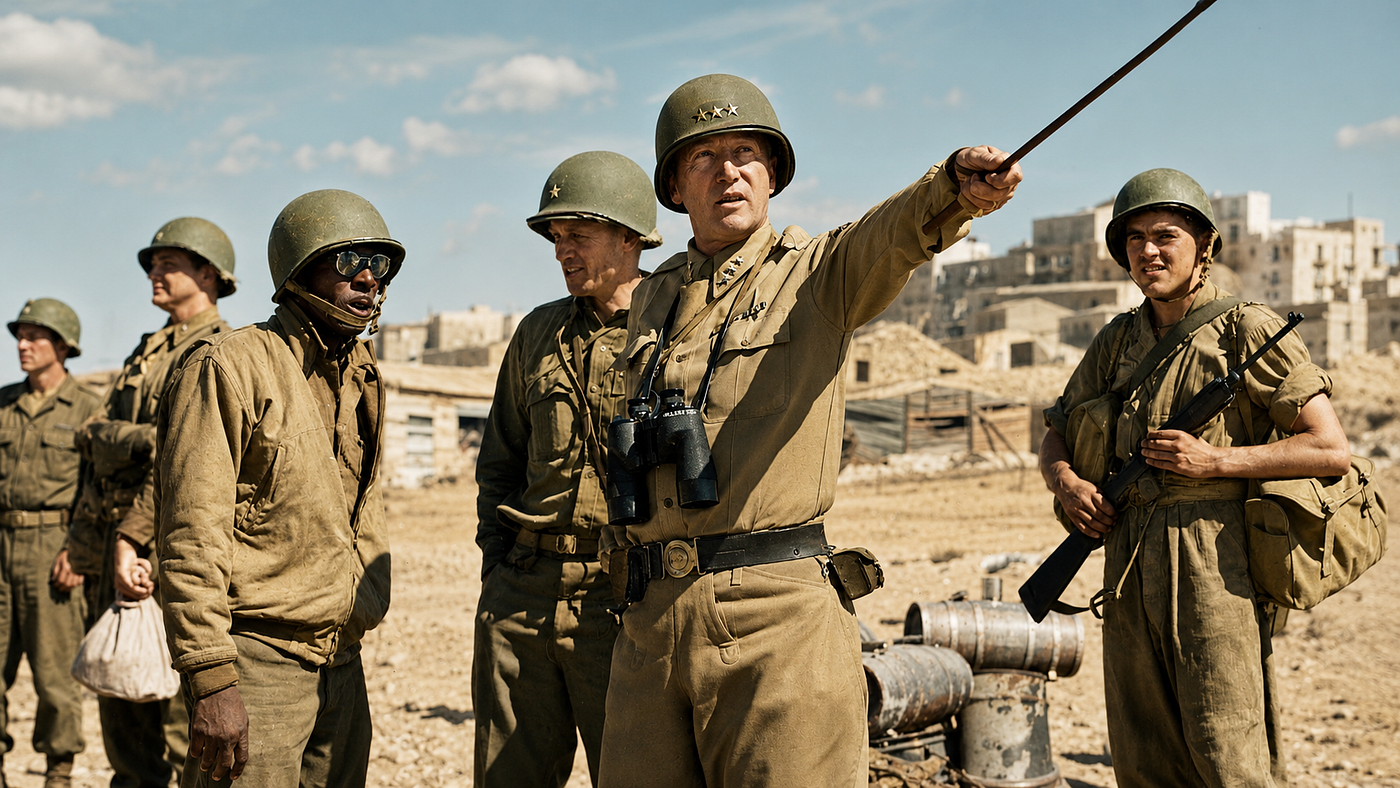
He arrived like a signal flare: polished helmet, hard stare, ivory-gripped pistols, profanity, speed, violence of movement, and a belief that war rewarded the commander who acted before the enemy could breathe. By the end of World War II, Patton had become one of America’s most recognizable battlefield generals: a cavalryman turned tank commander, a symbol of armored warfare, and a man whose victories were inseparable from his controversies.
He was not a clean hero. He was not merely a caricature with pistols and speeches. Patton was something harder to categorize: a commander built for offensive war, brilliant at momentum, often reckless in judgment, and impossible to understand without looking at both the victories and the damage around them.
A Soldier Before He Became a Symbol
George Smith Patton Jr. was born on November 11, 1885, in San Gabriel, California. He came from a family soaked in military memory, with ancestors who had fought in earlier American wars. As a boy, he struggled academically, especially with reading and writing, but he devoured military history and grew up fascinated by Hannibal, Caesar, Napoleon, Joan of Arc, and the commanders who turned battlefields into legend.
That obsession became his identity.
Patton attended the Virginia Military Institute before moving to West Point. He was not a flawless student. He repeated his first year after failing mathematics. But in drill, discipline, appearance, athletics, and military bearing, he stood out. In 1912, he competed in the modern pentathlon at the Stockholm Olympics, finishing fifth overall. Soon after, he studied fencing in France and helped design the M1913 Cavalry Saber, remembered as the Patton Saber.
That early Patton still belonged to the old world of horses and sabers.
The war that made him famous would belong to engines, tracks, radios, artillery, aircraft, and steel.
The First Motorized Attack and the Birth of a Tank Man
Patton’s first taste of combat came during the Pancho Villa Expedition in 1916, when the United States sent troops into Mexico after Villa’s forces raided Columbus, New Mexico. Patton served under John J. Pershing and took part in what became one of the first motorized attacks in U.S. military history, using Dodge touring cars in a raid against Villa’s men.
That mattered.
Patton saw something early: the future of war was movement.
In World War I, he moved from cavalry tradition into armored warfare. He helped establish the American Expeditionary Forces Light Tank School in France, trained tank crews, commanded American Renault FT light tanks, and led from the front during the fighting. Near Cheppy in September 1918, he was wounded while directing troops under machine-gun and artillery fire. For that action, he received the Distinguished Service Cross.
The experience marked him. The public image later became hard, theatrical, almost mythic. But the record you pasted makes something clear: Patton was deeply affected by the horror of World War I and carried the psychological weight of combat after the armistice.
The showman had seen the slaughter up close.
The Doctrine: Speed as a Weapon
Between the wars, Patton became one of the American officers pushing for mechanized warfare. He believed tanks should not be chained to slow infantry support. They should be used as independent instruments of shock, speed, and exploitation.
That belief became central to his command style.
When World War II broke out in Europe, Patton was already positioned as one of the U.S. Army’s armored warfare specialists. He helped train armored formations, commanded the 2nd Armored Division, staged large-scale maneuvers, and treated movement not as a detail of war, but as its organizing principle.
Patton’s logic was blunt: slowing down gave the enemy time to recover. In one wartime exchange, he argued that whenever you slowed anything down, you wasted human lives. That sentence explains almost everything about his method. He preferred pressure, pursuit, disruption, and relentless offensive contact.
His real weapon was not the tank.
It was tempo.
North Africa and Sicily: Victory With a Shadow
Patton entered World War II combat command in North Africa during Operation Torch, leading the Western Task Force in the landings around Casablanca in November 1942. After the U.S. II Corps suffered defeat at Kasserine Pass, Patton was brought in to rebuild morale, discipline, and combat effectiveness. He imposed strict standards, moved constantly among his men, and forced a battered formation back into shape.
Then came Sicily.
There, Patton commanded the U.S. Seventh Army and pushed aggressively across the island, becoming the first Allied commander to reach Messina. The operation reinforced his reputation for speed and drive, but Sicily also exposed the worst parts of his command temperament. The Biscari massacre raised grave questions about orders, prisoner treatment, and battlefield conduct. Then came the slapping incidents, in which Patton struck two hospitalized soldiers suffering from what was then called battle fatigue.
Those incidents nearly broke his career.
Eisenhower forced apologies. Patton lost battlefield command for months. Senior Allied leaders still valued his aggression, but they no longer trusted his self-control in the same way. The contradiction was now official: Patton was too useful to discard, too volatile to leave unchecked.
The General Who Became a Decoy
The Germans respected Patton. That respect became a weapon.
During Operation Fortitude, the Allied deception plan before D-Day, Patton was made the public face of a fake army supposedly preparing to invade at Pas de Calais. The deception used false radio traffic, decoys, and controlled intelligence leaks to convince the German High Command that Normandy might only be a diversion. German forces continued to hold at Calais even after the Normandy landings began.
That is one of the strangest measures of Patton’s reputation.
Even when he was not commanding the real invasion force, his name was still operationally useful. The enemy believed he was the man the Allies would choose for the main blow.
A commander can win battles with divisions.
Patton helped win time with reputation.
The Third Army Unleashed
In August 1944, Patton’s Third Army became operational in France. This was the moment his doctrine finally had space to breathe.
The Third Army drove through the German front with speed and violence, operating with forward reconnaissance, mobile artillery, tactical air support, and an aggressive exploitation mindset. Once German positions were located, armored infantry and tanks punched through, then kept pressing so the enemy could not reorganize.
The scale was extraordinary. From Avranches to Argentan, the Third Army covered roughly 60 miles in two weeks. Its speed depended not only on tanks, but on logistics, air reconnaissance, radio coordination, intelligence, and the ability to keep moving faster than the enemy command structure could respond.
That was Patton at his best.
Not subtle. Not cautious. Not elegant in the academic sense.
Effective.
Bastogne and the Turn North
The Battle of the Bulge gave Patton one of his defining moments.
In December 1944, Germany launched its last major offensive in the West. American troops were trapped at Bastogne, and the Allied command needed a response. Patton had already anticipated the problem. When asked how quickly he could disengage forces and attack north, he was ready with contingency plans.
His staff had prepared the move. His army turned.
The Third Army’s drive toward Bastogne became one of Patton’s signature achievements: a large formation redirected in winter, under pressure, toward a besieged American position. His reputation for speed was no longer just offensive vanity. At Bastogne, it became operational rescue.
Patton later considered the relief of Bastogne one of his greatest battlefield achievements.
He was probably right.
Into Germany: The Rhine and the Final Drive
By early 1945, the German army in the West was collapsing, but the final barriers still mattered. Rivers, cities, fuel shortages, resistance, and command decisions continued to shape the Allied advance.
Patton’s forces moved through western Germany, taking cities including Trier, Koblenz, Mainz, Worms, Kaiserslautern, and Ludwigshafen. In March 1945, the Third Army began crossing the Rhine after constructing a pontoon bridge. Patton later boasted that he had urinated into the river as he crossed, a crude gesture that fit his theatrical personality and his contempt for Germany’s final natural shield.
The Rhine was supposed to slow the Allies.
Patton turned it into another scene in the collapse.
From the Rhine to the Elbe, his Third Army captured tens of thousands of square miles of German territory and took hundreds of thousands of prisoners. Between becoming operational in Normandy and the end of hostilities in May 1945, the Third Army spent 281 days in continuous combat, crossed 24 major rivers, and captured more than 12,000 cities and towns, according to the figures in the pasted record.
The Cost of the Myth
Patton understood image better than most generals of his time.
The polished helmet, the high boots, the pistols, the rank insignia, the “war face,” the speeches, the profanity: all of it was deliberate. He believed leadership was not only about issuing orders. It was about becoming a symbol men could follow.
That symbolism worked. Many soldiers admired him. German commanders respected him. The public remembered him.
But the myth has a cost.
Patton’s record includes the slapping incidents in Sicily, the failed Task Force Baum raid to liberate a POW camp where his son-in-law was held, ugly views expressed during the occupation of Germany, resistance to denazification, and documented antisemitic statements about Jewish displaced persons. These are not footnotes to be hidden under the shine of his helmet. They are part of the record.
That is the hard truth of Patton: the same man who embodied offensive brilliance also carried moral and personal failures that cannot be excused by victory.
Great battlefield command does not erase character.
It complicates memory.
Patton’s Final Act
After Germany’s surrender, Patton wanted a command in the Pacific. He did not get one. Instead, he returned to occupation duty in Europe and became military governor of Bavaria. His behavior and statements became increasingly erratic, and his public comments on denazification angered Eisenhower. On September 28, 1945, he was relieved of his military governorship.
He later commanded the U.S. Fifteenth Army for a brief period. In December 1945, he was severely injured in an automobile accident in Germany and died twelve days later, on December 21.
He did not fade away.
He crashed out of the world like he had moved through it: abruptly, violently, unresolved.
What Patton Really Represents
Patton represents the terrible usefulness of aggressive command.
He was not the most diplomatic general. He was not the cleanest moral figure. He was not the easiest subordinate. He was not the kind of man modern memory can honestly reduce to a statue.
But in the kind of war that consumed Europe between 1939 and 1945, Patton understood something essential: once the enemy line breaks, hesitation is a gift. He built his command philosophy around pressure, speed, spectacle, and pursuit.
His enemies feared him.
His superiors managed him.
His men followed him.
History still argues over him.
That is why George S. Patton remains one of the most compelling figures of World War II. Not because he was simple, but because he was not. His life forces the question that war often leaves behind:
How much damage can a man carry and still be called great?
Key Takeaways
Patton’s genius was tempo. He understood speed as a battlefield weapon, not just a movement rate.
His career bridged two eras of war. He began in the age of cavalry and became one of America’s most famous armored commanders.
His reputation became operationally useful. In Operation Fortitude, the Allies used German respect for Patton as part of the deception before D-Day.
His record cannot be honestly cleaned up. The victories are real. So are the scandals, failed judgments, and hateful postwar statements.
His legacy is contradiction. Patton was a brilliant combat commander and a deeply flawed man.
“Patton’s real weapon was not the tank. It was tempo.”
Final Thought
George S. Patton helped turn armored warfare into movement, pressure, and shock. He drove armies across maps at a pace that made German commanders react instead of plan. He broke lines, relieved Bastogne, crossed the Rhine, and pushed deep into Germany.
But the man behind the legend was not clean marble.
He was steel, ego, brilliance, cruelty, discipline, spectacle, prejudice, courage, and contradiction.
That is why the story still matters.
War does not produce simple men. It reveals what men are willing to become.
메타데이터
- post_id
- b633fec70f76
- slug
- george-s-patton-the-general-war-couldnt-ignore-b633fec70f76
- url
- https://medium.com/@thecenturyofwar/george-s-patton-the-general-war-couldnt-ignore-b633fec70f76
- canonical_url
- https://medium.com/@thecenturyofwar/george-s-patton-the-general-war-couldnt-ignore-b633fec70f76
- author_url
- https://medium.com/@thecenturyofwar
- status
- ok
- fetched_at
- 2026-08-03 12:13:36