Introduction to Control systems
All of nature is made of systems that are intelligently designed, making it impossible to deny the possibility of the existence of a higher…
Introduction to Control systems
All of nature is made of systems that are intelligently designed, making it impossible to deny the possibility of the existence of a higher being of infinite intellifence ~ wise man
Control objectives Implicit objective and first priority • Stability • No damage
Explicit objectives Tracking
- In steady state
- In transient state
Rejection
- Disturbance rejection
- Noise rejection
Control Methodology Control objectives must be achieved within: • Established measures of system performance • Practical limitations imposed by the equipment
An essential principle of any control system is that its output is dependent on the control operation- a linear causal system where the output follows an input - the system is error actuated.
Open and closed loop systems
{Image from google/images}
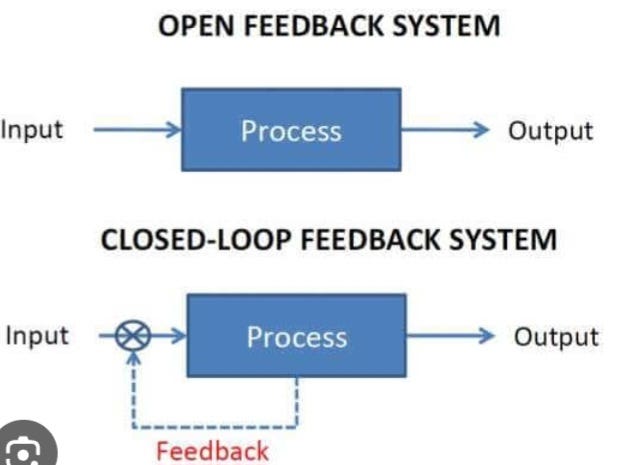
An open loop system has no means of tracking the output to ensure it matches the expectated value given the input or reference, whilst a closed loop system has a feedback loop that allows the performance to be cross-checked against the input or reference to ensure that system specifications are met.
The image above shows the block diagrams of an open and closed loop systems.
Control engineering is focused on ensuring that system specifications are met such that for a given input the expected output is known or can be tracked, and the system continually tuned, to ensure the required output is attained.
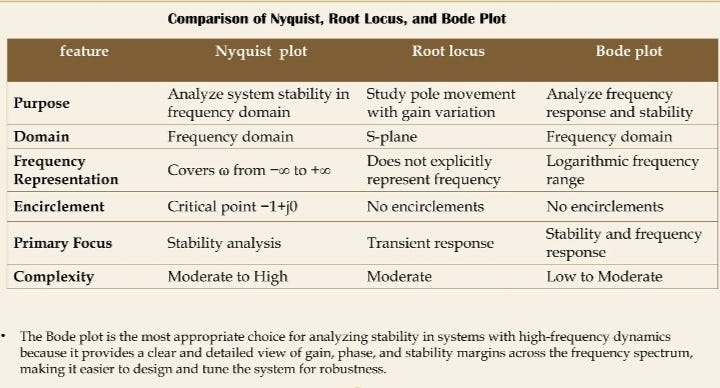
From the block diagrams of the above systems, its possible to calculate the transfer function of the system and the closed loop poles and zeros that can be then be adjusted accordingly to ensure that the system is stable. Several methods can be used to place poles and zeros correctly to ensure stability: • Routh-Hurwitz criterion stability • Nyquist plot method • Root locus method • Bode plots method
{Image from google/images}
The above image compares the different methods of determining stability checking/determining metrics. These methods can compute the ability of the system to remain stable even in the presence of noise and disturbaces, allowing good tracking of the reference signal. That is, they ensure the expected performance is obtained independent of external conditions and varying conditions, by checking its time and frequency domain responses whilst varying k-parameters of the model.
System models
- Electrical
- Mechanical
- Hydraulic
These systems can be simplified into models with transfer functions from which their stability conditions can be established using the above methods to correctly place poles and zeros.
In closing, any linear system, that is causal and has independent inputs, can be designed such that the system specifications allow for performance tracking, noise and disturbance rejection and stability independent of external conditions. The system can take the form of an electrical, mechanical or hydraulic system, the mathematical modelling boils to the same transfer function formulation. The above methods (bode, nyquist and root locus plots) are used to ensure the above system properties.
메타데이터
- post_id
- b63bcfea41a2
- slug
- introduction-to-control-systems-b63bcfea41a2
- url
- https://medium.com/@mompatiseete/introduction-to-control-systems-b63bcfea41a2
- canonical_url
- https://medium.com/@mompatiseete/introduction-to-control-systems-b63bcfea41a2
- author_url
- https://medium.com/@mompatiseete
- status
- ok
- fetched_at
- 2026-06-09 15:37:30