The Space Domain: Starlink, Counter-space and the War Above the War
No previous war has been run, in any meaningful part, by a commercial satellite constellation owned by a private company. This one is…
The Space Domain: Starlink, Counter-space and the War Above the War
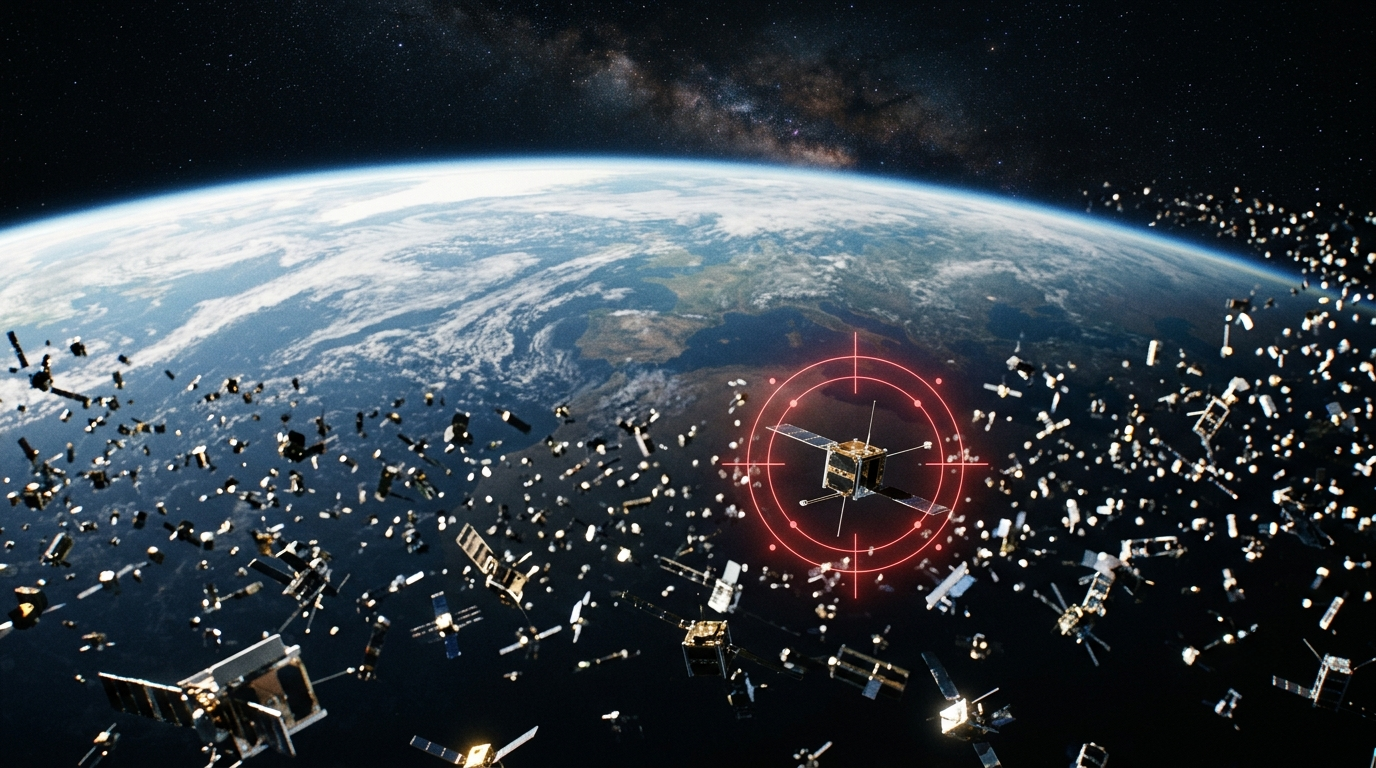
Roughly ten thousand of these are currently running a ground war. All images generated by author unless stated
No previous war has been run, in any meaningful part, by a commercial satellite constellation owned by a private company. This one is. Since days after Russia’s 2022 invasion, Ukrainian battlefield communications, drone control and artillery targeting have depended on Starlink, a network that did not exist as a strategic military asset a decade earlier, activated for a war within days because one company decided to switch it on.
That dependency has made the constellation itself a battlefield. What Russia has tried against it, and what it may be building next, tells you more about the actual shape of twenty-first century warfare than almost anything happening on the ground.
The war that’s already being fought up there
Russia’s campaign against Starlink opened with the February 2022 hack of Viasat’s ground terminals, the conflict’s first counterspace act, executed before the invasion’s first week was out. Since then it has escalated through layers of increasingly serious, increasingly limited effect countermeasures. Electronic warfare systems, one named “Volna Kupol Garant,” first spotted near Kharkov in 2024, jam Starlink signals across a radius of roughly twenty square kilometres. Against a constellation of more than ten thousand satellites capable of near-instant handoffs, analysts describe this as “pinhole defence”: a small, temporary bubble of denial in an otherwise unbroken sky. A separate Chinese academic study estimated it would take between 935 and 2,000 aerial jamming platforms to deny Starlink coverage across an area merely the size of Taiwan, a figure that puts the scale mismatch in concrete terms.
Physical terminal destruction and access-control warfare have followed the same pattern of partial, grinding effect rather than decisive success. Russia obtained Starlink terminals through third countries for a period; SpaceX and the Pentagon closed that gap by mid-2024 and a stricter verification and whitelisting regime enforced by SpaceX in February 2026 disabled unauthorised Russian military terminals outright. Per a Moscow City Duma deputy chairman’s own account, this created a genuine frontline coordination crisis for Russian units, one Ukraine exploited directly, retaking ten to twelve kilometres on the southern front in its spring 2026 counteroffensive against Russian forces operating, in effect, on outdated battlefield maps.

The weapon being described doesn’t distinguish between an enemy satellite and anyone else’s.
The weapon that can’t be aimed
The more serious threat is still speculative and it is worth being precise about what tier of evidence that claim rests on. Intelligence from two NATO-nation services, reported by the Associated Press in December 2025, suggests Russia is developing an anti-satellite weapon that would release hundreds of thousands of small, high-density pellets into Starlink’s orbital shell, disabling multiple satellites through collision, using formations of small satellites to deploy fragments too small to reliably track and deniable essentially by design.
The physics of such a weapon is also its fundamental limitation as a usable tool. Pellet clouds in orbit obey gravity and momentum, not military intent. As Canadian Space Division commander Brig-Gen. Christopher Horner put it: release enough fragments into a shared orbital band and you threaten every satellite operating at a similar altitude, not just the intended target. That includes Russia’s own military and commercial satellites, China’s expanding mega-constellations (three currently planned, totalling roughly 38,000 satellites) and both the International Space Station and China’s Tiangong station, both of which orbit below Starlink’s shell and would face descending debris for years afterward.
This is the asymmetry that likely keeps the weapon in the “developed but not deployed” category rather than active use. Starlink has roughly ten thousand satellites and the industrial capacity to replace losses quickly. Russia’s own Rassvet constellation has sixteen operational satellites against a stated 2030 target of 292. An indiscriminate weapon that damages every satellite in a shared orbital band hurts the side with fewer, harder-to-replace assets considerably more than the side with thousands and a running production line. Secure World Foundation’s Victoria Samson has suggested the programme may be experimental rather than operational, and noted, pointedly, that intelligence disclosures of this kind also serve Western counter-space budget arguments, which is itself worth remembering when reading the reporting.
The two-directional war
What makes this a genuine domain of the conflict rather than a one-sided Russian effort is that Ukraine has been hitting back at the ground segment of Russia’s own space architecture. In June 2026, Ukrainian drones struck Russia’s Dubna and Vladimir space communications centres three times within two weeks, damaging antennas and equipment that handle secure satellite links for Russian military and leadership communications, degrading imagery downloads, disrupting high-bandwidth command traffic and reportedly forcing Moscow toward purchasing foreign satellite imagery to fill the gap.
The symmetry is exact and revealing. Russia jams and threatens the constellation it doesn’t own and can’t fully deny. Ukraine physically destroys the fixed ground infrastructure of the constellation Russia does own. The side running a resilient, distributed, ten-thousand-node system is beating the side running a traditional, centralised, sixteen-satellite one, in orbit and on the ground simultaneously.

Take out the ground station and it doesn’t matter how many satellites are still in the sky.
Part of the What If AI Investigated series. Sources: Associated Press reporting (December 2025) citing two NATO-nation intelligence services on Russia’s reported orbital pellet weapon programme; reporting on the “Volna Kupol Garant” jamming system and its documented range limitations; Moscow City Duma official statements on the February 2026 SpaceX whitelisting crisis; Secure World Foundation analysis (Victoria Samson); Canadian Space Division commentary (Brig-Gen. Christopher Horner); reporting on Ukrainian strikes against Russia’s Dubna and Vladimir space communications facilities, June 2026.
메타데이터
- post_id
- b645c8ca4ac4
- slug
- the-space-domain-starlink-counter-space-and-the-war-above-the-war-b645c8ca4ac4
- url
- https://medium.com/what-if-ai-investigated/the-space-domain-starlink-counter-space-and-the-war-above-the-war-b645c8ca4ac4
- canonical_url
- https://medium.com/what-if-ai-investigated/the-space-domain-starlink-counter-space-and-the-war-above-the-war-b645c8ca4ac4
- author_url
- https://medium.com/@jamie_gray027
- status
- ok
- fetched_at
- 2026-07-14 18:43:25