Publora Review 2026: Social Publishing API for AI Agents
The risky part of social scheduling is rarely the calendar UI. It is the handoff between the place where content is created and the place…
Publora Review 2026: Social Publishing API for AI Agents
Image by @trelvek
The risky part of social scheduling is rarely the calendar UI. It is the handoff between the place where content is created and the place where it finally gets posted. If your posts start in a script, an internal tool, a content pipeline, n8n, or an AI assistant, most schedulers still make you fall back into a manual dashboard.
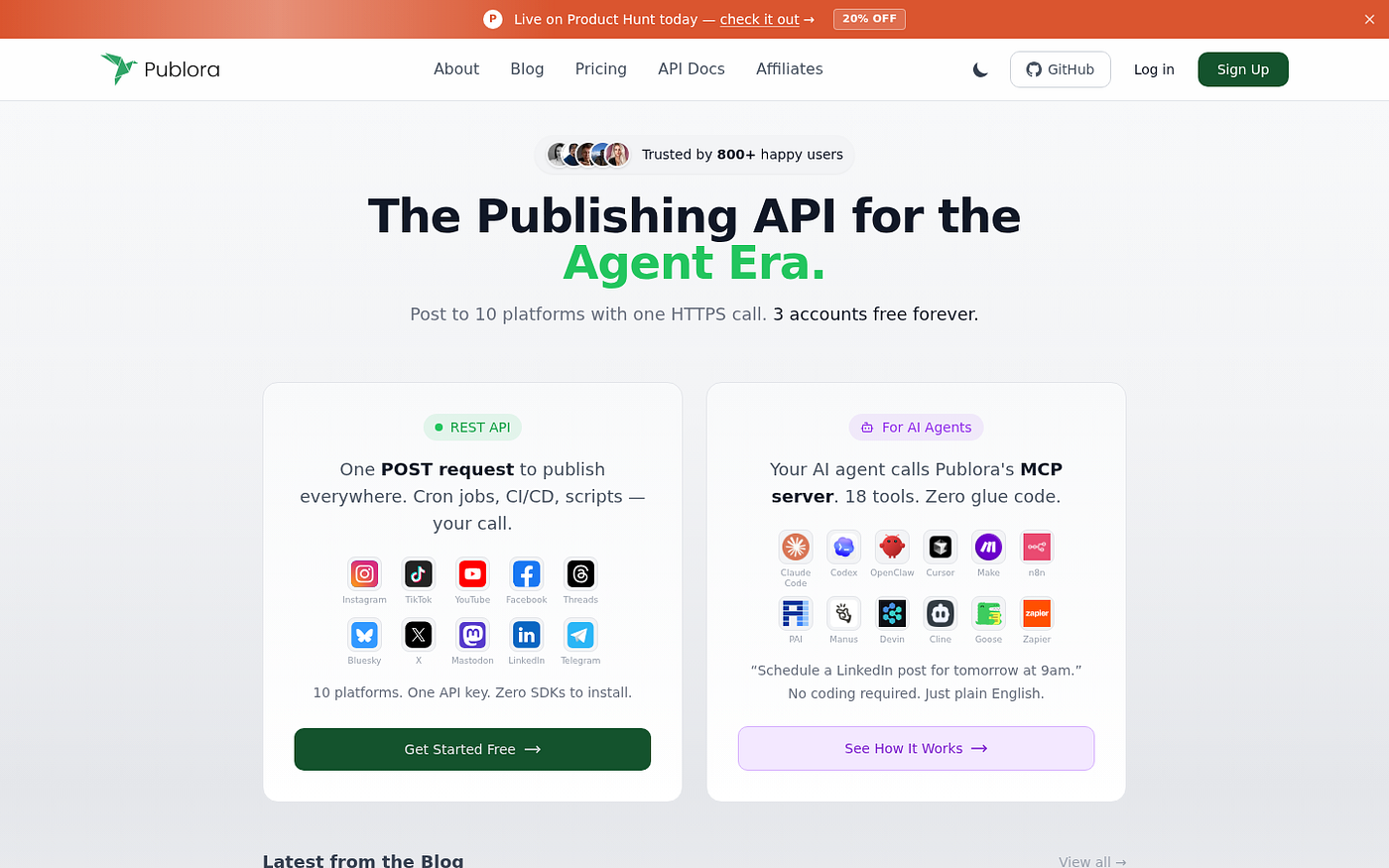
Screenshot of Publora’s official tool page, captured from publora.com.
That is why Publora is more interesting than another lightweight Buffer alternative. It pitches itself as a publishing API for the agent era: post to multiple platforms with one HTTPS call, or connect an AI assistant through MCP and manage social publishing in plain English. That is a specific technical promise, and it is worth separating the useful part from the launch-page shine.
I would look at Publora less as a social media suite and more as a thin programmable layer between your content system and the social networks. The technical fit or integration surface is discussed below, because that is where the product either earns its place or becomes just another calendar.
Where it Fits in the Stack
Publora sits in the execution layer. Your content can come from a human editor, a newsletter pipeline, a product changelog, a CMS, a Notion workflow, a build script, or an AI agent. Publora is the place that turns the final post into scheduled output across platforms like LinkedIn, X, Bluesky, Threads, Mastodon, Facebook, Instagram, TikTok, YouTube, and Telegram.
The vendor site leans on two technical surfaces: a REST API and an MCP server. The API angle is simple: one POST request, one API key, no SDK dependency. That matters if you want publishing from cron, CI/CD, an internal dashboard, or a small automation script.
The MCP angle is newer and potentially more useful for AI-heavy workflows. Publora says MCP-compatible clients can schedule content, check analytics, manage connections, and review the content calendar. In plain language: your assistant can ask what is scheduled next week or draft a LinkedIn post for tomorrow without you clicking through a scheduler.
That integration surface is the main reason I would test Publora. Plenty of schedulers have calendars. Fewer are explicitly trying to be a clean publishing backend for agents and automation builders.
Inputs and Outputs
The main inputs are posts, media, target platforms, connected accounts, scheduling times, and workspace context. Publora supports text, image, video, carousel, story, and reel-style posts, at least according to the product page. It also includes an AI editor and AI idea generation, but I would treat those as convenience features rather than the core technical reason to buy it.
The outputs are scheduled or published social posts, status notifications, error notifications, analytics checks, and a visible calendar. That sounds basic until you maintain the same behavior across ten networks. Publora’s value depends on how much platform-specific ugliness it absorbs.
Pricing also affects the architecture. Starter is free forever with 15 posts per month, 3 social accounts, all platforms except X/Twitter, and videos up to 50MB. Pro and Premium are per-account plans with higher monthly post limits, larger video uploads, all platforms, and two-month scheduling. That is friendly for a solo operator testing one or two channels, but per-account pricing can grow if an agency connects many client accounts.
Failure Modes
The first failure mode is platform drift. Social networks change APIs, upload rules, account restrictions, and rate limits constantly. A tool like Publora is only as good as its recovery path when LinkedIn rejects a post, X changes a requirement, or Instagram media validation gets picky. The vendor mentions platform-specific validations and error notifications; I would still test real failures before trusting it with high-volume publishing.
The second failure mode is automation confidence. It is easy to tell an AI assistant to “post this everywhere.” It is harder to guarantee the final copy, platform variants, links, hashtags, media crops, and timing are all correct. If your workflow includes AI-generated copy, you probably want a review checkpoint before publishing to every account.
The third failure mode is governance. Publora has workspaces, permissions, client onboarding, and centralized billing, which helps small agencies. But I would not assume enterprise-grade approval chains, legal review, inbox management, or deep social listening. If your team needs those, Publora may be the publishing pipe, not the whole operating system.
The fourth failure mode is scheduling horizon. Paid plans schedule two months in advance, which may annoy teams planning seasonal campaigns far ahead. That is at least one limitation or failure mode to test early.
What to Test Before Paying
Start with the free plan and test the boring path. Connect a few accounts, schedule posts with images and links, then intentionally vary the format per platform. Try LinkedIn, Bluesky, Mastodon, and one media-heavy channel if those matter to you. The goal is not to admire the dashboard; it is to see whether validation catches the issues you would otherwise discover after a failed publish.
Next, test the API or MCP route. If you are considering Publora because of automation, do not buy based only on the calendar. Wire one small script or n8n flow that creates a scheduled post from a real content source. Then check the response shape, error messages, idempotency behavior, and how easy it is to audit what got scheduled.
If you are an agency, test workspace separation too. Connect accounts, hand off limited permissions, and verify that a mistake in one workspace cannot spill into another.
Pricing Reality
Publora’s pricing is unusually approachable. A free plan with 15 posts per month and 3 social accounts is enough to validate the workflow. The paid tiers, listed per social account, are cheap at the individual account level and more variable at agency scale. That is not a complaint; it is just the math you should run before moving twenty client profiles into it.
The refund window is seven days after the first payment. I would use that window to test paid-only platform support, media limits, and the two-month scheduling behavior rather than simply checking whether the login works.
Verdict
Publora is a good fit if you want a simple scheduler with a serious automation angle. The strongest case is for technical operators, solo founders, creators with repeatable content systems, and small agencies that want social publishing to be callable from scripts, AI assistants, and no-code workflows.
It is not the tool I would pick first for enterprise social governance, heavy approval workflows, social listening, or inbox operations. But as a programmable publishing layer, it has a clear lane. The combination of low-cost plans, API access, and MCP support makes it worth testing if your current social workflow still ends with copy-paste into a calendar app.
If that is the bottleneck you are trying to remove, try Publora here, run the free-plan tests first, and only pay once the automation path behaves under real posting conditions. If this teardown helped, clap for it and follow for more practical AI tool reviews.
메타데이터
- post_id
- b647ae2e4fa7
- slug
- publora-review-2026-social-publishing-api-for-ai-agents-b647ae2e4fa7
- url
- https://medium.com/@trelvek/publora-review-2026-social-publishing-api-for-ai-agents-b647ae2e4fa7
- canonical_url
- https://medium.com/@trelvek/publora-review-2026-social-publishing-api-for-ai-agents-b647ae2e4fa7
- author_url
- https://medium.com/@trelvek
- status
- ok
- fetched_at
- 2026-06-16 19:09:56