Key Technologies Behind Digital Twin: AI, IoT, and Cloud Explained
Over the past decade, I’ve watched digital transformation shift from a buzzword into a business necessity. And if there’s one concept that…
Key Technologies Behind Digital Twin: AI, IoT, and Cloud Explained
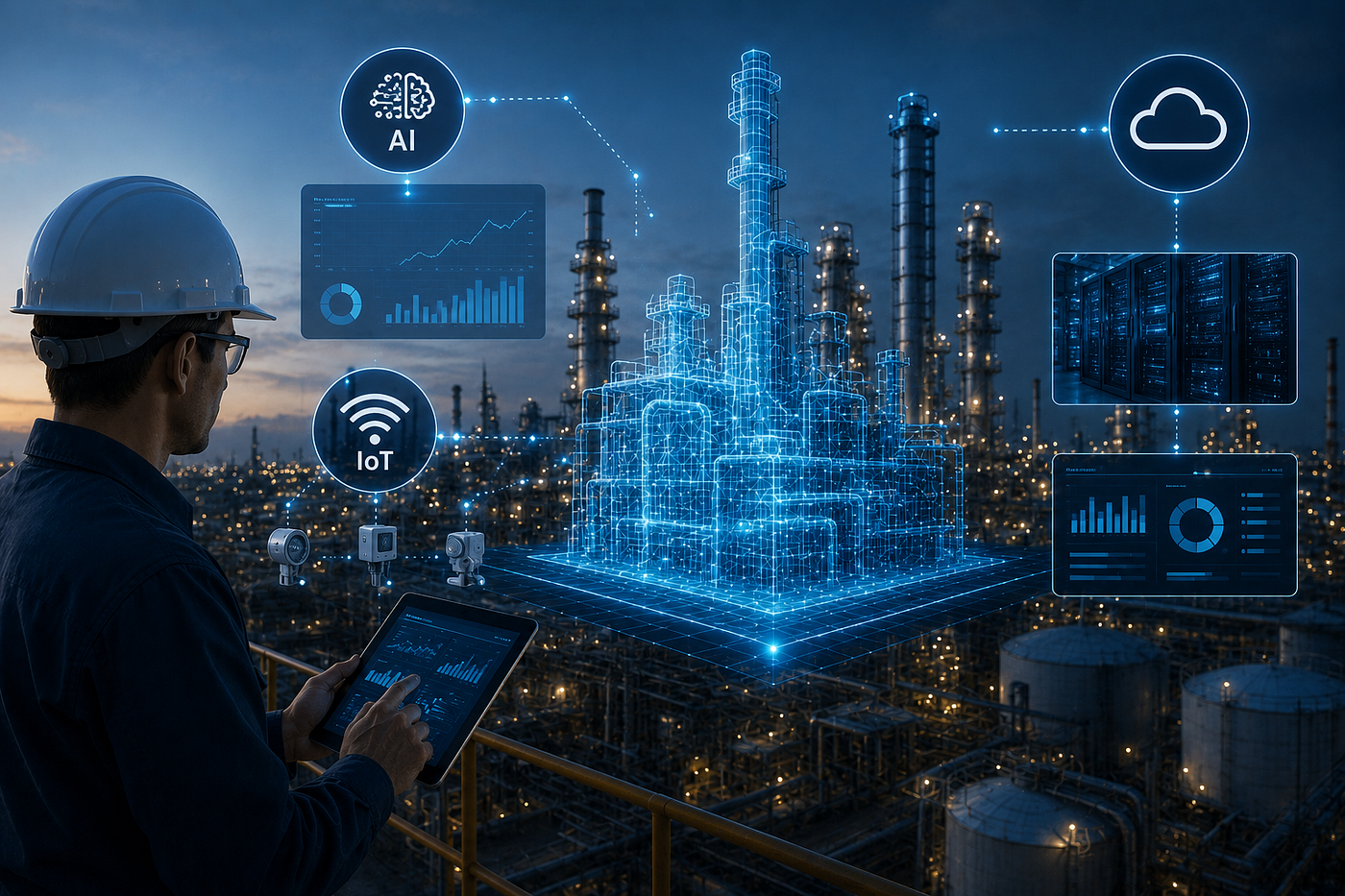
Over the past decade, I’ve watched digital transformation shift from a buzzword into a business necessity. And if there’s one concept that genuinely excites engineers, data scientists, and strategists alike, it’s the digital twin.
But here’s the thing: a digital twin isn’t just a 3D model or a simulation. What makes it powerful, what gives it the ability to predict, learn, and adapt, is the quiet collaboration of three foundational technologies: artificial intelligence, the Internet of Things, and cloud computing.
In this post, I’ll walk you through exactly how AI, IoT, and cloud come together to bring digital twins to life. No fluff, no jargon for the sake of it.
Just a clear, practical explanation based on real-world implementations I’ve studied and written about over the years.
What Exactly Is a Digital Twin? (And Why It Needs More Than Data)
Before we unpack the technologies, let’s get on the same page about what a digital twin actually is. A digital twin is a virtual replica of a physical object, process, or system.
But unlike a static computer-aided design (CAD) model, a digital twin lives and breathes with its real-world counterpart. It updates continuously, mirrors real-time conditions, and can run simulations to forecast future behavior.
Think of a jet engine. Its digital twin doesn’t just show the engine’s geometry. It receives real-time vibration data, temperature readings, and pressure levels from sensors.
Then it analyzes that information, spots anomalies, and even suggests maintenance schedules. That level of intelligence doesn’t happen by accident. It happens because three key technologies work in perfect sync.
If you’re curious about how companies build such systems from scratch, exploring Digital Twin Development Services can give you a clearer picture of the engineering behind the scenes.
The Three Pillars: IoT, AI, and Cloud
Let me break down each technology’s role in simple terms. Think of a digital twin as a human body. IoT acts as the nervous system, collecting sensory data from every corner. AI serves as the brain, making sense of that data and deciding what to do.
And cloud computing is like the bloodstream and memory combined, storing vast amounts of information and delivering it wherever it’s needed, instantly.
IoT: The Sensory Network Feeding Real-World Data
The Internet of Things is where every digital twin journey begins. Without IoT, your twin would be blind, deaf, and numb. Sensors, actuators, and connected devices continuously stream data from the physical asset to its virtual counterpart.
How IoT Collects and Transmits Data
Take a wind turbine farm. Each turbine has dozens of sensors measuring wind speed, blade pitch, rotor RPM, temperature, and vibration.
These IoT devices send readings every few seconds, sometimes milliseconds, over protocols like MQTT or LoRaWAN. That constant flow of real-time data turns a static model into a living mirror.
But IoT isn’t just about collection. It’s about context. A temperature reading of 80 degrees Celsius means nothing alone. When paired with rotational speed and ambient conditions from other sensors, the data gains meaning.
That’s where edge computing often steps in, filtering noise and sending only relevant information upstream.
Types of IoT Data Used in Digital Twins
In my experience, digital twins typically consume three kinds of IoT data:
Streaming telemetry: Continuous values like pressure, flow rate, or voltage.
Event-based alerts: Triggered when a threshold is crossed, like a bearing overheating.
Configurational data: Asset specifications, maintenance history, or calibration records.
Without robust IoT infrastructure, even the smartest AI would starve for data. And without cloud capacity to handle that data volume, the system would collapse under its own weight.
AI: The Analytical Engine Driving Prediction and Optimization
Once IoT delivers the raw material, artificial intelligence gets to work. AI in digital twins is not about chatbots or image recognition. It’s about pattern finding, anomaly detection, and decision support.
Machine Learning Models for Digital Twins
Here’s where most digital twins earn their keep. Using historical and real-time data, machine learning models learn normal behavior for a given asset. For example, a pump in a chemical plant might normally run at 1,450 RPM with 2.3 bar pressure.
When AI detects the pressure dropping while RPM stays constant, it flags a potential blockage long before any human notices.
More advanced twins use reinforcement learning or physics-informed neural networks. These models don’t just observe; they simulate “what if” scenarios.
What if we increase feed rate by 12%? What if we shut down line three for two hours? The AI runs thousands of simulations in seconds and recommends the optimal action.
How AI Enables Predictive Maintenance and Simulation
One of the most valuable applications I’ve covered is predictive maintenance. Instead of changing parts on a fixed schedule, AI predicts failures before they happen.
A semiconductor fab using digital twins reduced unplanned downtime by 45% simply by letting AI model wear patterns on etching equipment. That’s real savings.
AI also enables prescriptive insights. Not just “something will fail,” but “replace nozzle seven in the next 48 hours to avoid a three-hour line stoppage.” That level of clarity turns data into direct action.
Cloud Computing: The Scalable Backbone for Storage and Collaboration
You might wonder: why can’t we run all this on local servers? For small experiments, sure. But for any industrial-scale digital twin, cloud computing is non-negotiable.
Why Cloud Is Essential for Digital Twins
First, data volume. A single jet engine generates over a terabyte of data per transatlantic flight. Multiply that by a fleet of hundreds, and you’re in petabyte territory.
Local storage can’t keep up economically. Cloud platforms like AWS, Azure, and Google Cloud offer virtually limitless, pay-as-you-go storage.
Second, compute power. Training AI models for digital twins requires graphics processing units (GPUs) or tensor processing units (TPUs) running for hours or days. That’s cloud territory. You spin up the resources you need, run the training, then scale back down.
Third, collaboration. A digital twin of a city’s traffic system might be accessed by public works, emergency services, and urban planners across different locations. Cloud ensures everyone sees the same real-time twin, regardless of where they log in.
Real-Time Synchronization Across Distributed Systems
Cloud also enables hybrid twins, where part of the processing happens at the edge (close to sensors) and part in the central cloud. For example, a self-driving vehicle’s digital twin might process obstacle detection locally for split-second reactions, but send route optimization problems to the cloud. The cloud then updates the twin for all vehicles in the fleet simultaneously.
How AI, IoT, and Cloud Work Together in a Digital Twin
Let me give you a concrete example so you can see the interplay. Imagine a smart building digital twin.
IoT sensors throughout the building measure occupancy, CO2 levels, temperature, window positions, and energy consumption. These sensors send data every 30 seconds to a cloud-based platform.
In the cloud, an AI model compares current energy usage against weather forecasts and historical patterns. It notices that the west-facing conference room gets direct afternoon sun, causing the air conditioner to work overtime.
The AI runs a simulation: close blinds automatically between 2 PM and 5 PM and raise the temperature setpoint by 2 degrees. The simulation predicts a 13% energy saving without any occupant discomfort.
The cloud then sends a command back through IoT actuators to close the smart blinds and adjust the thermostat. Meanwhile, the facility manager sees a dashboard updated in real time on her tablet, showing current savings.
That loop, sense, analyze, simulate, act, and learn, happens continuously. No single technology could pull it off alone.
Benefits of Integrating AI, IoT, and Cloud for Digital Twins
Over the years, I’ve seen organizations achieve remarkable outcomes when they get this triad right. Here are the most consistent benefits.
Operational efficiency: Real-time visibility and predictive insights reduce waste and rework. One logistics company cut fuel costs by 11% using a digital twin of its delivery fleet.
Reduced downtime: Predictive maintenance catches failures early. Manufacturers using digital twins report 30 to 50 percent less unplanned downtime.
Better product design: Engineers run simulations on digital twins before building physical prototypes. That speeds up innovation and lowers costs.
Remote management: With cloud access, experts can monitor assets from anywhere. A mining company in Australia manages drilling rigs from a control center in Perth, 1,200 kilometers away.
Real-World Applications Across Industries
Let me share a few examples that go beyond generic theory.
Manufacturing: Siemens uses digital twins of its gas turbines. IoT collects vibration and combustion data. AI predicts emissions and efficiency. Cloud shares models across global service teams. The result? Maintenance visits are shorter, and turbines run closer to optimal specs.
Healthcare: Digital twins of human organs are emerging. A patient’s heart twin, built from MRI data and live sensor feeds from wearables, helps surgeons plan procedures.AI simulates how the heart responds to different interventions. Cloud enables collaboration among specialists across hospitals.
Smart cities: Singapore has a digital twin of the entire city. IoT sensors on lampposts, waste bins, and drainage systems feed data. AI models traffic flow, flood risks, and energy demand. Cloud makes this massive simulation accessible to multiple government agencies.
Retail: A grocery chain uses digital twins of its refrigeration units. IoT tracks temperature and door openings. AI predicts compressor failures. Cloud aggregates data from 300 stores. The chain reduced food spoilage by 22% in the first year.
Challenges to Consider (And How Smart Teams Overcome Them)
No technology is magic. Digital twins come with real hurdles. I’ve seen projects stumble, and usually for the same few reasons.
Data silos: IoT data often lives in proprietary systems. AI models can’t access it. The fix is investing in open data architectures and APIs early.
Latency: For fast-moving assets like robots or drones, cloud-only processing may be too slow. The solution is edge computing, where some AI runs directly on IoT gateways.
Integration complexity: Connecting sensors, AI platforms, and cloud services requires skilled engineers. Many companies start with a small-scope pilot twin on one production line before scaling.
Cost: Cloud storage and AI compute aren’t free. But costs have dropped significantly. Most businesses find the ROI positive within 12 to 18 months. I recommend running a detailed cost-benefit analysis before committing.
Security: More connections mean more attack surfaces. Encrypt IoT data in transit and at rest. Use identity management for cloud access. Regular penetration testing helps.
For a deeper look at adoption trends and market growth, check out these Digital Twin Statistics. They offer hard numbers on how fast this field is expanding.
The Future: Where AI, IoT, and Cloud Are Taking Digital Twins
I don’t usually make bold predictions, but the trajectory here is clear. Over the next three to five years, expect three major shifts.
First, edge AI will mature. Instead of sending all data to the cloud, digital twins will run lightweight AI directly on IoT devices. That means millisecond response times and lower bandwidth costs.
Second, digital twins will talk to each other. A vehicle twin will interact with a traffic system twin, which interacts with a weather twin.
The cloud will orchestrate these federated twins, enabling system-wide optimization that’s impossible today.
Third, generative AI will enter the picture. Imagine describing a change you want, “reduce energy use on floor two,” and the twin generates a full simulation and implementation plan. We’re already seeing early prototypes.
Wrapping Up: Why This Trio Matters for Your Strategy
If you take away one thing from this post, let it be this: a digital twin is not a product you buy. It’s a capability you build, and that capability rests on three interdependent technologies. IoT feeds it reality. AI gives it intelligence. Cloud provides it scale and accessibility.
You don’t need to master all three overnight. Start with a clear business problem. Connect IoT sensors to collect the right data.
Use cloud storage to keep it organized. Then layer in AI models to find patterns and recommend actions. Improve iteratively.
I’ve seen small teams with modest budgets build powerful twins using off-the-shelf cloud AI services and inexpensive IoT sensors.
The barriers are lower than ever. What matters most is understanding how these pieces fit together, and then taking that first, informed step.
Whether you’re an engineer, a product manager, or a business leader, I hope this explanation helps you see past the hype.
The key technologies behind digital twin are AI, IoT, and cloud. And now you know exactly how they work, together.
메타데이터
- post_id
- b64e79cd120a
- slug
- key-technologies-behind-digital-twin-ai-iot-and-cloud-explained-b64e79cd120a
- url
- https://medium.com/mindful-designing/key-technologies-behind-digital-twin-ai-iot-and-cloud-explained-b64e79cd120a
- canonical_url
- https://medium.com/mindful-designing/key-technologies-behind-digital-twin-ai-iot-and-cloud-explained-b64e79cd120a
- author_url
- https://medium.com/@Rsmith20
- status
- ok
- fetched_at
- 2026-06-14 11:28:49