How x402 Could Make Witnet ($WIT) More Valuable
Why a new HTTP payment standard could unlock private APIs — and a whole new frontier for the Wit/Oracle.
How x402 Could Make Witnet ($WIT) More Valuable
Why a new HTTP payment standard could unlock private APIs — and a whole new frontier for the Wit/Oracle.
A long-standing paradox
Witnet — also known as the Wit/Oracle — has always done one thing better than anyone else: ensuring **data integrity in a completely trustless way**.
Instead of relying on a single provider, Witnet uses a crowd-attestation mechanism: a random subset of validators independently fetch and attest to data before reaching consensus. The result is no single points of failure, total transparency, and resistance to manipulation — the qualities that make Witnet ideal for critical use cases like finance, insurance, and governance.
But there’s always been a catch. While Witnet can access virtually any public API, it’s not compatible with private or paid APIs that require access tokens or authentication.
Why private APIs don’t mix well with oracles
Private APIs typically expect clients to include an access token with every request. That’s how they identify who’s calling, enforce rate limits, and charge for usage.
The problem: Witnet’s oracle queries are public and reproducible by anyone. Including any kind of secret credential in them would instantly break trustlessness.
Asking validators to use their own access tokens isn’t feasible either — the Wit/Oracle is designed to query any HTTPS endpoint in the world without special adapters. The number of possible paid APIs is effectively infinite. No validator could manage keys for all of them.
So for years, the conclusion was simple:
Private APIs aren’t compatible with Witnet*
But there’s always been a fine print to that statement.
The missing piece: unattended payments
That limitation only holds as long as APIs don’t have a standard way to request payments directly from clients.
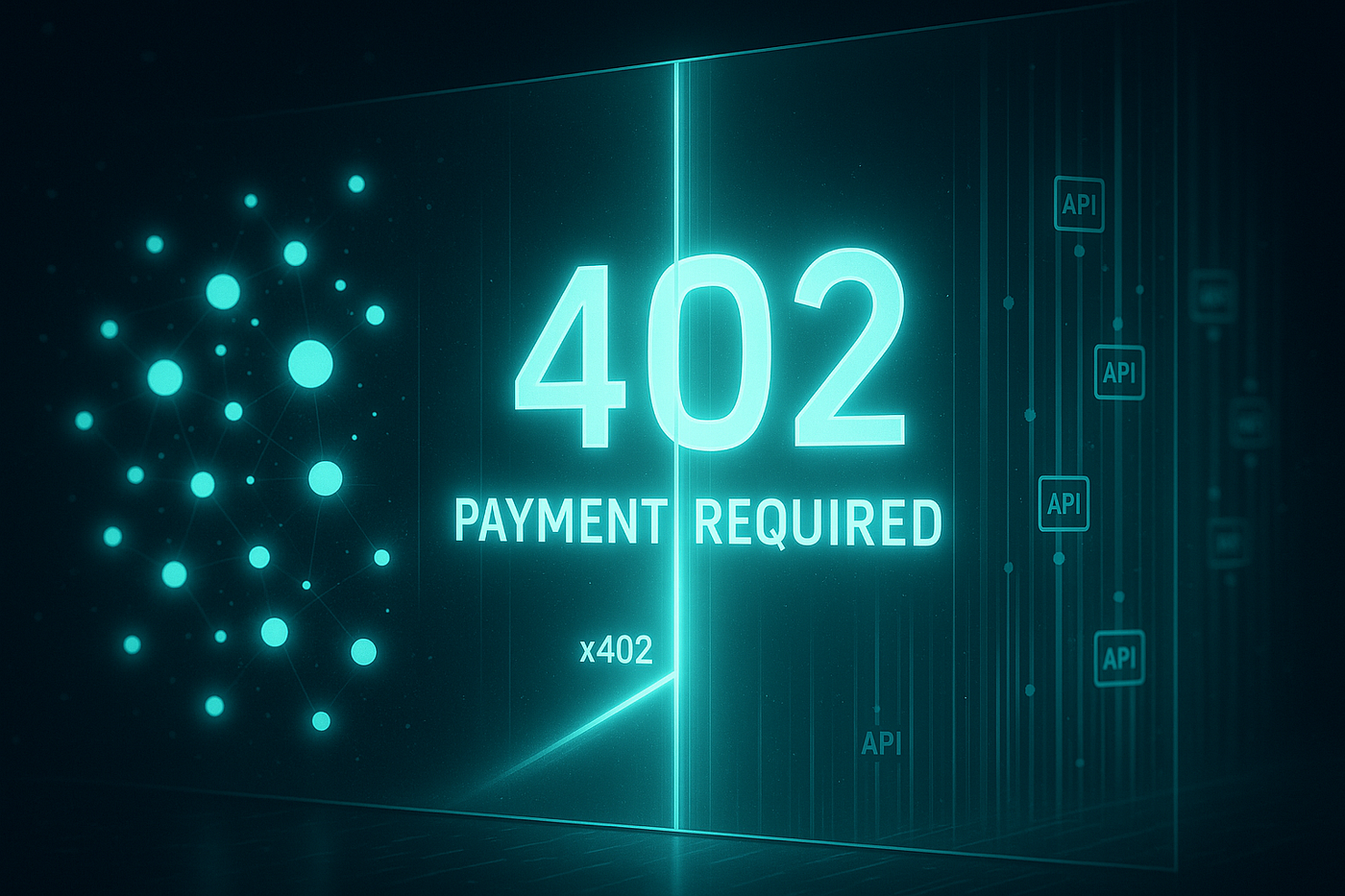
If such a standard existed — if APIs could simply say “402 Payment Required” and accept on-the-fly micropayments from anyone — then the picture changes dramatically.
In that world, Witnet validators could:
- Receive the API’s payment request,
- Pay for it autonomously,
- Prove the payment,
- And retrieve the data — all without using any secret credentials.
Good news: that vision has just become possible.
Enter x402
x402 is a new open standard built on top of HTTPS, named after the dormant HTTP status code 402 — Payment Required.
It defines a lightweight framework for APIs to express the cost of delivering data and for clients to fulfill and prove those payments — seamlessly, natively, and without centralized billing systems.
Think of it as a pay-per-request layer for the entire web:
- Fully compatible with existing HTTPS infrastructure,
- Friendly to both humans and autonomous agents,
- And built with crypto micropayments in mind.
With x402, APIs can set prices per request, clients can pay automatically, and both sides can verify the transaction — all in one elegant flow.
What this means for Witnet
Since Witnet validators already communicate with HTTPS endpoints, they are theoretically ready to speak x402.
In practice, a few assumptions in the current validator software prevents it from working right now. But if x402 adoption grows — and the web starts embracing “pay per API call” — it would take only minimal changes for the Wit/Oracle to make x402 a first-class citizen of the protocol.
That would instantly unlock one of the biggest pain points in Witnet’s history: the inability to access private APIs.
Validators could autonomously pay per request, fetch premium data, and include it in oracle reports — all within the existing decentralized protocol.
Why this would be huge
Adding x402 compatibility would:
- Expand Witnet’s universe of data sources — from open public APIs to high-value private ones (financial data, weather feeds, IoT sensors, AI models, analytics, etc.)
- Eliminate a major limitation that has often been cited by developers and analysts comparing oracles.
- Increase $WIT utility and demand, since data requests would need to fund off-chain API calls.
- Reinforce decentralization, by allowing validators to autonomously handle paid requests without centralized coordination.
In short: x402 could transform Witnet from the oracle of public data into *the oracle of all data*.
Parallel efforts already underway
Even before x402, several efforts within the Witnet ecosystem have aimed to extend support for private APIs:
- **Access token templating**, where validators can securely combine non-sensitive templates with local credentials.
- **Partial capabilities in Wit/2, which will allow validators to announce support for specific protocols or datasets** — enabling delegated access to private resources in a controlled, opt-in way.
Together, these developments show a clear direction: progressively expanding what Witnet can fetch, without compromising its trustless and censorship-resistant architecture.
x402 simply accelerates that trajectory — offering a universal language for paid API access that fits perfectly with Witnet’s decentralized design.
The bottom line
Witnet’s greatest strength — its transparent, trustless data retrieval — once limited it to public sources.
But with the rise of standards like x402, that boundary is fading.
If x402 becomes widely adopted, Witnet will have every reason to embrace it — and doing so could unleash hundreds of new use cases, more network activity, and stronger fundamentals for $WIT.
In other words, x402 could turn one of Witnet’s few limitations into one of its biggest growth catalysts.
And that’s the kind of quiet evolution that, over time, makes a project much more valuable.
**Website | X | Telegram | Discord | LinkedIn | Newsletter | YouTube | Reddit**
메타데이터
- post_id
- b664993fd71b
- slug
- how-x402-could-make-witnet-wit-more-valuable-b664993fd71b
- url
- https://medium.com/witnet/how-x402-could-make-witnet-wit-more-valuable-b664993fd71b
- canonical_url
- https://medium.com/witnet/how-x402-could-make-witnet-wit-more-valuable-b664993fd71b
- author_url
- https://medium.com/@asdpc
- status
- ok
- fetched_at
- 2026-07-16 00:14:14