The Patient Didn’t Follow the Rules
In Poland, one sentence is enough — “the patient didn’t follow the recommendations” — to shut down any story, even one where someone walks…
The Patient Didn’t Follow the Rules
In Poland, one sentence is enough — “the patient didn’t follow the recommendations” — to shut down any story, even one where someone walks out of the clinic with half their face in pain and the feeling that it’s all their fault.
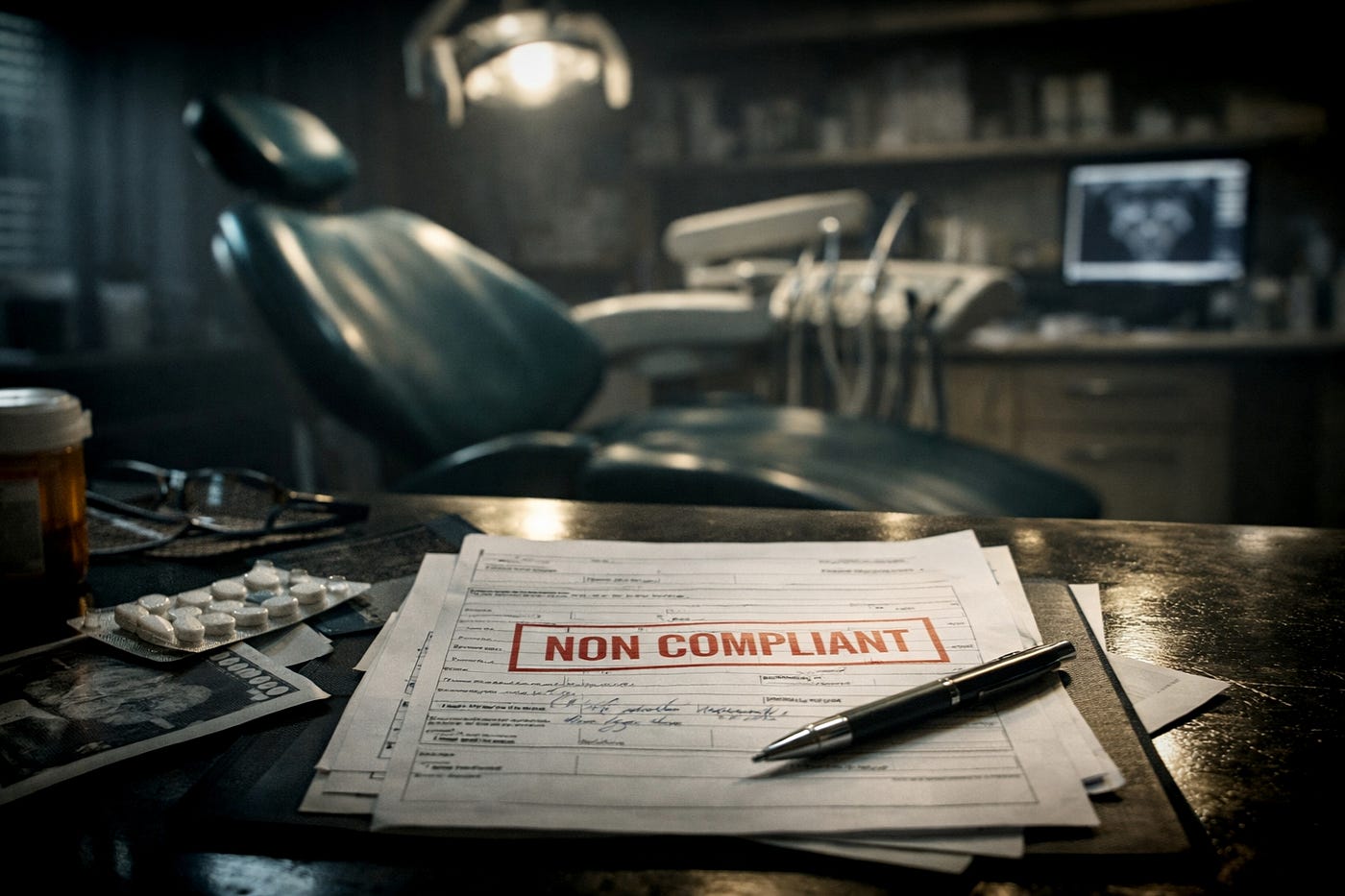
There are professions in Poland where one side is believed by default. Doctors are one of them. Even when the paperwork — the very same paperwork everyone later cites — says something else.
For me, it started like it usually does. An appointment. A tooth extraction. Nothing that should leave a person feeling as if half their face had been dismantled and then being told this was perfectly normal service.
I went there carrying something that dental offices rarely call by its proper name: fear. Dental anxiety isn’t “oh, I don’t like drilling.” It’s years of avoidance, tension throughout the body, inventing excuses to postpone, cancel, escape. And I had worked through that fear. It took a significant part of my life, but at some point — after 2018 — I genuinely felt I could go to the dentist like a normal person. That I didn’t have to feel ashamed, that I wouldn’t be mocked, that it wouldn’t hurt, that I wouldn’t fall back into that familiar state of “I have no control.”
And then one visit shattered all of it.
I won’t pretend I remember every movement of the doctor’s hand. What I do remember is what stays with you for a long time: the way you are treated. That moment when you realize that, to the other side, you are “just another case,” “a difficult patient,” “someone who exaggerates.” And when you try to name it afterward, you hear one word: “standard.”
There was no philosophy in my complaint. Just concrete things: no X-ray diagnostics before the extraction, refusal to use surface anesthesia despite my concerns, words that violated a patient’s dignity — and consequences that stayed with me for weeks and months. Numbness and tingling in the lower lip, chin, and cheek. The feeling that something is “stuck” in the cheek. Pain that doesn’t end “after two days.” And the most infuriating element of all: fear returning like an old debt. Supposedly paid off — yet suddenly standing in the doorway again.
There’s also diabetes. I’ve lived with it for years. And anyone who does knows one thing: the body does not forgive stress, pain, and inflammation. When your health starts to unravel, your blood sugar follows. When your blood sugar collapses, everything else follows. At some point, you realize you’re no longer in a story about “a tooth,” but in a story about whether you have any control over your own body at all.
When I later went to another doctor, I heard things that — paradoxically — brought relief. Because someone finally named them. Soft-tissue damage. A 2–3 centimeter tear in the mucosa. Inflammation, exudate, curettage. Dead tissue and a foreign body removed from the socket. Suspected damage to the terminal branch of the mental nerve. This isn’t “patient sensitivity.” This is a clinical description.
And then the paperwork begins.
The Professional Liability Ombudsman does their job: the case gets a number, a timeline, a deadline. You read the order and see that everything in the system is neat. Clean. Deadlines set through June. A designated case officer. Letters. Signatures. Registry numbers.
And suddenly you receive the doctor’s response — a text that sounds like it was written wearing latex gloves.
In short: I didn’t call the patient that. If I made a remark, it was “out of duty.” An X-ray wasn’t necessary because radiation should be avoided. The anesthesia was correct, and the gel is “for children.” The technique was appropriate, and complications most often result from failure to follow recommendations. The patient didn’t come for follow-up. The patient didn’t show up to have sutures removed. Diabetes? The patient should see a diabetologist. And finally — explicitly — the suggestion that this might be an “attempt to obtain compensation.”
And this is my problem with this culture. Not with one dentist. Not with one case. With the mechanism.
Because in this narrative, the patient is always somehow at fault. Always did too little, too late, or wrong. Always “didn’t report,” “didn’t return,” “didn’t comply.” Even if they reported it — “there’s no data.” Even if they have documentation from another clinic — “it’s unclear.” Even if they describe pain, numbness, and real problems — it’s “subjective.” And if they also have diabetes and post-procedure stress wrecks their glycemic control, they’re told that “no such delayed effects are known.”
It’s convenient. It’s airtight. And it’s infuriating when you’re the person on the other side.
Because I’m not a statistic. I’m not a Google review someone needs to respond to. I’m not a “demanding patient.” I’m a guy who spent years learning how to sit in a dental chair without fighting his own instincts. And after one visit, I’m back in the same place: that urge to flee. You won’t see that on an X-ray. You won’t measure it with calipers. And yet it can ruin a person’s life more effectively than a wound in the oral cavity.
What hurts most is that in all this correspondence, there is almost no single sentence that says: I’m sorry you experienced it this way. Or: let’s see what happened. Or even: let’s see if we can fix something.
Instead, there’s the classic line: “the patient did not follow the recommendations.”
It’s the easiest alibi in the world. Like a rubber stamp. It fits everything. You close the file with it, put it in a binder, and move on.
Except sometimes the story refuses to close.
Because I still feel that face. I still remember that return of fear. And I still have the sense that in Poland, a patient begins any conversation with medicine from the position of a suspect — and only later, if they’re lucky, becomes a human being.
I don’t go to the dentist looking for a war. I go for treatment. And for normalcy.
And that is what this case is really about.
메타데이터
- post_id
- b673f47da9d0
- slug
- the-patient-didnt-follow-the-rules-b673f47da9d0
- url
- https://medium.com/@jaceksumislawski/the-patient-didnt-follow-the-rules-b673f47da9d0
- canonical_url
- https://medium.com/@jaceksumislawski/the-patient-didnt-follow-the-rules-b673f47da9d0
- author_url
- https://medium.com/@jaceksumislawski
- status
- ok
- fetched_at
- 2026-07-14 02:31:40