Binary Bias
There are certain topics best left away from the dinner table, such as political alignments, opinions on abortion, or views on vaccines…
Binary Bias
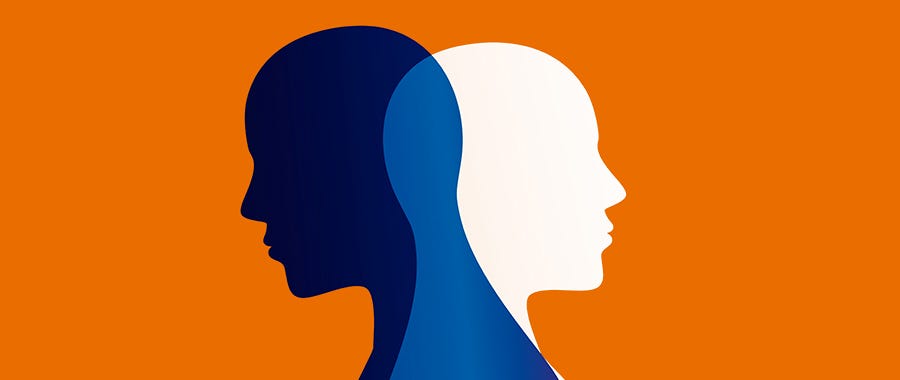
There are certain topics best left away from the dinner table, such as political alignments, opinions on abortion, or views on vaccines. Simply reading these words likely elicits a strong emotional response and a clear preference for one side. If asked whether a definitive “correct” choice exists, a large portion of people would instinctively say “yes.” Personally, I prefer a different answer: “It is always more complicated than that.”
These subjects are prime examples of binary bias, the human tendency to collapse complex, continuous spectrums of information into two mutually exclusive groups (Fisher & Keil, 2018).
Our brains are fundamentally wired to conserve energy. Unfortunately, the nuances, gray areas, and intricate details of geopolitical conflicts or regional theological differences are often distilled into simple, binary scenarios: yes or no, black or white, good guys versus bad guys. The brain defaults to these stark dichotomies to spare us the intense mental effort required to process true complexity (Kahneman, 2011).
Relying on this cognitive heuristic (mental shortcut) can have costly consequences. For instance, focusing solely on our chances of success can blind us to the catastrophic downsides of failure. This “all-or-nothing” mindset frequently drives poor financial choices when selecting stocks, real estate, or insurance policies.
Marketers heavily exploit this bias by pushing consumers to sort items into simple “buckets” rather than assessing their true value or utility. Consider how food products are categorized neatly as “healthy” or “unhealthy.” If a snack label boasts “Low Fat” or “Organic,” our brains instantly place it into a positive binary bucket. In doing so, we ignore the fact that the product may still be highly processed and loaded with sugar — a phenomenon known as the “Health Halo” effect (Schuldt et al., 2012). Consequently, we end up paying unreasonable financial premiums based on nothing more than a superficial, binary classification.
As with any cognitive bias, awareness is the first line of defense. Knowing that binary bias exists does not guarantee an instant or radical change in behavior, but it does serve as a mental prompt to pause and look through a more critical lens.
To actively counteract the effects of binary bias, we can implement three specific strategies:
- Analyze Characteristics in Depth: Resist the urge to simply sort options. Instead, actively examine underlying facts, data, and numbers.
- Use Continuous Scales: Move away from strict “yes or no” choices. Instead, evaluate options on a continuum, such as a scale from 1 to 10 (Grant, 2021).
- Introduce a Third Option: Actively disrupt a false duality by introducing a third alternative. This breaks the binary trap and allows us to generate more nuanced, partial solutions.
References
- Fisher, M., & Keil, F. C. (2018). The binary bias: A systematic distortion in the integration of information. Psychological Science, 29(11), 1846–1858.
- Grant, A. (2021). Think Again: The Power of Knowing What You Don’t Know. Viking.
- Kahneman, D. (2011). Thinking, Fast and Slow. Farrar, Straus and Giroux.
- Schuldt, J. P., Muller, D., & Schwarz, N. (2012). The “organic” path to obesity? Organic claims influence calorie estimation and exercise recommendations. Judgment and Decision Making, 7(4), 407–413.
메타데이터
- post_id
- b67ef93f7ce7
- slug
- binary-bias-b67ef93f7ce7
- url
- https://medium.com/@mse982imb/binary-bias-b67ef93f7ce7
- canonical_url
- https://medium.com/@mse982imb/binary-bias-b67ef93f7ce7
- author_url
- https://medium.com/@mse982imb
- status
- ok
- fetched_at
- 2026-06-20 20:29:01