Why Product Development Fails Without Value Engineering
Manufacturers invest millions in product development, yet many products fail to achieve their expected profitability. The reason is often…
Why Product Development Fails Without Value Engineering
Manufacturers invest millions in product development, yet many products fail to achieve their expected profitability. The reason is often not poor engineering. It is the absence of Value Engineering during the product development process.
Value Engineering is a structured approach that focuses on maximizing functionality while minimizing unnecessary costs. Instead of asking “How can we make this product?”, the better question is “How can we deliver the required function at the lowest lifecycle cost without compromising quality, performance, or customer expectations?”
The Hidden Cost of Traditional Product Development
Many organizations follow a linear development process:
Concept → Design → Prototype → Testing → Manufacturing
The problem is that cost optimization is often considered too late. By the time manufacturing begins, design decisions have already locked in a significant portion of the product’s total cost.
This creates challenges such as:
- Excessive material costs
- Complex manufacturing processes
- Increased assembly time
- Supply chain risks
- Lower profit margins
Engineering teams then spend months trying to reduce costs after production starts.
How Value Engineering Changes the Process
Leading manufacturers integrate Value Engineering from the earliest design stages.
The process focuses on:
Function Analysis
Every component must justify its existence.
Questions include:
- What function does this part perform?
- Is there a simpler alternative?
- Can multiple components be consolidated?
Material Optimization
The most expensive material is not always the best material.
Engineers evaluate:
- Strength requirements
- Durability requirements
- Environmental conditions
- Manufacturing constraints
The goal is optimal performance, not over-engineering.
Design Simplification
Reducing part count often creates multiple benefits:
- Faster assembly
- Lower inventory requirements
- Improved reliability
- Reduced supplier dependency
Manufacturing Efficiency
Products should be designed for manufacturability from day one.
This includes:
- Simplified machining
- Reduced tooling requirements
- Automated assembly opportunities
- Faster production cycles
Real Business Impact
Organizations applying Value Engineering during product development consistently achieve:
- Lower manufacturing costs
- Faster product launches
- Improved product quality
- Better profit margins
- Reduced supply chain complexity
Recent manufacturing research also shows increasing investment in smarter product development strategies as companies face growing pressure to balance innovation, speed, and cost efficiency.

The Future of Product Development
The most successful manufacturers are no longer treating Value Engineering as a cost reduction exercise.
They view it as a competitive advantage.
By combining engineering expertise, manufacturing knowledge, and customer requirements early in the development cycle, companies create products that are easier to manufacture, more profitable to sell, and better aligned with market needs.
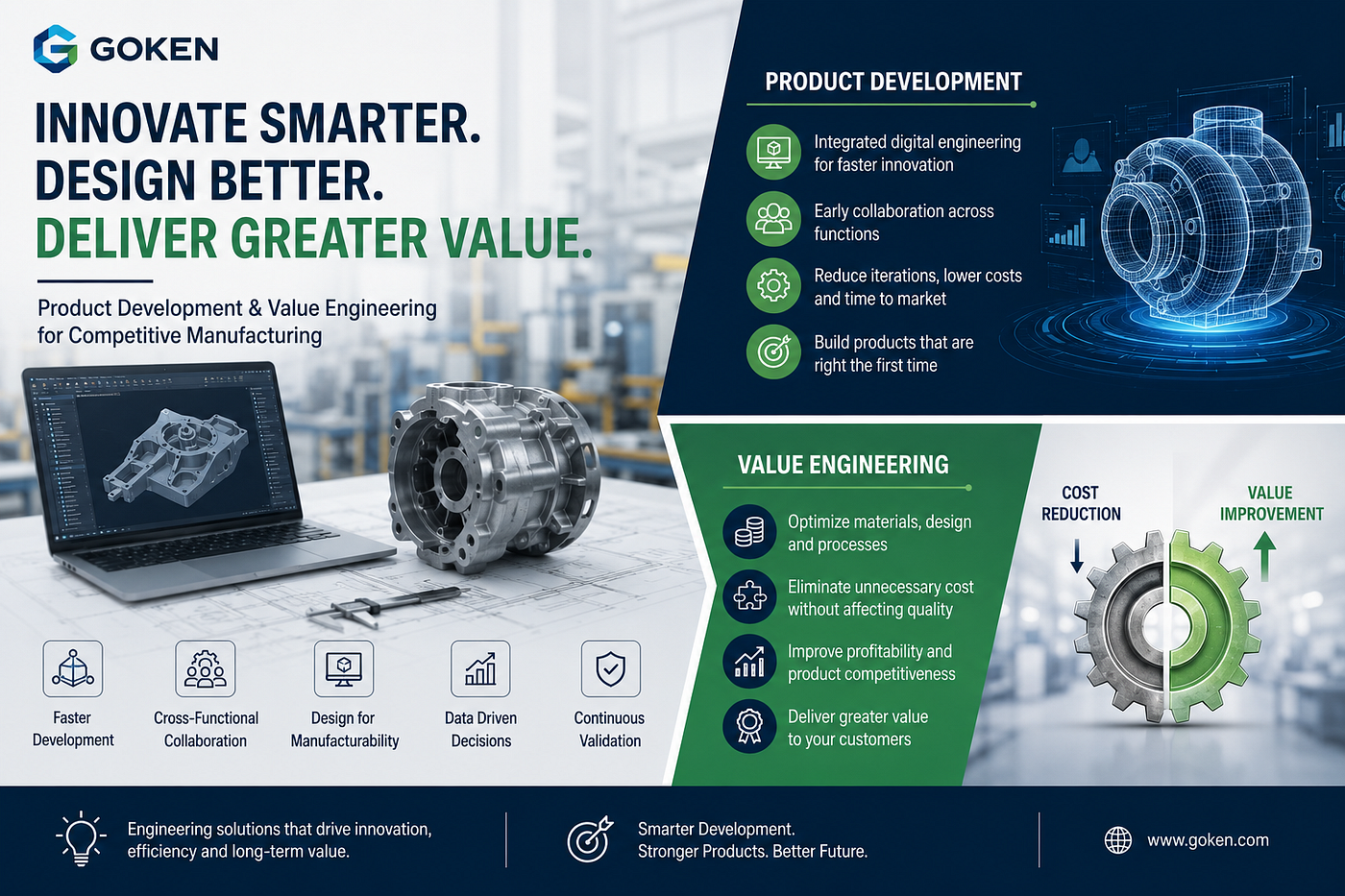
At Goken, Product Development and Value Engineering work together to help organizations accelerate innovation while improving manufacturing efficiency and long-term product value.
메타데이터
- post_id
- b6822b367cc3
- slug
- why-product-development-fails-without-value-engineering-b6822b367cc3
- url
- https://medium.com/@suroliabhagyashree/why-product-development-fails-without-value-engineering-b6822b367cc3
- canonical_url
- https://medium.com/@suroliabhagyashree/why-product-development-fails-without-value-engineering-b6822b367cc3
- author_url
- https://medium.com/@suroliabhagyashree
- status
- ok
- fetched_at
- 2026-08-25 09:42:17