Spielberg Celebration: The Emasculating Nightmare of ‘Duel’
A symbolic analysis of Spielberg’s forgotten road action thriller
Spielberg Celebration: The Emasculating Nightmare of ‘Duel’
A symbolic analysis of Spielberg’s forgotten road action thriller
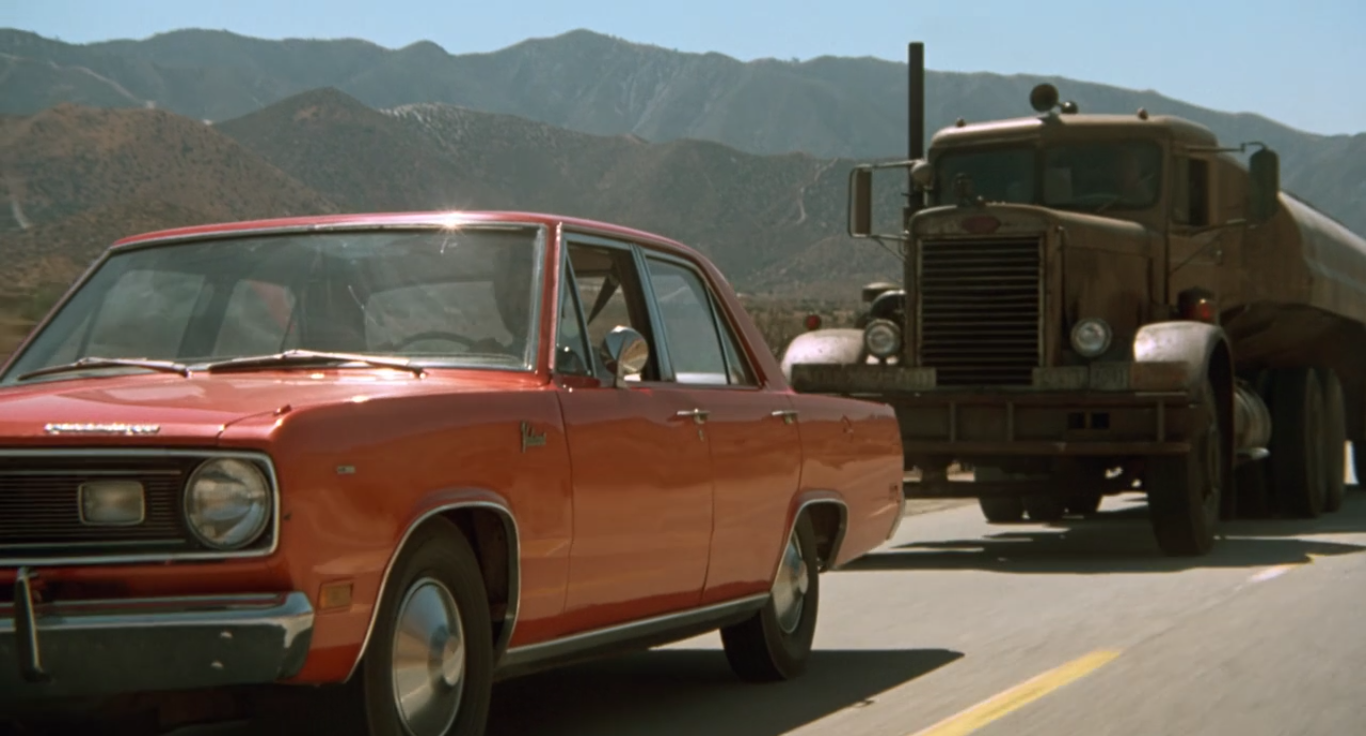
Screenshot from ‘Duel’ (1971) | Property of ABC
What if I told you that Steven Spielberg once directed a road action film that is equal parts psychological horror, Kafkaesque nightmare, and Freudian allegory?
I’m sure you would say something like, “Why, that doesn’t sound like Spielberg at all!” and it doesn’t, which is perhaps why the 1971 film Duel is such a forgotten gem in Spielberg’s filmography.
Warning: Spoiler Alert for ‘Duel’
Duel begins with a direct POV from the front of a vehicle leaving its garage in the American suburbia. The car then sets off on the highways of Southern California. Only later are we introduced to the driver: one Dave Mann (more on the name choice later), an average middle-class American and salesman. His car is a bright red 1970 Plymouth Valiant: a sign of ordinary, white-collar, lower-middle to middle-class background; not particularly luxurious, not imposing in size, but practical and understated in design. Dave himself is an unremarkable everyman, dressed in beige slacks, light blue shirt, and dark blue tie.
As Dave drives off into the Californian desert, the radio starts broadcasting a program about the government’s census; a man calls in complaining about feeling emasculated by his wife, arguing that she is the head of the family, because “the day [he] married that woman, that, unfortunately, [he’s] been married to for the last 25 years, [he] lost the position as head of the family.” The man goes on to explain that he hates working and “getting involved in the rat race,” so his wife is the one working instead. “I’m really not the head of the family,” he laments, “and yet I’m the man of the family, although there are people in the neighborhood who would question that.”
At this point, Dave runs into a bulky, old, rusted tanker truck driving at an excruciatingly low speed and spewing clouds of dark smoke into the air, more of a symbolic relic of a former era than a working vehicle. Dave overtakes the truck, and so the nightmare begins.
As Dave passes the vehicle, we hear the self-appointed man of the house on the radio admitting that he is afraid of his wife. Immediately after, Dave stops at a gas station to call his wife, but only after the gas station worker fills up his tank and says “You’re the boss,” to which Dave bitterly replies “Not in my house, I’m not.”
Dave tells his wife he wants to apologize “about last night” and says they should discuss what happened; she suggests avoiding the topic in order to avoid fighting about it. The following altercation ensues:
Dave: What’s that supposed to mean? Wife: Never mind. Dave: No, I know what it’s supposed to mean! It means that you think I should go out and call Steve Henderson up and challenge him to a fistfight or something! Wife: No, of course not. But, honey, I think you could have at least said something to the man last night. I mean, after all, he… [whispering] practically tried to rape me in front of the whole party! Dave: Oh, come on, honey! Wife: Just forget it.
This exchange informs us that Dave doesn’t just feel like “he’s not the head of the house”, much like the anonymous caller, but also that his manly honor has recently been scathed in two ways. First, another man acted in a way that was physically violating and inappropriate toward his wife. According to the traditional tenets of masculinity, this is a grave attack on any man’s manhood; just think of the European practice of duelling (!), which persisted until the 19th century, or the legal lenience with which men guilty of crimes of passion were treated in countries like Italy, where murdering one’s wife when she was caught in the act of cheating was seen as a “crime of honor” (“delitto d’onore”).
Second, in the aftermath of said incident, Dave’s wife seems to have at least suggested that Dave confront the man who tried to assault her; instead, Dave said nothing and chose to avoid any confrontation altogether. Now, Dave is trying to justify his cowardice and lack of manhood by turning his wife into the enemy: an insubordinate woman who is not only trying to “boss him around,” but also calling out his unmanly behavior.
After this exchange, Dave is back on the road. This time, he lets the truck pass, hoping that this will finally end the dispute, much like he just did with his wife, hoping that apologizing would put the matter to rest.
But it isn’t over. This time, the truck overtakes and proceeds to taunt Dave by driving slowly, blocking the road, and gesturing at Dave to pass only when a car is approaching from the opposite direction, which would have resulted in a fatal crash. This is where the story takes a much more sinister tone: the truck driver isn’t satisfied with overtaking Dave; he has to subjugate him, torment him, and, if necessary, even kill him.
Still stuck behind the mad truck, Dave chooses to drive off the road, speeding through the unpaved desert and re-emerging on the road in front of the truck. He even cheers in a triumph of victory; he did it, he finally outsmarted that truck! But the victory is only temporary, because the truck catches up to him and proceeds to aggressively tailgate him.
Next, Dave manages to seemingly escape the ordeal by speeding and then abruptly turning into a café’s parking lot, crashing into a fence in the process. The truck keeps driving off in the distance, and Dave is finally free. Or so he believes.
This is where we get to the café scene, which is arguably the most memorable in the entire film.
Just as Dave breathes a sigh of relief and tells himself that “it’s all over now,” he spots the truck parked outside the café, signaling that the driver has come back for Dave. The café owner asks Dave what happened; Dave dismisses it as a “slight complication,” to which the owner replies: “Looked like a big complication to me!” as the rest of the café bursts into mocking laughter.
Next, as the camera zooms in on a lonely, sweaty, and haunted Dave, we realize how much of an ordinary man in an extraordinary situation he is; a traveling salesman, just like Gregor Samsa was before he woke up one day and found that he was a cockroach. Dave’s life is one of unexciting routine, tedious work, and occasional bureaucratic fussiness. He is fundamentally unprepared to be cast into a dark pit of victimization, obsession, and violence. He is as lost in this new, twisted reality as Josef K. was when he was charged with a crime he did not know the nature of.
Dave suspiciously looks over at all the patrons in the café, carefully inspecting their attire, searching for the man who is the cause of his torment, but he’s never seen the man’s face, and all the patrons look back at him with accusatory stares. “He must be crazy,” Dave thinks to himself. “But what can I do about it? Find him a psychiatrist?” he ponders. In the meantime, the café’s patrons look at him as though he were crazy.
Dave’s internal monologue in this scene makes it all the more obvious that he is alone in this conundrum, as the fear and paranoia keep rising. “What if he followed me out?” he wonders, “Even if I got a lead, he’d overtake me soon enough.” He even contemplates speaking to the driver, but the thought of cornering any of the café’s patrons scares him. And if he tries to call the police, the driver could talk himself out of it and deny everything. “I’ve got no proof,” Dave realizes. The situation is too murky for him to try to do anything about it. He is trapped inside a Kafkaesque scenario, a twisted labyrinth disguised as normalcy, from which there is no escape. All he can do is wander aimlessly until tragedy strikes.
In a fit of desperation, Dave assaults a man who, as it turns out, was not the truck driver. And then, all of a sudden, he sees the big, menacing truck drive away, and… decides to run after it, for no discernible reason.
He and the driver are now bound. There can be no resolution to this.
Next is the bus sequence, which is almost Freudian to a fault.
Dave sees a school bus stuck by the side of the road; the driver asks him to help him by pushing the bus with his car. Dave fails to do so, much to the general amusement of the kids, who proceed to mock his incompetence. Dave wants to leave, but his front bumper is now caught under the bus’s rear bumper, and Dave has to ask the bus driver to rhythmically push on the car’s hood to help pull it out: a scene so patently Freudian it would have Sigmund himself blush.
And then comes the ultimate humiliation: just as Dave is about to drive off, the truck comes back and successfully pushes the school bus back on the road; the kids on the bus cheer and salute the truck driver like a hero, while the bus driver dismisses Dave’s claims that the truck driver is a dangerous lunatic by accusing Dave himself of being a lunatic.
In proper Kafkaesque fashion, Dave has now been belittled, humiliated, defeated, and made to feel like he’s the culprit and the madman in this absurd series of events.
As stated before, there can be no resolution to the obsessive feud between Dave and the truck driver. But what are the two men fighting about, anyway?
The beef between Dave and the truck driver seems to stem from nothing more than a bickering over who is allowed to pass the other. When one is overtaken, he reacts with indignation and a wounded sense of entitlement. The truck driver shall not be passed by Dave. And Dave shall not be passed by the truck driver. Each one keeps waiting for the other to yield and symbolically accept defeat. But neither wants to do that, because to do so would be to accept a blow to their fragile sense of masculinity. And even when Dave seems to accept defeat by yielding the road, the truck driver is not satisfied, because accepting the chance of overtaking, which is freely given to him by Dave, is not the same as proving his superiority by overtaking against Dave’s will. And so the feud continues.
The two drivers are not simply having a road argument; they are living a dilemma about symbolic masculine prowess.
It is not by chance that Dave and the truck driver embody two completely different types of masculinity. Dave is white-collar masculinity, an example of the modern, middle-class American man. He is dressed in respectable, professional attire: shirt, tie, slacks, and leather loafers.
In contrast, the truck driver, although unseen, is clearly an example of blue-collar masculinity: he has a modest, old-fashioned, manual job; he is presumably big and intimidating, much like his vehicle, and there is something quite archaic about his presence. We see him wearing blue jeans and cowboy boots: a traditional staple of American maleness, synonymous with the Wild West. His vehicle is old, large, heavy, and dark. And there is something deeply archetypal and uncanny about his faceless presence, something more akin to myth and childhood horror than a trivial, real-life confrontation.
And yes, the choice of Dave’s last name, Mann, is not incidental, either. Spielberg is dissecting myths of American masculinity, showing us how traditional constructs of masculinity and manhood are equally faulty and dangerous. At the same time, he is throwing the viewer into a Kafkaesque nightmare driven by fear of emasculation, with everyone around Dave, including his wife, the man who assaulted her, the truck driver, the men at the café, and even a group of school kids, not only seeing but mercilessly exposing his presumed lack of manliness.
Unsurprisingly, the duel between the two men ultimately leads to mutual destruction; physical for the truck driver, and existential for Dave, who, instead of returning to his life, ends up sitting on the edge of a cliff as the sun sets, staring at the wreckage of his invisible enemy, throwing stones at the carcass of the demon truck, perhaps wondering if it was all worth it. Is there really any such thing as victory in mutual annihilation?
메타데이터
- post_id
- b6861441ec9a
- slug
- spielberg-celebration-the-emasculating-nightmare-of-duel-b6861441ec9a
- url
- https://fanfare.pub/spielberg-celebration-the-emasculating-nightmare-of-duel-b6861441ec9a
- canonical_url
- https://fanfare.pub/spielberg-celebration-the-emasculating-nightmare-of-duel-b6861441ec9a
- author_url
- https://medium.com/@martinep1296
- status
- ok
- fetched_at
- 2026-06-22 12:55:45