System Design Building Blocks: The Redis Sorted Set
When you’re architecting a system and realize you need what is essentially a “distributed heap,” your first thought should probably be the…
System Design Building Blocks: The Redis Sorted Set
When you’re architecting a system and realize you need what is essentially a “distributed heap,” your first thought should probably be the Redis Sorted Set. It’s a bit of a hybrid powerhouse — designed to give you the lightning-fast lookup of a Hash Map while keeping everything perfectly ordered for those “Top K” queries. Let’s dive into how it actually works under the hood and why it’s such a perfect fit for high-scale designs.
🔥 Top Tech Jobs Are Hiring NOW — Don’t Miss Out. 👉 Apply & Secure Your Job

What is a Sorted Set?
If you’re coming from the Java ecosystem, you might be familiar with SortedSet. Typically, those are backed by a TreeSet (Red-Black Tree) or a ConcurrentSkipListSet. Both provide that nice O(log N) performance for lookups and inserts.
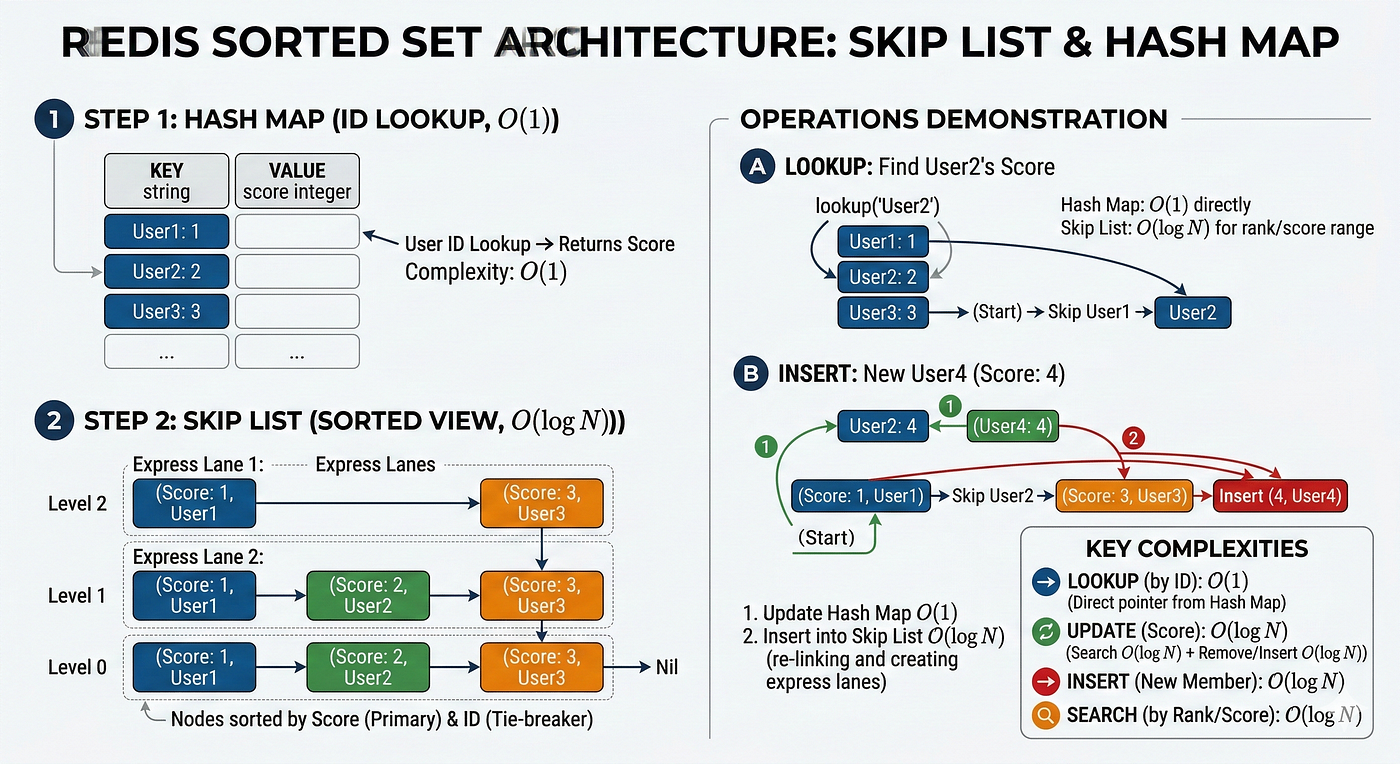
Redis takes a slightly different, more pragmatic approach. Instead of a single data structure, it builds the Redis Sorted Set (or ZSET) by essentially “marrying” two data structures together:
- A Hash Map: This maps the member (e.g.,
user_id1) to its score. This gives us O(1) lookup time. Need to know a user's score in an instant? The Hash Map handles it. - A Skip List: This keeps the members sorted by score. This provides the O(log N) performance for insertion, updates, and deletes. It’s also what makes finding “Top K” ranges so fast (O(log N + K)).
By combining them, Redis gives you the best of both worlds: the speed of a hash table for single-item lookups and the sorted utility of a Skip List for rankings.
A Quick Example: The Leaderboard
Imagine you’re building a game and need to track scores for three players to find the top two performers:
**user_id1**: Score 100**user_id2**: Score 200**user_id3**: Score 300
In Redis, you’d set this up with a few simple commands:
ZADD user_score 100 "user_id1"
ZADD user_score 200 "user_id2"
ZADD user_score 300 "user_id3"
Under the hood, if you want to check a player’s score instantly, you’d use ZSCORE user_score user_id1. Because of that Hash Map we mentioned, Redis returns the result in O(1).
When it’s time to find the top two players, you run:
ZREVRANGE user_score 0 1This hits the Skip List. One of the most interesting parts of this design is how it handles ties. Even if all three players had a score of 100, the Skip List wouldn’t slow down to a crawl. Redis uses the Member Name (the user_id) as a tie-breaker, sorting them alphabetically to ensure the complexity stays at O(log N).
The Sliding Window Rate Limiter
If you’ve ever had to protect an API from being overwhelmed, you’ve probably looked into rate limiting. Most people start with a “Fixed Window” — for example, you get 100 requests every hour, and the counter resets at the top of the hour.
But there’s a flaw: a user could spam 100 requests at 10:59 and another 100 at 11:01. That’s 200 requests in two minutes! Not exactly what we wanted.
This is where the Sliding Window comes in, and it’s where the Redis Sorted Set truly shines. Instead of a clunky reset, it looks at the exact 60 seconds leading up to right now.
How it works
Think of the Sorted Set as a notebook where you jot down the exact time of every request a user makes.
- Clear the Old Pages: Every time a new request comes in, you quickly flip through the notebook and rip out any pages older than 60 seconds. In Redis, this is a single command:
ZREMRANGEBYSCORE. - Jot Down the New Request: You write down the current time (the timestamp) in the notebook. That’s your
ZADD. - Count the Rows: You count how many entries are left. If there are 100 or fewer, they’re good to go. If it’s 101, you tell them to slow down. That’s your
ZCARD.
Why this is so elegant
Because the Sorted Set is backed by that Skip List, Redis doesn’t have to “search” for the old entries — it knows exactly where they are because they’re already at the front of the line. It snips them off in $O(\log N)$ time and gives you an answer instantly.
It’s efficient, it’s fair to the user, and it’s incredibly satisfying to implement.
Why should you reach for a Redis Sorted Set?
When you’re deep in a system design session, it’s easy to default to a standard relational database or a simple cache for everything. But the Sorted Set is that rare “Swiss Army Knife” that solves three or four different architectural headaches with one single structure.
Here’s why it should be a top-tier choice in your design toolbox:
1. It’s a “Set and Forget” Leaderboard
We’ve all seen the leaderboard use case, but the real beauty is that the sorting happens on write. You aren’t running heavy ORDER BY queries on a massive SQL table every time a user hits your homepage. The work is already done. By the time you need the "Top 10," Redis just hands them over.
2. It’s the Perfect Distributed Scheduler
This is where it gets really interesting for backend engineers. If you need to run a “cleanup” job or a delayed task — like deleting a temporary file after an hour or sending a follow-up email — you can use the score as a timestamp. Your workers just poll the set for anything “due” right now. It’s a robust, distributed way to handle time-based logic without the complexity of a full-blown message broker.
3. It Scales Where Standard Lists Fail
Unlike a standard Redis List (which is great for simple stacks or queues), the Sorted Set doesn’t care if you have 100 items or 10 million. Because of that Skip List under the hood, your performance stays flat. Whether you’re building a sliding-window rate limiter or a trending product feed, you get the same lightning-fast response every time.
Final Thoughts
At the end of the day, a Redis Sorted Set is more than just a list — it’s a Distributed Heap.
It’s the bridge between a fast lookup and a fast sort. Whether you’re coming from a Java background and missing your TreeSet, or you're building a high-throughput event pipeline from scratch, keep this structure in mind. It might just save you from over-engineering a much more complex solution.
메타데이터
- post_id
- b696c73be779
- slug
- system-design-building-blocks-the-redis-sorted-set-b696c73be779
- url
- https://medium.com/@sinha.k/system-design-building-blocks-the-redis-sorted-set-b696c73be779
- canonical_url
- https://medium.com/@sinha.k/system-design-building-blocks-the-redis-sorted-set-b696c73be779
- author_url
- https://medium.com/@sinha.k
- status
- ok
- fetched_at
- 2026-06-15 22:55:51