Sublimation: The Fire That Writes
How raw feeling becomes narrative meaning
ESSAY
Sublimation: The Fire That Writes
How raw feeling becomes narrative meaning
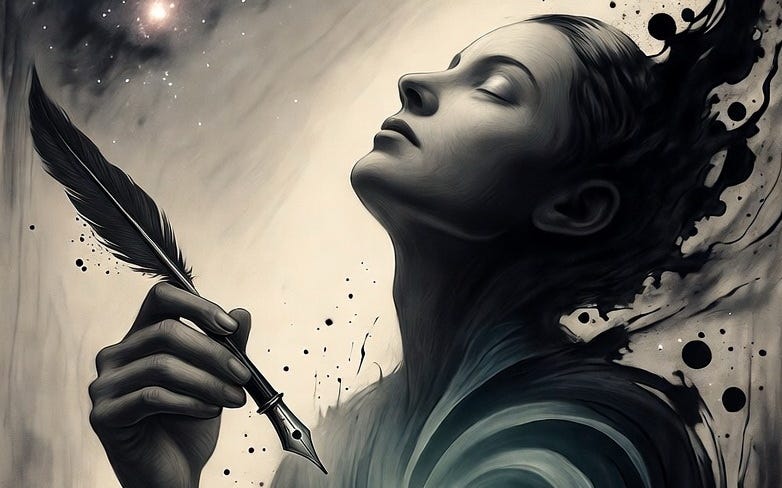
Created by the author using AI
One autumn afternoon a student told me she was “too angry to write.” I asked her to sit with the feeling, not to pour it onto the page but to notice what it does to the room: the way a hand holds a glass without drinking, the way a chair remains slightly pulled back, the way a window stays open in cold weather. Two days later she brought a story about a girl who moves half a step forward in a bread line — no speech, no slogans, just the quiet re-drawing of a boundary. That is what I mean by sublimation.
What we mean — without jargon
Sublimation is the redirection of intense, unruly, or painful energies into a form that can carry meaning and care. In fiction it looks like this: anger becomes a gesture rather than an outburst; shame becomes a silence that bends the scene; desire becomes an economy of distance and touch. The material is still fire; only the language and vessel change.
Why it matters
**1) **It gives energy without spectacle. Sublimation keeps the pulse high while protecting the dignity of characters and readers. The current is there, but it moves through image, action, and rhythm instead of noise.
**2) **It clarifies experience. Instead of naming emotions, the prose shows effects — light, weight, texture, timing — so the reader can feel rather than be told.
**3) **It is an ethics of looking. Stories can stage violence without turning it into entertainment. Sublimation refuses to feed on pain; it asks us to understand it.
**4) **It sustains the writer. Working from grief, rage, or longing won’t hollow you out if the page becomes a vessel. Form contains what would otherwise spill.
How it appears on the page (recognition, not instruction)
Subsurface heat. The piece feels warm though nobody shouts.
Action carries the charge. A choice — approach, retreat, say, don’t say — does the work emotions would normally explain.
A bearer image. One concrete thing holds the weight: a glass gripped too long, a lamp left on, a door that will not fully close.
Rhythm as breathing. Short/long, break/flow — the sentence pattern matches the felt state.
Sublimation is not the denial of feeling; it’s the form feeling takes when it learns to speak.
A small world sampler
· Virginia Woolf, To the Lighthouse. Grief and absence are transposed into the sea’s rhythm and the lighthouse’s steady blink. The book is full of weather that behaves like memory.
· Toni Morrison, Beloved. Trauma becomes the unforgettable image of the “tree” scarred into Sethe’s back; pain is made visible without being consumed.
· Franz Kafka, The Metamorphosis. Alienation is radicalized into a body; the world is rewritten to match the feeling rather than the other way around.
· Marcel Proust, In Search of Lost Time. Longing is architected into time itself; memory takes on grammar, breath, and architecture.
· Albert Camus, The Stranger. Numbness translates into flat diction and inexplicable action; the form itself feels estranged.
What it is not
Not suppression. Suppression deadens; sublimation gives shape. Not mere catharsis. Venting dissipates; sublimation builds. Not decoration. It isn’t fancy language laid over pain; it is structure grown from pain.
Sublimation isn’t about silencing emotions; it’s about transforming them into meaningful form.
Putting it together
Sublimation lets us keep faith with our fiercest feelings without making a spectacle of them. The page does not erase the fire; it re-forms it into image, action, and cadence. That is how stories carry heat without burning their world.
Share a scene — any book, any era — where feeling turned into form and stayed with you.
메타데이터
- post_id
- b69c0bf01e84
- slug
- sublimation-the-fire-that-writes-b69c0bf01e84
- url
- https://medium.com/@darius.ahmadi/sublimation-the-fire-that-writes-b69c0bf01e84
- canonical_url
- https://medium.com/@darius.ahmadi/sublimation-the-fire-that-writes-b69c0bf01e84
- author_url
- https://medium.com/@darius.ahmadi
- status
- ok
- fetched_at
- 2026-07-15 12:19:42