Deadly Orange Clouds at Ports: What the Bandar Abbas Explosion Reveals About Chemical Safety…
The Bandar Abbas port explosion exposes critical failures in chemical safety, hazardous materials storage, and CBRNE risk management at…
Deadly Orange Clouds at Ports: What the Bandar Abbas Explosion Reveals About Chemical Safety, Hazardous Materials, and CBRNE Risks
The Bandar Abbas port explosion exposes critical failures in chemical safety, hazardous materials storage, and CBRNE risk management at major ports.
Deadly Orange Clouds at Ports: A Chemical Safety Wake-Up Call
On 26 April 2025, a massive explosion struck Bandar Abbas, Iran’s most important port city, at Shahid Rajaee Port. At least 30 people were killed and more than 700 injured. As I watched the footage emerge, one image immediately stood out to me as a chemical safety professional. A dense orange cloud rising above a port.
That image instantly brought back memories of the 2020 Beirut port explosion. Once again, hazardous materials stored in a port environment had turned into a deadly force.
I am Nuwan Tharaka Weerasinghe, a chemical safety consultant and CBRNE advisor, and through my work at HAZMAT Advisor I regularly analyze incidents involving hazardous materials, dangerous goods, and large-scale industrial explosions. From a chemical safety and HAZMAT perspective, the warning signs at Bandar Abbas were visible from the very first seconds of available footage.
Initial Reports and the Chemical Question
Initial reports suggested that the explosion was linked to a shipment of sodium perchlorate imported from China and stored in the port’s hazardous materials area. Authorities pointed to poor handling and storage conditions as the main cause.
As someone who works daily with chemical safety, oxidizers, and dangerous goods classification, I found this explanation incomplete. Sodium perchlorate is a strong oxidizer, but it is generally stable under normal conditions. More importantly, it does not release nitrogen oxides when it burns or decomposes.
That single fact immediately raised questions for me.
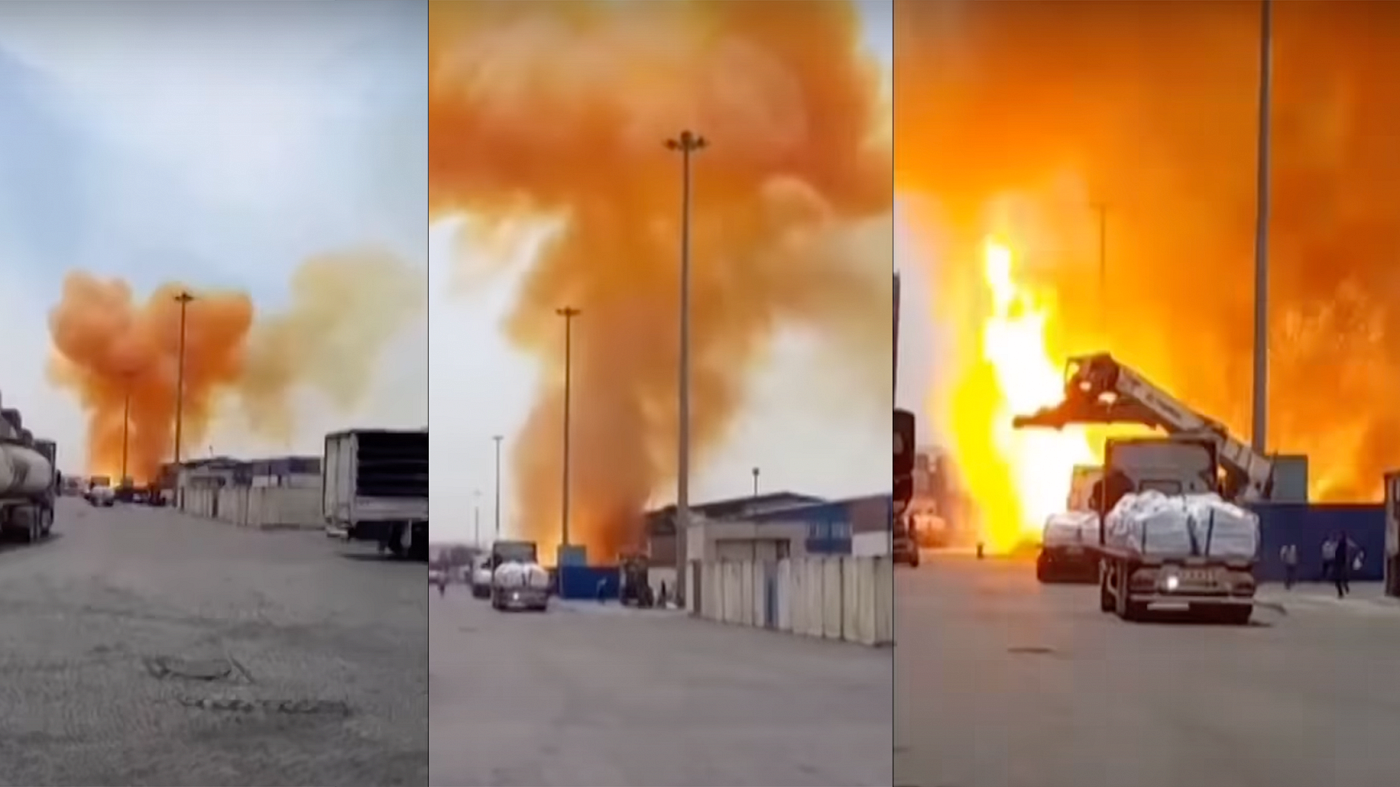
A fire accompanied by orange smoke quickly escalated, with the smoke rising and the flames turning bright yellow before the explosion occurred.
What the Orange-Brown Smoke Indicates
When I examined the available videos, the sequence was clear. The incident began with a rapidly expanding orange-brown cloud, followed by intense flames and then a massive explosion.
In hazardous materials incident analysis, this color is strongly associated with nitrogen oxides. These gases are typically produced when nitrogen-containing compounds decompose under heat or mechanical shock.
Examples include ammonium nitrate and ammonium perchlorate. Both substances are well known within dangerous goods regulations and CBRNE risk frameworks. Sodium perchlorate, by contrast, does not contain nitrogen and does not generate nitrogen oxides.
This leads to an uncomfortable but necessary technical question. Was sodium perchlorate truly involved, or was a different and more sensitive oxidizer present at the site?
Dual-Use Chemicals and Chemical Security Concerns
Ammonium perchlorate is not an ordinary industrial chemical. It is a tightly controlled dual-use substance used in solid rocket propellants for missiles and space launch systems. Because of this, its international movement is subject to strict export controls.
From a chemical security and nonproliferation perspective, this matters. Sodium perchlorate faces fewer restrictions and is commonly traded for civilian applications. If ammonium perchlorate was misdeclared or concealed within a legitimate shipment, it would point to a serious breach in chemical security controls.
In my work as a CBRNE advisor at HAZMAT Advisor, I often highlight how weaknesses in chemical supply chains, documentation, and inspections can allow high-risk materials to move undetected. If this scenario proves true, the incident would represent not only a chemical safety failure but also a significant chemical security incident.
Why Oxidizers Do Not Normally Explode
Another point that needs to be clearly stated is this. Strong oxidizers such as sodium perchlorate and ammonium perchlorate do not explode on their own. Even ammonium nitrate requires specific conditions to produce a catastrophic blast.
For an explosion of this scale, multiple failures usually occur at the same time. These include sustained heat from an uncontrolled fire, contamination with incompatible materials, confinement, or poor ventilation. Improper co-storage with flammable liquids or gases is often the decisive factor.
Reports from Bandar Abbas suggest that oxidizers, flammable substances, and possibly pressurized gases were stored together without adequate separation. This is a fundamental violation of hazardous materials storage principles and a pattern I have seen repeatedly in major industrial disasters.
In a fire scenario, oxidizers dramatically intensify combustion, accelerate flame spread, and trigger violent secondary explosions, even when the chemicals themselves are not classified as explosives.

The image of the Beirut explosion shows a similar sequence, starting with orange and brown smoke, followed by an explosion and a massive shockwave.
Beirut and Bandar Abbas: A Repeating Pattern
The similarities between Bandar Abbas and Beirut are difficult to ignore. In both cases, the sequence followed a deadly and familiar path.
- Fire accompanied by abnormal smoke development
- Rapid escalation driven by oxidizer and fuel interaction
- A massive explosion with widespread casualties and destruction
These are not random accidents. They are the predictable outcome of poor hazardous materials segregation, weak chemical safety management systems, and inadequate emergency preparedness at high-risk facilities such as ports.
At HAZMAT Advisor, I study such incidents not only as safety failures but also as indicators of broader CBRNE vulnerabilities within ports, warehouses, and national logistics hubs.
Chemical Safety and Chemical Security Are Linked
One of the clearest lessons from the Bandar Abbas explosion is that chemical safety and chemical security are inseparable. Poor storage practices may begin as a workplace safety issue, but when dual-use chemicals are involved, the consequences quickly extend into national security and geopolitical domains.
In many countries, including Sri Lanka where I have observed similar risks, hazardous materials continue to be stored without proper risk assessments, compatibility studies, or enforceable segregation standards.
As a chemical safety and dangerous goods specialist, my experience shows that real control goes beyond written procedures. It requires practical systems that account for human behavior, emergency conditions, and worst-case scenarios.
An Uncomfortable but Necessary Question
The image of another orange cloud rising over a port city should concern every safety manager, regulator, and logistics professional. These disasters are not unpredictable. The hazards are well understood, and the controls are well documented.
As a chemical safety, hazardous materials, and CBRNE consultant, I work through HAZMAT Advisor to support organizations with chemical safety consulting services, dangerous goods compliance, hazardous materials risk assessments, emergency response planning, and training.
The final question remains painfully simple. How many more deadly orange clouds must we witness before chemical safety, hazardous materials management, and CBRNE risk preparedness are treated as absolute priorities?
메타데이터
- post_id
- b6a0b749f481
- slug
- deadly-orange-clouds-at-ports-what-the-bandar-abbas-explosion-reveals-about-chemical-safety-b6a0b749f481
- url
- https://medium.com/@nuwantharakaweerasinghe/deadly-orange-clouds-at-ports-what-the-bandar-abbas-explosion-reveals-about-chemical-safety-b6a0b749f481
- canonical_url
- https://medium.com/@nuwantharakaweerasinghe/deadly-orange-clouds-at-ports-what-the-bandar-abbas-explosion-reveals-about-chemical-safety-b6a0b749f481
- author_url
- https://medium.com/@nuwantharakaweerasinghe
- status
- ok
- fetched_at
- 2026-07-13 06:23:13




