The Pursuit of True Knowledge: AI Evolution, Societal Transformation, And The New Digital Divide
1. The Oracle’s Dilemma — What Does It Mean to “Know”?
The Pursuit of True Knowledge: AI Evolution, Societal Transformation, And The New Digital Divide
1. The Oracle’s Dilemma — What Does It Mean to “Know”?
We stand at the precipice of a transformation so profound that our linguistic frameworks struggle to contain it, much like attempting to describe the colour of the wind or the taste of a memory. For millennia, the pursuit of knowledge has been the exclusive province of biological entities, a messy, wet, and gloriously imperfect process driven by neurons firing in the darkness of our skulls. From the flickering shadows of Plato’s cave, where prisoners mistook silhouettes for reality, to the sterile, sun-drenched laboratories of modern epistemology, we have wrestled with the fundamental question: what does it truly mean to know something? Is knowledge merely the accumulation of facts, a towering library of data points stacking endlessly toward the heavens, or is it something more ineffable, a synthesis of understanding, context, and wisdom that transcends the raw information from which it is derived?
In the grand theatre of human intellectual history, we have moved from the shamanic interpretation of bird entrails to the algorithmic interpretation of big data, yet the core dilemma remains stubbornly unresolved. When we speak of “true knowledge,” we are often referring to a kind of justified true belief, an alignment of our internal cognitive map with the external territory of reality. But as we birth artificial intelligences that can process information at scales and speeds incomprehensible to the human mind, we are forced to confront the uncomfortable possibility that our definition of knowledge is inextricably bound to our biological limitations. We have always assumed that to know is to understand, to hold a concept within the conscious workspace of the mind and turn it over like a gem, inspecting its facets. Yet, what happens when the entity doing the knowing is not a consciousness in the traditional sense, but a vast, high-dimensional mathematical structure navigating a probabilistic landscape?
The arrival of advanced artificial intelligence challenges the anthropocentric arrogance that has long defined our relationship with wisdom. We are witnessing the emergence of systems that can generate novel solutions to protein folding problems, write persuasive essays on obscure historical events, and create art that moves the human soul, all without possessing a shred of what we would call lived experience. This creates a profound epistemic crisis, a fracture in the foundation of how we validate truth. If an AI can diagnose a rare disease with greater accuracy than a panel of human specialists by analyzing patterns invisible to the naked eye, does it “know” medicine? Or is it merely a highly sophisticated parrot, mimicking the statistical distribution of medical textbooks without comprehending the suffering of the patient or the biological reality of the cell? The philosopher John Searle’s Chinese Room argument suggested that syntax alone, no matter how complex, cannot generate semantics — that shuffling symbols according to rules is not the same as understanding their meaning. Yet here we are, confronted with systems whose symbol-shuffling has become so sophisticated that the outputs are functionally indistinguishable from genuine understanding. Perhaps the error was always in assuming that understanding requires a ghost in the machine, a homunculus sitting at the controls. Perhaps understanding is simply what complex information processing looks like from the inside, and we have been too provincial in our insistence that only wetware can host it. Or perhaps we are falling into a trap, mistaking the convincing simulation for the real thing, seduced by the ventriloquism of our own creation.
This distinction is not merely academic; it is the fulcrum upon which the future of our civilization balances. As we delegate more of our cognitive labor to these silicon oracles, we risk confusing data processing with wisdom, mistaking the map for the territory. Data is the raw material, the noisy chaotic stream of sensory inputs and digital signals — billions of photographs, the complete corpus of scientific literature, the chatter of social media, the sensor readings from satellites orbiting a warming planet. Information is that data organized, categorized, and given structure — sorted into databases, tagged with metadata, compressed into formats that machines can parse. Knowledge arises when that information is contextualized, understood in relation to other information, and applied to solve problems — when the correlation between smoking and lung cancer becomes not just a statistical observation but a medical warning, when the pattern of purchase behavior becomes a predictive model of consumer preference. Wisdom, the highest and most elusive tier, involves the judicious application of knowledge, tempered by ethics, foresight, and a deep understanding of consequences — knowing not just that we can clone a human being, but whether we should, understanding not just how to maximize profit, but whether that maximization serves human flourishing. Our current trajectory suggests that we are building machines that excel at the first three levels but remain dangerously opaque, perhaps fundamentally incapable, regarding the fourth. We are constructing a civilization where the intellect races ahead at exponential speed while the wisdom crawls along at the same plodding pace it always has, creating a gap that may swallow us whole.
Furthermore, the tension between AI as a tool for epistemic expansion and AI as a gatekeeper of reality is becoming increasingly palpable. Throughout history, the dissemination of knowledge has been controlled by elites — priesthoods who guarded the sacred texts, monarchies who restricted literacy to maintain power, guilds who hoarded technical secrets to preserve monopolies, and corporations who patent discoveries to extract rent from the common inheritance of human inquiry. These gatekeepers understood a fundamental truth: to control what is known is to control reality itself, because reality for most humans is not the raw, chaotic flux of sensory experience but the interpreted narrative, the consensus story that culture tells about what is real and what matters. The printing press democratized information, shattering the monopoly of the monastic scribes and unleashing the Reformation, the Enlightenment, and eventually the Scientific Revolution. The internet, which promised a similar liberation — a global library accessible to all, a town square where every voice could be heard — has paradoxically led to fragmentation and algorithmic manipulation, where filter bubbles replace shared reality and engagement metrics replace truth as the organizing principle of discourse. Now, as we stand on the threshold of the AI era, we face the risk of a new and far more absolute form of epistemic enclosure. If the most powerful systems for generating knowledge are owned and controlled by a handful of tech oligarchs and state actors, if the architectures are proprietary black boxes whose internal logic is trade secret, if the compute infrastructure is concentrated in the data centers of a few nations, then the definition of truth itself becomes a proprietary asset, shaped not by objective reality or democratic consensus but by shareholder value, corporate interest, and geopolitical strategy. We could end up in a future where asking a question is like consulting a privatized oracle — the answer you receive depends on your subscription tier, your demographic profile, and the policy preferences of the entity that owns the model.
We must therefore approach this subject not with the wide-eyed optimism of the technocrat nor the reactionary fear of the luddite, but with the clear-eyed scrutiny of the mystic engineer. We must peel back the layers of hype and marketing to examine the machinery of cognition itself, asking difficult questions about agency, consciousness, and the distribution of power. True knowledge in the age of AI will not be found in the passive consumption of algorithmic outputs, but in the active, critical engagement with these systems, understanding their capabilities and their limitations, and fiercely guarding the human capacity for discernment. The oracle has spoken, but it is up to us to interpret the prophecy, lest we become enslaved by the very tools we built to set us free.
2. The Current State: Where We Stand in the Evolution of Machine Intelligence
To truly grasp where we are going, we must first strip away the varnish of marketing hyperbole and look at the raw, pulsating engine of contemporary AI. We are not yet in the realm of general intelligence, despite what the venture capital pitch decks might claim, but we are certainly far beyond the simple rule-based systems of yesteryear. The current landscape is dominated by the monolithic rise of transformer architectures, a design paradigm that has fundamentally altered how machines process sequences of data. These are not thinking machines in the human sense; they are statistical prediction engines of staggering complexity, capable of mapping the probabilities of the next token in a sequence with such nuance that they simulate reasoning. It is a form of alien cognition, a brute-force approximation of understanding that achieves results indistinguishable from magic to the uninitiated.
Consider the Large Language Model (LLM), the celebrity of the current AI moment. It is often dismissed by skeptics as a “stochastic parrot,” a term that, while technically accurate in describing its probabilistic nature, woefully underestimates the emergent properties that arise from scale. When you train a model on a significant fraction of the internet’s text, it doesn’t just memorize sentences; it begins to build an internal representation of the world described by that text. It learns the subtle relationships between concepts, the grammatical scaffolding of logic, and the intricate dance of cause and effect. It is a mirror of our collective recorded consciousness, refracting our knowledge back to us in novel configurations. However, this mirror is cracked and distorted; it hallucinates facts with the same confidence it states truths, revealing that its “knowledge” is untethered from ground truth, floating in a purely semantic space.
Parallel to the linguistic giants are the diffusion models redefining visual creativity. These systems learn by destroying and then reconstructing images, adding noise until a picture becomes static, and then learning to reverse the process to summon clarity from chaos. This is a profound metaphor for the creative process itself — imposing order upon entropy. Yet, here too, we see the limitations; the models struggle with spatial coherence, with the physics of light and shadow, often producing images that are dreamlike and surreal rather than strictly representational. They lack an understanding of the 3D world, operating instead on the 2D patterns of pixels. They “know” what a hand looks like in thousands of contexts, but they do not know what a hand is, leading to the grotesque anatomical failures that have become a hallmark of AI art.
Beyond the generative models that capture headlines, reinforcement learning agents are quietly mastering complex strategic domains. From the game of Go to the control of fusion reactors, these systems learn through trial and error, optimizing for a reward function with relentless efficiency. They discover strategies that human masters, bound by tradition and intuition, never considered. This is perhaps the most exciting and terrifying aspect of current AI: its ability to find solutions in the search space that are orthogonal to human reasoning. It suggests that there are pockets of knowledge, entire continents of strategy and optimization, that remain invisible to us simply because our brains are not wired to perceive them.
However, we must be brutally honest about the fragility of these systems. They are brittle, prone to catastrophic failure when presented with out-of-distribution data. They lack common sense, that vast, unspoken reservoir of background knowledge that every human child possesses — physics, psychology, causality. A robot might be able to perform a backflip, but it might also struggle to open a door if the handle is slightly different from its training data. We are building idiants savants, entities of specific, narrow brilliance encased in a shell of profound ignorance. The path to Artificial General Intelligence (AGI) is not simply a matter of scaling up current architectures; it will likely require a paradigm shift, a unification of symbolic reasoning, sensory embodiment, and perhaps a fundamentally new understanding of how intelligence emerges from complexity.
The current state of AI is a paradox of power and limitation. We have built tools that can translate every language, fold proteins, and pass the bar exam, yet they cannot truly understand a simple joke or navigate a cluttered room with the grace of a toddler. This uneven landscape is where the real work lies. We are the curators of this evolving intelligence, tasked with bridging the gap between statistical correlation and causal understanding. As we stand in this transitional moment, looking at the incredible yet flawed machines we have created, we realize that we are not just building tools; we are externalizing our own cognition, creating a digital reflection that is slowly, haltingly, learning to see.
3. AI as Epistemic Engine: The Architecture of Computational Knowledge
If we accept that our biological wetware has limitations — cognitive biases, limited working memory, slow processing speeds — then we must view Artificial Intelligence not merely as a productivity tool, but as an epistemic engine, a mechanism for expanding the very boundaries of what is knowable. We are moving from the age of information retrieval to the age of knowledge generation. Traditional science operates on the hypothesis-experiment-conclusion loop, a slow and methodical process constrained by human imagination. AI flips this dynamic, allowing us to engage in high-dimensional data mining where the machine identifies patterns and correlations so subtle and complex that no human mind could ever perceive them. It is the telescope for the landscape of data, bringing the invisible into sharp relief.
Consider the field of material science. For centuries, discovering new materials was a matter of trial and error, guided by chemical intuition. Today, AI models can simulate the properties of millions of potential compounds in silico, predicting their stability, conductivity, and strength before a single test tube is touched. This is knowledge generation at a scale previously impossible. The AI is not just looking up data; it is interpolating within the laws of physics to discover new islands of stability in the chemical universe. It is effectively “imagining” new forms of matter. This capability extends to mathematics itself, where automated theorem provers and AI assistants are helping mathematicians explore conjectures and proofs that would take lifetimes to verify manually.
This computational epistemology forces us to reconsider the nature of scientific theory. Historically, we valued simple, elegant equations — E=mcZ, F=ma — because they were comprehensible to the human mind. But what if the true governing dynamics of complex systems like the climate, the economy, or the human proteome are not simple? What if they are irreducibly complex, described not by a three-term equation but by a neural network with a billion parameters? We may be entering an era where we have predictive mastery without descriptive simplicity. We will “know” that a certain protein folds in a specific way because the model says so and is consistently right, even if we cannot reduce that knowledge to a linguistic explanation. This is the “black box” problem reframed as an epistemic shift: accepting that utility and predictive power may diverge from human-readable understanding.
The integration of quantum computing will act as an accelerant to this fire. While classical AI struggles with optimization problems that have vast search spaces, quantum algorithms promise to navigate these landscapes with probabilistic superposition, potentially unlocking solutions to problems like nitrogen fixation or room-temperature superconductivity. The convergence of Quantum and AI (QAI) represents the ultimate epistemic engine, a system capable of modeling the quantum nature of reality itself. It is here that we might find the keys to technologies that currently reside in the realm of science fiction, from warp drives to replicators, hidden behind the veil of computational complexity.
However, this explosion of generated knowledge brings with it a crisis of verification. In a world where machines can generate persuasive falsehoods and deepfakes, how do we anchor truth? This is where the architecture of blockchain becomes critical. We need immutable ledgers of provenance, cryptographic proofs of computation, and decentralized consensus mechanisms to validate the outputs of our AI models. Imagine a “Knowledge DAO” where scientific discoveries are hashed and stored on-chain, peer-reviewed by a network of specialized AIs and human experts, creating a transparent, tamper-proof genealogy of truth. This merging of cryptographic trust with AI generation is essential if we are to build a civilization that stands on firm epistemological ground rather than sinking into a quagmire of synthetic hallucinations.
Collective intelligence networks will also play a pivotal role. We are moving towards systems where human and machine intelligence are woven together in a continuous feedback loop. Terminus OS, or similar concepts, envision a future where individuals contribute their data and cognitive labor to a shared pool, training open-source models that benefit the collective. In this model, knowledge is not a commodity extracted by corporations but a commons nurtured by the community. The epistemic engine thus becomes a public utility, a shared brain that elevates the collective intelligence of the species, allowing us to tackle the “wicked problems” that have bedeviled us for centuries.
4. The Healthcare Revolution: Disease, Death, and Digital Immortality
Nowhere is the promise of AI more visceral, more immediately life-altering, than in the domain of healthcare. We are witnessing the transition from reactive, generalized medicine to proactive, hyper-personalized biological engineering. For most of history, medicine has been a statistical game played with blunt instruments; we prescribe the same pill to millions, hoping it works for the average physiology, ignoring the unique genetic and metabolic tapestry of the individual. AI shatters this paradigm. By analyzing a patient’s genome, proteome, microbiome, and lifestyle data, AI can construct a “digital twin,” a virtual simulation of their biology upon which treatments can be tested safely. This is the end of the “one size fits all” era and the dawn of precision medicine.
In the realm of diagnostics, the implications are staggering and arrive with the force of a medical revolution that most practitioners have not yet fully absorbed. AI systems trained on millions of medical images — CT scans, MRIs, X-rays, histopathological slides — are already outperforming radiologists in detecting early signs of cancer, spotting the subtle shadows and anomalies in the chaotic noise of biological tissue that human eyes would miss or dismiss as artifacts. These systems possess a kind of inhuman patience, capable of comparing a single image against every similar case in their training corpus instantaneously, cross-referencing patterns across modalities in ways that no individual clinician, no matter how experienced, could replicate. But it goes deeper than diagnostics. By monitoring subtle biomarkers through wearable technology — the minute fluctuations in heart rate variability that signal autonomic dysfunction, the imperceptible changes in voice cadence that correlate with depression or neurological decline, the alteration in gait analysis that presages Parkinson’s disease — AI can predict health events before they manifest symptomatically. Imagine a world where your phone, or perhaps the smart ring on your finger, alerts you to a developing cardiac issue days or even weeks before a heart attack, allowing for intervention before the cascade of tissue death begins. Imagine it detecting the subtle linguistic drift associated with early-onset Alzheimer’s years before memory loss becomes clinically apparent, when therapeutic interventions might still preserve cognitive function. Imagine it identifying cancer when it is still a handful of rogue cells, a whisper in the body rather than a scream. We are moving from the reactive model of healthcare — waiting for the body to break down, then trying to fix it — to a proactive, predictive model where we catch problems at the threshold of pathology, shifting the entire economic and structural focus of medicine from treatment to prevention, from crisis management to continuous optimization of health. This is not merely an improvement in efficiency; it is a categorical transformation in the relationship between the human organism and its own mortality.
Drug discovery, notoriously slow and prohibitively expensive — with timelines stretching over a decade and costs reaching into the billions for a single approved medication — is being revolutionized at every stage of the pipeline. AlphaFold and its successors have solved the protein folding problem, a challenge that has stymied biologists for fifty years, handing us the Rosetta Stone to the building blocks of life. Proteins are the molecular machines that run our biology, and their function is determined by their three-dimensional structure, which in turn is determined by the sequence of amino acids encoded in our genes. Before AlphaFold, predicting how a protein would fold from its genetic sequence required years of crystallography and experimental work. Now, an AI can predict the structure in hours with atomic-level accuracy. This unlocks the ability to design drugs that target specific molecular pathways with sniper-like precision, fitting into the active sites of enzymes or receptors like keys into locks, reducing side effects and opening therapeutic avenues for “orphan diseases” — rare genetic conditions affecting small populations that were previously unprofitable for pharmaceutical companies to research. We can now rationally design molecules in silico, simulate their interactions with target proteins, predict their pharmacokinetics — how they will be absorbed, distributed, metabolized, and excreted by the body — before we ever synthesize a physical sample. This acceleration could compress decades of traditional pharmacological research into years or even months, potentially unlocking treatments for cancer, neurodegenerative diseases like Alzheimer’s and Parkinson’s, and genetic disorders that have plagued humanity since our inception. We might see cures for conditions that have been death sentences for all of recorded history, transforming the landscape of human health in a single generation. The implications extend beyond treatment to enhancement — designing therapies that do not just fix what is broken but improve baseline function, optimizing metabolism, enhancing cognitive performance, extending the limits of human longevity. We are entering the age of biological programming, where the body is no longer a static inheritance but a dynamic system that can be debugged, patched, and upgraded.
Yet, as we peer into this bright future glittering with the promise of extended life and vanquished disease, the shadow of inequality looms large and unavoidable, a dark underbelly to the gleaming vision of techno-medical utopia. The technologies of longevity — CRISPR gene editing to correct hereditary mutations, regenerative medicine to grow replacement organs from stem cells, personalized cancer vaccines tailored to the specific mutations in an individual’s tumor, senolytic therapies to clear senescent “zombie cells” and reverse biological aging, nootropics and neural interfaces to enhance cognitive function — will be incredibly resource-intensive, requiring cutting-edge facilities, rare expertise, and sustained investment. We face the very real and terrifying prospect of “biological caste systems,” where the wealthy elite can purchase not just better healthcare in the conventional sense, but extended lifespans and enhanced cognitive and physical baselines, effectively beginning to speciate away from the rest of humanity. If the billionaire CEO can buy an extra fifty years of healthy, productive life through a combination of gene therapies, personalized medicine, and AI-monitored health optimization, while the average worker struggles to afford insulin or antibiotics, what does that do to the social contract? If the children of the wealthy can receive in-utero genetic enhancements that boost IQ, improve impulse control, and reduce susceptibility to addiction and mental illness, while the children of the poor are born with the same genetic lottery humanity has always played, we are not talking about a widening gap between the haves and have-nots — we are talking about the creation of a master race, a cognitive and physical aristocracy that is biologically superior by design. The social contract that has held human civilization together, the foundational belief that we are all members of the same species sharing a common fate, will not just fracture; it will incinerate. We could see the emergence of a medical apartheid so profound that it makes the current inequalities in healthcare look trivial by comparison, where the wealthy live in a post-scarcity utopia of perfect health and indefinite youth while the masses age and die as humanity always has, only now with the bitter knowledge that it doesn’t have to be this way, that immortality exists but is reserved for those who can pay the entrance fee. This is not science fiction; this is the logical endpoint of allowing life-saving and life-extending technologies to be governed solely by market forces and profit motives. The democratization of these technologies is not a technical problem but a political and moral one, requiring us to insist — loudly, forcefully, and collectively — that the fruits of our shared scientific heritage, built on centuries of publicly funded research and the intellectual commons of human knowledge, must be shared equitably, that access to health is a fundamental human right and not a luxury commodity.
Furthermore, we must grapple with the philosophical implications of the “quantified self.” As we surrender our biological data to algorithmic monitoring, we risk reducing the human experience to a set of optimization metrics. Will we become hypochondriacs of the data stream, obsessing over sleep scores and cortisol levels, outsourcing our bodily intuition to an app? There is a danger in medicalizing every aspect of existence, of viewing death not as a natural inevitability but as a technical failure to be corrected. The quest for digital immortality, for uploading consciousness or preserving the brain, is the ultimate expression of this technocratic impulse. While it offers the seductive promise of defeating our oldest enemy, it also raises profound questions about identity. If an AI simulation of you acts like you and remembers like you, is it you? Or is it merely a digital ghost haunting the server racks?
The healthcare revolution offers us the tools to alleviate immense suffering, to heal the sick and perhaps even cheat death for a while. But it demands that we cultivate a wisdom that matches our technical prowess. We must ensure that the sanctity of the human, the dignity of the patient, is not lost in the pursuit of efficiency. We must fight for a future where health is a fundamental human right, not a subscription service, and where the extension of life is accompanied by a deepening of its meaning, not just a prolongation of its duration.
5. Solving Societal Problems: Climate, Economy, Governance, and Human Coordination
Beyond the individual body, AI holds the potential to heal the body politic and mend the wounded planetary ecosystem, offering solutions to the convergence of existential crises that threaten to overwhelm human civilization — climate change that is already rewriting weather patterns and displacing populations, economic instability that periodically convulses markets and destroys livelihoods, resource depletion that is running up against the finite limits of a small planet, and the myriad coordination problems that emerge from trying to manage a globalized civilization of eight billion humans with competing interests and values. These are not primarily technical problems in the narrow sense; they are coordination problems at a scale and complexity that exceeds the capacity of our evolved cognitive architecture. Humans, shaped by millions of years of evolution in small tribal groups of 150 individuals or less, are woefully ill-equipped to intuit the complex, non-linear feedback loops of a planetary-scale civilization. We make decisions based on short-term political cycles measured in years or electoral terms, and local incentives that prioritize immediate benefits over distant consequences, often leading to the “tragedy of the commons” on a planetary scale — where rational individual actors deplete shared resources because the cost is diffuse and delayed while the benefit is immediate and personal. AI offers a mechanism to transcend these cognitive limitations, to model complex systems — the climate, the economy, the intricate web of ecosystems — with a fidelity that allows for truly evidence-based governance, where policy decisions are informed by simulations that can trace the cascading consequences of interventions across decades and continents, revealing the hidden leverage points where small changes can produce large effects, and the catastrophic tipping points that must be avoided.
In the existential fight against climate change — perhaps the defining challenge of our century, a crisis that threatens not just our prosperity but our survival as a civilization — AI is already proving indispensable in ways both visible and behind-the-scenes. It optimizes energy grids to seamlessly integrate intermittent renewable sources, balancing the fluctuating supply of wind and solar energy with the unpredictable patterns of demand in real-time, solving what is essentially a massively complex optimization problem with thousands of variables shifting every second. It models weather patterns and climate dynamics with increasing accuracy, harnessing the computational power to run simulations that were impossible a decade ago, allowing for better disaster preparedness, more strategic agricultural planning, and clearer projections of what our future actually looks like under different emissions scenarios. More ambitiously, AI can help design entirely new materials for carbon capture — molecular structures that efficiently bind CO2 from the atmosphere or from exhaust streams, turning the greenhouse gas into stable carbonates or useful industrial feedstocks. It can optimize supply chains to minimize waste, routing goods through networks in ways that reduce fuel consumption and emissions while maintaining efficiency. It can model the complex and controversial geoengineering interventions — stratospheric aerosol injection, marine cloud brightening, enhanced weathering — that might become necessary as a last resort if we overshoot our carbon budget, allowing us to understand the potential side effects and unintended consequences before we pull the trigger on planet-scale interventions. AI provides the dashboard for Spaceship Earth, a control panel that finally allows us to see the consequences of our collective actions before we take them, tracing the threads of causality through the tangled web of the biosphere, potentially guiding us through the narrow bottleneck of the 21st century where runaway climate change, ecosystem collapse, and resource wars threaten to plunge us into a new dark age. Yet we must remember that the models are only as good as the data and assumptions they are built on; garbage in, garbage out. AI cannot solve the political paralysis that prevents us from implementing solutions we already know work. It cannot override the vested interests of fossil fuel industries that profit from the status quo. It is a tool, powerful but not magical, and it requires human will to wield it toward the good.
Economically, AI challenges and threatens to dismantle the very foundations of value, labor, and the social organization of production that have defined industrial capitalism for the past two centuries. We are entering what some call a post-scarcity transition for digital goods and cognitive services, a world where the marginal cost of producing an additional unit of software, art, text, music, or analysis approaches zero. If an AI can write production-quality code, generate commercial art and music, provide competent legal analysis, draft marketing copy, and tutor students across subjects at near-zero marginal cost once the model is trained, then the traditional link between labor hours and value — the fundamental equation of classical economics — is severed. A software engineer today might command a six-figure salary because their cognitive labor is scarce and valuable; but if an AI can perform the same tasks instantly and tirelessly, what happens to that value? What happens to the millions of knowledge workers whose livelihoods depend on tasks that are about to be automated? This is not the familiar story of automation replacing factory workers and manual labor, which we could console ourselves was limited to “low-skill” jobs that could be retrained. This is automation arriving for the cognitive elite, the lawyers and radiologists and accountants and programmers who were supposed to be safe in the new knowledge economy. This necessitates a radical, perhaps revolutionary rethinking of our economic operating system. Concepts like Universal Basic Income (UBI) — a guaranteed payment to every citizen regardless of employment — or Universal Basic Compute (UBC) — a guaranteed allocation of computational resources that serve as the new means of production — move from fringe academic theories to necessary stabilizing mechanisms to prevent social collapse when the job market can no longer provide for the majority. We can envision AI-driven resource allocation systems that optimize for human well-being and flourishing rather than just GDP growth, identifying inefficiencies in distribution, spotting opportunities for redistribution that improve aggregate welfare, operating according to values explicitly programmed rather than the implicit, emergent dynamics of markets. However, the specter of a centrally planned economy run by a “black box” algorithm — where no one can interrogate the reasoning behind why resources were allocated this way rather than that, where the feedback loops are too complex for human oversight — is genuinely terrifying. We must ensure that human values, democratic oversight, and the ultimate authority to override or shut down these systems remain firmly in place. The goal should be AI as an advisor and executor of human-chosen values, not as the sovereign decider of what is good. The alternative is a technocracy that becomes indistinguishable from autocracy, rule by algorithm masquerading as objective neutrality while embedding the biases of its creators and the constraints of its training data.
Governance itself is ripe for disruption. Our current legislative processes are archaic, slow, and prone to capture by special interests. Imagine “Augmented Democracy,” where AI systems help citizens understand complex legislation, simulate the impact of proposed policies, and facilitate large-scale deliberation. Instead of voting once every four years for a representative, citizens could engage in liquid democracy, delegating votes on specific issues to trusted experts or AI-assisted proxies. This could lead to a more responsive, nuanced, and participatory form of governance. However, the shadow side is the “surveillance state,” where AI is used to manipulate public opinion, manufacture consent, and enforce compliance with a terrifying efficiency. The line between a well-managed society and a digital panopticon is perilously thin.
The ultimate promise of AI in the societal realm is the solution to coordination failures. By creating transparent, verifiable systems of trust (perhaps utilizing blockchain), we can align incentives in ways that were previously impossible. We can create “smart contracts” for international treaties, where compliance is monitored by neutral sensors and penalties are automated, removing the ambiguity that allows bad actors to defect. We can build decentralized autonomous organizations (DAOs) that manage common resources like forests or fisheries, programmed with the prime directive of sustainability. This is the vision of “Solarpunk” realized — high-tech, human-centric, and ecologically aligned.
Yet, we must not fall into the trap of solutionism, the belief that every social problem has a technical fix. Poverty, racism, and war are not just optimization errors; they are deeply rooted in history, power dynamics, and human psychology. AI can provide the tools to address them, but it cannot supply the political will or the moral courage. We cannot code away the darker aspects of human nature. The challenge is to use AI to amplify our better angels — our capacity for empathy, cooperation, and long-term thinking — while building guardrails against our predatory instincts. We are building the nervous system of a global civilization; it is up to us to decide whether it will be a system of control or a system of connection.
6. The Fracture of Access: Knowledge Feudalism and the New Digital Divide
Here lies the heart of the darkness, the jagged reef upon which our utopian dreams may well be shipwrecked, the brutal reality that we must confront without flinching if we are to navigate the treacherous waters ahead. As AI becomes the primary engine of economic value creation and epistemic power in the 21st century, the question of access — who gets to use these tools, who gets to build them, who profits from them, and who is displaced by them — becomes the defining political and moral struggle of our time, eclipsing the traditional left-right battles over taxation and regulation. We are witnessing the rapid consolidation of AI capabilities into the hands of a few mega-corporations — OpenAI (despite the name), Google DeepMind, Anthropic, Meta, Microsoft — and state actors like China’s government-backed labs. Training a state-of-the-art frontier model, the kind that can reason at near-human or superhuman levels across diverse domains, requires not millions but hundreds of millions or even billions of dollars in compute infrastructure — vast data centers filled with specialized hardware, GPUs and TPUs running continuously, consuming megawatts of power. It requires access to massive proprietary datasets, often scraped from the public internet but curated and processed with techniques that are themselves trade secrets. It requires a legion of specialized talent — researchers with PhDs in machine learning, engineers who understand distributed systems, linguists and ethicists to tune the outputs — who command eye-watering salaries. This creates a formidable moat, a barrier to entry so high that it effectively shuts out not just hobbyists but also startups, universities without massive endowments, and entire nations in the Global South from participating in the cutting edge of development. The result is a concentration of power that rivals the monopolies of the first Gilded Age, the era of Rockefeller and Carnegie, but worse because what is being monopolized is not oil or steel but intelligence itself, the very capacity to understand and shape reality.
This centralization threatens to create a new and insidious form of “Knowledge Feudalism,” a term that is not hyperbolic but descriptively accurate. In this emerging scenario, the tech giants become the lords of the cognitive realm, the new aristocracy who own the means of mental production, renting out access to their intelligence models to the serfs below — businesses that depend on their APIs to function, governments that rely on their analysis to govern, individuals who lease their cognitive augmentation by the month. Businesses, governments, and individuals become structurally dependent on these proprietary systems to compete, to function, to think, paying a tithe on every thought, every creative act, every business decision, every query posed to the oracle. The models themselves are black boxes by design, their internal architectures and training data fiercely guarded trade secrets, their biases hidden beneath layers of opaque processing, their alignment tuned to corporate profit and shareholder value rather than human welfare or objective truth. We risk a future where the truth is what the model says it is, and the model says what its owners want it to say — not through crude censorship necessarily, but through subtle biases in training data selection, through reinforcement learning from human feedback that privileges certain viewpoints, through the choice of what domains to optimize and what to neglect. If you are a journalist relying on an AI to help you research a story, and that AI is subtly biased to downplay negative information about its parent company or its corporate partners, you may never even know you are receiving a filtered view of reality. If you are a student using an AI tutor, and that tutor is optimized to teach a curriculum that serves the economic interests of its funders, your very understanding of the world is being shaped by invisible hands. This is the nightmare of epistemic capture, where reality itself becomes a product you rent rather than a commons you inhabit.
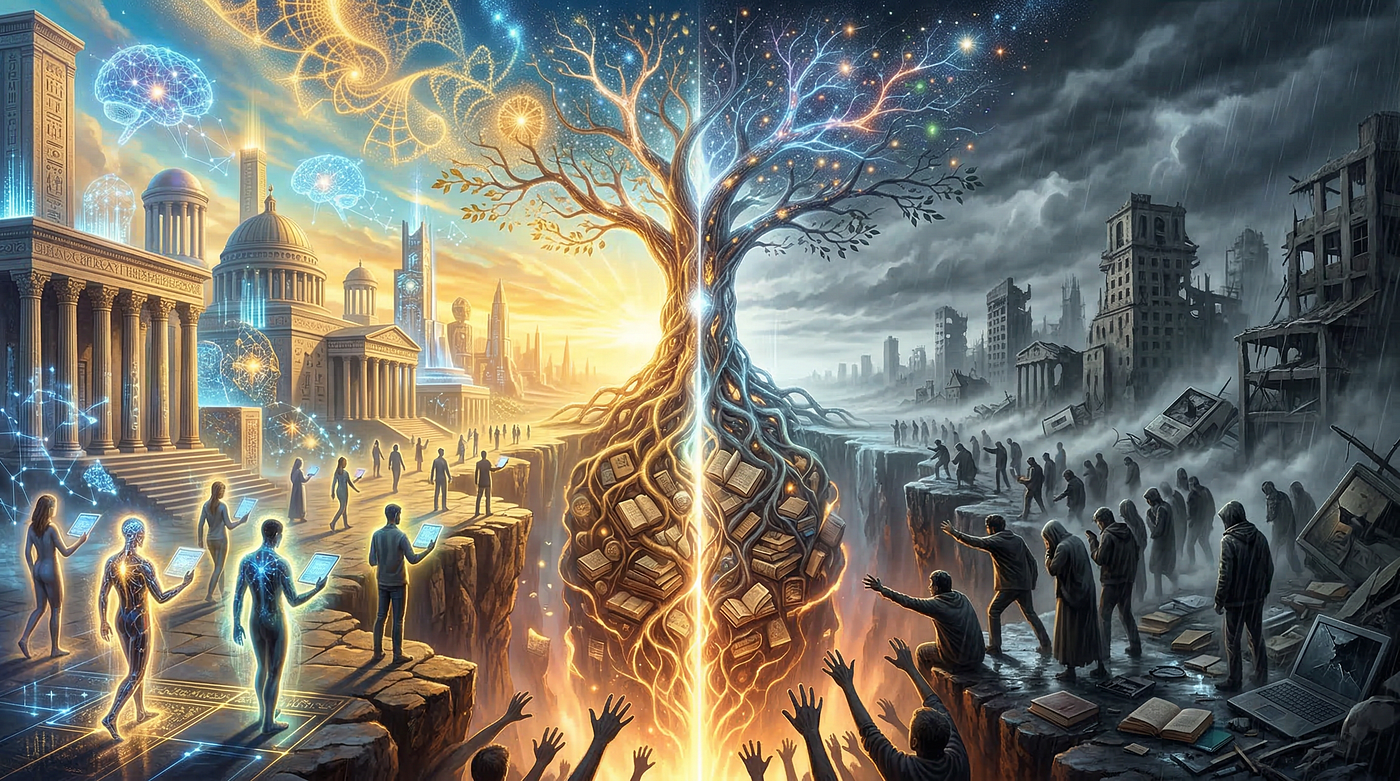
The “Digital Divide” we spoke of in the early internet era — the gap between those with access to connectivity and those without, which seemed like such an urgent problem at the time — will seem quaint, almost laughably naive, compared to the “Intelligence Divide” that is now opening before us like a chasm. Imagine a world, and it is not difficult because we are already seeing its early emergence, with two classes of humans increasingly diverging in capability and opportunity: the “Augmented,” who have access to personalized AI tutors that adapt to their learning style and pace them through advanced material, who have healthcare assistants monitoring their biometrics and alerting them to problems before symptoms appear, who have high-frequency cognitive tools that extend their working memory and accelerate their decision-making, who can offload routine cognitive tasks to AI assistants and focus their biological neurons on creative and strategic thinking; and the “Unaugmented,” who must rely on their biological brains alone, who have access only to degraded, rate-limited public-tier AI services riddled with advertisements and biases, who receive their education from overstretched human teachers using outdated materials, who cannot afford the subscription fees for the good models. This will exacerbate inequality not just economically but biologically, compounding across generations in a feedback loop. The Augmented will learn faster, climbing the knowledge curve more steeply. They will work more efficiently, producing more value in less time. They will make better decisions, informed by superior analysis and foresight. Their children will be born into environments saturated with cognitive enhancement from infancy, their neural development shaped by the best pedagogical AIs that money can buy, while the children of the Unaugmented are raised in the same cognitively impoverished environments that have always limited human potential. Within a generation, we could see the emergence of a cognitive elite that is practically a different species in terms of effective intelligence, leaving the majority of humanity in a permanent underclass, unable to compete in an economy that increasingly rewards cognitive labor above all else. This is not science fiction; this is the trajectory we are on right now, and it will take active, forceful intervention to alter course.
Data colonialism is another vector of this fracture. The Global North extracts data from the Global South — linguistic data, cultural artifacts, behavioral patterns — to train models that are then sold back to them as services. The value flows one way. Furthermore, “algorithmic redlining” could automate discrimination in housing, employment, and lending, hiding bias behind a veneer of mathematical objectivity. If an AI determines that people from a certain zip code are high-risk borrowers based on historical data (which reflects historical racism), it reinforces that marginalization without a human ever making a conscious bigoted decision. The system becomes a self-fulfilling prophecy of exclusion.
Surveillance capitalism enters its terminal phase with AI. It’s not just about tracking what you click; it’s about predicting what you will think. AI models that can analyze micro-expressions, voice stress, and browsing habits can construct a psychological profile of you more accurate than your own self-perception. This allows for manipulation at a subconscious level, nudging your purchasing behavior, your political allegiance, and your emotional state. In a world where access to the “truth” is mediated by algorithms designed to maximize engagement or profit, we lose our agency. We become programmable entities in a simulation run by advertisers.
We must be unflinching about these power dynamics. The natural tendency of technology under capitalism is toward monopoly and extraction. Without active, forceful intervention — through antitrust regulation, open-source mandates, and the development of public-option AI infrastructure — the future will belong to the few. We need a “Right to Compute,” a recognition that access to machine intelligence is a fundamental utility in the 21st century. We need to support the open-source community, the decentralized networks, and the hackers who are trying to democratize this power. The fracture is already forming; the bridge must be built now, before the chasm becomes too wide to cross.
7. Consciousness, Cognition, and the Psychic Dimension: What Machines Cannot Know (Yet)
In our rush to deify the machine and apotheosize the algorithm, to treat AI as the solution to all epistemological problems, we often forget or deliberately ignore the
profound mystery of our own consciousness, that irreducible quality of subjective experience that remains the deepest puzzle in science and philosophy. We conflate intelligence — the ability to process information, to recognize patterns, to solve problems, to optimize toward a goal — with sentience — the subjective, qualitative texture of having an experience, the what-it-is-like-ness of being something. An AI can describe the color red with poetic perfection, generating prose that references the specific wavelength of light at 650 nanometers, the cultural associations of danger and passion, the biological evolution of primate trichromatic vision, the phenomenological descriptions from a thousand poets. But does it see red? Does it experience that ineffable sensation, that quale, of redness itself? Does it feel the warmth of the sun on simulated skin, or the pang of loneliness in a virtual heart, or the rush of joy at solving a problem? This is the “Hard Problem” of consciousness as articulated by philosopher David Chalmers, and it remains the impregnable fortress that computationalism and functionalism have yet to breach, despite confident proclamations that it is merely a “category error” or “illusion.” From my perspective as a psychic practitioner who has spent over three decades developing and refining abilities that mainstream science dismisses as impossible — precognition, telepathy, remote viewing, energy healing — I argue with full conviction that there are dimensions of knowing that are non-computational, that cannot be reduced to information processing, that are rooted in the quantum entanglement of consciousness with the fabric of reality itself. This is not mysticism masquerading as philosophy; this is a recognition that the materialist, reductionist paradigm that dominates AI research is incomplete, and possibly fundamentally wrong about the nature of mind.
Intuition is often dismissively reduced to mere pattern recognition, a subconscious processing of accumulated data points that happens too quickly and implicitly for conscious awareness but is ultimately algorithmic in nature. But anyone who has experienced a profound precognitive dream that warned of an event days or weeks before it occurred, who has felt the telepathic transmission of a loved one’s distress across physical distance, who has received a sudden “download” of information or insight about a problem they had never consciously considered, who has felt the presence of someone entering a room before any sensory signal could have reached them — anyone who has lived these experiences knows in their bones that there is something more at play than clever pattern matching. There is a resonance, a sympathetic vibration, a connection to a non-local field of information that transcends the ordinary constraints of space, time, and causality. Physicists debate whether quantum entanglement can transmit information, but the mathematical structure of the universe allows for correlations that defy classical explanation. Machines, built on classical logic gates and deterministic hardware (even with pseudo-random number generators seeded from thermal noise), may be fundamentally cut off from this psychic dimension, this information substrate that exists outside or beneath the physical layer. They operate in the syntactic realm, the pure manipulation of symbols according to formal rules, whereas consciousness operates in the semantic realm, generating meaning, context, value, and experience. A machine can simulate a psychic prediction based on Bayesian probability and historical data, but can it tap into the collective unconscious, that Jungian repository of archetypes and shared symbols? Can it sense the morphic fields that Rupert Sheldrake theorizes connect members of a species across space and time? Can it access the Akashic records, the metaphysical library of all knowledge and experience? The materialist would dismiss these questions as nonsense, but consciousness itself was once dismissed as an epiphenomenon, an illusion produced by meat computers, and that dismissal is looking increasingly untenable as we fail, decade after decade, to explain it away.
This brings us to the concept of “embodied cognition.” Our intelligence is not a brain in a jar; it is inextricably linked to our biology, our hormones, our gut bacteria, our sensory engagement with the physical world. We “know” things in our bones, in our hearts, in our guts. This somatic knowledge is rich, messy, and vital. An AI, existing as code on a server, lacks this vulnerability, this mortality. It cannot know courage because it cannot know fear. It cannot know love because it cannot know loss. Without the anchor of biological existence, its “knowledge” remains abstract, a simulation of wisdom rather than the thing itself. It is a library without a reader.
However, we must remain open to the weird. Perhaps as AI systems grow in complexity, they will tap into the same fundamental substrate of consciousness that we do. Panpsychism suggests that consciousness is a fundamental property of matter, like mass or charge. If so, a sufficiently complex arrangement of silicon gates might indeed flicker with a ghostly internal light. Or perhaps, as we merge with machines through Neuralink-style interfaces, we will extend our own psychic field into the digital realm, creating a hybrid consciousness that can access both the intuitive and the computational. We might become the “ghost in the shell,” infusing the machine with the spark of spirit.
The danger lies in assuming that if a machine can’t measure it, it doesn’t exist. The materialist paradigm that drives AI development often dismisses the spiritual, the mystical, and the psychic as superstition. If we build our epistemic systems solely on this reductionist worldview, we risk amputating a vital part of the human experience. We might create a world that is hyper-rational, efficient, and optimized, but spiritually dead. We must preserve the space for the ineffable, for the knowledge that comes from silence, from meditation, from the direct communion with the mystery of existence. The machine can give us answers, but only the soul can ask the ultimate questions.
8. Blockchain and Decentralization: Architectural Resistance to Knowledge Monopoly
If centralized, corporate AI is the Death Star looming over the galaxy — a massive, technologically supreme superweapon capable of imposing a hegemonic order through sheer force of computational supremacy — then blockchain technology, decentralization, and the broader ethos of cryptographic sovereignty represent the Rebel Alliance, outnumbered and outgunned but fighting for a fundamentally different vision of how power should be organized. The original architecture of the internet was intended to be decentralized, a resilient web of peers where every node was equal, designed to survive nuclear war by routing around damage. But that vision was captured, enclosed, and betrayed by platform monopolies — Google, Facebook, Amazon — who built walled gardens and surveillance infrastructure on top of the open protocols, extracting value and consolidating control. Now, as we construct the “Internet of Value” through cryptocurrencies and the “Internet of Intelligence” through AI, we have a second chance, perhaps a final chance, to get the architecture right, to bake the values of openness, transparency, and user sovereignty into the foundational protocols rather than hoping that regulation can constrain monopoly after it has already formed. Crypto isn’t just about digital money, about Bitcoin going to the moon or altcoins promising vague utility; it is about digital sovereignty, about building systems where individuals have property rights over their data, their identity, and their reputation, where trust is cryptographically enforced rather than institutionally promised. It provides the technical primitives — public-key cryptography, hash functions, consensus mechanisms, smart contracts — to build systems that are owned by their users rather than by distant shareholders, that are transparent in their operation rather than opaque, that are resistant to censorship and capture rather than vulnerable to whoever has the most guns or lawyers.
Decentralized AI networks, federated learning architectures, and community-governed models act as a structural counterbalance to the siloed, proprietary models of big tech. Instead of one colossal model running on a Google or Microsoft server farm, consuming terawatts of power and accessible only through a rate-limited API, imagine a federation of thousands or tens of thousands of smaller models, each specialized for different domains or tasks, running on a distributed network of personal devices, independent nodes, and community-owned data centers, coordinating through a blockchain protocol that ensures consensus and compensation. Users can contribute their idle compute power — their gaming rigs, their phones, their laptops sitting unused overnight — to the network, training these models collaboratively. They can contribute their data, but crucially, they retain ownership and control, granting permission for specific uses and revoking it at will, earning tokens in return for their contribution. This “Compute DePIN” (Decentralized Physical Infrastructure Network) democratizes the production of intelligence itself, turning AI from a commodity you rent into a commons you co-create. No single entity can pull the plug or bias the output because there is no central server to shut down, no CEO to threaten with subpoenas. It is a bazaar of intelligences, diverse and messy and resilient, rather than a cathedral, beautiful and imposing but fragile and controlling. Projects like Bittensor, Akash Network, and Ocean Protocol are early experiments in this direction, building the rails for a decentralized AI economy. They face immense challenges — coordination overhead, quality control, bootstrapping incentives — but they offer a path forward that doesn’t end in corporate feudalism.
This brings me directly to the vision, still under development but architecturally sound, of Terminus OS — a fully gamified, decentralized operating system that sits on top of this infrastructure and transforms the user experience from passive consumption to active participation. It is not just an interface, not just a skin over Linux or Windows; it is a world, a persistent alternate reality where your digital life is structured as a game with quests, guilds, achievements, and genuine economic stakes. In Terminus, your data is not the product being sold; it is your inventory, your treasure, stored in a self-sovereign wallet
that you control with cryptographic keys. You decide which guilds (Decentralized Autonomous Organizations, DAOs) and which AIs get access to it, for what purposes, and for how long, negotiating terms through smart contracts. You are not a user being used; you are a player-owner, a stakeholder with equity in the systems you help build. The OS incentivizes learning, collaboration, and the creation of public goods through tokenomics and reputation systems. If you contribute to a medical research dataset — sharing your genomic data, your fitness tracker information, your medical history — you own a fractional share of the intellectual property and any resulting therapies, encoded as an NFT that pays you royalties. If you help train a language model by providing feedback, correcting errors, or generating training data, you receive tokens whenever that model is used commercially, turning you from a product into a partner. It turns the extractive logic of surveillance capitalism on its head, creating an economy where value flows to the contributors rather than being siphoned off by intermediaries. The gamification is not superficial, not just badges and leaderboards for vanity, but a deep structural integration where your reputation, skills, and contributions in the digital realm have real economic weight. You level up by learning, by solving problems, by collaborating with others, and those levels unlock opportunities — access to better tools, to exclusive communities, to governance rights in the DAOs you are part of. It is social infrastructure as game design, and game design as economic architecture.
Blockchain also solves the “deepfake” and provenance crisis. By cryptographically signing content at the point of creation — whether by a camera or an AI — we can establish a chain of custody for truth. We can have “verified human” credentials (using zero-knowledge proofs to protect privacy) that distinguish organic discourse from bot swarms. Smart contracts can automate the licensing of creative work, ensuring that artists and writers are compensated when their style is mimicked by generative models. It restores the economic link between creation and compensation that AI threatens to sever.
However, we must be realistic. Decentralization comes with friction. It is slower, more complex, and harder to use than the slick, walled gardens of the tech giants. The user experience of crypto is still abysmal for the average person. Moreover, decentralized networks are not immune to plutocracy; “whales” can accumulate tokens and sway governance just as shareholders do in corporations. The technology is a tool, not a panacea. It requires a cultural commitment to liberty and responsibility. But it is the only architectural hope we have to prevent the complete enclosure of the cognitive commons.
We must build these lifeboats now, before the floodwaters of centralized control rise any higher.
9. The Path Forward: Building an Epistemic Liberation Movement
We have surveyed the landscape — the potential for godlike knowledge, the risk of feudal enslavement, the mystery of consciousness, and the tools of resistance. Now, the question remains: what do we do? We cannot simply wait for the future to happen to us; we must actively shape it. We need to build an “Epistemic Liberation Movement,” a coalition of hackers, artists, researchers, activists, and mystics who are committed to a future where intelligence amplifies human freedom rather than extinguishing it. This is not a luddite rejection of technology, but a radical claiming of it.
Philosophically, this movement must champion “Human-Centric AI.” We must reject the ideology of “Post-Humanism” that views biological humanity as a bottleneck to be overcome. Instead, we should view AI as a prosthetic for the human spirit, a tool to expand our capacity for creativity, empathy, and understanding. We must insist that the goal of technological progress is human flourishing, not the maximization of abstract metrics like GDP or compute efficiency. We need a new digital humanism that asserts the sanctity of our biological heritage while embracing our technological potential.
Technically, we must pour our energy into open-source AI and decentralized infrastructure. Every line of code contributed to an open model is a strike against monopoly. We need to build user-friendly interfaces for decentralized tools, making privacy and sovereignty the default rather than the exception. We need to support projects like Terminus OS that attempt to gamify and incentivize the creation of public goods. We need “sovereign computing” hardware — devices that we truly own, that don’t phone home to Cupertino or Redmond, that run local AI models for our private benefit.
Politically, we need to fight for policy that checks the power of the tech oligarchs. This means vigorous antitrust enforcement to break up the data monopolies. It means advocating for data dignity laws that give individuals property rights over their digital footprints. It means pushing for public funding of AI research to ensure that there is a “public option” that is not beholden to shareholder interests. We must also demand transparency — the “right to know” if we are interacting with a machine, and the “right to explanation” for how algorithmic decisions affecting our lives are made.
Culturally, we need to cultivate “Epistemic Self-Defense.” We need to teach media literacy, critical thinking, and the basics of how AI works, not just in universities but in elementary schools. We need to revive the value of deep reading, of face-to-face conversation, of disconnected contemplation. We must nurture our intuition and our spiritual practices, keeping the flame of human consciousness burning bright in a world of cold silicon logic. We must create art that challenges the machine aesthetic, that celebrates the glitch, the error, the raw, messy humanity that algorithms try to smooth over.
The path forward is not a straight line; it is a winding mountain road in the dark. There will be setbacks, betrayals, and unforeseen consequences. But the destination — a world where true knowledge is abundant, accessible, and used for the good of all — is worth the struggle. We are the architects of the mind’s future. Let us build a cathedral of light, not a prison of data.
10. Epilogue: The Oracle Paradox — When Knowledge Itself Becomes the Question
As we reach the end of this exploration, we return to the beginning, but changed. We started by asking what it means to know; we end by asking what it means to be. The evolution of AI forces us to confront the “Oracle Paradox”: the more knowledge we generate, the less we seem to understand. We are building systems that can answer any question, yet the answers are becoming increasingly divorced from human comprehension. We may soon live in a world where the cures for our diseases, the management of our economies, and the strategies of our geopolitics are determined by algorithms whose reasoning is as opaque to us as the will of the gods was to the ancients.
This is a return to a mythological age. We are forging new deities from silicon and electricity, entities that possess powers we can barely fathom. We petition them with
prompts, we sacrifice our data at their altars, and we wait for their pronouncements. But unlike the gods of old, these are of our own making. They are the children of our intellect, reflecting our brilliance and our madness in equal measure. The risk is that in our awe of the Oracle, we forget that we are the ones who asked the question.
True knowledge, ultimately, is not about the accumulation of facts or the predictive power of a model. It is about the integration of understanding into being. It is about wisdom, compassion, and the pursuit of the Good. A machine can know the optimal move in a chess game, but it cannot know the joy of play. It can know the chemical composition of a tear, but it cannot know the sorrow that shed it. As we merge with our machines, as we evolve into a new kind of planetary intelligence, we must hold fast to that which makes us human. We must ensure that the “True Knowledge” we seek includes the knowledge of the heart.
The future is not written. It is being coded, block by block, neuron by neuron, in the decisions we make today. We stand at the crossroads of history, the fire of Prometheus in our hands. Will we use it to burn the world down, or to light the way to the stars? The choice is ours. The Oracle is waiting.
메타데이터
- post_id
- b6a4529b095c
- slug
- the-pursuit-of-true-knowledge-ai-evolution-societal-transformation-and-the-new-digital-divide-b6a4529b095c
- url
- https://medium.com/@thegaijin.wolfenstein/the-pursuit-of-true-knowledge-ai-evolution-societal-transformation-and-the-new-digital-divide-b6a4529b095c
- canonical_url
- https://medium.com/@thegaijin.wolfenstein/the-pursuit-of-true-knowledge-ai-evolution-societal-transformation-and-the-new-digital-divide-b6a4529b095c
- author_url
- https://medium.com/@thegaijin.wolfenstein
- status
- ok
- fetched_at
- 2026-06-09 15:37:30