The Ancient Practice That Solves a Modern Problem: International Yoga Day
The timeless solution to stress, screen fatigue, and the loss of presence
The Ancient Practice That Solves a Modern Problem: International Yoga Day
The timeless solution to stress, screen fatigue, and the loss of presence
“Yoga is the journey of the self, through the self, to the self.” — The Bhagavad Gita
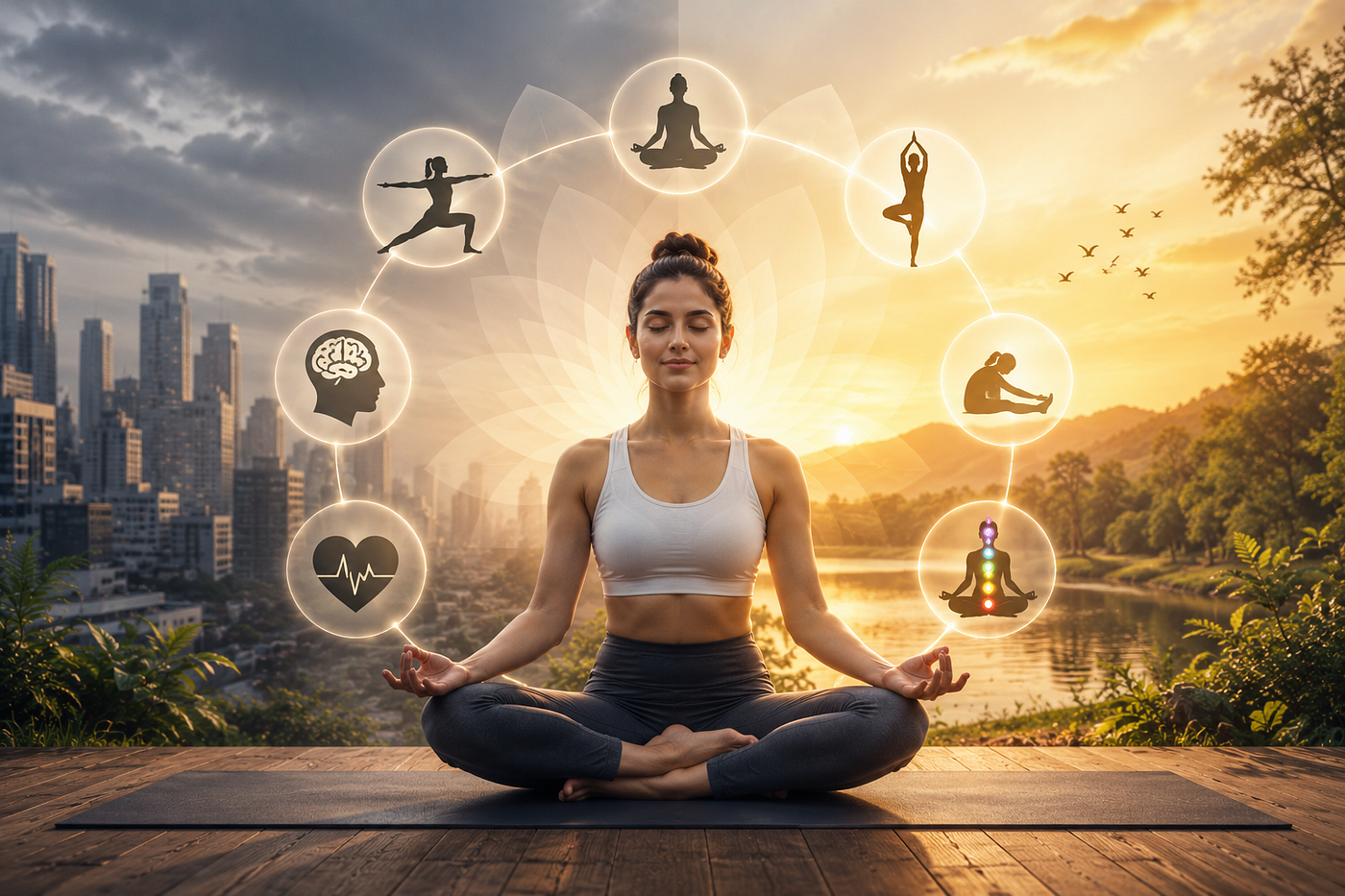
Image created with AI by author
We have built a world that can do almost everything.
It can deliver food in minutes.
Connect people across continents.
Answer questions instantly.
Yet millions of people still struggle with stress, anxiety, poor sleep, and a constant feeling that something is missing.
The problem is not that we need more technology.
We need more balance.
And that is exactly where yoga begins.
What Yoga Actually Is
Many people think yoga is simply stretching.
Or difficult poses performed by flexible people on social media.
But yoga is much more than that.
The word yoga comes from the Sanskrit word yuj, meaning “to unite” or “to join.”
Traditionally, yoga was designed to create harmony between the body, mind, and spirit.
It is not merely exercise.
It is a practice of awareness.
A way of becoming fully present in your own life.
More than 2,000 years ago, the sage Patanjali defined yoga as:
“Chitta Vritti Nirodhah” — The stilling of the fluctuations of the mind.
The body was the entry point.
The breath was the bridge.
But the destination was always the same: a mind that could be present, rather than perpetually scattered across past regrets and future anxieties.
The Benefits — Body and Mind Together
The body and the mind, in the yoga framework, are not separate systems.
Physically, regular practice improves flexibility, strength, balance, and cardiovascular health.
It reduces chronic pain — particularly back pain, which has become one of the defining physical complaints of the desk-and-screen era.
It improves sleep quality, immune function, and the body’s ability to recover from stress.
Psychologically, it develops the capacity for sustained attention — something that is eroding in direct proportion to the rise of notification-driven technology.
It builds the ability to tolerate discomfort without immediately escaping it.
It teaches the practitioner, slowly and through direct experience rather than concept.
“You cannot always control what goes on outside. But you can always control what goes on inside.” — Wayne Dyer
The Different Types of Yoga
Yoga continues to attract people as there is no single way to practice it.
Different styles serve different needs.
Hatha Yoga
It is the foundation.
Focused on the alignment of basic postures and breath.
It is the ideal starting point for beginners and for anyone whose nervous system needs gentling before anything more demanding.
Vinyasa Yoga
It links breath to movement in a flowing sequence.
More physically demanding.
Rhythmic.
Meditative in its own way.
The movement becomes the focus, and the mind follows the body into a kind of active stillness.
Ashtanga Yoga
It is a rigorous, structured sequence practiced in the same order every time.
Discipline-driven.
Physically demanding.
Deeply committed practitioners often describe it as a moving meditation that requires and develops extraordinary mental focus.
Yin Yoga
It works with long, passive holds.
Sometimes three to five minutes in a single pose.
It targets the connective tissue rather than the muscles.
Deeply restorative.
Deeply uncomfortable in the specific way that stillness is uncomfortable for an overstimulated mind.
Deeply effective for nervous system regulation.
Kundalini Yoga
It combines posture, breathwork, chanting, and meditation into a practice focused on the energetic body.
More spiritual in its orientation.
Less physically intense.
Powerful for practitioners dealing with emotional processing and inner work.
Restorative Yoga
It uses props to support the body in complete passivity.
The practice is one of total release.
Of learning to let the body be held rather than holding itself.
In an era of chronic tension, it is perhaps the most radical thing a body can do
Why Yoga Matters on International Yoga Day
International Yoga Day is more than a celebration of an ancient tradition.
It is a reminder that technology may continue to evolve, but the human need for balance remains the same.
Every year on June 21st, millions of people roll out yoga mats around the world.
They are pausing.
In a culture that rewards constant motion.
They are breathing.
In a world that encourages rushing.
They are reconnecting.
In an age defined by distraction.
“The nature of yoga is to shine the light of awareness into the darkest corners of the body.” — B.K.S. Iyengar
Final Thought
Yoga does not ask you to escape modern life.
It simply teaches you how to live inside it without losing yourself.
— *Swati* ✨
Thank you for being here ❤️
If something in these words resonated with you — I’d be incredibly grateful if you left 50 claps👏
More emotional reflections you may enjoy 👇
메타데이터
- post_id
- b6ab85dfcdd1
- slug
- the-ancient-practice-that-solves-a-modern-problem-international-yoga-day-b6ab85dfcdd1
- url
- https://medium.com/the-pillionaire-diaries/the-ancient-practice-that-solves-a-modern-problem-international-yoga-day-b6ab85dfcdd1
- canonical_url
- https://medium.com/the-pillionaire-diaries/the-ancient-practice-that-solves-a-modern-problem-international-yoga-day-b6ab85dfcdd1
- author_url
- https://medium.com/@swatikumari_57468
- status
- ok
- fetched_at
- 2026-06-21 21:05:38