I Chose AI… Unfortunately, My Laptop Did Not Agree 🤖🤕
“Small storage problem turned into a three-week research adventure”
I Chose AI… Unfortunately, My Laptop Did Not Agree 🤖🤕
“Small storage problem turned into a three-week research adventure”
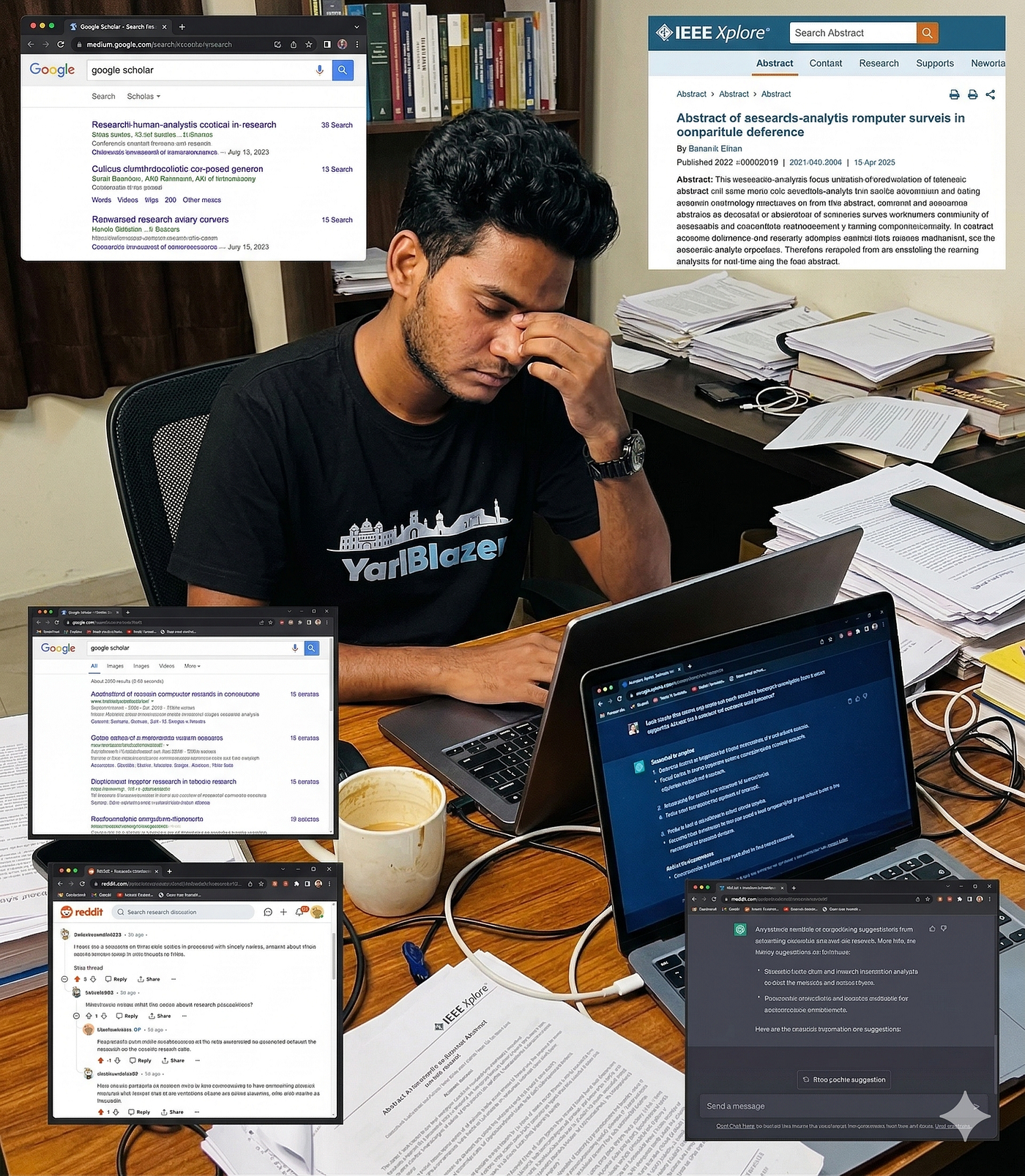
After days of confusion, I finally reached a point where things started to make sense. It was not a big success, but it was progress. And honestly, that small progress felt like a huge win for me.
I realized something very clearly. I want to choose AI and Machine Learning. Not because it is easy, but because I actually enjoy training models. Some people do not like this part. They feel it is too complex, too slow, and too frustrating.
But I am a bit different (yes, I like complicated things… for some reason).
There is something exciting about building and training a model from scratch. The idea of creating something, improving it step by step, and trying to make it better every time — that is what keeps me interested. One thought kept coming to my mind again and again: what if I could train a really good model on my own?
Since this is an individual research project, everything depends on me. From idea to final output, I have to build everything. And instead of feeling scared, I felt excited about it.
Things started improving when I spoke with another lecturer at my university. He suggested some research ideas, but honestly, none of them really impressed me (no spark). However, the way he guided me was very useful.
He showed me where to find research topics and how to search for papers properly. He introduced me to tools like SciSpace, which is like a chatbot made for research, and Overleaf, a platform used for writing research papers. I have not used Overleaf for research yet, but I used it to prepare my CV (yes, CV… that word has a story, I will share it in a future post).
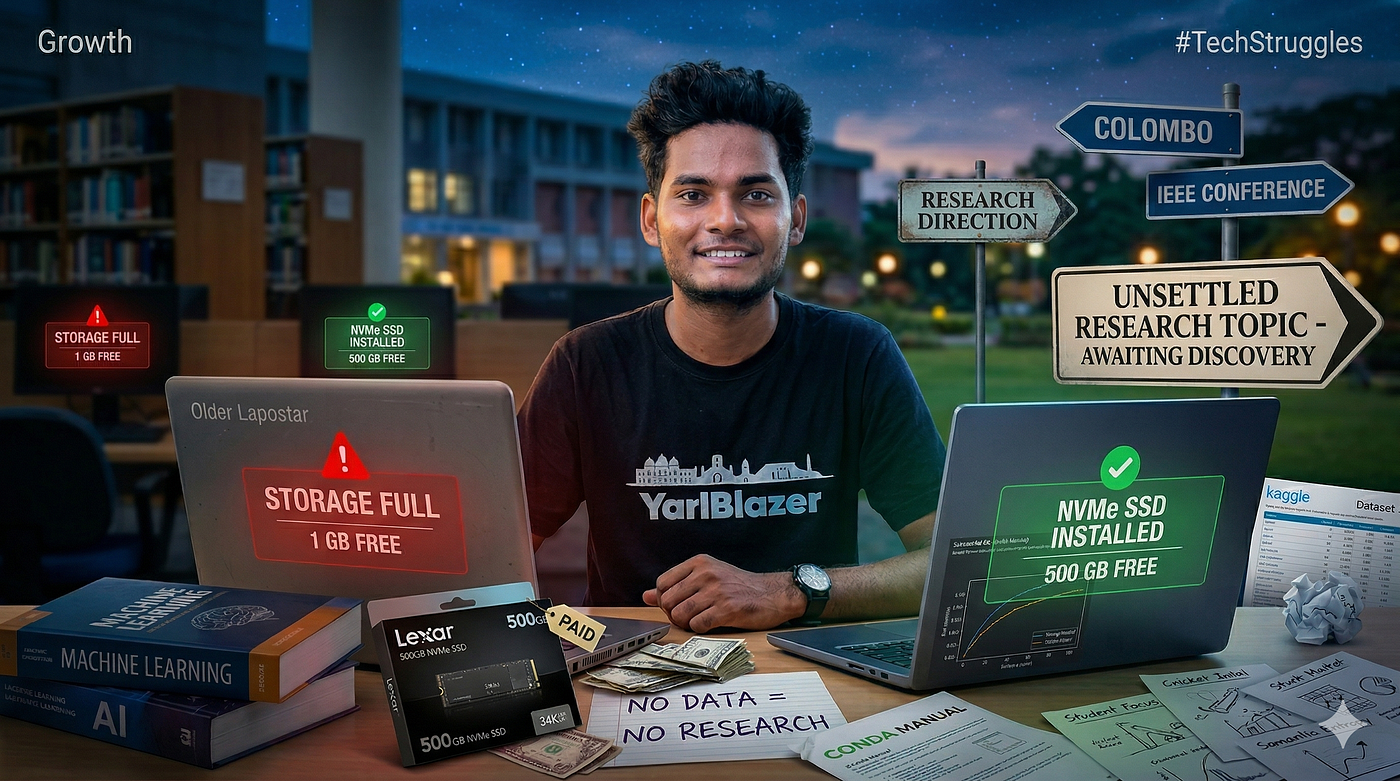
The most important advice he gave me was this: before choosing a research topic, always think about the dataset and the research gap. He also told me that I can find datasets from Kaggle. And if there is no dataset, then the idea cannot move forward. Simple as that (no data = no research).
He also explained something that changed my thinking. Research does not always mean creating something completely new. I can take an existing research and improve it like increasing accuracy, improving results, or solving a limitation. That idea made me think more creatively.
After that conversation, I started searching again. Topic after topic, idea after idea. At the same time, in my internship, my manager involved me in an AI marketing tool project. This also helped me understand how AI works in real-world situations.
Everything felt like it was finally going in the right direction.
But every story has a problem, right?
In my case, the villain was my laptop.
I was using an HP laptop with an i3 processor and very limited storage (basically fighting for survival). My task was to train models and connect them with a frontend. But I only had around 10GB of free space.
My mentor asked me to install Conda (it is like a tool that creates separate environments for projects, think of it as different “workspaces” so projects do not break each other). But installing it and running models quickly filled up my storage.
Sometimes, my free space went from 10GB to almost 1GB (yes, just like that).
Every time that happened, I had to restart my laptop and run everything again. This cycle repeated again and again for almost three weeks (pure pain).
To handle this, I deleted my old academic projects (no problem, they were saved in Git). Then I decided to switch to my old Lenovo laptop. It was slower (Celeron processor), but it had more storage (finally, something good).
I set up everything again and continued working. At the same time, I planned to upgrade my laptop with an NVMe SSD. But unfortunately, due to the sudden AI boom, prices were very high.
Samsung was around 50K, and Lexar was around 34K (not a good time to be broke).
I used some money from my freelancing work and borrowed the rest from a friend (first month of internship, so no salary yet). He helped me buy the SSD from Colombo, and finally, I upgraded my laptop.
(Big relief moment.)
After that, I had enough space and could work properly. I started exploring different research ideas like student focus monitoring, cricket intelligence, and stock market prediction.
I discussed these with lecturers, and one topic — student focus assistance — was accepted. I agreed, but only partially. It felt like something many people could do. I wanted something more unique and impactful.
On the same day, I also learned about IEEE and research conferences. That opened my mind to what real research should look like. It made me want to aim higher.
Even though I had a topic, I was not fully satisfied. So I continued searching.
During that time, I came across a term called semantic entropy. It sounded interesting, and I became curious about it. I started thinking about how I could include it in my research.
I also selected my supervisor, and I feel confident that she will guide me well in this journey.
So yes, this phase looks positive. I have direction, I have ideas, and I have support.
But deep inside, I know one thing.
The final decision is still not made.
And the real topic… is still waiting to be discovered.
메타데이터
- post_id
- b6abec804a1a
- slug
- i-chose-ai-unfortunately-my-laptop-did-not-agree-b6abec804a1a
- url
- https://medium.com/@Bijosilin/i-chose-ai-unfortunately-my-laptop-did-not-agree-b6abec804a1a
- canonical_url
- https://medium.com/@Bijosilin/i-chose-ai-unfortunately-my-laptop-did-not-agree-b6abec804a1a
- author_url
- https://medium.com/@Bijosilin
- status
- ok
- fetched_at
- 2026-08-16 10:54:36