How Machines Read Text Word by Word: A Complete Guide to NLP Token Classification
Language is effortless for humans. We read a sentence and instantly know who did what, where it happened, and why it matters. For machines…
How Machines Read Text Word by Word: A Complete Guide to NLP Token Classification
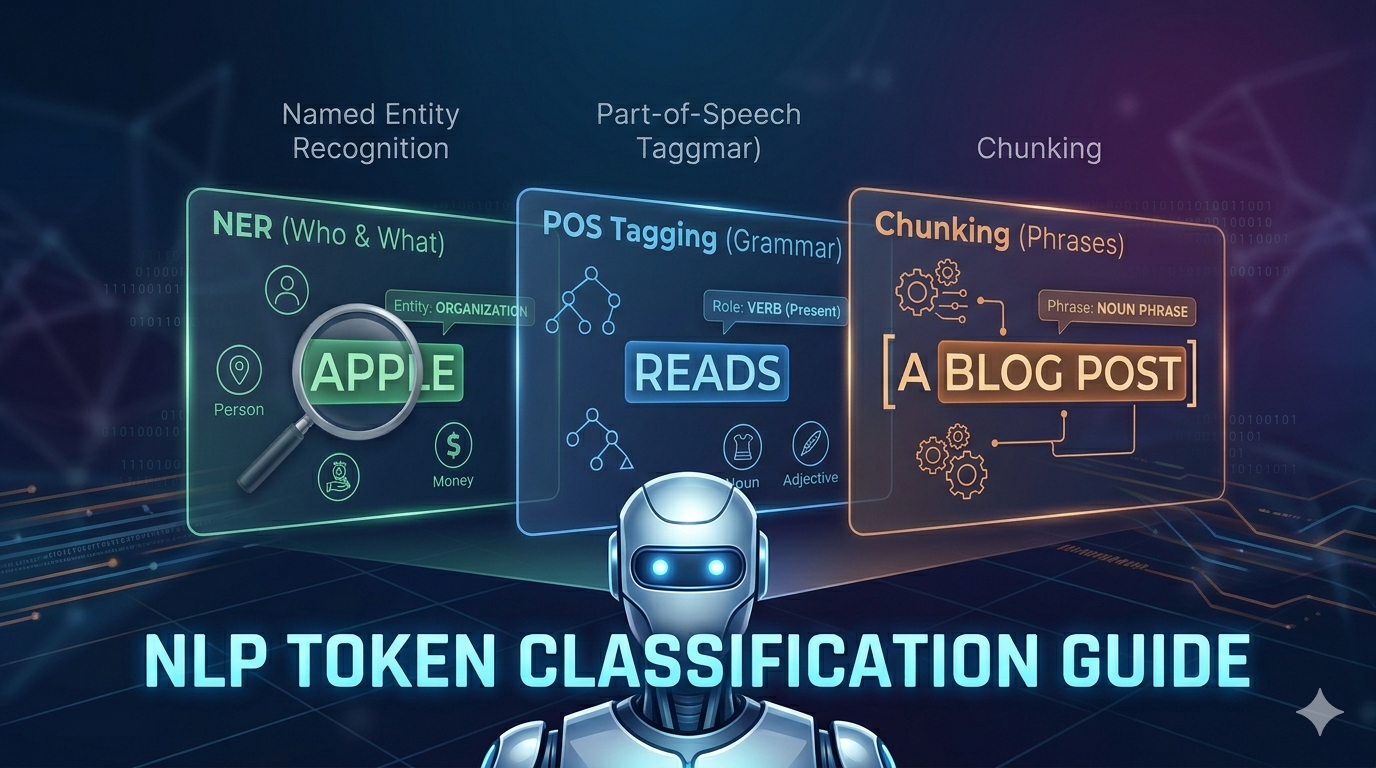
Language is effortless for humans. We read a sentence and instantly know who did what, where it happened, and why it matters. For machines, none of that comes naturally. This blog breaks down exactly how modern AI systems learn to understand text at the most fundamental level — one word at a time.
The Problem With Teaching Machines to Read
Imagine handing a computer this sentence:
“Apple is looking at buying U.K. startup for $1 billion.”
A human reads it and instantly knows — Apple is a tech company, not a fruit. U.K. is a country. $1 billion is a price. The sentence is about a potential acquisition.
A machine sees a string of characters. Nothing more.
This is the core challenge of Natural Language Processing. And solving it starts not at the sentence level, not at the paragraph level — but at the level of individual words.
That’s what token classification is all about.
What Is NLP?
Natural Language Processing, or NLP, is the branch of Artificial Intelligence that deals with human language. It’s what powers Google Search, Siri, ChatGPT, Gmail’s Smart Reply, and every autocomplete suggestion you’ve ever used.
The goal of NLP isn’t just to store text — it’s to understand it. To extract meaning, identify relationships, answer questions, and generate coherent responses. And before any of that sophisticated understanding can happen, there’s groundwork that has to be laid at a much more basic level.
Tokens — The Building Blocks of NLP
Before a model can classify anything, it needs to break text into manageable pieces. These pieces are called tokens.

In most cases, a token is simply a word. But it can also be a punctuation mark, a number, or even a fragment of a longer word. The sentence —
“I love NLP!”
— becomes four tokens: I, love, NLP, !
Token classification is then the task of looking at each of these tokens individually and asking: what is this token doing here? What role does it play? What does it refer to?
Think of it like colour-coding a printed article. You grab one colour for every person’s name, another for every location, another for every verb, and so on. You’re annotating meaning — token by token, word by word. Token classification automates exactly that process.
Three tasks sit at the heart of this: Named Entity Recognition, Part-of-Speech Tagging, and Chunking. Each one answers a different question about the text. Together, they form the foundation of how machines truly understand language.
Named Entity Recognition (NER) — Who, What, and Where
The Big Idea
Named Entity Recognition is the task of identifying real-world entities inside text and putting them into categories. People, organizations, locations, dates, currencies, percentages — NER finds them all.
The question NER answers is: who or what is this token referring to in the real world?
A Walkthrough Example
Take this sentence:
“Sundar Pichai announced that Google will invest $1 billion in Indian startups by 2027.”
Read it as a human and you immediately extract five key facts — a person made an announcement, a company is involved, a specific amount of money is mentioned, a country is referenced, and a year is given.
A trained NER model does the same thing automatically. It scans each token and outputs:
Sundar Pichai → PERSON Google → ORGANIZATION $1 billion → MONEY Indian → GPE (Geopolitical Entity) 2027 → DATE
Five labels. Five real-world facts extracted from a single sentence, without any manual effort.
Understanding BIO Tagging
Here’s where it gets cleverly technical. How does a model handle entity names that span multiple words? “New York City” is three tokens — how does the model know they belong together?
The answer is BIO tagging. Every token gets one of three labels:
B stands for Beginning — this token starts a new entity. I stands for Inside — this token continues an entity that already started. O stands for Outside — this token is not part of any entity.
So “New York City” gets tagged as B-LOC, I-LOC, I-LOC. Three separate tokens, clearly identified as one single location entity. Clean, unambiguous, elegant.
Real-World Applications
NER is quietly working in more places than most people realize.
In healthcare, NER systems scan clinical notes to automatically extract drug names, dosages, symptoms, and diagnoses — saving doctors hours of manual documentation.
In finance, trading platforms use NER to monitor thousands of news articles per minute, extracting company names, merger mentions, and financial figures to inform trading decisions in real time.
In recruitment, NER-powered resume parsers extract skills, job titles, companies, and education details automatically — making candidate screening dramatically faster.
Part-of-Speech Tagging — The Grammar Detective
The Big Idea
Part-of-Speech tagging, universally shortened to POS tagging, assigns a grammatical role to every single token in a sentence. Noun, verb, adjective, adverb, preposition, conjunction — every word gets precisely classified.

The question POS tagging answers is: what grammatical function is this word performing in this sentence?
A Walkthrough Example
Take this sentence:
“The brilliant engineer quietly solved the most complex problem.”
Breaking it down token by token:
The → Determiner (points to a specific thing)
brilliant → Adjective (describes the engineer)
engineer → Noun (the subject of the sentence)
quietly → Adverb (describes how the solving happened)
solved → Verb, past tense (the action)
the → Determiner
most → Adverb (modifies “complex”)
complex → Adjective (describes the problem)
problem → Noun (the object of the action)
Nine tokens. Nine grammatical roles. The entire sentence structure is now visible.
Why This Matters — The Ambiguity Problem
Here’s something that makes POS tagging genuinely important rather than just academically interesting. Many English words completely change their meaning depending on their grammatical role.
Consider the word “book”:
“Please book a flight to Mumbai.” — Here, “book” is a verb. It’s an action being requested.
“I left the book on the desk.” — Here, “book” is a noun. It’s a physical object.
Same spelling. Completely different meaning. A machine that can’t distinguish between these two uses will make errors across every task that follows — translation, summarization, question answering, everything.
POS tagging solves this problem by giving every word its grammatical identity before anything else happens.
Real-World Applications
Grammar checkers like Grammarly use POS tagging extensively — to know that “their” is wrong in a particular spot, the system first needs to understand what grammatical role is needed there.
Text-to-speech engines use it for correct pronunciation — the word “record” is stressed differently as a noun (RE-cord) versus a verb (re-CORD). Without POS tagging, the system can’t know which one to use.
Machine translation depends on it because languages order words differently. To correctly restructure an English sentence into Japanese or Arabic word order, a system must first understand every word’s grammatical function.
Chunking — Seeing the Forest and the Trees
The Big Idea
POS tagging works at the level of individual words. NER works at the level of named entities. Chunking works at an interesting middle layer — it groups consecutive tokens into grammatically meaningful phrases.
The most common form is noun phrase chunking, which identifies groups of words that together describe a single thing or concept.

The question chunking answers is: which tokens naturally belong together as a single phrase?
A Walkthrough Example
Take this sentence:
“The experienced data scientist at Infosys built a powerful recommendation engine.”
Chunking identifies three distinct groupings:
“The experienced data scientist” → This is a Noun Phrase. It refers to one person with specific attributes.
“at Infosys” → This is a Prepositional Phrase. It tells us where that person works.
“a powerful recommendation engine” → This is another Noun Phrase. It refers to the thing that was built.
The sentence’s internal phrase structure becomes immediately visible, without needing to know what any of the entities actually are in the real world.
Chunking vs NER — Clearing Up the Confusion
This is genuinely one of the most common points of confusion in NLP, so it’s worth addressing directly with a concrete example.
Take the phrase: “the experienced data scientist at Infosys”
NER looks at this and asks — is “Infosys” a person, an organization, or a location? It cares about real-world meaning and categorization. Its output: Infosys → ORGANIZATION.
Chunking looks at the same phrase and asks — how do these tokens group together grammatically? It cares about linguistic structure, not real-world categories. Its output: [The experienced data scientist] → NP, [at Infosys] → PP.
NER is about what something is. Chunking is about how words structurally belong together. Neither replaces the other — they answer fundamentally different questions.
Real-World Applications
Information extraction pipelines use chunking as an early step to isolate the meaningful phrases in a document before performing deeper analysis.
Knowledge graph construction relies on chunking to identify subject and object phrases that eventually become nodes and relationships in a graph database.
Search engines use it to understand multi-word queries — when you search “best Italian restaurant in Pune”, chunking helps the system understand that “best Italian restaurant” is one concept and “in Pune” is the location constraint.
How These Three Tasks Work Together
POS tagging, chunking, and NER are not competing techniques. They are complementary layers of a single understanding pipeline, each one informing the next.
POS tags tell the chunking algorithm where phrase boundaries naturally sit — a sequence of adjective followed by noun is almost always a noun phrase. Chunking in turn helps NER models identify cleaner entity spans, because entities rarely break across phrase boundaries. The output of all three feeds into higher-level tasks like dependency parsing, coreference resolution, and semantic role labeling.
Here’s an analogy that makes this intuitive. Imagine you are analyzing a piece of music.
POS tagging is like identifying each individual instrument — this note is a violin, this one is a cello, this one is a trumpet.
Chunking is like identifying the sections — here the strings play together, here the brass section takes over.
NER is like identifying what the music is referencing — this passage represents a specific character, this theme represents a location in the story.
Each layer of analysis adds something the previous layer couldn’t capture alone.
Seeing It in Code
Here’s a clean, working implementation using spaCy — one of the most widely used NLP libraries — demonstrating all three tasks on a single sentence:
python
import spacy

# Load the English language model
nlp = spacy.load("en_core_web_sm")
text = "Elon Musk founded SpaceX in 2002 to reduce the cost of space transportation."
doc = nlp(text)
# Named Entity Recognition
print("=== Named Entities (NER) ===")
for ent in doc.ents:
    print(f"  {ent.text:30} → {ent.label_}")
# Part-of-Speech Tagging
print("\n=== Part-of-Speech Tags ===")
for token in doc:
    print(f"  {token.text:20} → {token.pos_:10} ({token.tag_})")
# Chunking (Noun Phrases)
print("\n=== Noun Phrase Chunks ===")
for chunk in doc.noun_chunks:
    print(f"  {chunk.text}")
Output:
=== Named Entities (NER) ===
  Elon Musk                      → PERSON
  SpaceX                         → ORG
  2002                           → DATE

=== Part-of-Speech Tags ===
  Elon                 → PROPN      (NNP)
  Musk                 → PROPN      (NNP)
  founded              → VERB       (VBD)
  SpaceX               → PROPN      (NNP)
  in                   → ADP        (IN)
  2002                 → NUM        (CD)

=== Noun Phrase Chunks ===
  Elon Musk
  SpaceX
  the cost
  space transportation
One sentence. Three completely different but equally valid perspectives on its content. That is the practical power of layered token classification.
How BERT Took Everything Further
Classical token classification models had a fundamental weakness — they struggled with context. They looked at words in relative isolation, and that led to consistent errors with ambiguous language.
Take the word “bank”:
“She sat by the bank of the river.”
“She deposited cash at the bank.”
Older models frequently misclassified this because they couldn’t weigh the full surrounding context effectively.
BERT — Bidirectional Encoder Representations from Transformers — fundamentally changed this. Instead of reading text left-to-right or right-to-left, BERT reads every token in the context of every other token simultaneously, in both directions at once.
For token classification, a lightweight classification layer is placed on top of BERT’s final output. For every token position, the model uses the full bidirectional context of the entire sentence to predict the most accurate label. The results were a significant leap forward in accuracy across all three token classification tasks.
Today, domain-specific variants have extended this further. BioBERT is fine-tuned on medical literature for clinical NLP. LegalBERT handles the specialized vocabulary of legal documents. SciBERT covers scientific text. Each one brings BERT’s contextual power to a specialized vocabulary where general models previously struggled.
Final Thoughts
Token classification sits quietly at the foundation of modern NLP — rarely in the spotlight, but essential to almost everything the field does well.
Named Entity Recognition connects raw text to real-world meaning — identifying the people, organizations, and events being discussed. Part-of-Speech tagging gives every word its grammatical identity, resolving the ambiguity that would otherwise derail every downstream task. Chunking reveals the phrase-level structure that bridges individual words and full sentence semantics.
Understanding these three tasks — not just what they do, but why they work the way they do — gives you a genuinely solid mental model for how language AI actually processes text under the hood. The impressive outputs of large language models don’t emerge from magic. They emerge from getting these fundamentals exactly right, at scale, across billions of examples.
Start here. Understand the foundation. Everything else in NLP will make significantly more sense because of it.
If this gave you a clearer picture of how NLP works at the word level, drop a clap 👏 — it genuinely helps. Follow for more in-depth breakdowns of AI and NLP concepts, written to be understood by everyone.
#NLP #AI #DataScience #MachineLearning #TokenClassification #DeepLearning
메타데이터
- post_id
- b6bd0dbfa729
- slug
- how-machines-read-text-word-by-word-a-complete-guide-to-nlp-token-classification-b6bd0dbfa729
- url
- https://medium.com/@shitalbhokare83/how-machines-read-text-word-by-word-a-complete-guide-to-nlp-token-classification-b6bd0dbfa729
- canonical_url
- https://medium.com/@shitalbhokare83/how-machines-read-text-word-by-word-a-complete-guide-to-nlp-token-classification-b6bd0dbfa729
- author_url
- https://medium.com/@shitalbhokare83
- status
- ok
- fetched_at
- 2026-06-12 10:20:10



