1.3 Billion Free Tokens Every Month: How OpenRouter and Open-Source Routing Are Making Serious AI…
Every developer working with AI has experienced the same pattern. An idea arrives, the instinct is to test it immediately, and then the…
1.3 Billion Free Tokens Every Month: How OpenRouter and Open-Source Routing Are Making Serious AI Development Accessible to Everyone
Every developer working with AI has experienced the same pattern. An idea arrives, the instinct is to test it immediately, and then the friction sets in: which provider has the right model for this task, which free tier has quota remaining, and how much is this going to cost to experiment with before the idea is even validated. That friction is not a minor inconvenience. It is one of the primary reasons promising AI projects stall before they reach their first real test.
The situation has changed significantly. As of mid-2026, the combined free capacity available across major AI model providers on platforms like OpenRouter represents over 1.3 billion tokens per month in genuinely accessible, no-cost inference. The models behind that capacity are not lightweight placeholders. They include 672-billion-parameter reasoning engines, multimodal systems that understand video and audio, and coding agents that score above 80% on industry-standard software engineering benchmarks.
More importantly, an open-source approach to aggregating these free tiers into a single unified API has emerged, making it possible to access all of this capacity through one interface, with automatic routing and failover between providers as individual quotas are consumed.
This article covers what that capacity looks like in practice, which models are worth understanding, and how the routing infrastructure works.
The Scale of Free Inference in 2026
The phrase “free AI models” used to mean small, limited systems useful only for toy experiments. That description no longer applies. The models now available at zero cost through OpenRouter represent some of the most capable language models ever released, contributed by organizations including NVIDIA, OpenAI, Google, Poolside, MiniMax, and others.
OpenRouter’s position in this ecosystem is worth understanding. The platform aggregates models from dozens of providers into a single API, handles routing, and actively expands free model capacity by onboarding new providers and directly covering costs to subsidize accessible inference. The result is a catalog where a developer can experiment across a wide range of model architectures and capability profiles without managing multiple accounts, API keys, or billing relationships.
For developers who want the simplest possible entry point, OpenRouter exposes a special router called openrouter/free that automatically selects from available free models based on the requirements of each request. This means a developer can start building against free capacity without even choosing a specific model, and the routing layer handles the selection automatically.
The Models: What Is Actually Available for Free
NVIDIA Nemotron 3 Super: 120B Parameters, 1 Million Token Context
The flagship free model in OpenRouter’s current ranking is NVIDIA’s Nemotron 3 Super, a 120-billion-parameter open hybrid Mixture-of-Experts model that activates only 12 billion parameters per inference step. This selective activation is what makes a model of this scale practically deployable: the compute cost matches a 12B model while the knowledge and capability of a 120B model is available at inference time.
The architecture combines Mamba and Transformer components in a hybrid design, with multi-token prediction that delivers over 50% higher token generation throughput compared to leading open models of comparable size. The context window reaches one million tokens, enabling workflows that require reasoning across entire codebases, lengthy legal documents, or multi-session agent histories without truncation.
Nemotron 3 Super is specifically tuned for multi-agent applications and scores competitively on AIME 2025, TerminalBench, and SWE-Bench Verified. The model is fully open, with weights, datasets, and training recipes released under the NVIDIA Open License, making it suitable for both experimentation and production deployment on private infrastructure.
OpenRouter Owl Alpha: Designed for Agentic Workloads
Owl Alpha is OpenRouter’s own high-performance foundation model, built specifically for agentic workloads. It natively supports tool use and long-context tasks, with a context window exceeding one million tokens. The model ranks highly in finance, legal, and marketing categories and performs strongly on code generation, automated workflow execution, and complex instruction following.
Owl Alpha is compatible with Claude Code, OpenClaw, and other mainstream productivity and development tools, making it a practical choice for teams that want a capable free model integrated into existing toolchains.
inclusionAI Ring-2.6–1T: One Trillion Parameters, 63B Active
Ring-2.6–1T represents one of the most ambitious parameter counts in the free tier: a one-trillion-parameter-scale model with 63 billion active parameters per inference step. Like Nemotron 3 Super, it uses a Mixture-of-Experts architecture to make trillion-parameter scale economically viable at inference time.
The model is purpose-built for real-world agent workflows and demonstrates leading results on PinchBench, ClawEval, TAU2-Bench, and GAIA2-search. One of its more practically useful features is adaptive reasoning effort: the model can operate in high and extra-high reasoning modes, dynamically allocating its reasoning budget based on the complexity of the task at hand. Simple requests are handled efficiently while complex multi-step tasks receive deeper deliberation, all without the developer needing to specify the mode explicitly.
Poolside Laguna M.1: The Dedicated Coding Agent
Laguna M.1 is Poolside’s flagship coding agent model, optimized specifically for complex software engineering tasks. It scores 80.2% on SWE-Bench Verified, which measures a model’s ability to resolve real GitHub issues from major open-source repositories. This is not a benchmark that rewards memorized patterns. It requires genuine understanding of codebases, the ability to identify root causes, and the capacity to produce correct patches.
The model supports tool calling and agentic reasoning within a 128K context window and up to 8K output tokens, making it well suited for multi-file edits, debugging sessions, and code review workflows. Poolside has quantized the model to fp8 precision for efficient inference without meaningful capability degradation.
For teams building developer tools, code assistants, or automated software engineering pipelines, Laguna M.1 is one of the most capable free models available for this specific use case.
OpenAI gpt-oss-120b: Open Weights from OpenAI
OpenAI’s contribution to the free tier is gpt-oss-120b, a 117-billion-parameter Mixture-of-Experts model designed for high-reasoning, agentic, and general-purpose production use. The model activates 5.1 billion parameters per forward pass and is optimized to run on a single H100 GPU using native MXFP4 quantization, which makes it unusually deployable for a model of its capability profile.
It supports configurable reasoning depth, full chain-of-thought access, and native tool use including function calling, browsing integration, and structured output generation. The smaller companion model, gpt-oss-20b, offers a 21-billion-parameter option under the Apache 2.0 license, activating 3.6 billion parameters per forward pass and targeting lower-latency inference on consumer or single-GPU hardware.
Google Gemma 4 31B: Multimodal at No Cost
Google DeepMind’s Gemma 4 31B is a dense 30.7-billion-parameter multimodal model that accepts both text and image inputs and produces text output. It features a 256K token context window, configurable thinking and reasoning modes, native function calling, and multilingual support across more than 140 languages.
The model performs strongly on coding, reasoning, and document understanding tasks and is released under the Apache 2.0 license. For applications that need to process images alongside text, Gemma 4 31B is one of the few genuinely capable free options currently available.
MiniMax M2.5: Office Work and Software Engineering Combined
MiniMax M2.5 takes an interesting approach to capability design. Rather than focusing exclusively on code generation or reasoning, it is trained across complex real-world digital working environments, achieving fluency in generating and operating Word, Excel, and PowerPoint files as well as switching context between diverse software environments.
The model scores 80.2% on SWE-Bench Verified and 76.3% on BrowseComp, while also being trained for token efficiency through planning. It operates within a 197K context window, making it well suited for applications that span document creation, data processing, and software development within the same workflow.
NVIDIA Nemotron Nano: Multimodal Perception at Scale
The NVIDIA Nemotron family extends into multimodal territory with the Nemotron 3 Nano Omni, a 30-billion-parameter model that accepts text, image, video, and audio inputs and produces text output. Built on a hybrid Mixture-of-Experts Transformer-Mamba architecture with Conv3D video layers, it delivers approximately double the throughput and 2.5 times lower compute for video reasoning compared to separate vision and speech pipelines.
Supporting up to 300K context length and a 16,384 reasoning budget, the model is designed as a perception and context sub-agent in enterprise agent systems. The smaller Nemotron Nano 2 VL at 12 billion parameters specializes in video understanding and document intelligence, with leading results on OCRBench v2 and strong performance across chart reasoning, document visual question answering, and optical character recognition.
Z.ai GLM-4.5 Air and Arcee Trinity Large Thinking
GLM-4.5 Air from Z.ai is the lightweight variant of the GLM-4.5 flagship family, using a Mixture-of-Experts architecture with a compact parameter count. It supports hybrid inference modes including a thinking mode for advanced reasoning and a non-thinking mode for real-time interaction, with the mode switchable at the API level. This flexibility makes it useful for applications that need both deliberative and conversational behavior from the same model endpoint.
Arcee AI’s Trinity Large Thinking is an open-source reasoning model with strong performance on PinchBench and agentic workloads. It is optimized specifically for agentic workflows and performs best when reasoning tokens are preserved and interleaved with the response, a pattern the Arcee team calls preserved reasoning.
The Open-Source Routing Layer: One API Across All Free Tiers
Having access to a dozen capable free models across different providers would be significantly more useful if those providers had infinite quotas. In practice, each provider enforces usage limits on its free tier, and those limits vary by model, by time window, and by account type. A developer building seriously against free capacity will inevitably exhaust a quota on one provider while capacity remains available on others.
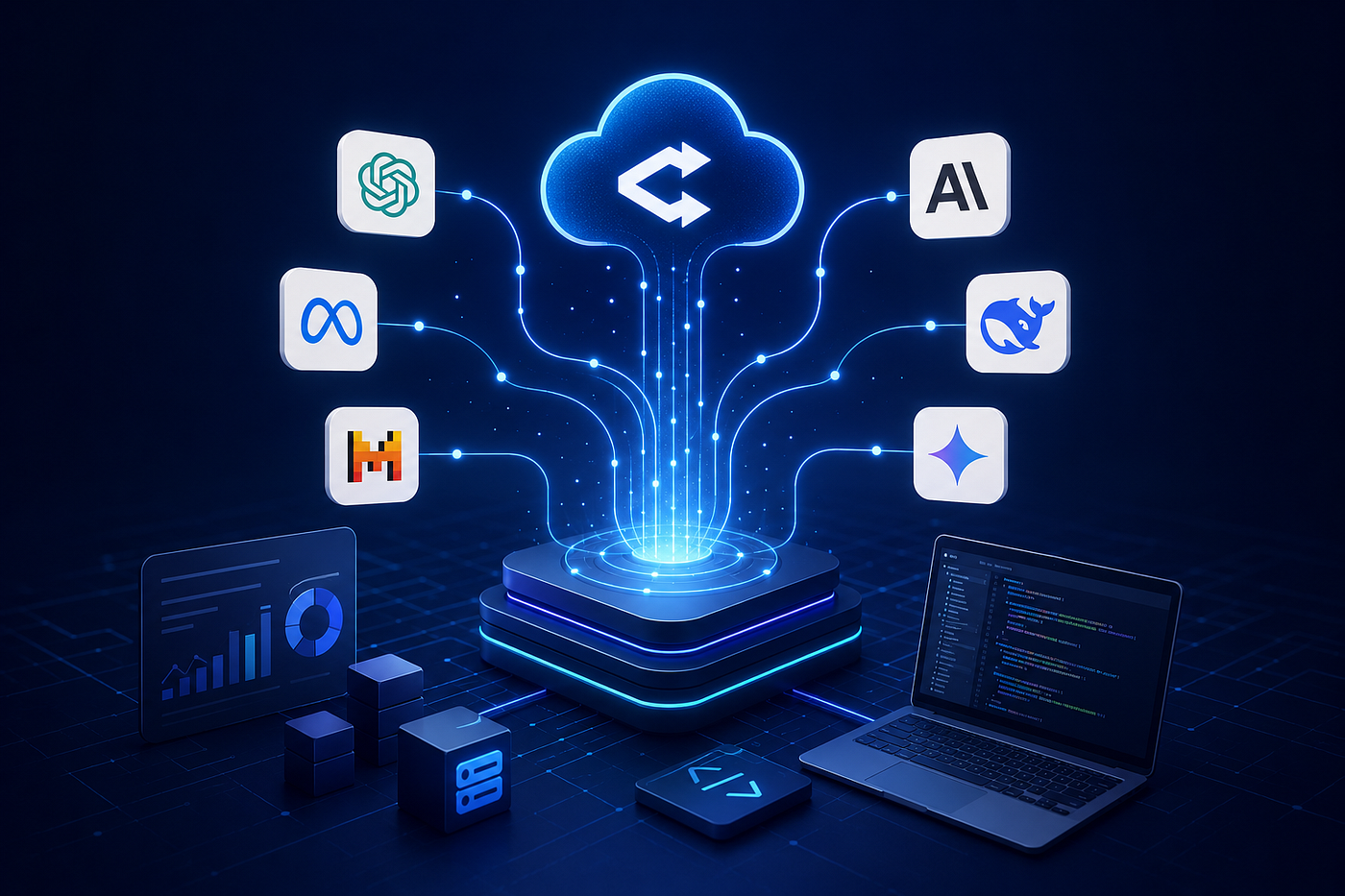
The open-source approach to solving this problem is a routing layer that aggregates the free tiers of multiple LLM providers behind a single API endpoint. The developer selects which providers to include, and the router handles directing requests based on remaining free quota, automatically switching to the next available provider when any individual provider’s free allocation is exhausted.
The practical effect is that the developer interacts with one endpoint, writes code against one API specification, and benefits from the combined free capacity of all included providers without managing quota state manually or writing provider-specific failover logic.
This kind of architecture is not conceptually new. Load balancers and API gateways have existed for decades. What makes the AI provider version particularly interesting is the heterogeneity of the underlying systems: different models have meaningfully different capability profiles, different context window sizes, different latency characteristics, and different strengths across task types. A sophisticated router does not just switch providers on quota exhaustion. It can route based on request characteristics, directing long-context tasks to providers with larger windows and coding tasks to providers with higher benchmark scores on software engineering tasks.
OpenRouter’s openrouter/free router implements this logic at the platform level, but the open-source equivalent allows the same routing behavior on self-managed infrastructure, with full control over which providers are included and how routing decisions are made.
Getting Started With Free Tier Routing
For developers who want to work with free models through OpenRouter’s unified API, the simplest entry point is selecting openrouter/free as the model identifier. This works with any OpenAI-compatible client:
import openai
client = openai.OpenAI(
    base_url="https://openrouter.ai/api/v1",
    api_key="your-openrouter-api-key"
)
response = client.chat.completions.create(
    model="openrouter/free",
    messages=[
        {"role": "user", "content": "Explain the Mixture-of-Experts architecture."}
    ]
)
print(response.choices[0].message.content)
For developers who want to target a specific free model directly:
response = client.chat.completions.create(
    model="nvidia/nemotron-3-super",
    messages=[
        {"role": "user", "content": "Review this code and identify potential issues."}
    ]
)
The same interface works with JavaScript, Go, and any other language with an HTTP client, since the OpenRouter API follows the OpenAI specification exactly.
For the open-source self-managed router, the configuration typically involves specifying provider credentials and quota limits, then running the router as a local service that exposes the same API interface. A minimal configuration might look like this:
providers:
  - name: openrouter
    api_key: your-openrouter-key
    free_quota_tokens: 500000
  - name: together
    api_key: your-together-key
    free_quota_tokens: 400000
  - name: groq
    api_key: your-groq-key
    free_quota_tokens: 200000
routing:
  strategy: quota-aware
  fallback: round-robin
With this configuration, the router directs requests to the first provider with remaining quota, tracks consumption across the configured window, and fails over automatically when a provider’s free allocation is exhausted.
Choosing the Right Free Model for the Task
With this many capable free models available, the selection decision depends on the nature of the work. For complex reasoning, long-context analysis, or multi-agent workflows, NVIDIA Nemotron 3 Super and Ring-2.6–1T offer the deepest capability at no cost. For software engineering and code generation specifically, Laguna M.1 and gpt-oss-120b are purpose-optimized and benchmark at production-relevant levels.
For multimodal applications that need to process images or video, NVIDIA’s Nemotron Omni family and Google’s Gemma 4 31B are the strongest free options currently available. For applications requiring multilingual support across a wide range of languages, Gemma 4 31B’s coverage of 140-plus languages makes it the natural choice.
For latency-sensitive applications or deployments on consumer hardware, the smaller models such as gpt-oss-20b and Poolside Laguna XS.2 offer meaningfully lower latency with a capability profile that remains competitive for many practical tasks.
For agentic workflows specifically, Owl Alpha’s one-million-token context and native tool use, Ring-2.6–1T’s adaptive reasoning effort, and Trinity Large Thinking’s preserved reasoning pattern each offer a distinct approach to agent-level capability within the free tier.
Conclusion
The combination of genuinely capable free models and open-source routing infrastructure has changed the economics of AI experimentation and early-stage development. The 1.3 billion free tokens available monthly across OpenRouter’s free model catalog are not a sampling of limited capabilities. They represent some of the most powerful language models ever built, offered at no cost by organizations that have made a deliberate choice to support open and accessible AI development.
For developers with ideas that deserve testing before a budget is committed, and for teams building applications where inference cost is a meaningful constraint, this ecosystem deserves serious attention. The open-source routing layer that aggregates free tiers across providers removes the last significant operational friction, making it practical to build production-quality AI features against free capacity without writing provider-specific logic or manually managing quota state across multiple accounts. The tools are there. The capacity is there. The barrier is lower than it has ever been.
메타데이터
- post_id
- b6ce63a14c4f
- slug
- 1-3-billion-free-tokens-every-month-how-openrouter-and-open-source-routing-are-making-serious-ai-b6ce63a14c4f
- url
- https://medium.com/ai-mindset/1-3-billion-free-tokens-every-month-how-openrouter-and-open-source-routing-are-making-serious-ai-b6ce63a14c4f
- canonical_url
- https://medium.com/ai-mindset/1-3-billion-free-tokens-every-month-how-openrouter-and-open-source-routing-are-making-serious-ai-b6ce63a14c4f
- author_url
- https://medium.com/@eng.fadishaar
- status
- ok
- fetched_at
- 2026-06-10 18:55:46