NYSE, Nasdaq, and DTCC are building tokenized equity infrastructure.
TradFi is building tokenized equity infra — NYSE announced a 24/7 tokenized equities platform, Nasdaq filed with the SEC to enable trading…
NYSE, Nasdaq, and DTCC are building tokenized equity infrastructure. Here’s what crypto captures — and what it doesn’t.
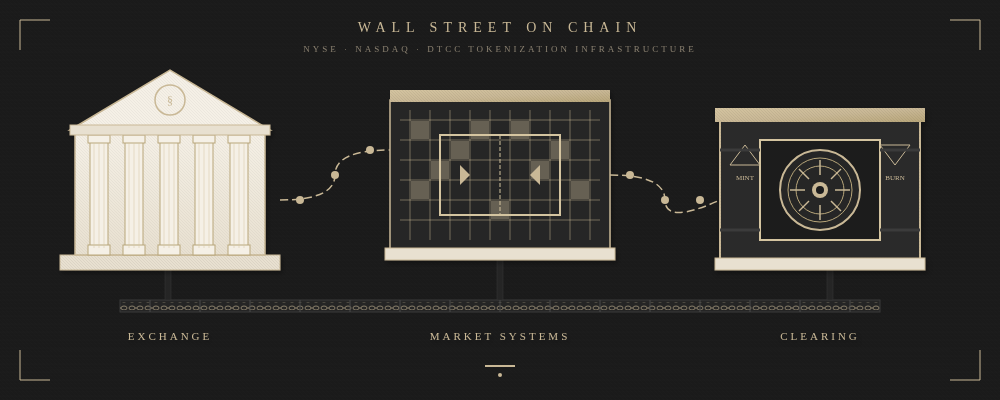
TradFi is building tokenized equity infra — NYSE announced a 24/7 tokenized equities platform, Nasdaq filed with the SEC to enable trading of tokenized equity, and DTC got a SEC no-action letter to mint/burn tokenized equities on-chain. Sure, this kills the crypto tokenized equity issuers’ value proposition. But it’s a redistribution of value. Here’s where crypto actually captures it: approved chains, stablecoin settlement, DeFi composability, and licensed distribution.
NYSE’s tokenized equity platform
Earlier this week, the New York Stock Exchange announced the development of a platform for 24×7 trading and on-chain settlement of tokenized U.S. equities, pending regulatory approval.
The platform will combine NYSE’s Pillar matching engine with blockchain-based post-trade systems, enabling instant settlement, stablecoin-based funding, and multi-chain custody. Tokenized shareholders will retain the same economic and governance rights as conventional shareholders, including dividends and voting rights.
This isn’t the first mover. On September 8, 2025, Nasdaq filed a proposal with the SEC to enable trading of tokenized equity securities and ETPs on its markets.
Why DTCC Is the Real Story
But the most significant development is DTCC. As the entity that clears and settles virtually all broker-to-broker equity transactions in U.S. markets. Its subsidiary DTC received a no-action letter from the SEC on December 11, 2025, enabling it to tokenize security entitlements on. DTC will provide minting and burning of tokens for eligible securities via multiple ‘approved’ public or private blockchains including Canton Network. The platform will be production ready in the second half year of 2026 and all broker-dealrs, banks or other financial institutions that are a DTC participant can then choose to open a Registered Wallet on any of approved blockchains.
Below is the minting and burning flow by DTC for eligible assets.

https://www.dtcc.com/-/media/Files/Downloads/digital-assets/conversion-order-flows.pdf
How it works:
- DTC Participants register one or more wallet addresses on an approved blockchain
- DTC uses its “Factory” software system to mint tokens representing security entitlements
- Participants can transfer tokens directly between whitelisted wallets without instructing DTC
- Participants can de-tokenize at any time, converting back to standard DTC book-entry entitlements
Eligible securities in the first phase:
- Russell 1000 constituents
- U.S. Treasury securities (bills, bonds, notes)
- ETFs tracking major indices (S&P 500, Nasdaq-100)
“Official” vs. “Unofficial” Tokenized Equity
I’d call what NYSE/Nasdaq/DTCC will issue “official tokenized equity” versus the “unofficial” versions from crypto platforms. The structural advantages are massive:
- Direct Link to Shareholder Rights
TradFi exchanges work directly with transfer agents, registrars, and clearing agencies. Tokenized shares map 1:1 to legal ownership — voting rights, dividends, corporate actions all preserved under existing corporate law.
By contrast, tokenized equities on crypto platforms like Kraken’s xStocks explicitly state: holders do not possess ownership rights over the underlying stock, nor are they entitled to receive shareholder rights. These are economic representations, not legal shares.
2. Full Capital Markets Integration
NYSE and Nasdaq sit at the center of the equity lifecycle: IPOs and follow-on offerings, proxy voting and dividends, index inclusion (S&P, Russell, MSCI), securities lending, margin, repo, and ETF creation/redemption.
Crypto-issued tokens cannot participate in primary issuance, support corporate actions natively, or integrate with index and ETF machinery. They deliver price exposure, not capital formation.
Is crypto getting regulated out?
When the NYSE announcement hit, some crypto people read it as an existential crisis. And in some ways, it is — this essentially kills the crypto tokenized equity issuers’ value proposition.
However, when NYSE, Nasdaq, and DTCC standardize the infrastructure for tokenized equities, new structural opportunities emerge for crypto-native companies.
Where Value Actually Gets Captured
When TradFi standardizes tokenized equity infrastructure, value doesn’t disappear — it redistributes.
The evidence is already overwhelming.
Broadridge’s Distributed Ledger Repo platform processed an average of $385 billion in daily repo transactions during December 2025, with nearly $11.55 trillion processed that month alone — up 490% year-over-year. That’s Wall Street’s overnight funding machine already running on blockchain rails.
Goldman Sachs and BNY launched a tokenized money market funds solution in July 2025, with BlackRock, Fidelity Investments, and Federated Hermes participating in the initial launch. JPMorgan’s Onyx (now Kinexys) has been executing blockchain-based repo trades since 2020.
The pattern is clear: institutions aren’t avoiding blockchain — they’re building their own value chains on it.
The question for crypto participants: where do you fit?
1. Approved Blockchain Infrastructure
Canton Network is the clearest play. DTCC announced a partnership with Digital Asset to tokenize U.S. Treasury securities on Canton.

Nasdaq joined as a Super Validator. J.P. Morgan’s Kinexys announced in January 2026 that it will bring JPM Coin natively to Canton in a phased rollout throughout 2026.
Canton Coin (CC) currently sits at ~$4.9B market cap (#20 on CoinMarketCap). The network’s institutional backing is unmatched — Goldman Sachs, IBM, J.P. Morgan, BNP Paribas, Deutsche Börse, and DTCC itself. Super Validators like Nasdaq and Goldman Sachs handle high-security coordination while regular validators manage day-to-day operations.
Critically, Canton didn’t create founder, team, or investor allocations — CC is emitted continuously and distributed to whoever is powering the network: validators, super validators, and developers. No unlock cliffs, no hidden overhang, no calendar-based supply shocks.
Ethereum is also likely to be approved by DTCC given its L2 ecosystem, existing institutional infrastructure. According to yahoo Finance: “In addition to Canton, DTCC plans to offer tokenized securities on “AppChain,” a permissioned, Ethereum-compatible network for applications that’s built on open-source technology.” Ethereum’s composability and DeFi ecosystem make it attractive for secondary market activity.
2. Stablecoin Settlement
NYSE’s platform will enable stablecoin-based funding for tokenized trading. This is a structural tailwind for regulated stablecoin issuers.
Circle (USDC) is positioned to capture significant settlement volume. In December 2025, Visa launched USDC settlement in the United States — for the first time, U.S. issuer and acquirer partners can settle with Visa in USDC over the Solana blockchain. Cross River Bank and Lead Bank are the initial participants, with broader availability planned through 2026.
Visa’s monthly stablecoin settlement volume has reached a $3.5 billion annualized run rate. That’s stablecoins moving from crypto-native use cases into core payment infrastructure.
The institutional adoption is accelerating. JPMorgan’s JPM Coin uses tokenized bank deposits for real-time, on-chain settlement between institutional clients. Citibank, Goldman Sachs, and UBS are all experimenting with tokenized deposits through initiatives like the Canton Network. Mastercard has announced partnerships to bring USDC and EURC settlement to acquirers across Europe, the Middle East, and Africa.
For tokenized equities specifically, the ability to settle in stablecoins enables 24/7 trading without dependence on banking hours — a core value proposition of the NYSE platform.
3. Licensed Crypto Intermediaries
Every TradFi broker-dealer will need blockchain support to participate. This favors crypto exchanges that already hold broker-dealer licenses.
Kraken offers equities trading in the US through Kraken Securities LLC, a broker-dealer registered with the SEC and a member of FINRA.
Dinari became the first firm to secure a broker-dealer license specifically to offer tokenized securities. Coinbase holds a dormant broker-dealer license and is actively seeking SEC approval for tokenized stock trading.
The structural advantage: these firms already have crypto-native users, on/off ramp infrastructure, and blockchain integration. Traditional broker-dealers will need to build this from scratch.
4. DeFi Integration
When DTC-issued tokenized equities become available, DeFi protocols can integrate them as collateral, yield sources, and trading pairs. This is where crypto-native infrastructure captures value.
The groundwork is already laid.
Ondo Finance has surpassed $2 billion in TVL across tokenized Treasuries, equities, and ETFs. Their OUSG token offers exposure to short-term U.S. Treasuries, while Ondo Global Markets launched tokenized U.S. stocks and ETFs in September 2025.
MakerDAO (now rebranded to Sky) holds approximately $900–950 million in RWA collateral, much of it US Treasuries, forming about 14% of total reserves. The protocol uses tokenized Treasuries via sDAI as collateral for DAI minting, demonstrating how traditional assets can integrate into DeFi yield strategies.
Onchain asset management platform Centrifuge distributes over $1.3 billion of tokenized assets including credit funds and equity index products, with partnerships with S&P Dow Jones Indices for the first licensed S&P 500 index fund token on blockchain.
Onchain asset management platform Maple Finance has grown to $2.5 billion in TVL serving institutional credit markets, with active loans expanding 45.2% in Q3 2025 to $1.75 billion.
When official tokenized equities arrive, these same protocols can integrate them — using tokenized AAPL or SPY as collateral, creating yield strategies, or enabling on-chain lending against equity positions. The infrastructure exists; it just needs the assets.
5. Collateral Mobility & 24/7 Repo
In July 2025, an industry working group completed live 24/7 trades on Canton Network, achieving on-chain intraday and after-hours financing using tokenized U.S. Treasuries, with atomic settlement outside market hours.
This creates opportunities for market makers arbitraging between on-chain and traditional liquidity pools, liquidity providers earning yield by facilitating 24/7 repo markets, and DeFi protocols integrating official collateral into lending markets.
What Crypto Probably Won’t Capture
Let’s be realistic:
Absorbed by TradFi: Primary issuance (IPOs, follow-ons), custody of underlying shares, corporate actions (dividends, voting, splits), index inclusion mechanics, regulatory compliance and reporting.
Potentially retained by crypto: Settlement infrastructure (stablecoins, approved chains), 24/7 liquidity provision, DeFi composability (collateral, lending, derivatives), cross-chain interoperability, retail distribution via licensed crypto exchanges.
TradFi keeps the high-margin, high-trust functions. Crypto captures the infrastructure layer and the composability layer — valuable, but different from issuing securities.
The Bigger Picture
Tokenization of real-world assets has emerged as one of the biggest narratives in crypto, with total distributed value more than tripling over the past year.
McKinsey projects total tokenized market capitalization could reach around $2 trillion by 2030, driven by adoption in mutual funds, bonds, ETNs, loans, securitization, and alternative funds.
Boston Consulting Group and Ripple estimate tokenization could reach $19 trillion by 2033 — close to a tenth of global GDP.
The benefits are clear:
- 24/7 trading across global time zones
- Instant settlement (T+0 vs T+1), reducing counterparty risk
- Fractional ownership removing barriers to premium stocks
- Global access for investors worldwide
- Programmable assets enabling DeFi composability
- Collateral mobility allowing assets to move freely between ecosystems
When NYSE, Nasdaq, and DTCC standardize tokenized equity infrastructure, history suggests a new wave of financial intermediaries emerges — just as electronic trading created new broker-dealers in the 2000s, and just as ETFs created new issuers and market makers.
For crypto participants, the playbook is:
- Own the rails: Canton validators, Ethereum stakers, approved chain infrastructure
- Own the settlement: Stablecoin integration, on/off ramps
- Own the composability: DeFi protocols that integrate official tokenized assets
- Own the distribution: Licensed broker-dealers with crypto-native user bases
The rest — the shareholder rights, the corporate actions, the regulatory moat — stays with TradFi. And that’s probably fine. The infrastructure layer of a multi-trillion dollar market is still a massive opportunity.
The honest assessment: TradFi is absorbing blockchain’s best innovations. But they’re building on crypto rails, using crypto settlement, and connecting to crypto liquidity. The value may shift, but it doesn’t disappear — it just moves to different parts of the stack.
메타데이터
- post_id
- b6f56a2bd6f1
- slug
- wall-street-on-chain-existential-crisis-or-structural-opportunity-for-crypto-b6f56a2bd6f1
- url
- https://medium.com/@natalie-d/wall-street-on-chain-existential-crisis-or-structural-opportunity-for-crypto-b6f56a2bd6f1
- canonical_url
- https://medium.com/@natalie-d/wall-street-on-chain-existential-crisis-or-structural-opportunity-for-crypto-b6f56a2bd6f1
- author_url
- https://medium.com/@natalie-d
- status
- ok
- fetched_at
- 2026-06-16 19:09:56