Recursive Language Models: What They Are, Why They Matter, and How They Work
If you gave a human a million-page document and asked a question, they wouldn’t read every word.
Recursive Language Models: What They Are, Why They Matter, and How They Work
Photo by Vimal S on Unsplash
If you gave a human a million-page document and asked a question, they wouldn’t read every word.
They would search. They would skim. They would break the problem into parts.
Transformers don’t do that. They process everything in parallel through attention — even when most of it is irrelevant.
Recursive Language Models bring something new to language models: Control flow.
The Real Problem with Long Context
Long context is failing because attention doesn’t scale as cleanly as we pretend.
Transformers process context through dense self-attention. Every token attends to every other token. As sequence length grows, computation grows rapidly and signal quality drops.
In theory, a 1M-token window means the model can reason over 1M tokens.
In practice, something else happens.
1. Context Rot
As input length increases, model performance degrades — even when the relevant information is inside the window.
This isn’t a hard limit. It’s a soft degradation.
The model technically “sees” everything. But its ability to prioritize what matters weakens.
Attention becomes diffuse. Important tokens compete with thousands of irrelevant ones. Signal gets diluted.
More context doesn’t automatically mean better reasoning.
2. The Lost-in-the-Middle Problem
Empirical studies show that models tend to prioritize information at the beginning and end of a long context.
Information in the middle is more likely to be ignored.
And it’s a structural behavior of attention patterns.
Even when the answer is clearly present in the prompt, the model may miss it simply because of where it is positioned.
Bigger windows don’t fix this. They just make the middle larger.
3. Attention Is Not Structured Search
Attention treats context as a flat field of tokens.
It does not:
- Build an index
- Perform hierarchical search
- Execute divide-and-conquer logic
- Navigate the document step by step
It computes weighted correlations across the entire sequence in parallel.
That’s powerful for pattern recognition. But it’s inefficient for structured exploration.
When we push massive documents into attention, we’re asking the model to solve a search problem using correlation.
That mismatch becomes visible at scale.
The Core Limitation
The long-context problem is about control.
Standard LLMs have no explicit mechanism to:
- Decide which region to inspect first
- Narrow the search space
- Recursively refine hypotheses
- Separate reasoning from storage
Everything happens inside one forward pass. And as context grows, that flat, monolithic pass becomes harder to manage.
This is the gap Recursive Language Models try to fill.
What RLMs Actually Are
Recursive Language Models are not bigger models.
They are not models with larger context windows. And they are not a new transformer variant.
They are a shift in how language models are used.
Traditional LLMs operate in a single forward pass. You give them a prompt. They process the entire context through attention. They produce an output.
Everything happens in one monolithic computation.
Recursive Language Models break that assumption.
They allow the model to decompose a task into smaller sub-tasks, solve those sub-tasks independently, and combine the results into a final answer.
Instead of one large reasoning step, you get structured reasoning over multiple steps.
The Core Difference
A standard LLM treats context as input.
An RLM treats context as state.
That distinction matters.
In the traditional setup, all information must fit inside the model’s context window at once. The model’s only tool is attention.
In an RLM setup, the information can live outside the model — in a controlled environment such as a Python runtime or structured memory.
The model interacts with that environment.
It can:
- Inspect parts of it
- Transform sections of it
- Generate sub-queries
- Call itself recursively on smaller pieces
The reasoning process becomes iterative instead of flat.
From Correlation to Control Flow
Transformers excel at pattern correlation across tokens. But correlation is not the same as structured computation.
Recursive Language Models introduce something transformers lack natively: Control flow.
Instead of forcing attention to compare every token against every other token, the model can decide:
- Where to look first
- What to ignore
- How to reduce the problem
- When to stop
This changes long-context reasoning from brute-force attention into guided exploration.
A Compact Definition
You could define a Recursive Language Model like this:
A Recursive Language Model is an inference framework in which a language model interacts with external context programmatically and can recursively call itself to decompose and solve complex tasks.
What Problem Do Recursive Language Models Actually Solve?
1. Structured Exploration of Massive Data
Traditional LLMs process long documents through dense attention. Everything is compared against everything else.
RLMs change the strategy.
Instead of flattening all information into a single token sequence, they allow the model to:
- Inspect specific regions of the data
- Partition the context into manageable segments
- Narrow the search space step by step
- Aggregate intermediate results
This turns long-context reasoning into a structured exploration problem instead of a correlation problem.
The model doesn’t “scan everything.” It navigates.
2. Long-Horizon Reasoning
When a task requires multiple intermediate steps — searching, filtering, summarizing, refining — standard LLMs must simulate that reasoning inside one continuous generation.
RLMs externalize those steps.
They allow:
- Recursive sub-queries
- Independent sub-computations
- Iterative refinement
- Explicit composition of results
This makes multi-stage reasoning more stable because intermediate steps are executed and returned before the final answer is produced.
The reasoning process becomes modular rather than monolithic.
3. Deterministic Context Traversal
Attention is probabilistic and diffuse.
RLM-based systems can implement deterministic traversal strategies:
- Binary-style narrowing
- Chunk-by-chunk summarization
- Indexed lookups
- Explicit filtering
Instead of hoping the attention mechanism focuses on the right tokens, the system can explicitly control which parts of the context are inspected.
This reduces ambiguity in how information is accessed.
4. Separation of Reasoning from Storage
In standard LLM usage, reasoning and storage compete for the same limited context window.
All retrieved data must be injected into the prompt.
RLMs decouple the two.
- Storage lives outside the model (e.g., database, file system, memory).
- The model interacts with it as needed.
- Only relevant intermediate results are fed back into the reasoning loop.
This separation reduces context pollution and keeps the reasoning surface focused.
What RLMs Do Not Solve
Recursive Language Models are not a universal fix. They do not eliminate hallucinations.
If a model reasons incorrectly at one recursive step, errors can propagate.
They do not automatically reduce latency. Recursive calls introduce sequential execution and can increase wall-clock time.
They do not solve code-generation fragility. If the model generates incorrect instructions, the system must handle failures safely.
And they are not optimized for real-time conversational speed. RLM frameworks are better suited for research, analysis, and long-horizon tasks than instant chat responses.
RLM vs RAG: What’s the Difference?
At first glance, Recursive Language Models can look like an advanced form of Retrieval-Augmented Generation.
Both:
- Store information outside the model
- Fetch relevant pieces when needed
- Avoid stuffing everything into the context window
But the similarity stops there. The underlying philosophy is different.
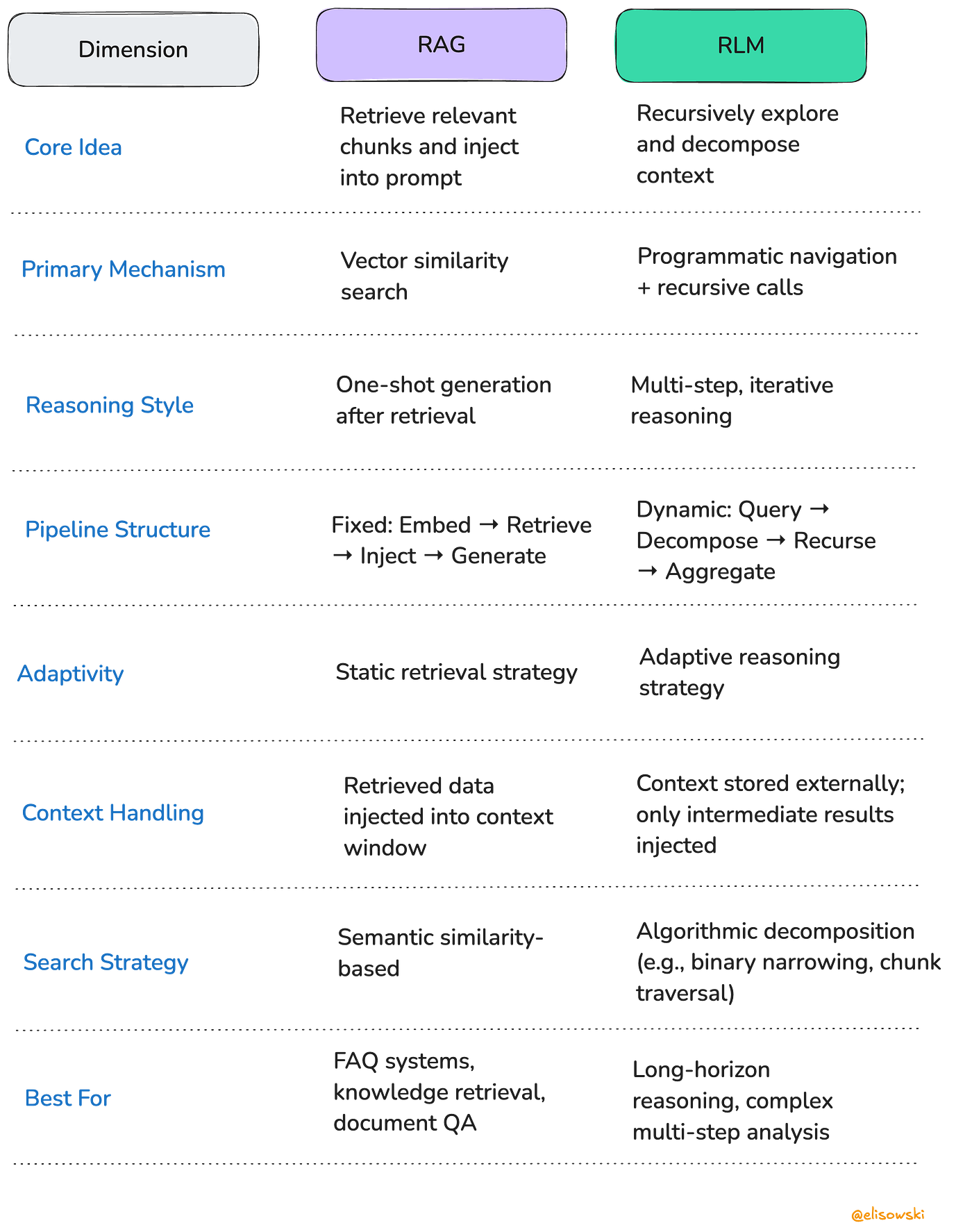
1. Retrieval vs Exploration
RAG retrieves. You embed documents, store them in a vector database, and retrieve the most similar chunks to the query. Those chunks are injected into the prompt.
It’s a one-step lookup.
RLM explores. Instead of retrieving once, the model can:
- Query
- Inspect
- Partition
- Re-query
- Refine
- Aggregate
It’s multi-step and adaptive.
RAG answers:
“What chunks are most similar to this query?”
RLM asks:
“How should I navigate this data to solve this problem?”
2. Static vs Dynamic Reasoning
RAG pipelines are typically fixed:
- Embed query
- Retrieve top-k documents
- Inject into prompt
- Generate answer
The structure doesn’t change based on complexity.
RLMs are dynamic.
The model decides:
- Whether to split the task
- Whether to call sub-queries
- Whether to recurse deeper
- How to combine intermediate outputs
The reasoning strategy adapts to the problem.
3. Similarity Search vs Algorithmic Decomposition
RAG relies on semantic similarity.
If the answer is close in embedding space, retrieval works well.
But similarity search struggles when:
- The query requires combining multiple distant sections
- The relevant information isn’t semantically similar to the question
- The task requires stepwise narrowing rather than lookup
RLMs allow algorithmic decomposition.
For example:
- Binary search over document sections
- Recursive summarization
- Structured filtering
- Iterative hypothesis testing
4. Injection vs Separation
In RAG, retrieved chunks are injected directly into the context window.
Reasoning and storage still share the same space.
In RLM systems:
- Storage remains external.
- Only intermediate results are injected.
- The main context stays focused on reasoning.
This separation reduces noise and prevents context overload.
Are They Opposed?
No.
In practice, RLMs can use retrieval internally.
You can combine:
- Vector search for coarse filtering
- Recursive decomposition for structured reasoning
RAG optimizes access. RLM optimizes reasoning over large structures.
They solve different layers of the same problem.
Where Recursive Language Models Could Go Next
Recursive Language Models are still early. But the direction they point to is important.
They shift progress from scaling parameters to scaling inference structure. That opens several paths.
RLM + Reinforcement Learning
Right now, most RLM systems rely on prompting to guide recursive behavior.
But there’s no reason that strategy has to remain static.
You can imagine training models with reinforcement learning to:
- Learn better decomposition strategies
- Optimize recursive depth
- Minimize unnecessary sub-calls
- Balance cost vs accuracy
RLM + Agents
Agents already use tools, memory, and iterative reasoning.
RLMs provide structure for long-horizon control.
Instead of agents relying on ad-hoc chains of prompts and memory compression, recursive frameworks offer:
- Explicit task decomposition
- External state management
- Controlled intermediate execution
- Clear termination signals
This makes agent systems more modular and less brittle.
RLM + Multimodal Systems
As models expand into video, codebases, sensor streams, and large datasets, brute-force attention becomes even less practical.
Recursive traversal becomes more natural.
For example:
- Navigating a long video by recursively narrowing time segments
- Exploring a massive code repository function by function
- Analyzing structured logs through staged filtering
RLM-like control flow may become essential for multimodal reasoning.
메타데이터
- post_id
- b6f6471831c7
- slug
- recursive-language-models-what-they-are-why-they-matter-and-how-they-work-b6f6471831c7
- url
- https://medium.com/@elisowski/recursive-language-models-what-they-are-why-they-matter-and-how-they-work-b6f6471831c7
- canonical_url
- https://medium.com/@elisowski/recursive-language-models-what-they-are-why-they-matter-and-how-they-work-b6f6471831c7
- author_url
- https://medium.com/@elisowski
- status
- ok
- fetched_at
- 2026-06-12 07:40:50