Airbus estimates that Thailand has the potential to produce over 5 million tonnes of SAF a year
That’s equivalent to the country’s entire consumption of jet fuel in 2019
Airbus estimates that Thailand has the potential to produce over 5 million tonnes of SAF a year
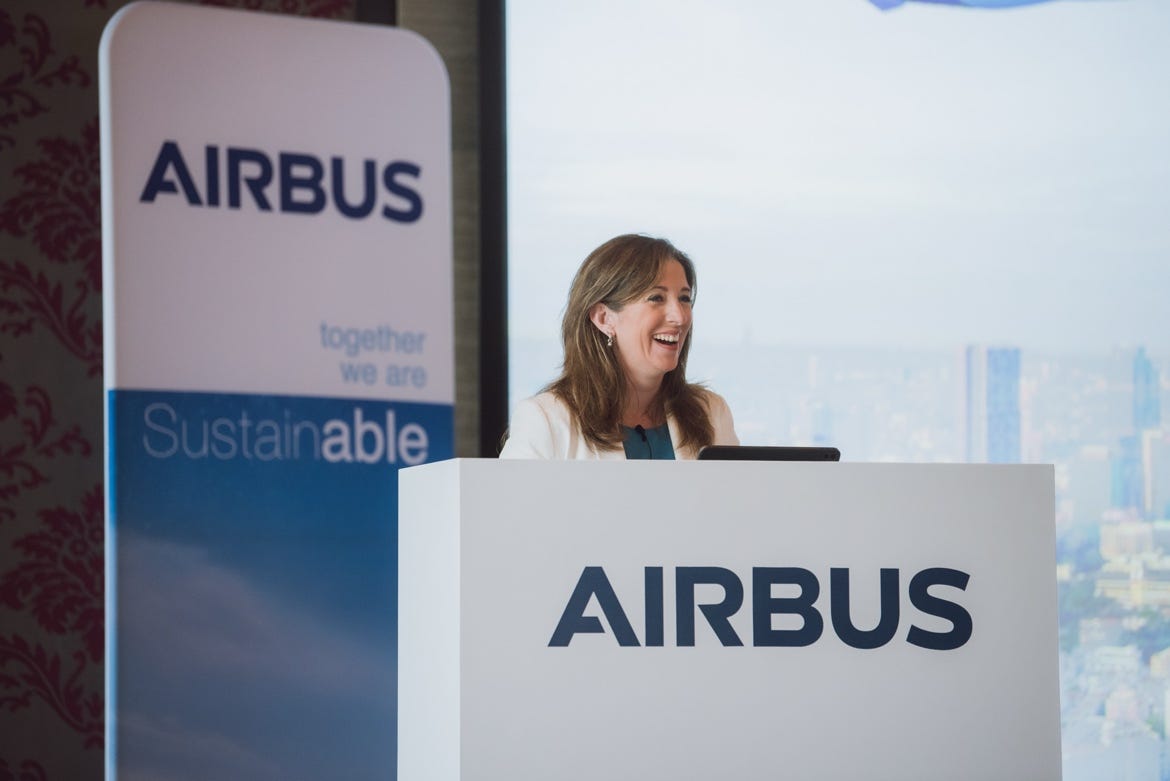
That’s equivalent to the country’s entire consumption of jet fuel in 2019
· It’s clear that the development of a large-scale SAF industry would bring Thailand multiple benefits, starting with improved energy security and export opportunities.
· It would also support economic development in rural areas: agricultural waste would have a financial value as a SAF feedstock
· Collecting agricultural waste, rather than burning it, would also help to address air pollution
More information on SAF in Thailand on Page 10
Please find the rest of the speech by Julie Kitcher, Airbus Chief Sustainability Officer, delivered on 11 April 2025 during the Airbus Industry Outreach event in Thailand.

I’m pleased to be here in Bangkok and would like to begin by expressing sincere sympathies for all those affected by the recent earthquake in Myanmar and nearby countries, including Thailand.
We all saw the GISTDA images taken from the Airbus THEOS-2 satellite, comparing areas in Bangkok before and after the quake.
This highlights the crucial role satellite imagery can play in disaster assessment, and we are proud to have worked with Thailand to deliver this latest generation application.
At Airbus, we are so happy to have grown our presence in this beautiful country over many years.
Thai Airways is, of course, one of our longest-standing customers: our partnership began in 1977. We also provide aircraft to Bangkok Airways, Thai AirAsia and Thai Vietjet. In fact, Airbus supplies Thailand with products from across our defence, space and helicopter portfolios too.
We are equally pleased that our Flight Operations Services Centre and helicopter maintenance facility is located here. And we are committed to building further on our presence in Thailand, including with new partnerships in the area of sustainability, where we see huge potential.
Today, I will set out the path to decarbonisation for the global aviation sector. I will then reinforce the importance of sustainable aviation fuels. Finally, I will look at the role Thailand can play in this revolution as a supplier of these fuels.
I will begin, however, by stepping back and considering why decarbonisation matters and why flight matters.
Aviation is a powerful force for good in the world. This sector fuels employment and prosperity, moving a third of global trade by value and supporting 86.5 million jobs worldwide.
It brings people together across borders and cultures, with five billion airline passengers in the world last year alone. I always find that there is an especially acute understanding of the importance of aviation in this region.
In Thailand alone, the aviation sector employs some 133,500 people and accounted for more than 7% of the country’s GDP before COVID. More than 80% of the tourists who visit Thailand arrive by air. Over vast distances, often over large expanses of sea, air travel is very often the only viable means of transportation in this region.
Aviation is as critical to communities here as other basic forms of infrastructure. This is why the decarbonisation of flight is so important. By reducing emissions and addressing climate change, we can ensure that future generations will benefit from the transformative power of flight, just as we do in 2025.
We can also ensure aerospace’s positive contribution today doesn’t come at the expense of these future generations.
2024 was the warmest year on record globally, and the first calendar year in which the average global temperature exceeded 1.5°C above its pre-industrial level (the limit set in the Paris agreement).
Parts of the Asia-Pacific region are already experiencing the effects of climate change. At the moment, I am often asked about whether we will scale back our commitment to decarbonisation.
This follows recent perceived changes of direction by some governments and companies. I am pleased to say that at Airbus, our conviction has not faltered. Sustainability is at the heart of our purpose — to pioneer sustainable aerospace for a safe and united world.
We know that reaching net-zero emissions in this sector will be extremely challenging. We do not have all the answers and we can not do it alone. It will take unprecedented collaboration to reach our net zero goal.
That’s why I am really pleased to see that many friends and partners here in Thailand and the Asia-Pacific region share our conviction. As chair of the ASEAN Air Transport Working Group, Thailand is driving the decarbonisation of aviation in the region.
And Thailand is a signatory of CORSIA, the carbon offsetting and reduction scheme for international aviation.
Decarbonisation: roadmap
At the beginning of 2025, what is the state of play on decarbonisation?
Even five years ago, aviation was labelled simply as “difficult to decarbonise”. That perception has changed fast. The global aviation industry is now united by a clear path to net-zero emissions by 2050.
What is the path ahead? Put simply, fuel-efficient aircraft, improved air traffic management and operations, and Sustainable Aviation Fuels — known as “SAF” within the industry — will combine to provide most of the emissions reductions before 2050.
There will, of course, be some remaining so-called “residual emissions” in 2050. For these, carbon removal comes into play. There are natural ways of removing carbon from the atmosphere, such as reforestation. Thailand has not only made a commitment to stop deforestation but also to promote reforestation as a way to generate carbon credits.
Technological innovation provides other means to remove carbon from the atmosphere. Direct Air Capture technology, for example, captures CO2 directly from the atmosphere and can store it safely underground.
What about the more distant future? In the second half of the century, hydrogen will join SAF as a low carbon aviation fuel of the future.
Decarbonisation: the aircraft of today and tomorrow
So let me focus on fuel-efficiency first. Technological advances continue to drive remarkable improvements in fuel-efficiency.
Indeed, these efficiency improvements are at the core of our competitiveness as a business for a simple reason: more fuel-efficient aircraft make the airlines, our customers, more competitive.
Our latest generation of aircraft is around 25% more fuel-efficient than the last one and sometimes even more. Overall the proportion of the newest generation of commercial aircraft in the global fleet represents only one-third.
The Asia-Pacific’s region’s airlines have been replacing older planes with these new aircraft. We’re also laying the technological foundations or “bricks” for the aircraft of tomorrow.
Our engineers are already working on the next generation of single-aisle aircraft for the second half of the 2030s. We expect this aircraft to feature new aerodynamic wings, which are likely to be longer, slimmer and lighter than anything we see today.
It could also feature so-called “open fan” engines, with visible fan blades. In today’s aircraft engines the rotating fans are enclosed behind casing. With our partner CFM, the engine maker, we intend to test this exciting engine technology on a demonstrator aircraft by the end of this decade.
This new single-aisle aircraft would also be capable of being powered solely by sustainable aviation fuels. It would provide another radical step forward in fuel efficiency and emissions reductions. I’m talking about a gain of between 20 and 30% compared to today’s most advanced aircraft.
Hydrogen
So that’s tomorrow. What about the day after tomorrow? At Airbus, we remain convinced that hydrogen-powered aviation will also be a defining feature of the decarbonisation of aerospace.
Hydrogen is one of the most promising alternatives to power a low-emission aircraft because it emits no carbon dioxide when generated from renewable energy.
Some of you may know that we recently pushed back our plans to bring the first such aircraft to the market by 2035. We began work on this project in 2020.
Back then, perhaps we were a little optimistic in setting a deadline of 2035. The main challenge is that a global hydrogen production and distribution network has struggled to gain momentum.
Renewable hydrogen production projects are under development in the world. But they face headwinds. As a result, hydrogen is unlikely to be available in sufficient quantities in 2035.
Since 2020 we have, however, learned many valuable lessons. Our teams have made considerable progress in researching and understanding hydrogen technology. In fact, we could be ready to proceed with plans to build the aircraft itself. We’ve even addressed perhaps the biggest initial challenge in developing the aircraft: choosing its propulsion technology.
After exploring several options, we have now selected a fully electric propeller propulsion system powered by fuel cells. So be assured that our work on hydrogen technology will continue.
To sum up where we stand: our newest aircraft are already driving significant advances in fuel-efficiency today. The aircraft of tomorrow, the late 2030s, will be the next-generation, fuel-efficient single-aisle.
And the aircraft of the day after tomorrow will be the hydrogen-powered airliner. This is how we expect the fleet of the future to evolve.
Sustainable Aviation Fuels
All this begins to explain why Sustainable Aviation Fuels will be so important in the decarbonisation of aviation.
For many decades to come commercial aircraft will be powered either by conventional kerosene or by renewable, lower-CO2 liquid fuels that can do the same job as kerosene and are compatible with today’s distribution infrastructure. In other words, I’m talking about SAF. This in turn explains why the majority of the emissions reductions needed to reach net-zero in 2050 are expected to come from SAF.
But, first, what is meant by SAF? These fuels are produced from waste, for example used cooking oil, and from biomass, such as crop waste, that does not compete with food production.
Importantly, these fuels have to be certified as sustainable by CORSIA, the international carbon offsetting scheme.
Over the longer term, low-carbon synthetic aviation fuels will be made from green hydrogen, produced using electrolysers powered by low-emissions electricity, combined with CO2 that has been removed from the atmosphere.
Sustainable aviation fuel can reduce emissions by an average of 80% across the lifecycle from production to use. Today, SAF can power Airbus aircraft as part of a 50% blend with kerosene.
We are working to ensure that by 2030 our aircraft are capable of flying on up-to-100% SAF.
What are we striving for? Today, SAF still supplies well under 1% of the global aviation fuel mix. To be on-track for net-zero emissions by 2050, we need to lift that figure to at least 6% by 2030 and as much as 20% by 2035.
These are the targets adopted by ICAO, the global body that oversees aviation worldwide. Is SAF use growing fast enough to fulfil these aspirations? The realistic answer is: not yet.
Global supply is not growing as fast as desired, although it did double last year.
Many people find the story of SAF difficult to understand.
On the one hand, I said supply is not growing fast enough with airlines struggling to get hold of it. On the other hand, it is too expensive for airlines to access in large quantities.
SAF supply and demand today
We are in a chicken and egg situation, we have limited demand due to high pricing, which means no production at scale. We also expect new types of SAF production to begin soon, such as alcohol-to-jet fuel in the US.
There’s also so-called “co-processing”, whereby refineries can co-process up to 5% of approved renewable feedstocks alongside their existing crude oil streams. The necessary upgrade to refineries can be implemented quite quickly.
Demand weakness
Many leading airlines and operators are pledging to use more SAF in their operations. The Association of Asia Pacific Airlines has a target of 5% SAF usage by 2030.
For airlines, however, SAF is still too expensive — in fact between around three and five times more expensive than kerosene. That’s because the SAF industry is still in the early stages of development.
But the high cost of SAF matters because potential producers and investors require security of demand in the form of multi-year purchasing commitments from the airlines.
Policymakers are taking action to boost demand. Mandates are in place in the UK and Europe, for example, which require airlines to fly with a set percentage of SAF in each flight.
In several Asian countries, national SAF roadmaps are appearing, for example in Japan which has an impressive 10% target planned for 2030.
To be able to meet that growing demand beyond 2030, we need to see continuing investment in new SAF projects today. For the time being, a sound business case for SAF seems to be lacking for too many potential producers and airlines.
This in turn is slowing the growth of the market. However, at Airbus we’re confident that it is possible to break this deadlock and accelerate.
And it is imperative that we do accelerate in order to be on-track for 2030, 2035, and ultimately 2050.
Role of policymakers
Effective policies will be critical. And we’re seeing more of them appearing around the world. We’ve already touched on the importance of targets and policies that provide investors with greater clarity.
When implemented, these should give a powerful boost to SAF demand across the Asia-Pacific region, and bring energy security, energy optionality, attract investments and create employment.
There’s more that policymakers can do to support the supply of SAF.
One option is to introduce revenue certainty mechanisms for producers. These are quite complex to explain, but what they do is provide producers with a price guarantee for SAF and greater clarity about the future, allowing them to plan five or seven years ahead.
This certainty gives producers the confidence to invest. Such schemes have worked effectively in other fields. And they are now under consideration by some countries for SAF.
Overall, I’d highlight the importance of governments and regulators moving towards a global, harmonised set of standards and regulations for SAF. Many major centres of aviation are pondering how to regulate SAF at the moment.
At Airbus, we are encouraging them to develop frameworks that are consistent with existing ones elsewhere in the world, for example when determining sustainability criteria for fuels.
Currently, we see different regulatory approaches in the US, China, Europe, the UK and across Asia. A global level playing field would give the SAF market the firm and fair foundations it needs to attract more investment.
Industry contribution
It’s also for us in the aviation industry to continue to do everything we can to support the growth of this market. At Airbus, we’re working with airlines, suppliers, governments, fuel producers and other key partners across the world to encourage the production of these fuels.
We’re also an active partner in the programme run by the global aviation body, ICAO, called “ACT-SAF”, to build capacity and support training on SAF across all regions. We’re also advocating for what’s known as “book and claim” for SAF.
SAF can be hard to access for operators, for example where there isn’t a ready source of supply in a small airport. The book and claim system allows an airline, for example, to book — and pay for — a specific quantity of SAF being burned in an aircraft elsewhere in the world, and claim the associated emission reduction for their own operations.
That’s where the “Airbus Book and Claim Demonstrator” comes in. Through our partnership with the Roundtable on Sustainable Biomaterials, we will facilitate the purchase, management, and resale of Book and Claim units for our customers.
This is part of our effort at Airbus to increase the availability of SAF for operators. So that is the state of play in the global and regional SAF market. The market may be growing more slowly than hoped at the moment. Over the long-term, however, the direction of travel is clear.
Many SAF policies, partnerships and industry initiatives are being planned or implemented. Unarguably, there is a need for greater urgency and speed. However, we expect SAF demand to grow strongly over the long-term and for more supply to come on-stream, helping to lower prices.
The message is clear: SAF producers globally and in the Asia-Pacific region have excellent prospects for decades to come. It’s estimated that 40% of the world’s potential SAF feedstocks are located right here in Asia-Pacific. Remember this could bring broader social and economic benefits too.
According to one study, the SAF industry could create some 14 million jobs globally. That’s in addition to the more than 86 million jobs that the aviation industry already supports either directly or indirectly.
Together, the ASEAN countries have potentially the most SAF feedstocks of the entire Asia-Pacific region. To put this in perspective, in 2019 (when demand peaked before the Covid crisis) these countries together used 22 million tonnes of jet fuel.
It’s estimated that they could produce 26 million tonnes a year of SAF. It’s not far-fetched to talk of regional self-sufficiency or export opportunities for south-east Asia.
SAF in Thailand
This brings me to Thailand specifically. This country is, of course, already home to a successful and well-established energy sector, spanning renewables as well as oil and gas.
Thanks to its strong agricultural sector, Thailand has rich potential as a producer of SAF, with extensive feedstocks including molasses, agricultural waste such as rice straw and rice husk, corn cobs and leaves, and manure.
Several projects are already under development to produce SAF from used cooking oil, such as that announced by Bangchak. There’s also the start of SAF production by PTT Global Chemical using the co-processing pathway I mentioned earlier.Looking ahead, alcohol-to-jet fuel derived from ethanol holds great promise here too.
The strategy to increase the number of electric vehicles on Thailand’s roads will reduce demand for bioethanol in the road transport sector, freeing up more for use in SAF.
It’s extremely encouraging to see Thailand’s ethanol industry considering SAF production. It is also very encouraging to see this “industry cooperation” approach as this mindset will be needed in developing and validating data such as Life Cycle Assessment data for new feedstocks.
At Airbus, we look forward to working with the Thai government and SAF producers to help develop the industry.
I’d like to highlight two critical challenges to address. The first will be to help new SAF technologies through the early stages of development, when the technological and financial risks are at their highest.
We are also working to support SAF projects here in south-east Asia and Thailand. For example, we signed a memorandum of understanding with CP last year to explore the potential of SAF production from agricultural waste.
And we are keen to help bring other new feedstocks on-stream here too. This brings me to a second challenge for the industry in Thailand: gaining a thorough understanding of the various feedstocks here.
We have all heard some substantial figures to describe SAF’s potential. What we’ve learned at Airbus, however, is that it’s not simply enough to understand the potential production capacity of a given feedstock.
You also need an in-depth understanding of its location, accessibility and the costs of collecting and transporting it. Thailand has already made strong progress in gathering valuable data and information about where the country’s feedstocks are located.
But there is more work to be done. Policymakers will have a critical role to play in developing Thailand’s SAF industry. Being successful will require a high level of co-ordination between different stakeholders and the setting out of a clear ambition and roadmap.
That’s why I’m so pleased to see so many policymakers here today and to hear about the many discussions ongoing about SAF in Thailand. I can only encourage you to continue working together in the future SAF working committee.
The swift publication of a national SAF roadmap, including a 1% blending target for 2026, would provide potential producers and investors with the clarity they need.
Conclusion
In conclusion, I am very optimistic about Thailand’s prospects as a SAF producer.
I would like to thank the Thai government and the Federation of Thai Industry for working to give the industry here such firm foundations.
I’d like to thank all of you for being here. Thailand is blessed with substantial SAF feedstocks and has a clear long-term ambition.
I have great confidence that Thailand can become a supplier of SAF to the world.
We look forward to working with the government, producers and airlines here to build a successful SAF industry for generations to come.

메타데이터
- post_id
- b6fc99c6d2be
- slug
- airbus-estimates-that-thailand-has-the-potential-to-produce-over-5-million-tonnes-of-saf-a-year-b6fc99c6d2be
- url
- https://medium.com/@taantoothname/airbus-estimates-that-thailand-has-the-potential-to-produce-over-5-million-tonnes-of-saf-a-year-b6fc99c6d2be
- canonical_url
- https://medium.com/@taantoothname/airbus-estimates-that-thailand-has-the-potential-to-produce-over-5-million-tonnes-of-saf-a-year-b6fc99c6d2be
- author_url
- https://medium.com/@taantoothname
- status
- ok
- fetched_at
- 2026-07-28 00:39:46