I Woke Up at 4:30 AM for 30 Days — The Truth Nobody Tells You
What actually happens when you force yourself into the “5 AM Club” — and whether it’s actually worth it.
I Woke Up at 4:30 AM for 30 Days — The Truth Nobody Tells You
What actually happens when you force yourself into the “5 AM Club” — and whether it’s actually worth it.
I need to be honest with you before we start.
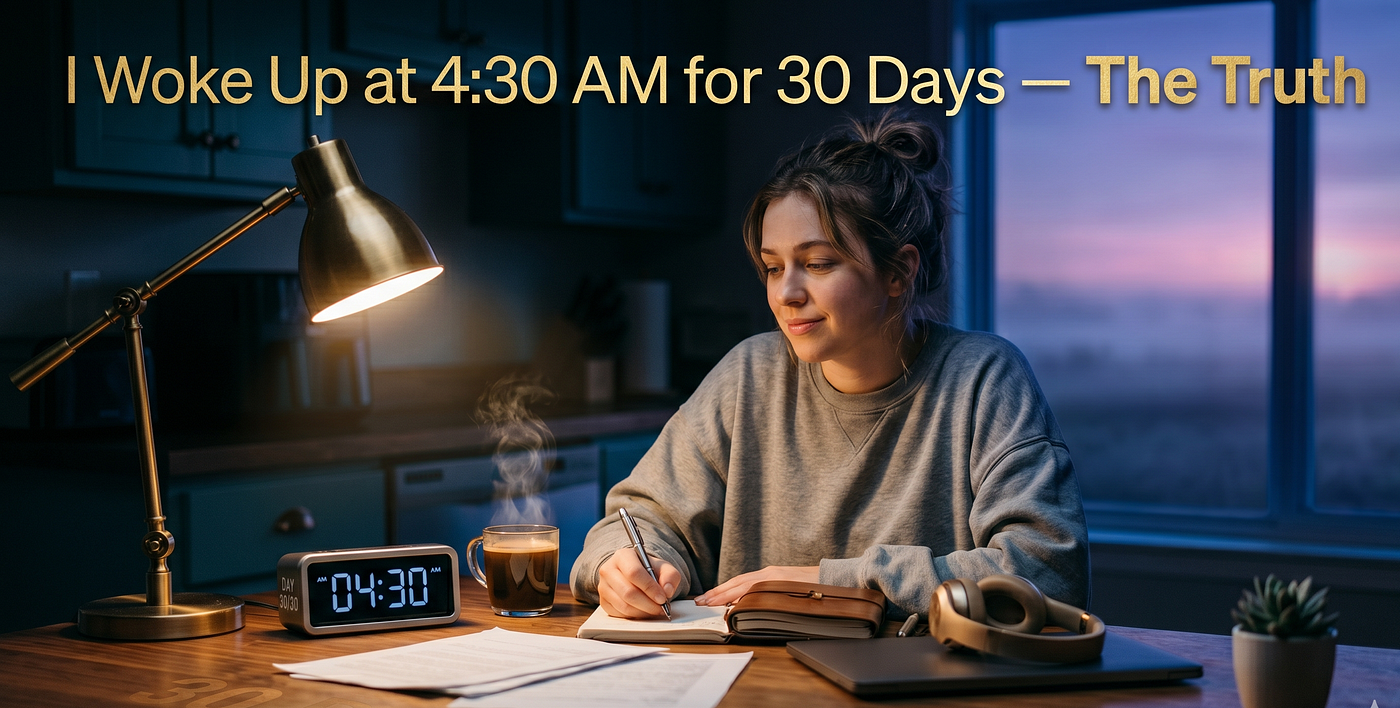
When I first decided to wake up at 4:30 AM every single day for 30 days, I had this cinematic vision in my head. Me, standing by the window. Warm coffee in hand. Soft golden light just beginning to peek over the horizon. A journal open. Deep thoughts flowing. Productivity unlocked.
You know — the kind of morning routine you see on YouTube thumbnails where someone is wearing a linen shirt and looking ethereally calm at 5 AM.
That is not what happened.
At all.
What actually happened was messier, more surprising, and honestly — way more interesting than any motivational YouTube video would ever show you.
This is that story.
Why I Even Did This (A.K.A. My Breaking Point)
Let me set the scene.
It was a regular Tuesday night. 1:47 AM. I was doom-scrolling Instagram, eating crackers directly from the packet, and watching a reel about how “successful people wake up at 5 AM.” Then another one. Then another.
By 2 AM, I had consumed approximately 47 pieces of content telling me that waking up early was the single most transformative thing I could do for my life.
By 2:15 AM, I had set an alarm for 4:30 AM the next morning.
By 2:16 AM, I was already dreading it.
Here’s the truth about why most of us want to try this: we’re not lazy, we’re overwhelmed. The days feel too short. There’s never enough time. The evenings get swallowed by screens, by fatigue, by the endless low-grade noise of modern life. And somewhere in the back of our minds, we believe that if we could just steal a few quiet hours from the rest of the world before it wakes up — maybe, just maybe — we’d feel like we had our lives together.
So I tried it. For 30 full days.
Here’s everything that actually happened.
Week 1: The Suffering Stage

Accurate representation of me. Every single morning. For the first 7 days.
Let me not romanticize this even slightly.
Day 1 was brutal. The alarm went off at 4:30 AM and I genuinely could not understand what was happening. My brain was running on emergency backup power. I sat up, stared at the wall for what felt like 10 minutes, and then shuffled to the kitchen like a zombie who had also just been punched.
Coffee didn’t help immediately. Water didn’t help. Splashing cold water on my face made me feel aggressive, not awake.
I sat at my desk at 5:03 AM with absolutely zero thoughts in my head except: Why am I doing this? Who hurt me? Is this a cult?
By 6:15 AM, I had written approximately 200 words of garbage in a journal, made a to-do list I would never look at again, and spent 20 minutes reading the same paragraph in a book without absorbing any of it.
But — and this is important — I did it. I was up. I was at the desk.
Days 2 through 4 were more of the same. My body screamed. My mind was foggy until about 7 AM. I made embarrassing typos in emails I sent early in the morning. I knocked over my coffee once. I fell asleep sitting upright on Day 3 and woke up 12 minutes later with my face on the keyboard.
The biggest shock of Week 1 wasn’t the tiredness — it was the silence.
I had forgotten that silence was a thing. Living in a city, sharing space with others, constantly connected to the internet — actual, complete, uninterrupted silence at 4:45 in the morning is almost disorienting. It felt like the world had been put on pause and I was the only one who hadn’t gotten the memo.
By Day 5, something subtle started to shift. The alarm still sucked, but I was getting out of bed maybe 30 seconds faster than before. Tiny victory.
Day 7: I went to sleep at 10 PM for the first time in years. Not because I planned to. Just because my body made the executive decision that we were done for the day.
That was the first real signal that something was actually changing.
Week 2: The “Wait, This Might Actually Be Working?” Phase
Something happened around Day 10 that I didn’t expect.
I started looking forward to the morning.
Not “jumping out of bed with joy” looking forward. More like… the quiet had started to feel like mine. That two-hour window between 4:30 AM and 6:30 AM — before notifications, before responsibilities, before the world fully booted up — started to feel like a secret room that only I had access to.
I began to understand what the early morning advocates were actually talking about. It’s not just about being “productive.” It’s about having uncontested mental space.
During normal waking hours, your attention is a pinball machine. Ding ding ding — a message here, a thought there, an obligation over here. But at 4:30 AM? Nobody wants anything from you. Your phone is silent. Your inbox is untouched. The world is just… quiet.
I started using this time differently in Week 2. Less trying to force productivity, more just thinking. Reading slowly. Writing things that didn’t need to be written but felt good to write. Drinking coffee without simultaneously watching something.
For context: I genuinely cannot remember the last time before this that I drank coffee without also consuming media. That alone felt revolutionary.
What I noticed by Day 14:
My mornings at work felt calmer. Not because I had done more in the morning, but because I had already had two hours of existing before the day officially started. I wasn’t showing up to the day already behind. I was showing up with something already in the bank.
Sleep quality improved dramatically by Week 2. I was going to bed between 9:30 PM and 10:30 PM consistently. I slept more deeply. I woke up before the alarm a few times, which is something that has never happened to me in my adult life.
Week 3: The Dark Night of the Soul (Every Experiment Has One)
Me on Day 19, questioning every decision I had ever made.
I need to be real about this because most “I woke up early for 30 days” articles skip it.
Day 18 was terrible.
I had a late event the night before — a gathering I couldn’t skip — and didn’t get to bed until 1 AM. I still set the alarm for 4:30 AM because I had committed to the experiment. I got up. I sat at my desk. I was a husk of a person.
I accomplished nothing. I sat there resentfully, staring into the middle distance, actively hating the concept of morning. I wrote “this is stupid” in my journal three times. Then I drew a little box around it. Then I closed the journal.
The broader realization of Week 3 was this: waking up early is not a magic pill. It is a container. What you fill it with is entirely your responsibility.
I had romanticized the idea that 4:30 AM would somehow automatically make me more disciplined, more creative, more intentional. But the early morning doesn’t do any of that for you. It just gives you the space. Whether you use that space to write a novel, doom-scroll Twitter, or stare at the wall is completely on you.
I also realized, around Day 20, that I had been mildly insufferable about this experiment to the people around me. I had mentioned it approximately too many times. I had used phrases like “I was up before the sun” in conversations. I had sent two (2) voice notes about it at 5 AM.
Nobody cared. And more importantly — they shouldn’t have to. Self-improvement is a solo sport.
The social cost was real, by the way. Going to bed at 10 PM means missing the part of the evening where most social things happen. Dinner plans that start at 8 PM, friends who want to catch a late movie, events that go until midnight — all of this becomes genuinely difficult when your body has recalibrated its entire rhythm. There is a trade-off. Anyone who tells you there isn’t is selling something.
Week 4: Integration
By Week 4, the experiment had stopped feeling like an experiment.
The alarm went off and I got up. Not dramatically, not with suffering — just got up. It had become, somehow, the normal thing to do.
The morning hours had started to feel structurally important to my days. I was using them for deep work — writing, thinking, planning things that needed actual concentration. Everything that requires sustained mental energy now lived in the early morning hours. Administrative tasks, emails, reactive work — that moved to the afternoon when I’m naturally more scattered anyway.
The big thing I understood in Week 4 that I hadn’t expected: this isn’t about the morning. It’s about deciding who is in charge of your time.
Most of us have given up enormous amounts of our own agency without realizing it. We respond to what the day throws at us. We run on notifications. We fill the quiet with noise because the quiet feels unproductive. Waking up early — at least for me — cracked open this question of: what would I actually do if I had unstructured time with zero expectations attached to it?
The answer, it turned out, was pretty revealing about what I actually value and what I’d been neglecting.
What Actually Changed After 30 Days
Let me get concrete, because this is what you actually want to know.
What genuinely improved:
My focus during work hours improved meaningfully. I’m not sure if this was the early wake-up directly or the fact that I was sleeping more consistently and going to bed earlier — probably both.
I finished a writing project I had been putting off for months. Having two protected, distraction-free hours every morning made this possible in a way that squeezing time in the evenings never did.
My relationship with my phone improved. When you’ve already had two hours of peace before the world wakes up, you feel less desperate to consume content every spare second. The phone still exists. I still use it. But it doesn’t feel as urgent.
I felt, for the first time in a long time, like I was ahead of my day rather than chasing it.
What did NOT improve:
I did not become a morning person in the conventional sense. I do not bound out of bed filled with joy. I never did. That’s not who I am, and 30 days of early rising doesn’t change your fundamental wiring.
I did not achieve a perfect morning routine. Some mornings I journaled. Some mornings I read. Some mornings I just sat and drank coffee and thought about nothing in particular. Real life is not a YouTube thumbnail.
I did not solve all my problems. This will surprise nobody.
The one thing I genuinely did not anticipate:
The evenings became richer.
When you start protecting the morning and going to bed early, you start treating the evening differently too. That two-hour pre-sleep window — which I used to waste on mindless scrolling — became quieter. More intentional. I started reading actual books in it. Cooking more. Having actual conversations. The whole rhythm of the day shifted, not just the morning.
The Honest Verdict

Here is the most honest thing I can tell you about waking up at 4:30 AM for 30 days:
It works. But not for the reasons the internet tells you it works.
It’s not magic. It’s not a superpower. Waking up early doesn’t make you special, it doesn’t make you more disciplined by default, and it definitely doesn’t automatically make you successful in any meaningful sense of that word.
What it does — if you actually use it and don’t just lie in bed on your phone — is give you something that modern life makes almost impossible to find: undisturbed time that belongs entirely to you, before the world gets its hands on it.
That is not nothing. In fact, for many people, it might be the most valuable resource they’re not currently accessing.
But here’s the part nobody says:
You have to want it. And not in an Instagram-quotes way. In a “this requires changing your actual evening habits and telling some people that no, you can’t stay out until midnight anymore” kind of way.
The 4:30 AM wake-up was never the hard part. The hard part was the 10 PM bedtime. The hard part was leaving parties early. The hard part was the day-18 exhaustion when life didn’t cooperate with my experiment.
If you want to try this — and I genuinely think some of you should — start with the evening, not the morning. Fix your sleep first. Then set the alarm earlier. Work back gradually: if you’re going to bed at 1 AM, trying to wake up at 4:30 AM won’t teach you anything except that you’re capable of suffering.
The question is not “can I wake up at 4:30 AM?”
The question is: what would I actually do with two hours of quiet if I had them?
If you have a real answer to that — something that matters to you, something you’ve been not-doing because the day never has enough room — then the alarm is worth setting.
If you don’t have an answer yet, figure that out first.
The morning will still be there.
Day 31? I woke up at 4:30 AM again. Not because of the experiment. Just because my body had decided it was morning.
Make of that what you will.
If this resonated with you, consider sharing it with someone who’s been talking about “changing their morning routine” for the last six months. You know who that person is.
메타데이터
- post_id
- b704f0f86c3b
- slug
- i-woke-up-at-4-30-am-for-30-days-the-truth-nobody-tells-you-b704f0f86c3b
- url
- https://medium.com/@reshmadudhat29/i-woke-up-at-4-30-am-for-30-days-the-truth-nobody-tells-you-b704f0f86c3b
- canonical_url
- https://medium.com/@reshmadudhat29/i-woke-up-at-4-30-am-for-30-days-the-truth-nobody-tells-you-b704f0f86c3b
- author_url
- https://medium.com/@reshmadudhat29
- status
- ok
- fetched_at
- 2026-08-30 17:00:02