Stop Creating Digital Products Nobody Asked For
The fastest way to waste 30 days is to build a product before understanding the person who needs it.
Stop Creating Digital Products Nobody Asked For
The fastest way to waste 30 days is to build a product before understanding the person who needs it.
Most people start a digital product with a question like:
“What should I create?”
I think there’s a better question.
“Who am I creating this for, and what are they already struggling with?”
That small change can completely alter the way you build.
Because creating a digital product isn’t really a content problem.
It’s a customer problem.
The Product Isn’t the Starting Point
Imagine you want to create an ebook.
You spend a week researching topics.
Another week writing.
A few days designing the cover.
Then you upload it to Gumroad.
You publish a few posts.
And nothing happens.
So you ask:
“Why isn’t my product selling?”
Maybe the writing wasn’t good enough.
Maybe the marketing wasn’t strong enough.
But there’s another possibility:
The product solved a problem that wasn’t important enough.
That’s a much bigger problem.
And no amount of beautiful design can fix it.
Start With the Person, Not the Product
Before creating anything, try describing your customer in one sentence.
For example:
“I help beginner ecommerce sellers who struggle to identify products worth testing.”
That’s much stronger than:
“I sell ecommerce resources.”
Why?
Because the first statement gives you something specific to investigate.
You can now ask:
What are they struggling with?
What have they already tried?
Where do they look for information?
What mistakes keep happening?
What would save them time?
What are they already paying for?
The customer gives you the direction.
The product comes later.
Your Customer Is Already Leaving Clues
You don’t have to guess what people want.
People are constantly telling you.
Look at:
Reddit posts
People describe problems in their own words.
Amazon reviews
Customers explain what they liked, hated, or wished was different.
YouTube comments
People ask questions because they don’t understand something.
Competitor reviews
Customers often explain exactly why existing products disappoint them.
Online communities
Repeated questions can reveal recurring pain points.
The important part isn’t finding one interesting comment.
It’s finding patterns.
One Complaint Isn’t a Business
This is where beginners can make another mistake.
You find someone saying:
“I wish there was a better way to do this.”
And immediately think:
“That’s my product!”
Slow down.
One complaint is a clue.
A repeated complaint is a signal.
A repeated complaint combined with existing spending is much more interesting.
That’s why customer research should look for patterns instead of isolated opinions.
Ask Yourself: What Are They Doing Right Now?
This is one of the most useful questions you can ask.
Suppose someone says:
“Researching products takes too much time.”
Don’t stop there.
Ask:
How are they doing it now?
Maybe they’re:
- opening dozens of browser tabs
- watching YouTube videos
- checking marketplace reviews
- using spreadsheets
- asking ChatGPT
- paying for research tools
- hiring someone else
Now you’ve learned something important.
They’re not just experiencing a problem.
They’re already spending time or money trying to solve it.
That creates a much stronger opportunity.
Don’t Ask What They Want. Watch What They Do.
People aren’t always good at predicting their future behavior.
Someone might tell you:
“I’d definitely buy that.”
But their actual behavior may say something completely different.
That’s why behavioral evidence is so valuable.
Look for:
What are they searching for?
What are they buying?
What tools are they using?
What alternatives are they creating themselves?
What are they complaining about repeatedly?
Actions often tell you more than opinions.
AI Can Help You Connect the Dots
This is one area where I find ChatGPT extremely useful.
You can collect customer comments, reviews, questions, or interview notes and ask AI to organize them.
For example:
“Analyze these customer comments. Identify recurring pain points, desired outcomes, existing solutions, complaints about current solutions, and opportunities for a digital product.”
Then go one step further:
“Which problems appear most frequently? Which ones seem urgent? Which ones already have people spending money on solutions?”
Now you’re not asking AI to invent a business idea.
You’re giving it real customer evidence and asking it to help you analyze it.
That’s a much more useful way to use AI.
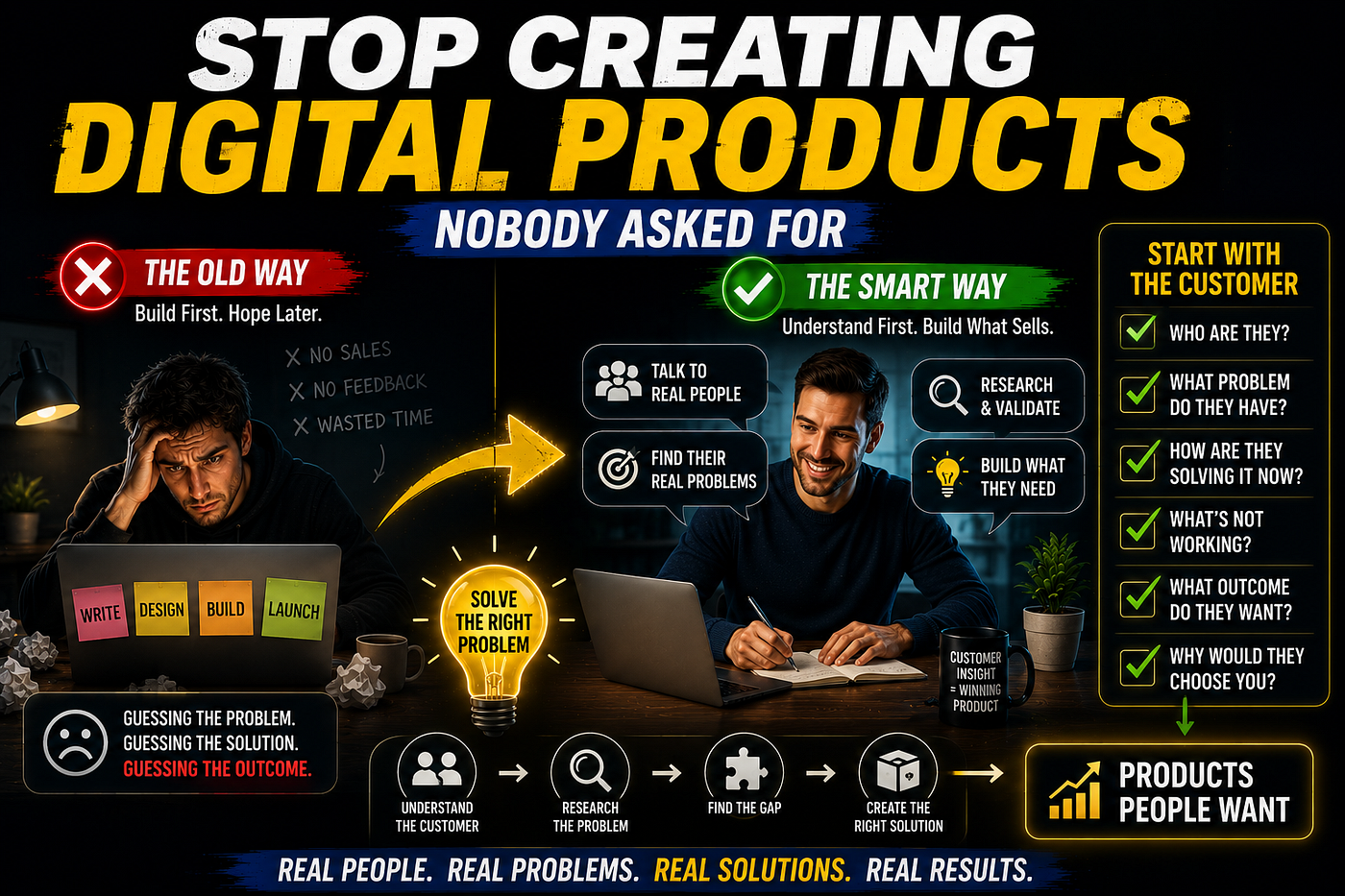
A Simple Customer-to-Product Framework
Here’s the process I’d recommend:
Customer
Who experiences the problem?
↓
Problem
What specifically frustrates them?
↓
Existing Solution
How are they solving it today?
↓
Gap
What’s missing from those solutions?
↓
Outcome
What result do they actually want?
↓
Product
What could you create to help them get there?
Notice where the product appears.
It’s the final step.
Not the first.
This Is Why I Created My Free Research Kit
When you’re new to product research, the hardest part is often not using AI.
It’s knowing what to ask.
That’s why I created Free AI Product Research Starter Kit.
It’s designed to give you a starting framework for researching customers, problems, product opportunities, and market signals with AI.
Instead of opening ChatGPT and asking:
“Give me some digital product ideas.”
You can start with a much more useful question:
“Help me understand this customer and the problem they’re trying to solve.”
That’s a very different conversation.
Your First Product Doesn’t Need to Be Perfect
There’s another trap worth avoiding.
Once you identify a problem, you may feel pressure to create a huge product.
Don’t.
Start small.
If the customer needs a simple checklist, create a checklist.
If they need a template, create a template.
If they need a workflow, create a workflow.
If they need a detailed system, build the system.
The size of the product should be determined by the problem.
Not by your desire to make the product look impressive.
The Best Product Ideas Often Look Boring at First
A product doesn’t need to be revolutionary.
It needs to be useful.
A spreadsheet that saves someone three hours can be more valuable than a beautiful 100-page ebook.
A template that prevents one frustrating mistake can be more valuable than a complicated course.
A simple workflow can become valuable if it consistently produces a useful outcome.
Don’t confuse complexity with value.
Before You Build, Answer These 6 Questions
Write down your next product idea.
Then answer:
1. Who exactly is this for?
2. What problem are they experiencing?
3. How are they solving it today?
4. What isn’t working about their current solution?
5. What outcome do they actually want?
6. Why would they choose my solution instead?
If you can’t answer these questions, don’t rush into creating the product.
You have more research to do.
And that’s okay.
Final Thoughts
The goal isn’t to create more digital products.
It’s to create more useful digital products.
And usefulness starts with understanding people.
Before you open Canva, before you design a landing page, and before you spend weeks writing content, spend some time listening to the people you want to serve.
Their problems can tell you what to build.
Their behavior can tell you whether the problem matters.
And their feedback can tell you how to make the product better.
AI can accelerate that process.
But the starting point will always be the same:
Understand the customer first. Build second.
If you want to go deeper into AI-assisted product research, **50 ChatGPT Prompts to Find Winning Products** includes structured prompts for customer research, pain-point discovery, competitor analysis, validation, and product opportunity research.
Because the best digital product isn’t the one you can create fastest.
It’s the one that makes someone say:
“I’ve been looking for something like this.”
메타데이터
- post_id
- b71be37372c2
- slug
- stop-creating-digital-products-nobody-asked-for-b71be37372c2
- url
- https://medium.com/@sp.egolights/stop-creating-digital-products-nobody-asked-for-b71be37372c2
- canonical_url
- https://medium.com/@sp.egolights/stop-creating-digital-products-nobody-asked-for-b71be37372c2
- author_url
- https://medium.com/@sp.egolights
- status
- ok
- fetched_at
- 2026-08-16 21:26:00




