Bias vs Variance in Machine Learning
When building machine learning models, one of the most important concepts to understand is:
Bias vs Variance in Machine Learning
When building machine learning models, one of the most important concepts to understand is:
Bias vs Variance
These two factors directly affect how well your model performs on real-world data.
If not handled properly, they can lead to poor predictions and unreliable models.
What Is Bias?
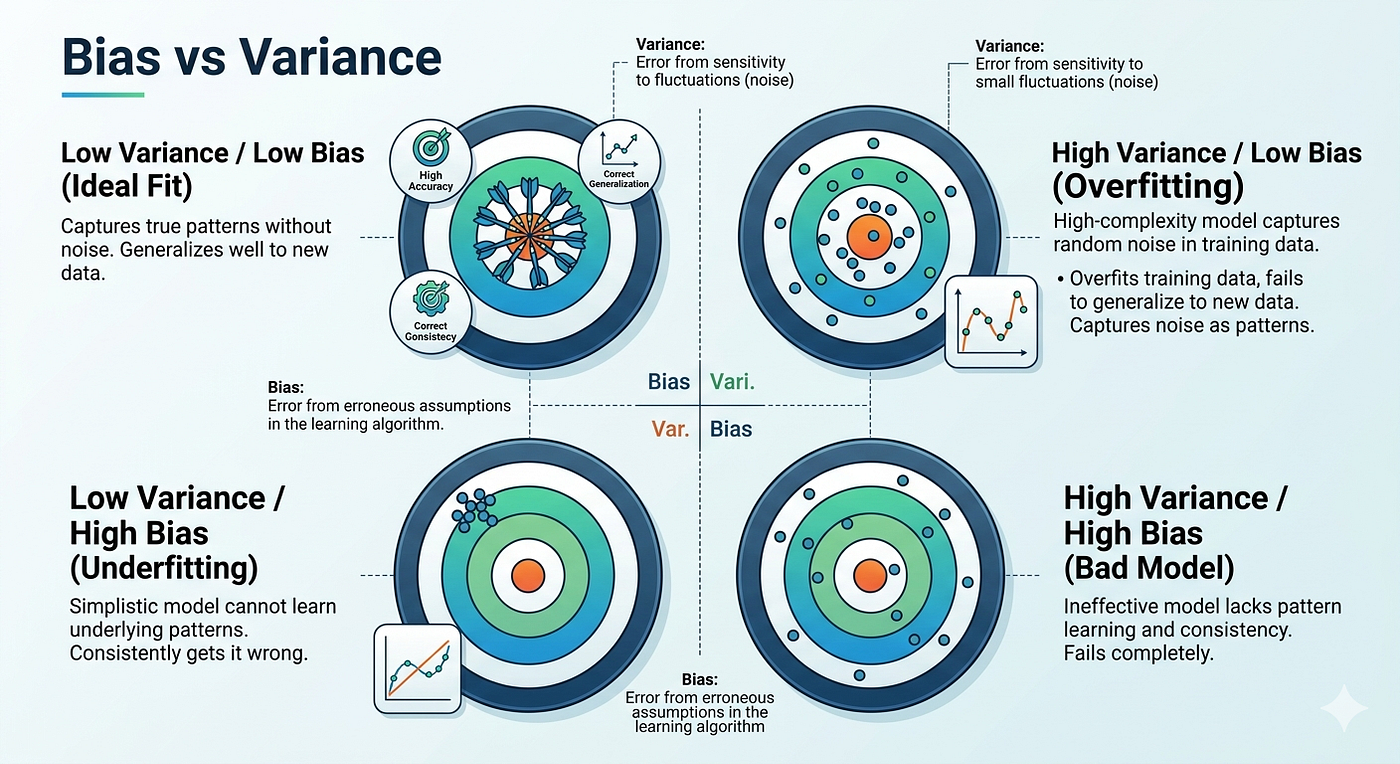
Bias refers to the error caused by over-simplifying a machine learning model.
A high-bias model:
- Makes strong assumptions about data
- Fails to capture complex patterns
- Performs poorly on both training and testing data
This problem is called underfitting.
Example
Using a simple linear model to predict highly complex relationships.
What Is Variance?
Variance refers to the model’s sensitivity to small changes in the training data.
A high-variance model:
- Learns noise from the dataset
- Performs very well on training data
- Performs poorly on new (unseen) data
This problem is called overfitting.
The Trade-Off
In machine learning, there is always a balance:
- High Bias → Model is too simple
- High Variance → Model is too complex
The goal is to find the right balance where the model:
✔ Learns meaningful patterns ✔ Generalizes well to new data
Simple Visualization Idea
Think of it like this:
- High Bias → Missing the target completely
- High Variance → Hitting different spots every time
- Balanced Model → Consistently near the target
How to Handle Bias and Variance
Data scientists use several techniques to manage this trade-off:
Reduce High Bias
- Use more complex models
- Add more features
- Reduce regularization
Reduce High Variance
- Use more training data
- Apply regularization
- Use cross-validation
- Simplify the model
Why This Matters in Real Projects
In real-world applications, a model must perform well on new data, not just training data.
Managing bias and variance ensures:
✔ Reliable predictions ✔ Stable model performance ✔ Better business decisions
This is critical for production-level AI systems.
How I Build Reliable ML Models
I focus on creating machine learning models that are:
✔ Accurate ✔ Generalizable ✔ Scalable ✔ Business-focused
Services I Provide
• Data Analysis • Machine Learning Models • Predictive Analytics • AI Solutions • Data Visualization
Let’s Connect
If you’re looking for help with Machine Learning, Data Science, or AI projects, feel free to connect.
LinkedIn: LinkedIn Portfolio: Shaista Shahid | Data Science Student & ML Enthusiast
Let’s build smart and reliable AI systems.
메타데이터
- post_id
- b72a2e8151be
- slug
- bias-vs-variance-in-machine-learning-b72a2e8151be
- url
- https://medium.com/@Shaistaprincess/bias-vs-variance-in-machine-learning-b72a2e8151be
- canonical_url
- https://medium.com/@Shaistaprincess/bias-vs-variance-in-machine-learning-b72a2e8151be
- author_url
- https://medium.com/@Shaistaprincess
- status
- ok
- fetched_at
- 2026-07-15 08:12:24




