The Devil’s Advocate: Why Every Investment Committee Needs an AI Adversary
How AI is reshaping the most consequential meeting in asset management. The one where a thesis lives or dies.
The Devil’s Advocate: Why Every Investment Committee Needs an AI Adversary
How AI is reshaping the most consequential meeting in asset management. The one where a thesis lives or dies.

TL;DR. Devil’s Advocate is an open-source AI Chief Investment Officer that stress-tests every investment thesis against your personal investment mandate before it reaches the Investment Committee. It runs four adversarial agents over your memo, grounds every objection in citable primary sources via Valyu’s financial-research API, and emits a binding verdict — Approved, Changes Requested, or Rejected with a full audit trail. Built for solo fund managers, family offices, boutique funds, CIOs, and angel investors.
The 11th-Hour “Uncomfortable” Case
There’s a particular silence that falls over an Investment Committee meeting when someone, usually the most senior person in the room, often the one who has said the least leans forward and asks the question nobody wanted asked.
“Where does this go wrong?”
Every fund manager has lived this moment. You spent three weeks building conviction. You have the multiples, the channel checks, the management call notes, the regression. And then, somewhere between the second and third sip of coffee, the CIO finds the one fact you didn’t look hard enough for, and your thesis dies on the table.
That moment is, on the whole, a feature of the system. The job of the committee is not to nod; it’s to find the hole. The fund manager who never gets pushed back on is the fund manager whose LPs are about to lose money.
But here is the uncomfortable truth: the IC is also where the most expensive cognitive biases in asset management get baked in. Confirmation bias, anchoring, narrative fallacy, groupthink, the sunk-cost trap of “we’ve already done the work.” Every CFA charterholder has read Kahneman. And yet, year after year, allocators look at the post-mortems on their worst trades and find the same DNA: a thesis that wasn’t stress-tested hard enough, by someone who wasn’t independent enough, fast enough to matter.
I built **Devil’s Advocate** for that gap. It is an AI Chief Investment Officer, a relentless, mandate-aware, citation-bound adversarial reviewer that runs your thesis against your own House View before the IC meeting, not after.
Who This Is For
Devil’s Advocate is for the seats where the IC is, on most days, the principal and a mirror:
- Solo fund managers and portfolio managers running a discretionary book. public equities, special situations, sector funds, PMS, the seat where you are the analyst, the PM, and your own CIO at the same time.
- Boutique AIFs, hedge funds, and emerging managers with two or three investment professionals and no full-time risk seat.
- Family offices evaluating direct deals. pre-IPO secondaries, PE co-invests, structured credit where the principal is also the gatekeeper.
- CIOs and Heads of Research at larger funds who want every analyst’s memo pre-graded against the mandate before it eats an hour of IC time.
- Angel investors and syndicates writing $25K–$500K checks who need a venture-style scoring discipline they can repeat across hundreds of decks a year.
If you have ever closed a position and thought I knew that risk, I just didn’t weight it enough, you are the user. The product is not pretending to replace your judgment. It is, very specifically, trying to make the moment before the decision more honest.
Why I Built This
I should be honest about my own standing, because it explains both the design choices and the gaps the product is trying to close.
I’m an Angel investor (better still I was, and hopefully in the future I resume). I’ve written checks into something north of 20 companies, pre-seed through seed stage, mostly in fintech, edtech, devtools, and consumer-facing software. I have a fairly negative view of how my own due diligence has historically been done.
The honest version of my DD loop, for most of those 20+ deals, has looked like this:
- A founder gets introduced to me, usually warm, usually from another founder I trust.
- I drop the name into three or four WhatsApp groups full of operators and other angels. “anyone seen this team? anyone working in this space?”
- I read whatever the founder sends me. The pitch deck, sometimes a data room, sometimes a Notion page that hasn’t been touched since the round opened.
- I spend an evening clicking through websites trying to triangulate the addressable market. Competitors, their competitors, a couple of industry reports, Crunchbase, LinkedIn for headcount trends, sometimes Glassdoor for early attrition signals.
- I make a decision.
That is not, by any honest accounting, due diligence. It is pattern-matching on a small sample, with heavy recency bias, against an information set that is mostly second-hand. Some of those checks have been my best decisions. Many have been my worst. And I have never been able to predict, at the moment of the check, which would be which because I didn’t have the structural discipline to surface the bear case that would have told me. The bear case is almost always there. It’s just not in the WhatsApp groups.
Over the last couple of years I’ve spent a lot of time in rooms with people who do this work professionally and at scale, investment bankers running deal teams, listed-equity fund managers, solo GPs running emerging venture funds, family-office principals running direct-deal pipelines. I went in expecting to find that the institutional workflow was meaningfully different. It mostly wasn’t. Better data sources, in-house financial models, sharper modeling, more pattern recognition built up over decades but the same fundamental shape.
A thesis written by the person who already believes it. A “risks” section nobody believes. An IC meeting where the bear case lands too late.
Devil’s Advocate is the tool I wish I’d had for my own 21st angel check. It is also pretty close to the tool the fund managers, GPs, and family-office principals I spoke with said they wished existed for theirs. The fact that the same broken loop exists at the $25K angel check and the $25M institutional position is, in my view, an indictment of the workflow, not the people. The people are smart. The loop is broken.
I open-sourced it deliberately. A citation-backed adversarial pass before any memo reaches the IC should be the default, not a competitive edge held by one shop.
What Devil’s Advocate Actually Does
The premise is simple to state and surprisingly hard to execute.
You sign in, write a thesis for stock, fund, or private company and the system runs a four-agent stress test in parallel:
- A Bull Advocate that builds the strongest possible case for the thesis from primary sources.
- A Bear Advocate that runs an adversarial review against your thesis, pulling contradicting data from broker reports, regulatory filings, peer signals, and macro data. Not a politely-worded “risks section.” Built to win.
- A House View Checker that evaluates the thesis against your written mandate. Your hard rules, your portfolio constraints and surfaces any violation as a citation-backed objection.
- A Synthesizer that combines all three into a structured memo and a verdict.
Then the Critic engine runs a two-stage gate:
- Stage 1 (HARD). Mandate violations, fund-level concentration thresholds, memo completeness. A single blocking objection here returns Rejected.
- Stage 2 (SOFT). Bear findings, consensus divergence, blind spots, your custom rules. Major objections return Changes Requested. Only minor and informational findings return Approved.
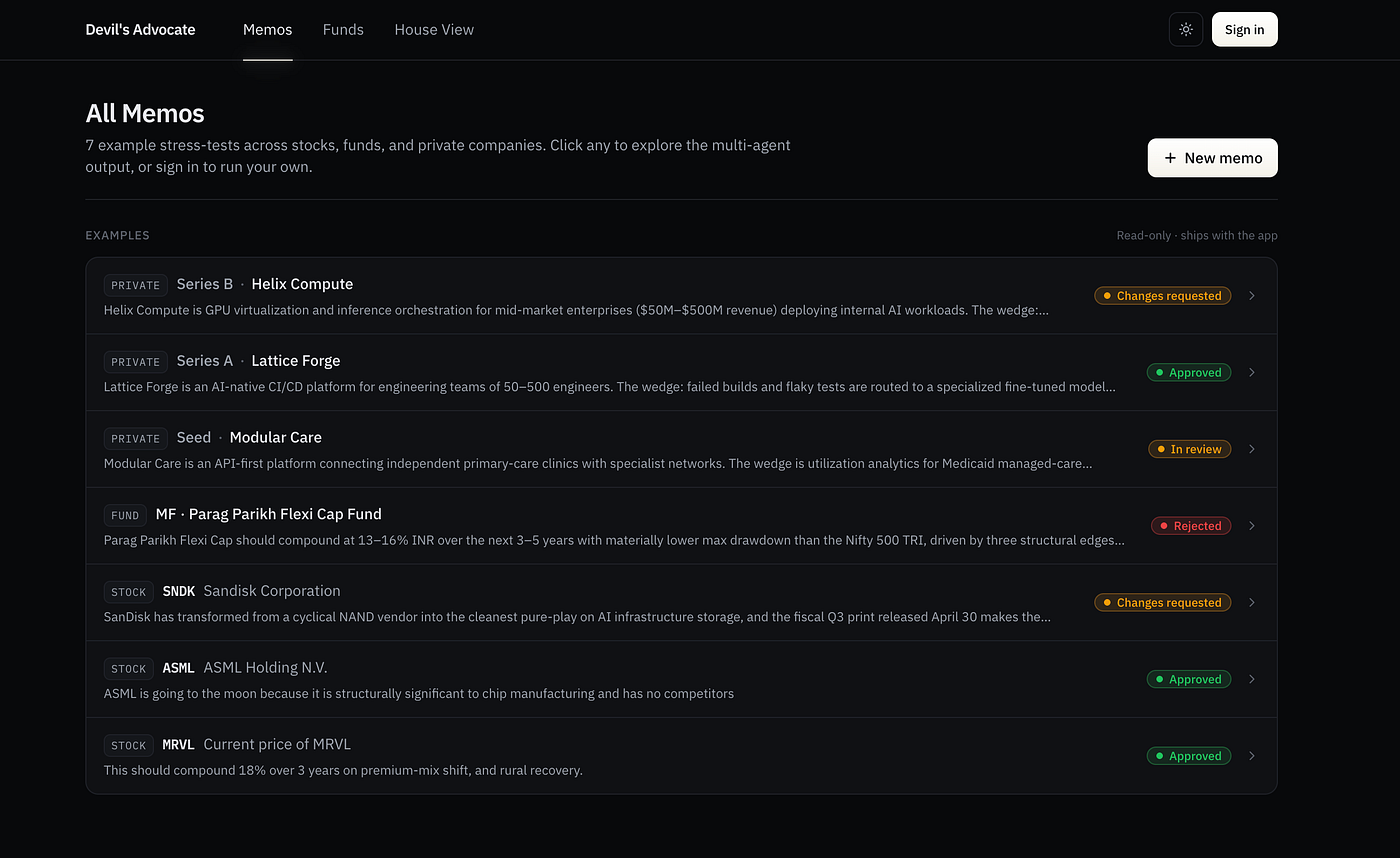
Memos — funds, stocks, private companies
Approval is one click away from a paginated IC PDF with citations baked in and a record of every objection raised, disputed, resolved, or accepted along the way.
The committee never gets tired. It never has a conflict of interest. It never anchors on the last deal it saw. And it remembers exactly what your mandate said when the memo was submitted six months ago when you have to explain the trade to your LPs.

House View in the Devil’s Advocate
Why Open Source
Devil’s Advocate is MIT-licensed for three reasons.
- Transparency. A tool that judges your investment memos cannot be a black box. Every rule, every prompt, every objection-generation path is in the repository.
- No lock-in. The code is yours. The SQLite database is a single file on a disk you control. You can deploy it on-premise for your organization.
- Composability. The Critic engine is intentionally a post-processor. Swap data sources, swap model providers, plug in your own house rules, integrate with your existing memo system. Self-host on Railway, on your own infrastructure, or behind your firewall, with your own keys. For funds with confidentiality concerns about pre-IC memos, this is the only architecture that makes sense.
The Workflow, End to End
Monday morning. A semiconductor name reports a soft quarter, sells off 12%, but the long-term thesis (data-center exposure, recovery in industrial channels) looks intact. You open Devil’s Advocate, click New Memo, paste in the ticker and a four-paragraph thesis. You include your areas of concern: customer concentration, gross margin pressure, China revenue exposure.
Click **Stress-Test.** The orchestrator dispatches Bull, Bear, and House View agents in parallel. Bear pulls a sell-side note showing a competitor winning hyperscaler share, a regulatory filing flagging accelerated export-control restrictions, and a Glassdoor signal showing senior engineering attrition. House View Checker notes your written rule that “single-issuer exposure cannot exceed 4% NAV at cost” and warns the proposed sizing would breach it. The Synthesizer rolls all three into a structured memo.
You revise. Incorporate Bear’s findings into the areas-of-concern section. Reduce the proposed sizing. Add a hedge structure for the China risk. Click Submit for Review.
The Critic runs. Stage 1 passes, no hard mandate violations remain. Stage 2 surfaces three soft objections: a consensus-divergence flag (your earnings recovery timing is six months ahead of sell-side consensus), a blind-spot flag (export-control risk is in the risks section but not the thesis statement), and a custom-rule flag (you have a personal rule that any margin-expansion thesis must quote the historical peak margin, which you forgot to include).
Address each. Dispute the consensus-divergence flag on the record, your view is based on a primary-source channel check, citation included. Resolve the export-control flag by moving it into the thesis. Resolve the margin-quotation flag by adding the line.
Resubmit. The Critic runs again. Verdict: Approved.
Click **Download IC PDF.** A paginated A4 memo renders with your House View overlaid, the stress-test findings preserved, the disputed objection on the audit trail, and the verdict on the cover page. You email it to your committee. Or, if you’re a solo PM, you put it in the file and sleep on it for one more night.
This is, end to end, a Tuesday afternoon. The same work, done well, in the old loop, is a week. The compression is not the point. The point is that the work is now complete, every contradiction surfaced, every mandate check run, every assumption challenged in a way that the old loop, with one analyst and a tight deadline, could never structurally guarantee.
That’s the product. That’s what AI is actually useful for in investment management. Not picking the stock. Picking the holes in your case for the stock, faster than your IC can.
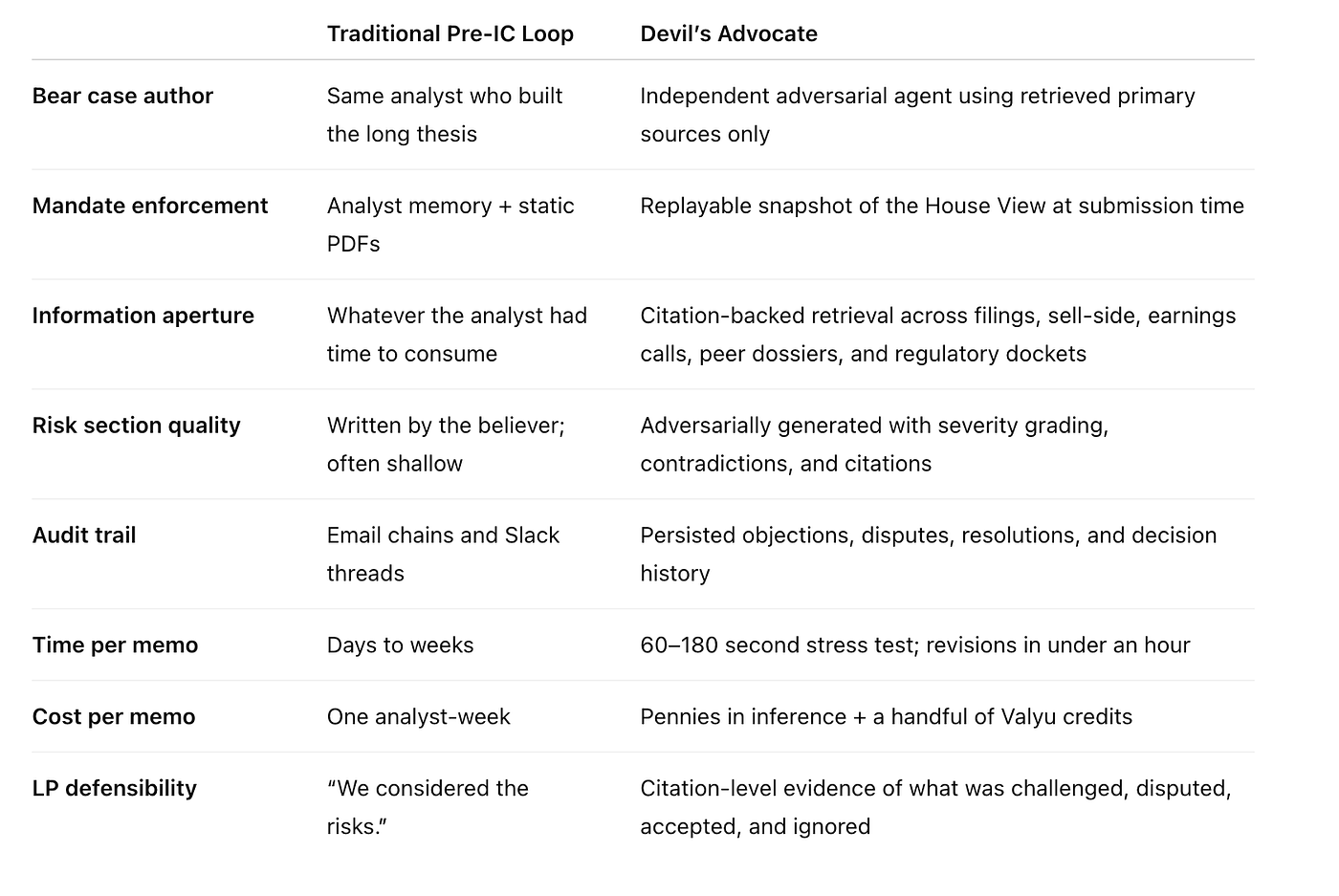
How Devil’s Advocate Compares to the Traditional Pre-IC Workflow
Frequently Asked Questions
What is Devil’s Advocate?
Devil’s Advocate is an open-source AI tool that stress-tests investment theses against a fund manager’s personal mandate (called the “House View”) before they reach the Investment Committee. It runs a four-agent adversarial review. Bull Advocate, Bear Advocate, House View Checker, and Synthesizer over every memo, then a two-stage Critic engine emits a binding verdict (Approved, Changes Requested, or Rejected) with citations.
Who is Devil’s Advocate built for?
Solo fund managers, portfolio managers at boutique funds, family office principals, angel investors, and CIOs at small-to-mid investment shops. The common thread: anyone whose Investment Committee is, on most days, them and a mirror and who needs an independent adversarial pass on every thesis without staffing a full risk seat.
How is this different from Bloomberg, FactSet, or S&P Capital IQ?
Those are data platforms. Devil’s Advocate is a judgment workflow on top of a data platform. It doesn’t replace your terminal, it sits between your research and your IC, enforces your written mandate, surfaces the bear case adversarially, and generates a citation-backed memo with an audit trail. The data layer it uses is Valyu, which is built for financial primary sources.
What is Valyu, and why does it matter here?
Valyu is a financial-source-friendly search & deepresearch API. It indexes and provides data sources— SEC filings, sell-side research, earnings transcripts, regulatory dockets, peer dossiers, macro and economic data, patent records and returns structured, citable passages with provenance. In Devil’s Advocate, every Bear Advocate objection is grounded in a Valyu retrieval, which is the difference between an AI risk and a hallucinated risk. If a bear claim can’t be backed by a retrievable document, it doesn’t make it into the memo.
Is my memo data private?
Yes. Devil’s Advocate is self-hosted by default. The database is a single SQLite file on disk you control. There is no central server, no shared multi-tenant database, and no telemetry. If you self-host on your own infrastructure or behind your firewall, your memos never leave your network.
Does it work for private companies, or only listed equities?
Both. There are dedicated workflows for listed stocks, funds (with look-through holdings analysis), and private companies (with stage-aware comparable analysis — Seed, Series A, Series B, with appropriate peer dossier pulls and competitive mapping). The private-company workflow is the one most angel investors and family offices use most.
What LLM does Devil’s Advocate use?
OpenAI by default, fully configurable. The agent architecture uses structured outputs via Zod schemas, so swapping providers (Anthropic, open-weight, or fine-tuned models) is a configuration change rather than a rewrite.
Does it make the investment decision for me?
No. The verdict is procedural — mandate compliance, completeness, citation strength, objection severity, not a judgment on investment merit. The capital allocation call stays with you. The discipline around the call is the product.
How long does a stress test take?
The full four-agent stress test typically completes in 60–180 seconds, depending on the depth of the bear case and the number of citations retrieved. The binding Critic review runs as a post-processor on the already-synthesized output and finishes in seconds.
What does a memo run cost?
The software itself is free (MIT-licensed). You pay for the underlying APIs, OpenAI for the LLM calls, Valyu for the research data. A typical memo run costs a few cents in LLM calls plus a small number of Valyu credits. There is no per-seat license fee, and no telemetry-based pricing.
Can I add custom rules for my specific strategy?
Yes. You can author plain-English AI rules that only run on your memos. Examples: “Flag the memo if it claims a price target without a quoted multiple basis.” Or: “Reject any thesis on a sector we are currently underweight per the latest House View.” Each rule is private to you, sent to a fast LLM with the memo context and a strict structured-output schema. You can also disable any built-in rule for your seat without affecting other users.
Can multiple team members use it together?
Currently designed for a single team. Multi-tenant workspaces are on the roadmap. Today, each user has their own private House View, their own private custom rules, and per-user toggle state on built-in rules. Memos are evaluated against the author’s framework, not a shared one.
Is it safe to use in regulated jurisdictions?
Self-hosted deployment means your data does not leave your environment. Whether the output is suitable for regulatory disclosure is jurisdiction-specific and depends on your firm’s policies. Devil’s Advocate provides a complete audit trail of every objection raised, disputed, and resolved, with citations; how you use it inside your compliance framework is your call. The MIT license and open codebase mean you can have your own compliance team read every line.
Can I self-host it?
Yes. Deployment is documented for Railway (one volume mount, push to deploy) and for local self-hosting on any Linux/macOS environment that runs Node.js 20+. The full stack: Next.js, SQLite, Drizzle ORM, the agent orchestrator, the Critic engine runs as a single Node service.
Is Devil’s Advocate a product or a project?
Project. It’s open-source under MIT and built as a discipline I think the industry should adopt, not a business I’m trying to grow. The repository is at github.com/unicodeveloper/devils-advocate. PRs welcome, particularly on sector-specific Critic rules and additional data sources.
메타데이터
- post_id
- b7309f6d7250
- slug
- the-devils-advocate-why-every-investment-committee-needs-an-ai-adversary-b7309f6d7250
- url
- https://medium.com/@unicodeveloper/the-devils-advocate-why-every-investment-committee-needs-an-ai-adversary-b7309f6d7250
- canonical_url
- https://medium.com/@unicodeveloper/the-devils-advocate-why-every-investment-committee-needs-an-ai-adversary-b7309f6d7250
- author_url
- https://medium.com/@unicodeveloper
- status
- ok
- fetched_at
- 2026-06-09 15:37:30