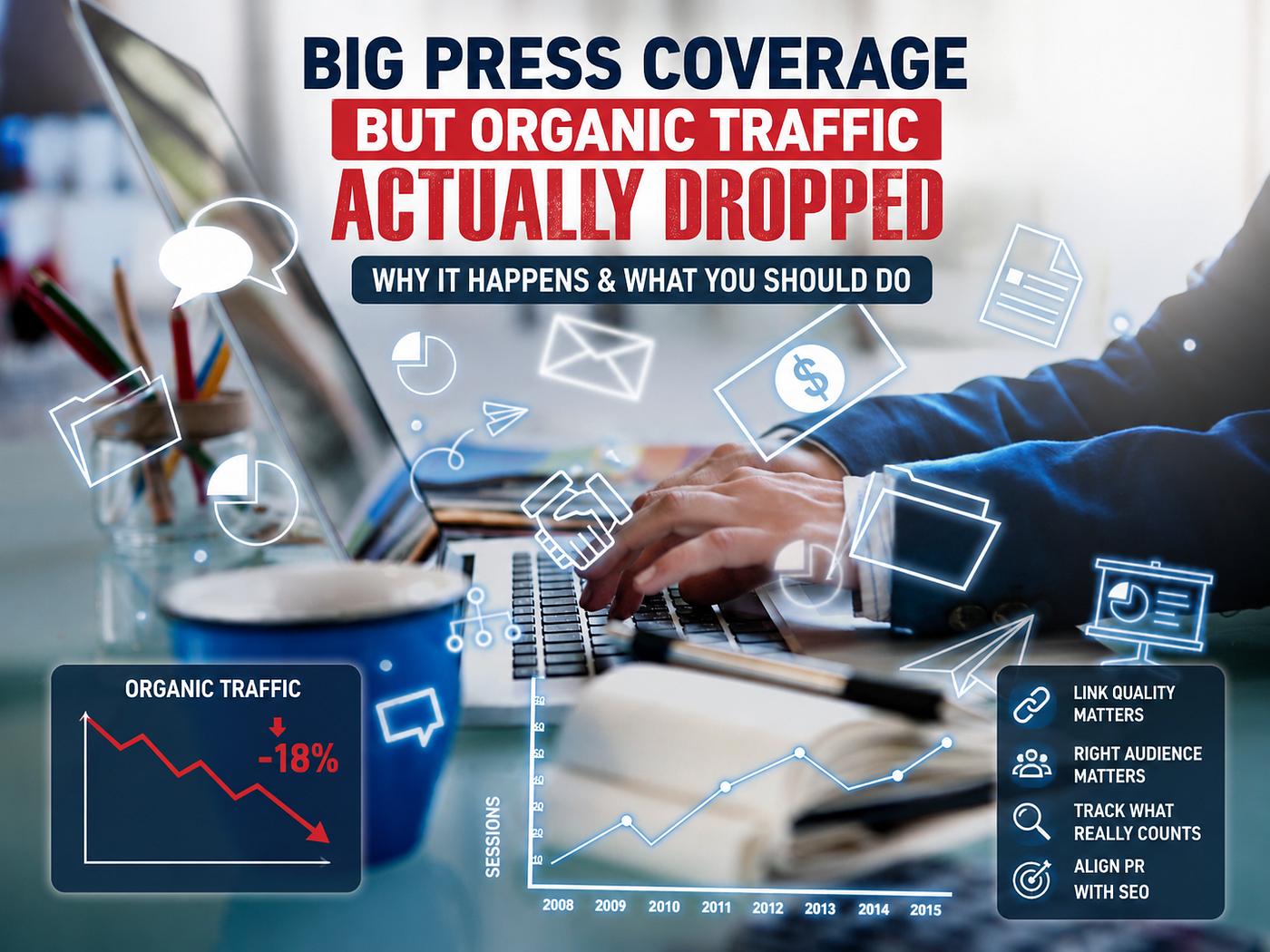
Big Press Coverage — But Organic Traffic Actually Dropped
You know that feeling when something goes really well on paper… but the numbers just don’t show it?
Big Press Coverage — But Organic Traffic Actually Dropped
You know that feeling when something goes really well on paper… but the numbers just don’t show it?
That’s exactly what happened here.
A major press feature. A big-name publication. Everyone’s excited. The client is over the moon.
Then we open Google Analytics.
And the traffic? Flat. Or worse — it actually went down.
Sounds strange, right? But honestly, after 22+ years of running SEO and **digital PR services** campaigns, we’ve seen this happen more times than we can count.
So let’s talk about it. No jargon. No fluff. Just the real stuff — the kind of things that don’t usually make it into agency reports.
Why Didn’t the Traffic Come?
Here’s the thing, most people don’t realise.
Press coverage is built for readers. SEO is built for search engines. And unless someone deliberately connects the two, they just don’t talk to each other.
When a journalist writes about your business, that article is written for their audience. Not for Google. Not for your target keywords. For their readers.
So if the link they include is nofollow… or the anchor text is just your brand name… or your landing page isn’t ready for the people clicking through — you get the exposure. But you don’t get the rankings.
And that’s the gap nobody warns you about when you’re celebrating the coverage.
The Nofollow Problem Nobody Puts in the Report
Okay, here’s something we wish more agencies talked about upfront.
Most links from big publications such as Forbes, Business Insider, and HuffPost are nofollow. Some use redirects that dilute link value even further.
Back in 2019, Google said it would treat nofollow links as “hints”, meaning they might pass some value. But in practice? Across the campaigns our team has tracked, nofollow links from press rarely move rankings in any measurable way.
So when a client calls asking why their traffic didn’t move after a major feature, this is the first place we look.
The link is real. The coverage is real. But the SEO value? Often, it’s close to nothing.
That doesn’t mean press is useless. It just means you can’t count mentions and call it a win. You have to look at follow status, anchor text, and the actual authority of the linking page — every single time.
Here’s Where It Gets Really Interesting
Ready for the part that surprises almost everyone?
Press coverage can actually hurt your rankings. Temporarily. But it happens.
Picture this. You run a B2B software company. You get featured in a lifestyle magazine with 10 million monthly readers. Exciting, right?
But those readers have no idea what your product is. They click through, land on your homepage, look around for about 8 seconds, and leave.
Your bounce rate shoots up. Session duration drops. And Google’s systems see all of this, and start to wonder if your page is really as relevant as it seemed.
We watched this happen with a SaaS client a few years ago. After a big general-interest feature, two of their core keywords dropped 6 to 11 positions. For three full weeks.
Once that referral traffic dried up and normal search behaviour came back, the rankings recovered. But those three weeks were not fun for anyone.
The lesson here isn’t to avoid the press. It’s to prepare your landing pages for whoever that article is sending your way.
Have You Ever Checked Your Branded Search Volume After a Press Feature?
Most people haven’t. And this is where a lot of the value gets lost.
Here’s what actually happens when someone reads about your brand in a big article.
They don’t always click the link right then. They close the tab. Make a coffee. Come back three days later and Google your name directly.
That visit shows up in your analytics as organic or direct traffic, not as a referral from the publication. So the press drove the visit. But the data makes it look like it came from somewhere else entirely.
This is what marketers call the dark funnel. And it makes press coverage look a lot less effective than it actually is, if you’re only looking at referral clicks.
The fix is simple. Before any big PR push, note your baseline branded search volume in Google Search Console. Then check it again in the two weeks after the feature runs.
If you see a spike in people searching your brand name, that’s the press working. You just couldn’t see it in the usual place.
PR With SEO vs. PR Without SEO
Let’s put it side by side so it’s easy to see what makes the difference:
Factor PR Without SEO Integration PR With SEO Integration Link Type Mostly nofollow Mix of follow and nofollow Anchor Text Brand name only Brand plus keyword-rich variations Landing Page Generic homepage Optimised for that specific audience Bounce Rate High, wrong audience Lower, relevant audience Ranking Impact at 30 Days Minimal or negative Measurable improvement Branded Search Lift Moderate Strong and trackable Traffic Attribution Hard to connect Clear via GSC and UTM tags
The press quality is the same in both columns. What’s different is everything built around it.
Does Google Actually Care About Press Mentions?
Yes, but not the way most people think.
Google has been pretty clear that unlinked brand mentions are not a direct ranking factor. But what does matter is entity recognition.
When your brand keeps showing up across high-authority sites alongside the same topics and keywords, Google starts to connect the dots. It builds a stronger association between your entity and those subjects. Over time, that association helps your rankings.
But here’s the practical angle that actually moves the needle faster.
Big press tends to generate secondary links. Other writers, bloggers, and researchers who read that original article may mention your brand in their own content. Those links are often followed, often more topically relevant. And those are the ones that produce real ranking changes.
So after any major press feature, our team always runs a secondary outreach push. We contact bloggers and content creators in the same space. We share the press mention as social proof. We ask to be included in relevant content they’re already working on.
That second wave of links is often where the actual SEO return on a PR campaign comes from.
So What Should You Actually Do?
Stop measuring press campaigns by mention count alone. That number feels good, but it doesn’t tell you anything about SEO impact.
Before the next campaign launches, sit down with your landing pages. Ask yourself, if someone reads this specific article and clicks through, will this page make sense to them? Will it keep them engaged? If the answer is no, fix the page before the coverage goes live.
Open Google Search Console right now and note your current branded search volume. That’s your baseline. After your next press push, compare it. That’s your real signal.
Every time a placement is confirmed, check the link. Is it followed? What’s the anchor text? Is the linking article topically relevant to your business? These three questions will tell you more about the SEO value of that placement than the publication’s logo ever will.
And build a secondary outreach list. Every time a major story runs, someone else in your industry is going to want to reference it. Find those people first.
Wrapping It Up
Here’s the truth about press and SEO.
They’re not the same thing. But they’re also not separate things.
Press builds the brand. SEO captures the search demand that the brand creates. When digital PR services are done right, with the technical layer, the right landing pages, the secondary outreach, and the proper attribution tracking, the two systems work together and the results compound over time.
But if you’re just chasing logos and counting mentions, you’re going to keep opening Analytics and feeling confused.
The press is doing its job. The question is whether the SEO setup around it is doing its job too.
Want help connecting the two properly? That’s exactly what the team at **SEO Discovery Pvt. Ltd.** has been doing for over two decades — and the results speak for themselves.
People Also Ask
Why did website traffic drop after a press feature?
The coverage likely sent a mismatched audience to the site. When visitors land on a page that doesn’t match what they expected, they leave fast. That raises bounce rate and drops session duration — both of which Google reads as signals that the page may not be relevant. Rankings can dip temporarily as a result.
How long before press coverage affects rankings?
With a followed link and an optimised page, you might see movement in 4 to 12 weeks. With nofollow links or indirect brand awareness, it’s more like 3 to 6 months, and the effect shows up in branded search volume before it shows up in keyword rankings.
What makes digital PR different from regular PR for SEO?
Regular PR is about reputation. Digital PR is about reputation plus search signals. The difference is in how placements are chosen, how links are tracked, and how the whole campaign connects back to keyword and ranking goals from the very start.
Can press coverage actually hurt SEO?
Yes, temporarily. Irrelevant traffic to a poorly matched landing page sends bad behavioural signals to Google. It’s most common when a niche business gets featured in a broad consumer publication. It’s preventable with the right page setup before the feature goes live.
메타데이터
- post_id
- b76a09586099
- slug
- big-press-coverage-but-organic-traffic-actually-dropped-b76a09586099
- url
- https://medium.com/@sirjana2810/big-press-coverage-but-organic-traffic-actually-dropped-b76a09586099
- canonical_url
- https://medium.com/@sirjana2810/big-press-coverage-but-organic-traffic-actually-dropped-b76a09586099
- author_url
- https://medium.com/@sirjana2810
- status
- ok
- fetched_at
- 2026-06-09 15:37:30