Ridge Regression (L2 Regularization) in Python for Engineering: An End-to-End Guide
This article demonstrates how engineers can apply Ridge Regression in Python to stabilize regression models, manage collinearity, and…
Nilimesh Halder, PhD
in
Data Analytics Mastery
· 2025-08-31 11:45
· 1 claps
· 2.1 min read
paywalled
Ridge Regression (L2 Regularization) in Python for Engineering: An End-to-End Guide
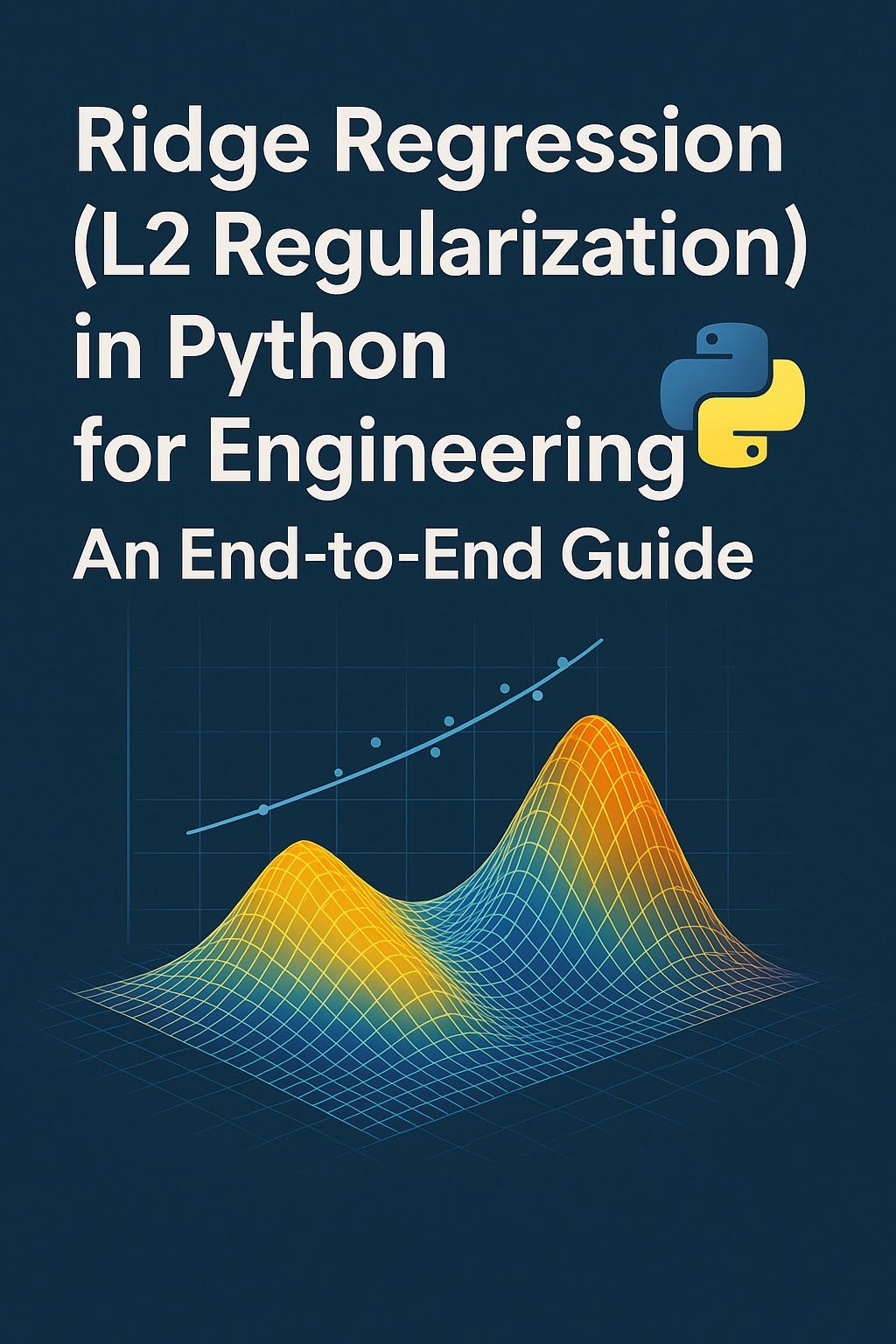
This article demonstrates how engineers can apply Ridge Regression in Python to stabilize regression models, manage collinearity, and improve predictive performance in noisy and complex engineering datasets.
Article Outline
1. Introduction
- Overview of regression in machine learning and its importance in engineering contexts.
- The problem of overfitting in ordinary least squares (OLS) regression.
- Introduction to Ridge Regression (L2 regularization) and why it is effective.
2. Understanding Ridge Regression
- Mathematical formulation of Ridge Regression.
- The role of the L2 penalty term in shrinking coefficients.
- How regularization controls multicollinearity and stabilizes solutions.
- Difference between Ridge and other methods like Lasso (L1).
3. Importance in Engineering Applications
- Handling high-dimensional sensor or experimental data.
- Improving predictive accuracy when data is noisy or collinear.
- Examples of use cases: predictive maintenance, structural analysis, energy forecasting, vibration modeling.
4. End-to-End Example in Python
- Generate an engineering-inspired dataset with correlated predictors (temperature, pressure, vibration, flow).
- Compare OLS regression and Ridge regression.
- Fit models using scikit-learn.
- Visualize coefficient shrinkage and prediction performance.
- Evaluate models using RMSE and R² metrics.
5. Case Study Applications
- Structural engineering: predicting stress from strain and conditions.
- Electrical engineering: forecasting energy demand with noisy signals.
- Mechanical engineering: vibration data modeling with correlated features.
- Civil engineering: predicting traffic flow or load on infrastructure with multicollinear data.
6. Challenges and Considerations
- Choosing the regularization parameter (alpha/λ).
- Bias-variance tradeoff in Ridge Regression.
- Interpretation challenges when coefficients are shrunk.
- Comparing Ridge with Lasso and Elastic Net in practice.
7. Conclusion
- Recap of how Ridge Regression stabilizes models and prevents overfitting.
- Emphasis on its practical value in engineering datasets with collinearity.
- Future directions: combining Ridge with cross-validation and ensemble methods.
Download file:
End-to-End Example
import numpy as np
import matplotlib.pyplot as plt
from sklearn.linear_model import LinearRegression, Ridge
from sklearn.metrics import mean_squared_error, r2_score
from sklearn.model_selection import train_test_split

np.random.seed(123)

# Simulated dataset
n = 800
temp = np.random.normal(70, 8, n)
pressure = np.random.normal(10, 2.5, n)
vibration = 0.6*(temp-70)/8 + 0.5*(pressure-10)/2.5 + np.random.normal(0,0.5,n)
flow = np.random.normal(100, 15, n)

y = 0.25*temp + 0.9*pressure - 1.2*vibration + 0.05*flow + np.random.normal(0,2,n)

X = np.column_stack([temp, pressure, vibration, flow])
cols = ["temp","pressure","vibration","flow"]
X_train, X_test, y_train, y_test = train_test_split(X, y, test_size=0.3, random_state=42)

# OLS
ols = LinearRegression().fit(X_train, y_train)
ols_pred = ols.predict(X_test)
print("OLS RMSE:", np.sqrt(mean_squared_error(y_test, ols_pred)))

# Ridge
ridge = Ridge(alpha=10.0).fit(X_train, y_train)
ridge_pred = ridge.predict(X_test)
print("Ridge RMSE:", np.sqrt(mean_squared_error(y_test, ridge_pred)))

# Coefficient shrinkage
coefs = []
alphas = np.logspace(-2, 3, 50)
for a in alphas:
    ridge = Ridge(alpha=a).fit(X_train, y_train)
    coefs.append(ridge.coef_)

plt.figure()
plt.plot(alphas, coefs)
plt.xscale('log')
plt.xlabel('Alpha')
plt.ylabel('Coefficient Value')
plt.title('Ridge Coefficient Shrinkage')
plt.legend(cols)
plt.show()
메타데이터
- post_id
- b772df2aead2
- slug
- ridge-regression-l2-regularization-in-python-for-engineering-an-end-to-end-guide-b772df2aead2
- url
- https://medium.com/analytics-mastery/ridge-regression-l2-regularization-in-python-for-engineering-an-end-to-end-guide-b772df2aead2
- canonical_url
- https://medium.com/analytics-mastery/ridge-regression-l2-regularization-in-python-for-engineering-an-end-to-end-guide-b772df2aead2
- author_url
- https://medium.com/@HalderNilimesh
- status
- ok
- fetched_at
- 2026-08-22 18:52:42