Decree No. 13: An End to Kurdish Statelessness or a Potemkin Solution?
In January 2026, Syria’s transitional government announced Decree No. 13 of 2026, which poses imperfect solutions to the statelessness of…
Decree No. 13: An End to Kurdish Statelessness or a Potemkin Solution?
In January 2026, Syria’s transitional government announced Decree No. 13 of 2026, which poses imperfect solutions to the statelessness of Syrian Kurds. This new law seeks to restore the citizenship of all previously denationalized Syrian Kurds — whose population has peaked to around 300,000 stateless individuals with the addition of children born to denationalized families — and enshrines various other improvements like recognizing Kurdish as a national language. While this law undoubtedly sounds like a great improvement on the surface, it fails to provide effective systemic safeguards against statelessness. Through conversations with individuals and organizations working on statelessness in Syria, the Boston University International Human Rights Clinic (IHRC) is investigating the statelessness of Kurds and other groups in the country as a part of its multi-year Middle East and North Africa statelessness project. With effective coalition-building across civil society, and a forthcoming report on statelessness in Syria, we are advocating to improve legal protections for the right to a nationality for all Syrians during the state’s critical point of transition post-Assad.
The History of Kurdish Statelessness in Syria
From our research and conversations, we have gleaned that much of the issue of Kurdish statelessness in the region results from colonialism. Whereas the highly diverse region was once relatively borderless with a loose concept of nationality until the 19th and 20th centuries, European colonization drew new arbitrary boundaries throughout that were imbued with the idea of the western nation state. In the 1950s and 1960s, the nascent states of the Middle East and North Africa (MENA) who liberated themselves from colonialism began the process of creating their own set of laws, including those governing nationality. This time was defined by a strong sense of Arab nationalism across the region, much to the detriment of the region’s numerous minority groups. As the largest ethnic minority in Syria — composing up to 10% of the population — Kurds quickly became a target.
In 1962, the Syrian government passed Decree No. 93, ordering a census in the predominantly Kurdish region of Al Hasakah. The Syrian government centered on this region based on a claim that many of the Kurds on Syrian territory had crossed illegally from Turkey and therefore were not nationals of the Syrian state. Kurds subject to the census were required to prove their residence in Syria from 1945, or they would be deemed non-citizens. This standard proved exceptionally difficult for many Kurds, as it was often harder for people in more rural areas to obtain documentation. The census ultimately denationalized about 120,000 Syrian Kurds, making them effectively stateless.
The al-Hasakah census split the stateless Syrian Kurdish population into two separate groups. If one was able to present some documentation, but not proof that they had lived in Syria since 1945, they would have had the ability to register their names in the census as foreigners, or Ajanib. Others who had no documentation, were unaware of the census, or were subject to the arbitrary discretion of those running the census became unregistered in the census, or Maktumeen. The Ajanib received official documentation through a foreigner’s residence permit, but due to their statelessness cannot access many public services and face restrictions on owning or inheriting property. The Maktumeen are afforded significantly fewer rights. They only receive unofficial documentation from local mukhtars that cannot be used for any official purposes and need special security permission to travel within the country.

“Red card” used as the typical documentation of Ajanib Kurds that designates them as foreigners. Source: https://www.syrianationality.org/index.php?id=21
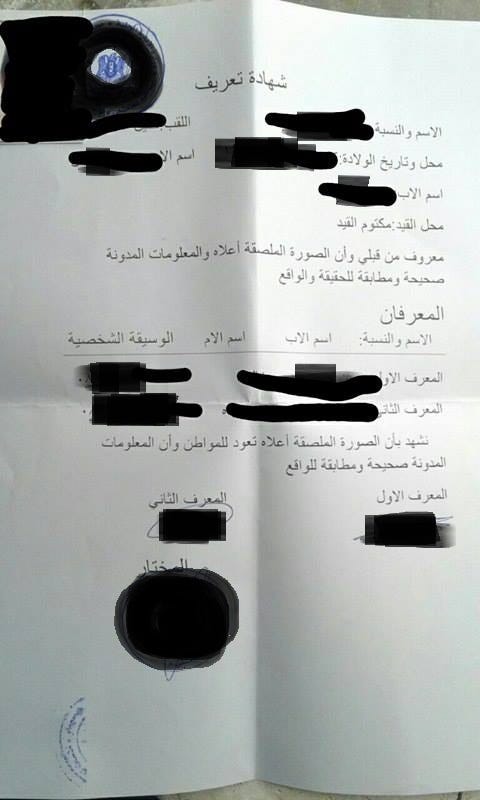
Unofficial documentation for a Maktumeen Kurd that fails to even include an ID photo. Source: https://www.syrianationality.org/index.php?id=21
The Political Exploitation of Kurdish Nationality
A frequent issue encountered in the IHRC’s advocacy is that major improvements for Kurdish nationality rights tend to coincide with major political crises. The first change for Syrian Kurds occurred in 2011 with Decree No. 49. This decree allowed the Ajanib Kurds to apply for the restoration of their citizenship. However, it also had grander political motives. The Assad government instituted this policy during the 2011 popular uprisings that started the Syrian Civil War in order to win the support of Kurds. The decree was not uniformly applied, and there was a compounded issue of significant mistrust of the Assad government, which led to about 20,000 of the Ajanib remaining stateless. Additionally, the decree excluded the Maktumeen who already have fewer rights than the Ajanib. Many Kurds furthermore felt that naturalization through this law was inadequate to realizing true transitional justice for their systematic discrimination, and instead called for compensation for their suffering in addition to citizenship.
Decree No. 13 of 2026 is another extension of this political exploitation of Kurdish nationality rights. During the Syrian Civil War, the predominantly Kurdish Syrian Democratic Forces (SDF) created their own government, the Democratic Autonomous Authority of North and East Syria (DAANES). Kurdish groups such as SDF have long fought collectively for Kurdish autonomy from the Syrian government. Therefore, they have been hostile to surrendering their current autonomy to the new Syrian transitional government which they do not yet trust. Since the Syrian transitional government’s inception in March of 2025, there have resultantly been armed skirmishes between SDF and the Syrian government, which wants full control of all territory that it considers to be Syrian. Decree No. 13 of 2026 emerged in this context as another attempt to garner Kurdish support for the new Syrian government by granting them greater nationality rights.
The Shortcomings of Decree No. 13
When seen as a political tool rather than an earnest attempt at transitional justice for the Kurdish population, Decree No. 13’s problems become increasingly apparent. One of the most prominent criticisms of the decree that we have heard in interviews is that when the new Syrian government created a new Constitution, it did not include any provisions specifically enshrining Kurdish rights. Rather, these rights appeared as an afterthought through Decree No. 13 after the inability to centralize control over the Kurdish regions.
As the application process for naturalization has begun, there are also worries that many Maktumeen may face difficulties in applying, especially because the application requires some identification documentation and proof of residence, both of which are documents that the Maktumeen have historically struggled to receive.
Additionally, there are only nine centers across the country where stateless Kurds can apply for citizenship, making it potentially difficult for Kurds who require transportation from more remote areas, who may be affected by significant financial burdens, and who may not be aware of the registration procedure. Last, although now allegedly rectified, there were reported issues of Syrian Kurds only being able to label themselves as Syrian Arabs on their new citizenship applications — a painful reminder of the Arab nationalism that originally denationalized them in 1962. This issue only enflames the Kurdish community’s continued distrust of the Syrian government.
The Future of Kurdish Statelessness
The IHRC has noted that there is a genuine sense of hope among many different stakeholders who work with Syria’s Kurdish communities due to the passage of Decree No. 13. The new law is a welcome and long-needed change that will hopefully bring immediate positive developments to the material conditions of Kurds who have long suffered from statelessness in Syria. It may also signal an openness to instituting further laws addressing statelessness. However, it should not be considered the conclusion of their struggle for equal nationality rights. A focal point of our advocacy based on the issues raised by community stakeholders is that the right of Kurds and all other minorities in Syria to Syrian nationality must be explicitly enshrined in the Constitution. Doing so would create a stronger realization of transitional justice through the legal recognition that Kurds are an integral part of Syria. Statelessness in Syria can only be ended when the equality of all of its minority groups is a central part of the state’s identity, and no longer just a politically instrumentalized afterthought. Working alongside advocates at the domestic, regional, and international levels, the IHRC will continue to fight for the rights of Kurds and all Syrians to a nationality and full equality.
메타데이터
- post_id
- b77b409aa7b5
- slug
- decree-no-13-an-end-to-kurdish-statelessness-or-a-potemkin-solution-b77b409aa7b5
- url
- https://medium.com/@buslahr/decree-no-13-an-end-to-kurdish-statelessness-or-a-potemkin-solution-b77b409aa7b5
- canonical_url
- https://medium.com/@buslahr/decree-no-13-an-end-to-kurdish-statelessness-or-a-potemkin-solution-b77b409aa7b5
- author_url
- https://medium.com/@buslahr
- status
- ok
- fetched_at
- 2026-06-09 14:34:10