AI Didn’t Kill the Design Handoff. It Finally Exposed How Broken It Always Was.
Last week I wrote about why most design systems are already obsolete. This week, I want to talk about what just arrived to make that…
AI Didn’t Kill the Design Handoff. It Finally Exposed How Broken It Always Was.
Last week I wrote about why most design systems are already obsolete. This week, I want to talk about what just arrived to make that problem impossible to ignore.
The design-to-code handoff has been broken for as long as there has been a design-to-code handoff.
Designers know it. Engineers know it. Every product team that has ever watched a pixel-perfect comp turn into a “close enough” implementation knows it. We just got exceptionally good at normalizing it. We called it interpretation. We blamed tooling gaps. We wrote detailed spec documents and added more red-lines to our Figma files and hoped for the best.
AI didn’t create this problem. It just made it impossible to keep pretending it doesn’t exist.
Because now the gap is wider, the speed is faster, and the cost of a weak foundation compounds in ways it never did before.
What Is Actually Changing
For the last few years, AI in the design-to-code workflow mostly meant smarter Inspect panels and plugins that could generate a passable CSS snippet from a Figma frame. Useful. Incremental. Nothing that fundamentally changed how design and engineering related to each other.
That era is over.
Figma’s recent integration with OpenAI’s Codex signals where this is heading. The explicit goal is to dissolve the boundary between design and engineering entirely. As Figma’s chief design officer put it, the aim is to let engineers iterate visually without leaving their flow and let designers work closer to real implementation without becoming full-time coders.
Agentic AI tools are going further still. The leading platforms in 2026 can now coordinate across multiple roles simultaneously, handling UI design, component implementation, test writing, and documentation in a single workflow. What used to be a sequential relay race between disciplines is becoming a parallel, AI-orchestrated process.
This is not iteration on the old model. It is a structural break from it.
The Role Shift Nobody Is Ready For
Here is the part that most conversations about AI and design skip over.
When AI handles the execution layer, the value of the humans in the room shifts. Dramatically. The question stops being “can you design a component?” or “can you write the code for it?” and starts being “can you direct the system to produce the right outcome, and do you have the judgment to know when it hasn’t?”
This is actually where design engineering as a discipline has always been pointing. The best design engineers I have worked with over 30 years were never the fastest at pushing pixels or the cleanest at writing CSS. They were the ones who understood both sides deeply enough to make good decisions at the intersection. Who could hold the design intent and the engineering constraint in their head at the same time and find the path through.
AI accelerates execution. It does not supply that judgment. It does not know what your brand actually means. It does not understand why that interaction pattern matters to your users or what the edge cases are in your data model. It produces things that look right until they fall apart.
The most experienced practitioners building with AI right now are arriving at the same conclusion: treat it as a pair programmer that needs clear direction and oversight, not as an autonomous agent that can be trusted to make product decisions. The human remains the director. AI expands what the director can produce, but it does not replace the director’s judgment.
That reframe is important because it clarifies what actually needs to be true for AI to help rather than hurt.
The Risk Hiding Inside the Opportunity
And this is exactly where a weak design system stops being a maintenance problem and becomes a liability.
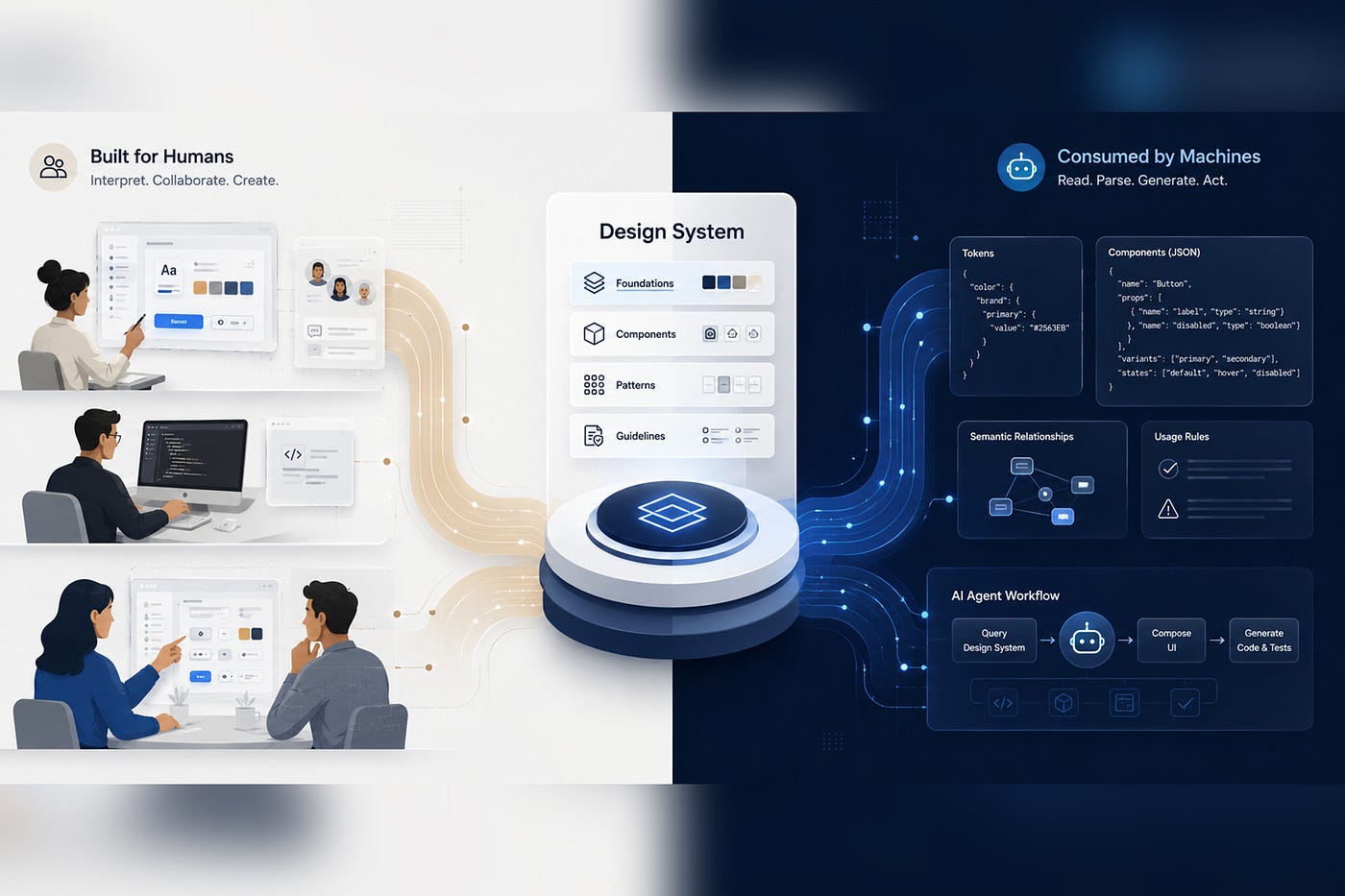
AI-assisted design-to-code is only as trustworthy as the system it is working from. Feed an AI a well-structured, token-first design system with clear component definitions, documented patterns, and accessibility baked in at the component level, and it can produce output that is fast, consistent, and on-brand. Feed it a scattered collection of one-off Figma frames and undocumented conventions, and it will produce things that look plausible and break in production.
Speed without infrastructure is just faster chaos.
This is the risk that is not getting enough attention in the current AI enthusiasm cycle. Teams are adopting AI tools at a pace that far outstrips the maturity of the systems those tools are working from. The result is a new category of design debt that accumulates faster than the old handoff ever could, because AI can generate inconsistency at scale in a way that a human designer working alone simply cannot.
The companies reporting real productivity gains from AI in their design-to-code workflow, and credible research is showing 25 to 30 percent gains for teams that get this right, share a common thread. They invested in the infrastructure first. Standardized tokens. Clear component architecture. Documentation that is current and machine-readable. Governance with actual teeth. Then they added AI on top of that foundation.
The foundation is what makes the speed real rather than illusory.
What This Means in Practice
If you are leading a design or engineering organization, the arrival of capable AI in your design-to-code workflow is not primarily a tooling decision. It is an infrastructure readiness question.
Before asking which AI tool to adopt, ask whether your design system is ready to be the source of truth that AI works from. Whether your tokens are standardized enough to travel across a generative pipeline without losing fidelity. Whether your documentation is machine-readable, or buried in a Notion page nobody has touched in six months.
The teams that will move fastest with AI are not the ones who adopted it earliest. They are the ones who built the right foundation and then adopted it with discipline.
That has always been the point of a strong design system. AI just made the stakes clear.
This is the second post in an ongoing series on design, design engineering, and the infrastructure behind great products. If you missed the first one, start here: Your Design System Is Already Obsolete. Here’s What Comes Next.
Eddie Lou is a UX and Design Engineering leader with 30+ years of experience at Cisco, PayPal, Apple, Visa, BigCommerce, and Indeed. He is the author of the Design Engineering Handbook (InVision / Design Better) and the founder of EFX Design, a design and development studio specializing in experience platforms, design systems, and custom product development.
Interested in evolving your design system? Let’s talk.
메타데이터
- post_id
- b77c632a5a67
- slug
- ai-didnt-kill-the-design-handoff-it-finally-exposed-how-broken-it-always-was-b77c632a5a67
- url
- https://medium.com/@ed-lou/ai-didnt-kill-the-design-handoff-it-finally-exposed-how-broken-it-always-was-b77c632a5a67
- canonical_url
- https://medium.com/@ed-lou/ai-didnt-kill-the-design-handoff-it-finally-exposed-how-broken-it-always-was-b77c632a5a67
- author_url
- https://medium.com/@ed-lou
- status
- ok
- fetched_at
- 2026-06-09 15:37:30