Red vs Amber Sleep Glasses — Which Color Actually Helps You Sleep Better?
You’ve tried everything. Magnesium before bed. No caffeine after noon. The phone-in-another-room rule that lasts about two nights. And yet…
Red vs Amber Sleep Glasses — Which Color Actually Helps You Sleep Better?
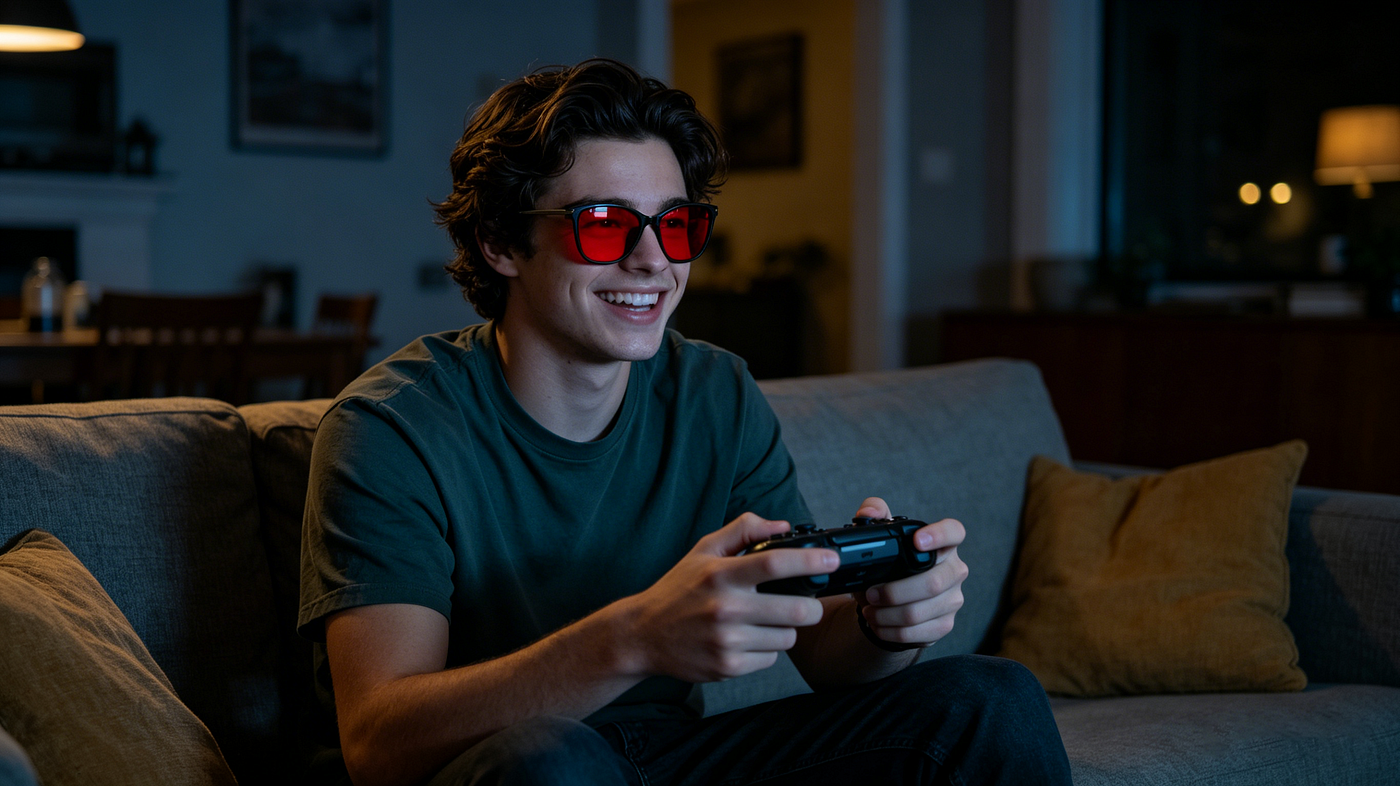
You’ve tried everything. Magnesium before bed. No caffeine after noon. The phone-in-another-room rule that lasts about two nights. And yet here you are at 1 AM, scrolling through product pages for sleep glasses, paralyzed by one question: red or amber?
Here’s the short answer most review sites won’t give you: they’re not the same thing, and most people are buying the wrong one. Red and amber lenses sit at opposite ends of the blue-light-blocking spectrum — one is a scalpel, the other is a sledgehammer. Using the wrong one for your situation isn’t just ineffective; it might actually make your sleep routine harder to stick with.
Let’s break down what actually matters so you can stop guessing.
The Science: Why Lens Color Determines Your Melatonin
Your circadian rhythm — your body’s internal 24-hour clock — is controlled by a tiny region in your brain called the suprachiasmatic nucleus (SCN). Think of it as the shift supervisor that tells every organ in your body when to wind down and when to wake up. The SCN’s primary input? Light. Specifically, short-wavelength light in the 400–520 nanometer range (blue and some green light).
When blue light hits your eyes in the evening, your SCN suppresses melatonin — the hormone that makes you feel sleepy. This is exactly what evolution intended; blue light meant daylight. The problem is your screens and LED bulbs pump out this same blue light at 10 PM, tricking your brain into thinking the sun just came up.
Blue-light-blocking glasses work by filtering out these disruptive wavelengths. But here’s where red and amber lenses diverge dramatically:
Amber lenses block roughly 95% of blue light in the 380–500nm range. They let through most green and longer wavelengths, so you can still see colors reasonably well — your phone screen looks slightly warm, but you can read a text without squinting.
Red lenses block approximately 99.89% of blue light and green light up to around 550nm. This is a far more aggressive filter. It also blocks the green wavelengths that research has shown can suppress melatonin production, albeit less potently than blue light [1]. The tradeoff? Everything looks red. Your white phone screen becomes an eerie crimson glow.
A 2025 study comparing red and blue LED exposure found that after three hours of evening light exposure, melatonin levels under red light conditions were over four times higher than under blue light (34.2 pg/mL vs 8.4 pg/mL) — a statistically significant difference [1]. That’s the kind of gap that matters if you’re lying in bed wondering why meditation apps aren’t working.
Amber Glasses: The Practical Choice for Most People
If you typically spend your evenings watching Netflix, reading on a tablet, or catching up on emails before bed, amber lenses are probably what you need. They strike a balance between melatonin protection and real-world usability.
A randomized controlled trial published in the Journal of Psychiatric Research found that insomniacs who wore amber-tinted blue-light-blocking lenses before bedtime showed significant improvements in sleep quality compared to a control group [3]. A 2025 meta-analysis of blue-light-blocking glasses and actigraphic sleep outcomes similarly concluded that wearing these glasses in the evening improved total sleep time and sleep efficiency [4].
The key advantage of amber lenses is compliance. Let’s be honest — if your glasses make it impossible to distinguish between your partner’s face and a tomato, you’re going to take them off. Amber lenses are tolerable enough that you’ll actually wear them for the recommended 1–2 hours before bed, which is the window where melatonin suppression is most critical.
Best for: Evening screen use, general sleep improvement, people new to light-management strategies, shift workers winding down after a shift.
Red Glasses: The Heavy Artillery for Stubborn Sleep Problems
Red lenses are not for casual use. They’re for people who have tried amber glasses and still can’t fall asleep, or who have diagnosed circadian rhythm disorders like Delayed Sleep-Wake Phase Disorder. A 2016 study found that wearing blue-light-blocking glasses in the evening advanced circadian rhythms in patients with this exact condition [5].
Research has established that wavelengths below 550nm — which includes both blue and green light — can interfere with melatonin secretion [1]. Red lenses are the only consumer eyewear option that blocks this full range. If you’ve been wearing amber glasses for weeks with no improvement, it’s possible that the remaining 5% of blue light plus the unfiltered green light is still enough to keep your SCN active.
Biohackers and sleep optimization enthusiasts have gravitated toward red lenses for this reason. Brands like TrueDark have built their entire nighttime product line (the Twilights series) around red lenses, claiming 99% blue light blockage plus green and violet light filtration. The science behind this approach is solid — the trade-off is purely practical.
Best for: Chronic insomnia that hasn’t responded to other interventions, diagnosed circadian rhythm disorders, jet lag recovery, the last 30–60 minutes before sleep when you need maximum melatonin support.
Side-by-Side Comparison

How to Choose: A Simple Decision Framework
Go with amber if:
This is your first pair of sleep glasses
You want to wear them while using screens in the evening
Your sleep issues are mild to moderate
You value comfort and daily compliance over maximum light blocking
Go with red (or use red as a second pair) if:
You’ve already tried amber glasses without success
You have a diagnosed circadian rhythm disorder
You’re dealing with severe, chronic insomnia
You’re willing to wear them only for the last 30–60 minutes before sleep
The ideal approach for serious sleep optimization? Both. Wear amber lenses starting 1–2 hours before bed, then switch to red for the final stretch. This gives you the best of both worlds — usability during your evening routine, then maximum melatonin protection when it matters most.
The Right Tool for the Right Phase
Red and amber sleep glasses aren’t interchangeable alternatives — they’re tools for different jobs. Amber lenses are the everyday workhorse: practical, wearable, and backed by solid clinical evidence for improving sleep in most people. Red lenses are the specialist tool: more powerful but harder to use consistently, reserved for cases where amber isn’t enough.
Most people should start with amber. If you’re reading this article, there’s a decent chance that’s all you need. But if you’ve been chasing better sleep for months and amber glasses haven’t moved the needle, red lenses might be the thing you haven’t tried yet — and the science says there’s a real, measurable difference in how they affect your melatonin production.
The best move is probably the one nobody talks about: getting both. Start with amber during your evening routine, then switch to red for that final hour. It’s not overkill — it’s just matching the right tool to the right phase of your wind-down.
References
[1] Sanchez-Cano, A. et al. (2025). Comparative Effects of Red and Blue LED Light on Melatonin Levels During Three-Hour Evening Exposure. Life (Basel), 15(5), 715.
[2] Luna-Rangel, F.A. et al. (2025). Efficacy of blue-light blocking glasses on actigraphic sleep outcomes: A systematic review and meta-analysis of randomized controlled crossover trials. Frontiers in Neurology, 16, 1453267.
[3] Shechter, A. et al. (2018). Blocking nocturnal blue light for insomnia: A randomized controlled trial. Journal of Psychiatric Research, 103:91–100.
[4] Glickman, G.L. et al. (2025). Optimizing the potential utility of blue-blocking glasses for sleep and circadian health: A systematic review. Translational Vision Science & Technology, 14(7), 25.
[5] Esaki, Y. et al. (2016). Wearing blue-light-blocking glasses in the evening advances circadian rhythms in patients with delayed sleep phase disorder. Chronobiology International.
메타데이터
- post_id
- b7955829330c
- slug
- red-vs-amber-sleep-glasses-which-color-actually-helps-you-sleep-better-b7955829330c
- url
- https://medium.com/@austindo332/red-vs-amber-sleep-glasses-which-color-actually-helps-you-sleep-better-b7955829330c
- canonical_url
- https://medium.com/@austindo332/red-vs-amber-sleep-glasses-which-color-actually-helps-you-sleep-better-b7955829330c
- author_url
- https://medium.com/@austindo332
- status
- ok
- fetched_at
- 2026-07-19 17:17:15