Why I’ll Never Fly Peach Aviation Between Tokyo and Osaka Again
This story was updated and posted on Substack
Why I’ll Never Fly Peach Aviation Between Tokyo and Osaka Again
This story was updated and posted on Substack

peach aviation aircraft
Budget airlines in Japan can be great. When everything lines up, they offer low fares, decent punctuality, and a perfectly acceptable experience for short domestic flights. I’ve used budget airlines in Japan before without major complaints.
That’s why I don’t regret choosing a low-cost carrier in general. What I regretted was choosing Peach Aviation for the Tokyo–Osaka route — and no, this isn’t simply about Narita or Kansai Airport being far from the city center.
Budget airlines aren’t the problem
On paper, flying between Tokyo and Osaka with a budget airline makes sense. The flight itself is short, prices can look attractive, and there are multiple departures every day. For travelers trying to save money, it’s easy to see the appeal.
The issue with Peach wasn’t one single major failure. It was a series of small inconveniences that added up — especially on a route where efficiency matters.
The check-in problem
Peach is, as far as I know, is the only budget airline in Japan (and possibly the world), that does not allow online check-in unless you are a registered member and that’s only at selected airports. Even if you’re traveling without checked luggage, you still have to check in at the airport.
This changes the entire calculation.
Mandatory check-in at the airport means arriving earlier than you otherwise would, standing in line, and losing any time advantage you might expect from flying. For a short domestic route like Tokyo–Osaka, that already puts Peach at a disadvantage.
Terminal choice matters more than you’d expect

The departure hall at KIX T2
At Narita Airport, Peach operates out of Terminal 1, one of the main terminals, which is perfectly fine. The experience there was straightforward and uneventful.
The real issue came at Kansai International Airport (KIX).
Peach uses Terminal 2 at Kansai Airport, which is one of the worst airport terminals I’ve experienced in Japan. It’s essentially a temporary structure located far from the main terminal area, with no direct train access.
To get from Terminal 2 to Terminal 1 — where the Kansai Airport Station is — you must take a shuttle bus. The ride alone takes around 10 minutes, not including waiting time. Because of this extra transfer, I nearly missed my train.
This isn’t always clearly emphasized when booking, and it completely changes the arrival experience. What should have been a simple transition turned into unnecessary stress.
Why this matters on the Tokyo–Osaka route
Between Tokyo and Osaka, convenience matters more than it might elsewhere. When you factor in mandatory airport check-in, early arrival, terminal transfers, shuttle buses, and tight train connections, the supposed efficiency of flying disappears.
On this route especially, the Shinkansen sets a very high bar. Any alternative needs to be clearly better in cost or convenience to justify itself. Peach, in my experience, wasn’t.
Better budget options do exist
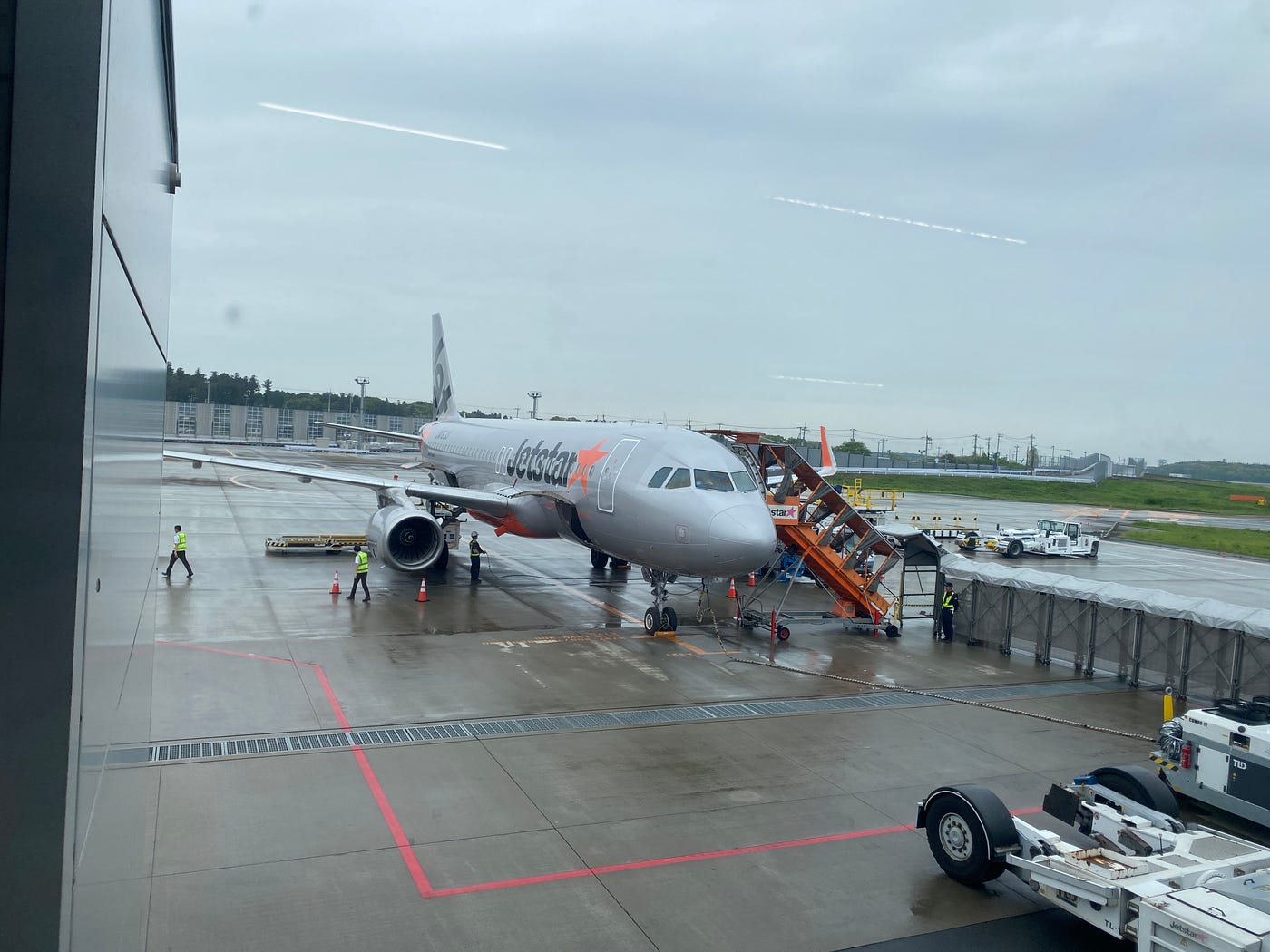
A Jetstar Japan Aircraft at Narita T3
If you’re traveling on a budget between Tokyo and Osaka, there are better alternatives.
Highway or overnight buses are often cheaper and more predictable door-to-door. They avoid airport transfers entirely and work well if your schedule is flexible.
Among budget airlines, Jetstar Japan is a much more practical choice.
Jetstar Japan operates from Terminal 3 at Narita, which is either a short walk or a quick shuttle bus ride from Terminal 2. While the terminal is basic, it’s functional and clearly designed for low-cost carriers.
At Kansai Airport, Jetstar uses Terminal 1 — the main terminal — with no remote stands and no shuttle bus required. You can walk directly to the Kansai Airport Station after landing, which makes a real difference.
Jetstar Japan also allows online check-in — something that shouldn’t be remarkable, but in this case, is.
Despite its Australian parent company sometimes being jokingly referred to as the “Death Star,” Jetstar Japan operates as a joint venture between Japan Airlines and Qantas. The experience reflects that structure more than the stereotype.
The takeaway
Budget airlines in Japan can absolutely make sense. But not all low-cost options are equal, and details matter — especially on heavily traveled routes like Tokyo–Osaka.
For me, Peach added too many small inconveniences to justify the savings. Between mandatory airport check-in and the complications of Kansai Airport’s Terminal 2, it simply wasn’t worth it.
If I’m traveling on a budget, I’d choose the bus or Jetstar Japan instead. And that’s why I won’t be flying Peach on this route again.
메타데이터
- post_id
- b7b8731daffa
- slug
- why-ill-never-fly-peach-aviation-between-tokyo-and-osaka-again-b7b8731daffa
- url
- https://medium.com/@satoshiashkanemura/why-ill-never-fly-peach-aviation-between-tokyo-and-osaka-again-b7b8731daffa
- canonical_url
- https://medium.com/@satoshiashkanemura/why-ill-never-fly-peach-aviation-between-tokyo-and-osaka-again-b7b8731daffa
- author_url
- https://medium.com/@satoshiashkanemura
- status
- ok
- fetched_at
- 2026-06-27 23:56:40