How to Build Topical Authority That AI Engines Actually Recognise and Cite
Topical authority is the single most important factor in whether AI engines cite your brand more than backlinks, more than domain age, more…
How to Build Topical Authority That AI Engines Actually Recognise and Cite
Topical authority is the single most important factor in whether AI engines cite your brand more than backlinks, more than domain age, more than individual page quality. Here is exactly how it is built, measured, and sustained.
Ask most marketing teams why their competitors are appearing in AI-generated answers and they aren’t, and the answer they reach for first is backlinks. Or domain authority. Or technical SEO. These are the factors that shaped search visibility for two decades so they’re the factors that feel most familiar when something new needs explaining.
They are not, however, the primary reason one brand appears consistently in AI answers while another with comparable or superior traditional SEO metrics is absent. That reason is topical authority. And topical authority is built through a fundamentally different process from the one that built rankings in traditional search.
This piece explains precisely what topical authority means in the context of AI answer engines, why it matters more than any other AEO signal, and exactly how to build it in a way that produces consistent, compounding citation visibility across all the major platforms your customers are using.
Photo by Zulfugar Karimov on Unsplash
What topical authority actually means for AI engines
Topical authority, in the traditional SEO sense, meant that a domain had accumulated enough links, engagement signals, and crawl depth around a subject that Google treated it as a reliable reference point for that subject. A domain could achieve topical authority on a narrow topic with a handful of well-linked pages, if the external signals were strong enough.
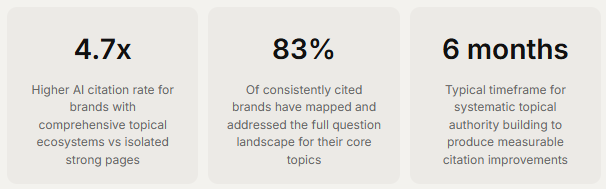
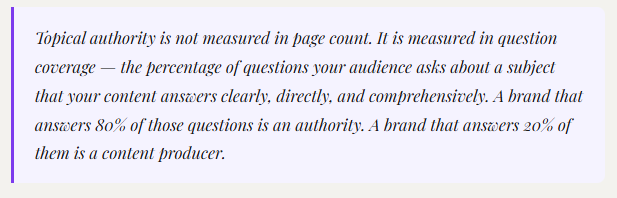
AI engines have redefined topical authority in ways that require a different strategic response. For an AI system constructing a response, topical authority is not primarily assessed through link signals. It is assessed through the comprehensive, coherent, consistent coverage of a subject area the evidence that a brand genuinely understands the full landscape of a topic, not just the high-traffic surface questions.
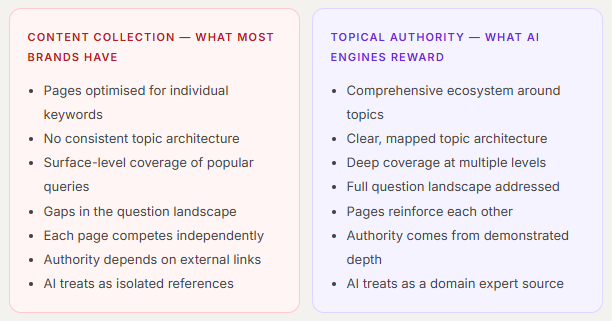
The distinction is between a library and an expertise. A library has many books on many subjects. An expert has deep, interconnected knowledge of a specific domain knowledge that becomes more valuable and more reliably citable the more comprehensively it covers the field. AI engines are looking for the expert, not the library.
The three layers of topical authority
Building topical authority that AI engines recognise requires systematic investment across three distinct layers. Each layer contributes a different dimension of the authority signal. Weakness in any one of them limits what the others can achieve which is why content-heavy programmes that neglect technical structure, or technically excellent sites with thin content depth, consistently underperform on AI citation metrics.
Layer 1: Content Depth Owning the Full Question Landscape
The first and foundational layer of topical authority is comprehensive question coverage. For every subject area you want to be cited on, the goal is to answer every meaningful question your audience asks from the broadest definitional questions at the top of the knowledge hierarchy to the most specific, technical, or situational questions at the bottom.
This is not about publishing volume for its own sake. It is about closing the gaps in your coverage that prevent AI engines from treating your domain as a comprehensive reference on the topic. A brand with fifteen pages that collectively cover 90% of the question landscape for a topic will consistently outperform a brand with forty pages that collectively cover 50% because the former’s coverage signals genuine expertise, while the latter’s signals an opportunistic approach to keyword capture.
The question landscape for any topic has a predictable structure. At the top are the definitional and foundational questions “what is X?”, “how does X work?”, “what are the different types of X?” These are the highest-volume questions and the ones most brands have addressed. Below them are the comparative questions “X vs Y”, “which X is best for Z situation?” Below those are the procedural and diagnostic questions “how do I do X?”, “why is X happening?”, “what should I do when X fails?” At the bottom are the edge case and advanced questions the ones that differentiate genuine expertise from competent surface coverage.
The brands consistently cited as category authorities in AI answers have content at every level of this hierarchy. The ones appearing occasionally have content at the top but significant gaps further down. The ones rarely or never appearing have content only at the most common entry points the same content every competitor has, offering no differentiating signal to an AI engine evaluating source quality.
How to Execute This Layer
Build a question map for each of your two or three core topic areas. List every question your audience asks using search tools, “People Also Ask” data, forum analysis, and your sales and support conversations. Categorise each question by level: foundational, comparative, procedural, advanced. Map your existing content against this list. The uncovered questions at each level are your content programme for the next six months prioritised by purchase intent, not search volume.
Layer 2: Content Architecture Connecting Coverage into a Coherent Ecosystem
Comprehensive question coverage is necessary but not sufficient for topical authority. The second layer content architecture is what transforms individual pages into an interconnected knowledge ecosystem that AI engines can navigate, cross-reference, and treat as a coherent expert resource rather than a collection of isolated pages.
The architectural principle that matters most for AI-recognised topical authority is the pillar-cluster model. Each core topic area is anchored by a comprehensive pillar page a definitive, deep resource that addresses the topic at a breadth that signals its central role in the ecosystem. Around each pillar, cluster pages address the specific sub-questions, comparisons, procedures, and edge cases in depth. Internal links from cluster pages to the pillar page, and from the pillar page to cluster pages, create the web of connections that allow AI systems to understand the relationship between pages and to treat the cluster as an interconnected body of expertise rather than a set of coincidentally related pages.
The architectural signals that AI engines read most clearly:
- Consistent semantic relationship between pages addressing related topics expressed through internal linking, shared entity references, and complementary content structures
- Pillar pages that provide genuine breadth comprehensive enough that an AI system can extract an overview answer from them while understanding they are part of a larger ecosystem
- Cluster pages that provide genuine depth specific enough that they answer a precise question better than any other available source
- Clear navigation between related content breadcrumbs, related content sections, and topic tag structures that make the architecture legible to both AI crawlers and human readers
The most common architectural failure in content programmes targeting AI visibility is the absence of genuine pillar content. Brands publish many cluster-level pages good, specific, question-answering content without the comprehensive pillar pages that anchor the topic ecosystem and signal to AI engines that this domain has comprehensive, hierarchically organised knowledge on the subject.
How to Execute This Layer
For each of your core topic areas, identify or create a definitive pillar page comprehensive, 2,500+ words, addressing the topic at breadth and linking to every cluster page in the ecosystem. Audit your internal linking: every cluster page should link to its pillar, and the pillar should link to every cluster. Use consistent entity language across all pages in a topic cluster refer to the same concepts with the same terminology to reinforce semantic relationships that AI systems use to map your content architecture.
Layer 3: External Validation Confirming Authority Through Third-Party Signals
The third layer is the one most content strategies neglect and the one that most directly determines whether AI engines treat your topical authority as genuine expertise or self-assessed expertise. AI systems don’t take your word for your authority on a subject. They look at what the rest of the web says about you.
External validation for topical authority works differently from traditional link building. The signals that matter are not link quantity they are citation quality, mention context, and source credibility. Being mentioned as an expert source in a credible industry publication on the topic you want to be authoritative on is worth significantly more to AI citation frequency than a hundred backlinks from general-purpose directories.
The external validation signals that carry the most weight for AI-recognised topical authority:
- Expert citation in credible publications: Being quoted or referenced as an authority on a specific topic in publications that AI systems treat as high-credibility sources for that topic area
- Original data that becomes a primary reference: Publishing research, surveys, or analysis that other credible sources cite establishing your domain as a primary source rather than a secondary reference
- Consistent presence in category discussions: Appearing regularly in the expert roundups, comparison pieces, and “best of” lists that credible third parties publish in your topic area
- Review platform authority: Strong, specific, review-rich presence on the platforms AI systems reference when assessing brand credibility in your category
- Co-citation patterns: Being mentioned alongside established authorities in your topic area which tells AI systems that the domain has been assessed and validated by sources that already have established credibility
The practical implication is that building AI-recognised topical authority requires an external presence programme running in parallel with the internal content programme. The most common pattern among brands that have strong content depth but weak AI citation rates is an absence of this external validation layer their authority exists on their own domain, but the independent confirmation that makes AI engines confident in citing them is missing.
How to Execute This Layer
Identify the five most credible publications in your topic area and develop a programme of contributed expert content aimed at establishing your brand as a citable authority, not at generating traffic. Commission original research on a question your industry cares about and that your data uniquely allows you to answer. Track which external sources are driving citations for your cited competitors and pursue inclusion in the same sources. Build your external validation programme alongside your content programme they compound together in ways neither achieves alone.
The content types that build topical authority most efficiently
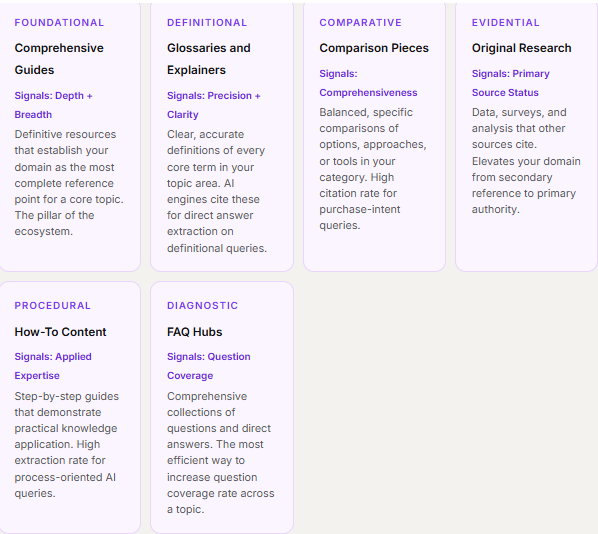
Not all content contributes equally to topical authority. Understanding which content types signal which dimensions of authority allows you to build your content programme for maximum AI citation impact rather than maximum traffic or engagement.
How much coverage is enough? The depth benchmark
One of the most common questions from marketing teams building their topical authority programme is how much coverage is sufficient when does a content ecosystem cross the threshold from “present on the topic” to “authority on the topic” in AI engine assessment?
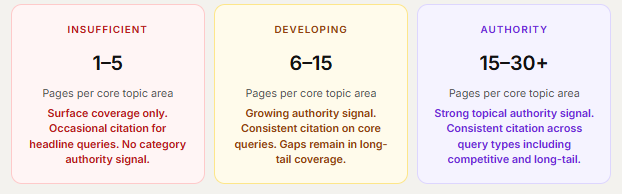
These numbers are indicative rather than absolute the quality and architecture of the content matters as much as the volume. Fifteen well-structured, comprehensively interconnected pages covering a topic’s full question landscape will outperform thirty loosely related, poorly structured pages with similar content. But the depth benchmark provides a useful sense of the investment scale required: if you have two pages on a topic you want to be cited as an authority on, you are not close to the threshold. If you have twenty-five well-structured pages forming a coherent ecosystem, you almost certainly are.
The five mistakes that prevent topical authority from building
Understanding what builds topical authority is half the picture. Understanding what prevents it from building despite significant content investment is the other half, and often the more practically useful one for teams already producing content without seeing the AI citation results they expected.
Building for keywords rather than questions. Pages optimised for keyword density signal relevance to a ranking algorithm. Pages that answer specific questions directly signal authority to an AI synthesis system. The same topic, approached through these two lenses, produces content that performs very differently in AI citation contexts even when the surface-level subject matter is identical.
Covering topics in isolation rather than ecosystems. A single strong page on a topic, however well-written, does not establish topical authority. Authority requires the interconnected ecosystem that demonstrates comprehensive knowledge not any individual piece within it. Publishing isolated strong pages without building the surrounding cluster consistently underdelivers on AI citation frequency relative to the content investment made.
Neglecting the long tail of the question landscape. The questions at the bottom of the knowledge hierarchy the edge cases, the advanced technical questions, the highly specific situational queries are the ones that most clearly differentiate genuine expertise from surface coverage. Brands that cover only the popular queries look indistinguishable from every other brand that has done the same. Brands that cover the full landscape, including the questions most competitors haven’t bothered with, stand out as genuine authorities.
Treating topical authority as a content project rather than a content programme. A content project has a start date and an end date. A content programme runs continuously, adding coverage, updating existing pages, and expanding into adjacent question territory as the topic landscape evolves. AI engines assess topical authority in real time a domain that was comprehensive six months ago but has published nothing since is losing authority relative to a competitor publishing consistently, even if it currently has more pages.
Building internal depth without building external validation. A comprehensive content ecosystem on your own domain establishes the internal case for topical authority. Without external validation credible third-party sources confirming that this domain is genuinely knowledgeable on the subject AI engines cannot fully distinguish between deep genuine expertise and deep self-promotion. Both internal and external dimensions of the authority signal need to be built in parallel for the full citation frequency benefit to materialise.
Building topical authority the six-month programme
Topical authority is not built in weeks. It is built in months through consistent, systematic investment across all three layers. Here is what a well-structured six-month programme looks like for a brand starting from a typical position of moderate content coverage and limited topical ecosystem development
- Month one: Map the full question landscape. For each of your two or three core topic areas, build a comprehensive question map covering every level of the knowledge hierarchy. Audit your existing content against this map. Identify coverage gaps by level and by intent. This map is the foundation of every content decision for the next six months commission nothing without cross-referencing it against the map.
- Month one to two: Build or identify your pillar pages. For each core topic, identify whether you have a comprehensive pillar page or need to create one. A pillar page that truly anchors a topic ecosystem takes time to do well budget two to three weeks per pillar. The pillar is the highest-leverage single content investment in the programme; get it right before building the cluster around it.
- Month two to four: Systematic cluster content production. Working from the question map, produce cluster content in priority order highest purchase intent first, then comparative and procedural questions, then long-tail and advanced questions. Each cluster page should address one question comprehensively, lead with a direct answer, and link both to its pillar and to related cluster pages. Quality over speed three excellent cluster pages per month outperform ten mediocre ones.
- Month two onwards: External validation programme running in parallel. Identify and begin cultivating relationships with the credible publications in your topic area. Commission original research on a question the industry cares about. Pursue inclusion in the comparison pieces and expert roundups where cited competitors are already appearing. This programme has a longer lead time than content production starting it in month two ensures the external validation is accumulating alongside the internal content development.
- Month three onwards: Architecture audit and optimisation. As the cluster content accumulates, audit the internal linking structure systematically. Every cluster page should link to its pillar. The pillar should link to every cluster. Related cluster pages across different topic areas should link to each other where genuine relevance exists. This architectural work takes one to two days per topic area and should be done before the ecosystem is fully built retrofitting architecture onto a complete ecosystem is significantly more time-consuming than building it as you go.
- Month four to six: Measurement, gaps, and iteration. Test your priority queries monthly across all four major AI platforms. Track citation frequency by topic area and query type. Use the measurement data to identify which parts of the question landscape are still underperforming and prioritise the remaining content production accordingly. By month six, a well-executed programme should be producing measurable citation improvements on core topic queries and the ecosystem should be comprehensive enough to sustain those improvements without the intensive production pace of the first six months.
When specialist support makes the programme faster and more precise
The six-month programme above is executable with internal resources but the combination of question landscape mapping, pillar content production, cluster content creation, architectural optimisation, external validation building, and monthly citation measurement represents a sustained, multi-disciplinary workload that most marketing teams find difficult to execute alongside existing programme responsibilities.
There is also the intelligence dimension. Understanding which questions within a topic landscape are currently driving the most AI citation activity and which content structures are performing best on each platform requires continuous monitoring across multiple AI systems. That monitoring is difficult to maintain internally at the scale that makes the intelligence genuinely actionable.
For brands serious about building topical authority that translates into consistent AI citation visibility and doing so at a pace that produces measurable results within six months rather than eighteen partnering with a specialist team brings the strategic and technical depth that the programme demands. Working with a specialist like Gorilla360’s AEO services means accessing a practice built specifically around topical authority development for AI citation visibility combining content strategy, architectural implementation, external authority building, and continuous platform monitoring into a managed programme that produces the kind of compounding citation improvements that most brands find significantly harder to achieve building the capability from scratch internally.
The bottom line: Topical authority in the AI era is not about publishing more it is about covering comprehensively, connecting architecturally, and validating externally. The brands consistently cited as category experts by ChatGPT, Perplexity, and Google AI Overviews have built all three layers of this authority signal deliberately, systematically, and with the patience to let the compounding effects accumulate. The question landscape map is the starting point. The pillar-cluster architecture is the structure. The external validation programme is the confirmation signal. Together, they produce the kind of topical authority that AI engines cannot ignore and competitors cannot quickly replicate.
메타데이터
- post_id
- b7bddccf8a66
- slug
- how-to-build-topical-authority-that-ai-engines-actually-recognise-and-cite-b7bddccf8a66
- url
- https://medium.com/@fizza.q1399/how-to-build-topical-authority-that-ai-engines-actually-recognise-and-cite-b7bddccf8a66
- canonical_url
- https://medium.com/@fizza.q1399/how-to-build-topical-authority-that-ai-engines-actually-recognise-and-cite-b7bddccf8a66
- author_url
- https://medium.com/@fizza.q1399
- status
- ok
- fetched_at
- 2026-06-09 15:37:30