GC-Loc: Graph-based Collaborative Indoor Localization
Co-authors : Qun Niu, Ning Liu
GC-Loc: Graph-based Collaborative Indoor Localization
Co-authors : Qun Niu, Ning Liu
Nowadays, we increasingly rely on indoor positioning technology to provide precise navigation, location, and tracking services. As indoor spaces continue to grow larger and more complex, the demand for high-precision indoor positioning is also on the rise. As the traditional satellite-based positioning systems (such as GPS) are prone to be ineffective indoors on account of the signal attenuation caused by poor connectivity between end devices and satellites, it triggers researchers to bend their energies to explore various ambient signals for indoor localization. The crux is how to effectively establish the identifiable mapping relationships between these ambient signal observations and spatial locations.
Why collaborative indoor localization?
Recently, with the rapid development of the techniques like Peer-to-Peer and Crowdsourcing, the concept of collaboration and sharing provides another perspective for efficient indoor localization. Actually, the most common indoor positioning application scenarios are usually some large places with high crowd density, such as the shopping mall, the hospital and the passenger station. And this provides a basis condition. Employing collaborative mechanism, fusing multiple discrete fingerprints from multiple spatially interconnected sources are able to provide much higher discriminability, meanwhile avoiding the high respond time and map constraints.
Inspired by the idea above, we propose a graph attention based framework for collaborative indoor localization, termed GC-Loc. We first construct an adaptive graph representation to model the collaborative relationships among the signal fingerprints from multiple sources. Then we employ the optimized GAT and further bring in the residual structure and hierarchical attention mechanism to realize efficient feature extraction, since the recent proposed GAT exhibits great ability to handle the multivariate non-Euclidean data structure. Moreover, we take advantage of ensemble learning mechanism and further devise a signal similarity based multi-model fusion strategy based on model consensus, finally achieving accurate and robust collaborative indoor localization.
How did we construct the collaborative relationships?
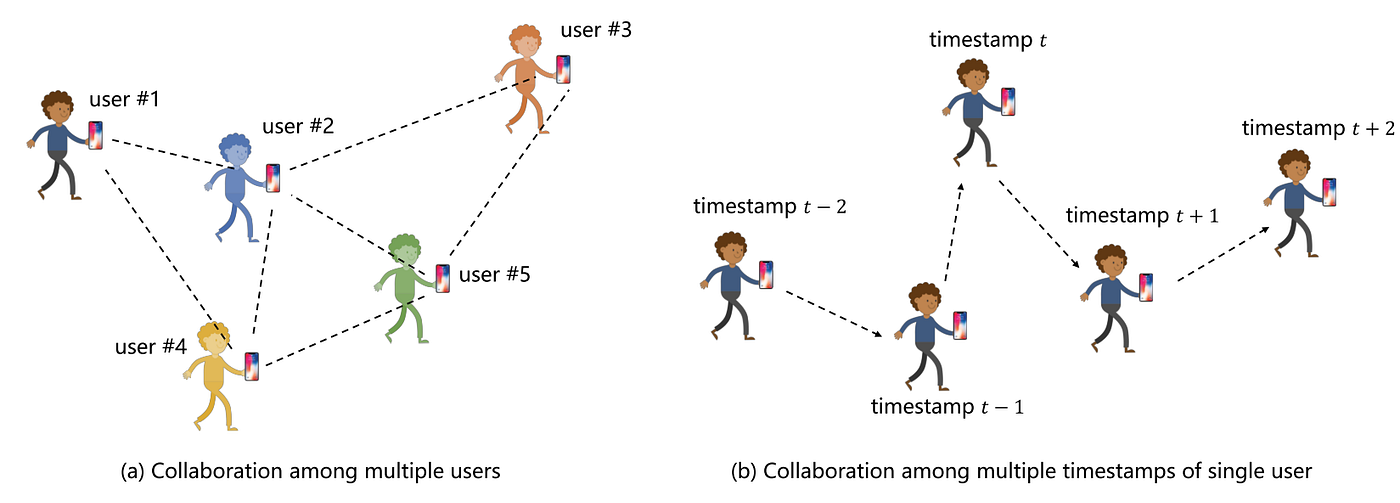
Utilizing graph structure, we construct an adaptive graph representation, in which the vertexes indicate the discrete signal fingerprints and the edge denotes the distance between the corresponding two vertexes.
The constructed representation is not only applicable to the collaboration in the indoor scenes with multiple users intuitively, but also works well with multi-timestamps’ collaboration for the single user scenes.
- Collaboration among multiple users.
- Collaboration among multiple timestamps of single user.
How did we aggregate the location features?
Intuitively, we consider employing state-of-the-art graph learning techniques to aggregate the features for collaborative localiza- tion. For indoor localization, the propagation or distribution of the localization signals are usually fixed unless the indoor environment changes. Therefore, in a specific indoor scene, although the locations of users and their collaborative relationships are highly dynamic, multiple signal fingerprints collected at specific positions (at a specific timestamp) and the corresponding interrelations are usually static. That means users’ locations and their collaborative relationships are static at a specific timestamp of the dynamic variation. Although graph learning is originally suitable for the problems that nodes and edges are relatively static, it can also work for dynamic indoor localization at a static point-in-time.

Network design for feature extraction and aggregration
Graph Attention Network (GAT) is employed as basis to extract and aggregate the location features for localization. Considering the complex and diverse indoor scenes, we construct a residual structure when applying multi-layer deep GAT model, which also effectively restrains the over smoothing problem. On this basis, we further devise a hierarchical attention mechanism, in which we take into consideration the different distance measurements between vertexes so as to fit the actual spatial characteristics of indoor localization.
Location Refinement with Model Consensus
Due to the existence of signal random noise and outliers in the training data, we can obtain multiple independent models through different training settings based on the proposed network. After training convergence, these models almost have same accuracy on training dataset but have different sensitivity to the random noise and signal outliers. Then we can integrate the predictions of all these independent models and make a vote for final location estimation. By this way, we are able to effectively reduce the impact of the problem that a single location prediction model is prone to random errors. And the underlying idea is that even if one single sub-model incurs large random deviations, other sub-models can correct the error back.

The performance of single model (left) and multiple model fusion (right)
Discussion
Nevertheless, a few practical challenges (not the main focus of this work) remain to be addressed or further optimized.
- Device calibration. In practice, the various devices or sensors usually have different calibrations for signal observation reading, e.g., the magnitude of magnetic field intensity obtained from different devices may be inconsistent, which will affect the performance of most fingerprint-based approaches. The recent study on crowdsourcing techniques can provide an efficient solution. Since the calibration is a relative simple task, it can easily leverage or be integrated into the existing crowdsourcing approaches.
- Data security and privacy protection. As indoor localization empowers a variety of mobile applications, the potential privacy and security problems have attracted more and more attentions. With the rapid development of software (e.g. PyTorch Mobile, TensorFlow Lite) and hardware (especially the graphical processing units in mobile smart devices), it’s also possible to explore the local offline deployment in mobile end devices, by which the privacy data leakage can be addressed to a certain extent.
Our paper will be presented at the Ubicomp/ISWC 2023. Check out the full paper here.
If you’re interested in learning more or collaborating in this space, feel free to reach out to me and my amazing co-authors including Qun Niu and Ning Liu.
메타데이터
- post_id
- b7c39d739088
- slug
- gc-loc-graph-based-collaborative-indoor-localization-b7c39d739088
- url
- https://medium.com/ubicomp-iswc-2023/gc-loc-graph-based-collaborative-indoor-localization-b7c39d739088
- canonical_url
- https://medium.com/ubicomp-iswc-2023/gc-loc-graph-based-collaborative-indoor-localization-b7c39d739088
- author_url
- https://medium.com/@hetao23
- status
- ok
- fetched_at
- 2026-06-09 15:37:30