SBIR/STTR Program Status (Jan 10, 2026)
What small businesses and innovators need to know in 2026
SBIR/STTR Program Status (Jan 10, 2026)
What small businesses and innovators need to know in 2026
As of January 2026, the Small Business Innovation Research (SBIR) and Small Business Technology Transfer (STTR) programs are in a period of uncertainty due to a lapse in their congressional authorization. These flagship federal innovation funding programs, which together direct more than $4 billion a year toward early-stage research and development by U.S. small businesses, lost their statutory authority on September 30, 2025, because Congress did not reauthorize them before the deadline.

What the Expiration Means
The expiration of authorization means that federal agencies currently lack the legal authority to issue new SBIR/STTR awards or solicitations until Congress acts. In practical terms:
- New solicitations and award selections are paused or delayed, and some may be cancelled or rescinded.
- Agencies such as NASA have explicitly stated that they cannot release new SBIR/STTR solicitations or fund new awards during the authorization lapse, though existing awards and contracts remain active.
- NIH has taken the step of marking existing SBIR/STTR Notices of Funding Opportunity (NOFOs) as expired.
- Federal departments like the Department of Homeland Security have clarified that they cannot issue new SBIR/STTR awards until reauthorization, but can still pursue Phase III follow-on work and other innovation mechanisms outside SBIR/STTR authority.
For current applicants and awardees, the impact varies: active, ongoing awards are generally being managed under existing contracts, but future funding and continuation notices may be delayed or contingent on reauthorization. Stakeholders are being advised to reach out directly to participating agencies with specific questions about status and next steps.
Congressional Action and Legislative Proposals
In the months leading up to the expiration, lawmakers debated various reauthorization proposals. The House passed a one-year extension bill (H.R. 5100) by a wide margin in September 2025 as a short-term fix, but the Senate did not act on it before the fiscal year deadline.
Since then, several legislative options have been discussed in Congress, including:
- Comprehensive reauthorization bills, such as the SBIR/STTR Reauthorization Act of 2025, would extend authority and include provisions for program modernization.
- Alternative reform packages like the INNOVATE Act, which would introduce structural changes to how awards are distributed and managed.
- Ongoing efforts by small-business coalitions, research organizations, and advocacy groups are urging rapid reauthorization to prevent long-term disruption in innovation funding.
What Comes Next
Without congressional action, the SBIR and STTR programs remain paused for new awards, creating uncertainty for small businesses that rely on federal R&D support to advance emerging technologies. Many stakeholders expect reauthorization language to be attached to broader budget or appropriations legislation in early 2026, though no definitive timeline has been set.
For innovators, the current status means staying informed and connected with agencies and congressional offices. Given the historic importance of SBIR/STTR in fueling U.S. small-business innovation, monitoring developments and advocating for timely reauthorization remains critical for maintaining continuity in federal R&D funding.
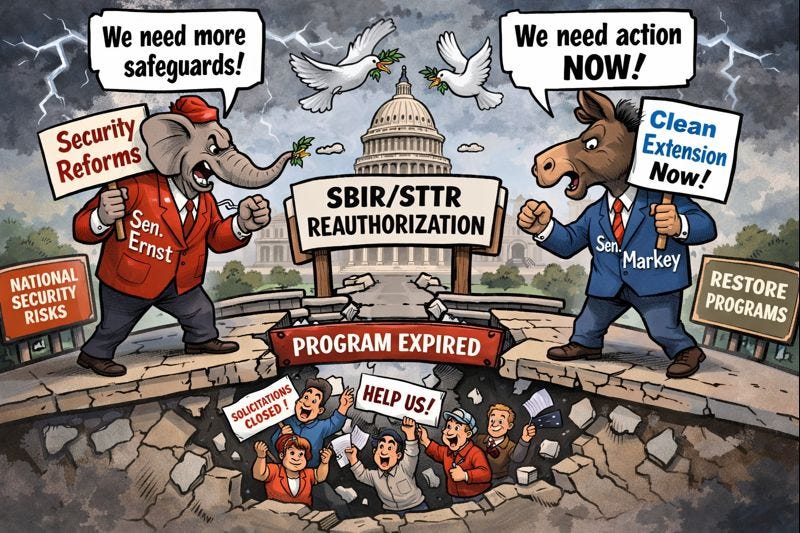
Senator Joni Ernst (R-IA) is currently preventing reauthorization efforts. What is publicly described as Ernst “blocking” mostly shows her opposition to a simple, unanimous consent process for a clean extension or reauthorization. This stance makes it hard for the Senate to quickly pass the House-approved one-year extension (H.R. 5100) without a bigger clash. This is clear in the Congressional Record during Senator Ed Markey’s (D-MA) effort to advance H.R. 5100.
What Ernst says she wants instead
1) Research security / China “foreign influence” concerns
Ernst characterizes SBIR/STTR as susceptible to exploitation by adversaries and to IP or technology transfer, advocating stricter, more standardized “foreign risk” regulations and enforcement. This view is a common motif in her press materials and the Senate Small Business Committee's messaging regarding her bill. Additionally, a wider policy environment promotes the “innovation versus China” narrative, further elevating the political importance of this rationale beyond SBIR.
2) “SBIR mills” / repeat winners / “small business welfare” framing
A major fault line is the claim that a subset of companies repeatedly win awards (sometimes called SBIR mills) and that the program needs structural changes to direct funding toward new entrants and higher-impact outcomes. Multiple neutral-ish policy writeups describe this as central to the Markey vs. Ernst conflict. Her INNOVATE Act section-by-section explicitly includes mechanisms to reshape participation (e.g., creating a “Phase 1A” on-ramp for new entrants, proposal submission caps, and limits tied to cumulative SBIR funding).
3) Commercialization and DoD transition: “stop funding science projects that never get adopted.”
A significant aspect of the INNOVATE Act pitch is emphasizing that SBIR should accelerate the transition to production and deployment, particularly in the defense sector. The bill’s explanation features a notable DoD-focused element — “Strategic Breakthrough Awards,” offering up to $30M in Phase II funding, with matching funds and an acquisition route. The “transition gap” is frequently mentioned in reports and policy debates, serving as a primary reason for reform rather than a straightforward extension.
4) Reshaping STTR specifically
The INNOVATE Act explainer proposes limiting STTR to Phase I and making all later phases follow SBIR, along with adjusting the funding split between SBIR and STTR — boosting SBIR funds and reducing STTR. This focused change would greatly shift how benefits are distributed, especially impacting pipelines with many university partnerships.
5) “Merit-based” rhetoric and opposition to certain participation requirements
The INNOVATE Act explainer also criticizes some diversity-focused requirements, arguing they distract from “merit-based” awards. Whether you agree with this perspective or not, it’s clearly part of the reasoning.
Why block the clean extension vs. “fixing it later”?
Hypothesis A (high confidence): leverage for structural reforms
If a clean one-year extension passes, the urgency collapses. Blocking it keeps maximum pressure on negotiators to accept her reform package (or something close to it). This motive is explicitly described in multiple summaries of the standoff: Ernst opposing the clean extension and pushing the INNOVATE Act framework instead.
Hypothesis B (high confidence): She believes “security + mills” is a now-or-never window
Ernst’s side frames the status quo as actively dangerous (foreign influence/IP leakage) and wasteful (repeat winners). If you buy those premises, then “extend first, reform later” looks like “kick the can forever.” That logic is consistent with the committee/Ernst messaging and the way reform bills are being sold.
Hypothesis C (medium confidence): Intra-Senate bargaining and credit-claiming
As chair of the Senate Small Business Committee and the main Senate author of an alternative bill, her motivations include: 1.) preventing Markey’s plan from becoming the “default bipartisan solution,” and 2.) securing a clear policy victory as a direct result of her leadership. This reflects an inference about procedural behavior in Washington rather than a direct quote, but it matches the observed bottleneck dynamic involving two key individuals noted by several observers.
Hypothesis D (medium confidence): DoD/industrial-base alignment
The INNOVATE package is explicitly designed to support defense adoption and manufacturing scale-up (Strategic Breakthrough Awards, matching capital, purchase commitments). That suggests she may be prioritizing the defense innovation pipeline over broader “keep the taps on” logic — even at the cost of short-term disruption.
What her critics usually argue (why they think she’s wrong)
Common counterpoints (summarizing the opposition's reasoning):
- A lapse harms real companies now (layoffs, stalled R&D), and reform could have been negotiated without shutting down the program.
- Some reforms may punish legitimate repeat performers in niche defense markets where “commercialization” looks different.
- STTR restrictions could weaken university-to-startup pathways.
Perspectives
Ernst appears to be using the expiration/lapse as leverage to force adoption of a reform-heavy reauthorization (INNOVATE) focused on security, limiting repeat-winner dynamics, and increasing transition-to-fielding — especially for DoD.
“Blocking” may be less about principled reform and more about political power: extracting concessions, controlling the narrative, and shaping SBIR into a vehicle for preferred ideological and procurement priorities — while externalizing the costs to small businesses during the lapse.
I hope this article summarizes the current status and helps to separate signal from noise — what’s actually in INNOVATE (real rule changes), what’s likely to survive negotiation, and what companies should do right now with agencies while authority is lapsed.
Thank you for reading my work. Post comments below if you have any pointers, ideas, suggestions, support, etc.
Loveya,
-Bev
Check out these articles also:
- Free Speech?? — https://medium.com/@Bev_B/free-speech-2fc7663788d1
- My Wife’s book: https://medium.com/be-reaching-hearts/book-announcement-miles-apart-5be12f5a94c6, and her profile: https://medium.com/@amburnett
- My Son’s new book: https://medium.com/introvert-diary/a-crime-against-science-by-cole-burnett-fb5b4f8fa764, his profile: https://medium.com/@cbburnett
You can also ☕buymeacoffee☕ or ☕ko-fi.com☕. Did you know you can clap more than once, up to 50 times! I really like claps 😊🙂.
Thank you for your support!
메타데이터
- post_id
- b7e1f885ca62
- slug
- sbir-sttr-program-status-jan-2026-b7e1f885ca62
- url
- https://medium.com/sbir-sttr-info/sbir-sttr-program-status-jan-2026-b7e1f885ca62
- canonical_url
- https://medium.com/sbir-sttr-info/sbir-sttr-program-status-jan-2026-b7e1f885ca62
- author_url
- https://medium.com/@Bev_B
- status
- ok
- fetched_at
- 2026-06-21 15:33:18