Abandon all hope, ye who enter here.
Romanian state is always right
Abandon all hope, ye who enter here.
Romanian state is always right
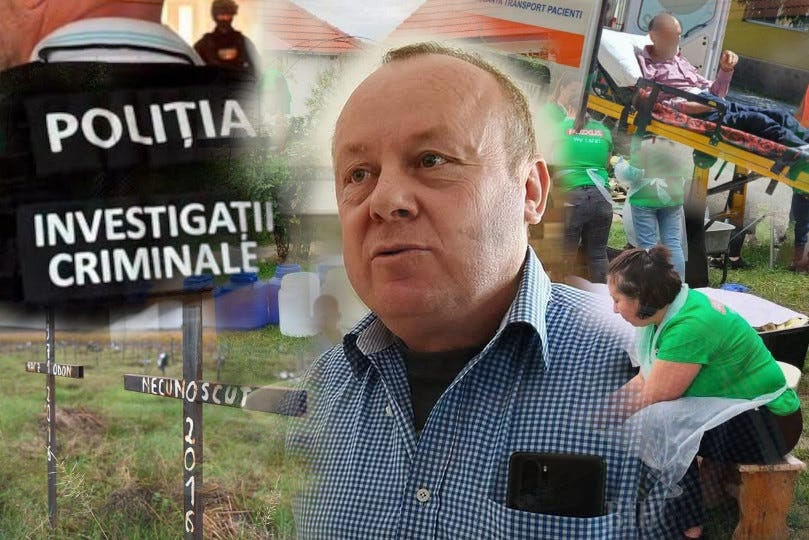
Composite of Viorel Pașca, the central figure in the latest aged private care scandal in Romania
A famous story, beautiful precisely because it may not be entirely true, speaks about one of the oldest values human beings developed: care.
Margaret Mead, the renowned American cultural anthropologist, is often quoted as having answered a student’s question about the first sign of civilisation in the human species. It was not clay pottery, fire, tools, or weapons, as one might expect. It was a healed femur. A broken thigh bone that had been allowed to mend meant that someone had survived long enough to be protected, fed, carried, sheltered and kept alive by others.
The story is largely anecdotal, and the attribution to Mead is uncertain. But its meaning survives the uncertainty. It captures something essential about humanity: care for the weak, the sick, the elderly, the injured, the abandoned and the disabled. Care is not a decorative virtue. It is part of the social contract. It is one of the duties by which a society proves that the life of a vulnerable person is still a life, and that even its passing deserves dignity, ritual and protection.
Romania has struggled with this duty, even when it claimed to fulfil it. Ceaușescu’s regime promised universal care, but in 1989 the world discovered what that promise had hidden from view: institutions where disabled children, abandoned children and sick people lived in squalor, underfed, neglected, tied to beds, left in filth, packed into rooms where care had become little more than storage. The images travelled across the world, recorded by foreign and Romanian journalists and investigators who entered the dark machinery of a state that had turned its most vulnerable citizens into a secret.
Many died. Some survived.
For a while, it was tempting to believe that this failure belonged entirely to the past. That it could be blamed on dictatorship, on Ceaușescu, on the cruelty of a totalitarian state obsessed with appearances, production quotas and ideological proof that socialism cared better than democracy.
Today, we can say something much harder.
Romania failed again.
Despite the fall of the totalitarian and secretive state, some habits are difficult to remove, even thirty-five years after the end of Romania’s communist era. Care for the elderly, the disabled and the chronically ill is one of them.
In Romania, this kind of care has traditionally remained inside the family. Parents are looked after by children. Grandparents are absorbed into the household. In many rural or poorer communities, the duty often falls on the child who remains closest to home, sometimes with the expectation that sacrifice will later be compensated through inheritance. It is an old arrangement, part affection, part obligation, part economic necessity.
Romanian public policy has often seemed to lean into this reality rather than replace it. Instead of building a large state residential-care system, the state has encouraged a mixture of family care, home care, private providers, non-governmental organisations and licensed social-service providers. On paper, this resembles the model of many developed countries: people should remain at home for as long as possible, supported by community and medical-social services, while institutional care should be reserved for those who truly need it.
Romania, however, presents several challenges.
The first is information, or more precisely the lack of usable information.
Trying to navigate the publicly available statistical data of the National Institute of Statistics is slow, fragmented and often incomplete. A quick look at the INS TEMPO series for local council-run elderly care homes shows how difficult it is to understand the real capacity of the public system over time. Some datasets stop before the present day, others appear under slightly different names, and the user is left to reconstruct a national picture from tables that should have been easy to read, compare and update.
One table on council-run elderly care homes shows data only up to 2017. Another broader table, covering elderly care homes by type of provider, contains older series that stop even earlier. In 2014, the recorded number of public elderly care homes was 105, lower than in 2012. Meanwhile, private provision was expanding quickly: the number of private elderly care homes rose from 12 in 1998 to 141 in 2014. Other European long-term-care reporting, using Romanian statistical data, shows the same trend continuing, with private elderly homes increasing from 95 in 2012 to 246 in 2016.
The direction is clear even when the data is messy. Public capacity remained limited. Private capacity grew.
Trying to fill the gaps between statistical information and government intention is equally cumbersome. Public government sites are hard to search, documents are hidden under complex menus, and key information often appears under bureaucratic titles that make sense only to insiders. Yet the official direction can still be reconstructed.
In December 2022, Romania approved the National Strategy on Long-Term Care and Active Ageing for 2023–2030. Its objectives included the promotion of long-term home care, non-institutionalised services, integrated socio-medical community services, and better identification of vulnerable groups: people at high risk of poverty, people with disabilities, people with rare diseases, people with dementia, and people requiring long-term care and specialised support.
In other words, in 2022, Romania’s official answer to its ageing and dependent population was still heavily oriented toward evaluation, mapping, home care, community services and future reform. These are not wrong objectives. In fact, they are necessary. But they also reveal a state that was still trying to define the size and shape of the problem decades after the problem had become visible.
The second challenge is poverty.
Romania’s poverty did not appear by accident. It was shaped by chaotic decentralisation, the abrupt collapse or closure of former communist industrial platforms, weak local economies, unstable legislation, low wages, underfunded public services and corruption that spread through almost every layer of administration. From mayoralties to ministries, from local contracts to national budgets, public money was often treated less as a tool of development and more as a resource to be captured.
The result was a slow destabilisation of the very institutions that should have carried the burden of care. Health care, social care, elderly care, disability services and palliative care were left exposed to chronic underfunding, staff shortages, poor infrastructure and bureaucratic indifference.
Then came migration.
Pushed by low wages, lack of predictable work, unstable laws and a constant sense that the future was elsewhere, Romania’s able working population began one of the largest peacetime migrations in Europe. Since the 2000s, millions of Romanians have left the country, permanently or temporarily. Some left for a few months. Some left for years. Some never returned.
The official numbers depend on definitions: definitive migration, temporary migration, residence abroad, citizenship, labour mobility. But the scale is not in doubt. Hundreds of thousands leave in certain years under temporary migration categories, while estimates of the Romanian diaspora vary from at least four million to far higher figures used by Romanian institutions and public officials.
These were not abstract demographic losses. They were workers, taxpayers, nurses, builders, drivers, engineers, carers, parents and children. Many were young. Many were skilled. Many could have helped support the public budget and their own families. Their departure left behind villages of elderly parents, apartment blocks of pensioners, children raised by grandparents, and households where care became a private crisis hidden behind closed doors.
For some families, money sent from abroad helped. For others, migration meant distance, exhaustion, estrangement and abandonment. Parents grew old alone. Disabled relatives remained dependent on neighbours, distant kin or local authorities. Pension income was often too low to pay for private residential care, while public places were too few, too far away or too difficult to access.
If you are elderly, disabled, physically or mentally impaired, alone, abandoned by family, or left behind by children who now live abroad, your options depend brutally on how much money you can bring to the table.
For many, public services are effectively out of reach. Access is difficult, places are limited, waiting lists are long, and the administrative process can be exhausting even for a healthy person with documents, relatives and patience. For someone confused, immobile, undocumented, poor or alone, the system can become almost impossible to enter.
The private sector is larger and more visible. Nursing homes, residential care homes, specialised home-care services, registered nurses and informal carers can be found across the country. Alongside them exists a serious grey and black market of care: a few hours a day, overnight stays, live-in arrangements, basic nursing, cleaning, cooking, shopping, changing diapers, administering medication, lifting a person from bed, taking them to medical appointments. Some providers have credentials. Many do not. Some work through agencies. Many work through recommendation, cash and trust.
A decent place in a nursing home starts at around 4,000 RON per month if the resident is still able-bodied: able to walk, wash, dress, eat, use the toilet and manage most daily needs alone. Anything cheaper usually comes with caveats: location, hygiene, staffing, overcrowding, qualifications, certifications, food quality, medical supervision or long-term stability.
That price does not always include medication or the consumables a person may need. In some places, families are asked to provide or pay separately for diapers, hygiene products, toiletries, special food, medical supplies and additional services. What the resident receives, at the basic level, is a bed, three meals, occasional medical supervision, perhaps some activities, perhaps a yard, and the simple possibility of speaking to another human being instead of measuring time alone in an empty house, waiting for a child to call from overseas.
Emergency care, of course, comes through the public ambulance service. If the resident is in trouble, the ambulance comes at no cost to the care home.
The price rises as soon as the person becomes more difficult to care for. Mobility problems can add another thousand RON or more, depending on the evaluation made by the establishment’s doctor. Incontinence can add hundreds more every month. Diapers alone may cost around 600 RON. Recovery or rehabilitation services can push costs dramatically higher, depending on the person’s needs. Transport to medical tests — MRI, X-ray, specialist consultations — is often charged separately. The test itself is one cost. The transport can add another 400 to 800 RON. Waiting time may be billed by the hour.
A partly disabled person with mobility issues, incontinence and additional care needs can easily reach 6,000 RON per month in a modest nursing home. In better private facilities, or in cases requiring more intensive care, the cost can reach and exceed 10,000 RON per month.
And even then, places are often full.
The informal alternative is not necessarily cheaper. It is usually filled by nurses, hospital staff, former carers, women from poorer rural areas, acquaintances of acquaintances, and people recommended by someone who once needed the same thing. Many are trying to supplement wages that do not cover their own cost of living. The offers vary, but the prices are still high.
Three visits a week, four hours per visit, with some basic care, cleaning, cooking and shopping, can cost around 3,000 RON per month. A live-in carer, the familiar “poor soul who is caring,” often from the countryside and willing to stay in the home, can start at around 5,000 RON per month. But this arrangement usually works only if the elderly or disabled person is still somewhat mobile, somewhat coherent and somewhat able to care for themselves. If family members are still present in the household, the arrangement may stretch further. If the person is alone and seriously impaired, it becomes fragile very quickly.
Most of the time, there is no contract. Money changes hands, not accounts. Credentials are assumed, not verified. Punctuality depends on goodwill. Missed visits are common. Even when the carer is recommended by an agency or by someone trusted, the arrangement remains precarious.
This is the private geography of Romanian care: expensive when legal, risky when informal, inaccessible when public, and impossible when the person has no money, no documents, no family and no one willing to insist on their behalf.
In the first quarter of 2026, the average Romanian old-age pension hovered around 3,100 RON. The average disability pension was around 1,080 RON. The average agricultural pension was around 714 RON.
Placed next to the real cost of private care, these numbers become brutal. Many pensioners would not qualify for a private nursing home without family support. A disabled person living only on a disability pension would not even come close. An agricultural pensioner would be entirely outside the market.
But even that is only half of the story.
There are people below the pension system, below the family system, below the private-care system and sometimes below the paperwork through which the state recognises a person as a person. The homeless. The severely impaired. The elderly thrown out by wives, husbands, children or relatives. People who lost their homes because they could no longer pay utilities and eat at the same time. People with no valid documents. Beggars, wanderers, psychiatric cases, alcoholics, amputees, bedridden people, people with dementia, people whose names no one knows and whose absence no one reports.
They live where the state rarely looks: on streets, under bridges, in forests, in abandoned buildings, in empty shipping containers, in improvised shacks, in decrepit houses, or simply under the open sky.
Sometimes they reach a hospital bed. Someone finds them unconscious, collapsed, frozen, beaten, infected, dehydrated or unable to stand. For a few days, perhaps a few weeks, the hospital becomes shelter by accident. They are washed, fed, stabilised, medicated and recorded.
Then the medical episode ends.
And once the hospital decides that the person no longer belongs to medicine, the old question returns: where should they go?
Too often, the answer is nowhere. They are discharged back into the same streets, shelters, ruins, families or informal arrangements from which they came, because the hospital is not a care home, the care home has no place, the public system has no immediate answer, the private system requires money, and the family is absent, incapable or unwilling.
This is where a man many call “the Samaritan” enters the picture.
It is hard to be on the street.
It is hard to live in a makeshift shelter, or in a broken-down house where the windows no longer close and the roof no longer keeps the rain out. It is hard to sleep on a dirty mattress, if there is one; otherwise on hard earth, on cardboard, on a broken door, under plastic bags used as blankets.
The clothes on you are several sizes too large and still somehow too short. The trousers end abruptly above the ankle. A few centimetres of red, paper-thin skin show through before the foot disappears into shoes that do not belong to you, shoes held together with duct tape, plastic bags and habit. Whatever colour the clothes once had has faded into dark brown and grey. Dust and rot sit at the elbows and knees. Your entire life fits inside an overused red shopping bag, on which someone can still guess the logo of a political party.
“You stink.
You have forgotten how warm water feels on your skin. Your underwear itches, but you cannot throw it away because winter is coming and it is already cold.
You no longer remember clearly where you came from. Your name is a mumbling blur, something that ends in “-jghi”, or perhaps not. Your memory holds on to a delicate blond face that appears now and then, without warning. You remember the face more clearly than you remember yourself. You remember its voice. Your cracked lips move around one word.
Elena.
That is all. That face is the only proof that you were once someone. But the proof remains locked inside your mind, unreachable no matter how hard you try.
You have passed through many helping places, but you never managed to stay. Trouble seems to follow you, even when it is not your fault. You cannot explain yourself. You cannot arrange words into meaning quickly enough for others to understand. You are confused, frightened, sometimes aggressive, sometimes silent, sometimes absent. People grow tired. Institutions grow tired faster.
When the hospital, the nursing home, the shelter or the carer can no longer keep you, you leave with a discharge summary written in the cold vocabulary of administration: unidentified male, approximately seventy years old, severe intellectual impairment, signs of lung cancer, missing fingers and toes amputated after frostbite, family unknown, name unknown, previous address unknown.
The system does not know what to do with you.
You are moved from one place to another, and because there is no clear paper trail, there is no clear money attached to your care. People avoid taking responsibility for you, not always because they do not want to help, but because they cannot absorb what helping you would require. Your future is pitch black. Then, when all hope seems lost, someone remembers a name and a place.
A phone call is made.
A man says yes.
Some paperwork is done.
You sit in the corner of a nondescript room while people speak around you. They think you are absent, lost in your own vegetative state. But your eyes are turned inward, looking again at that face, trying desperately to remember who you are.
For the millionth time.
To no avail.
A long car trip carries you from one unknown place to another. The red or blue lights above the car hold your attention for a while. Then another face appears. A round one. Then another. Voices you do not recognise. Hands that lift you. A door that opens.
And then, for a while, it is better.
Food comes on time. The frostbite wounds slowly heal, even if the cough keeps eating away at your lungs. The clothes are clean. The bed is yours. The next meeting with warm water may sting and feel strange, but you wish for it to come sooner, because for a few minutes it means that your body is not garbage. It means someone has touched you without disgust. It means that, for a while, you belong somewhere.”
This is not a real story.
It is made from fragments of many lives endured inside a system that was not built for the level of need it pretends to manage. A system too small, too cold, too bureaucratic and too poor in the places where poverty matters most. A system in which money is somehow always available for official cars, ceremonies, contracts and administrative comfort, but rarely enough for people who arrive without documents, without relatives, without memory and without anyone willing to fight for them.
It is built from pieces of people who, one way or another, made their way to Viorel Pașca.
A man who ran a place where hope seemed, at least for a while, to live.
According to his own public statements, God was the one who showed Viorel Pașca the way into charity.
The beginning, as he presented it, was simple: one homeless man, one abandoned person, one human being without support from family, friends or government, taken in because leaving him outside felt impossible. It is reasonable to assume that Pașca did not initially imagine how large that gesture would become.
But it grew.
It grew in a country where poverty was widespread, public care was limited, private care was expensive, and the people with the highest needs often had the fewest documents, relatives or legal pathways through which help could be organised.
The practical model was simple. Pașca housed and supported people expelled by the formal system, mainly through donations, volunteer labour and whatever income could be obtained for those who had papers and therefore access to pensions, disability benefits or other forms of public support. The legal position he appears to have occupied was equally important: he could present himself not as a social-service provider, but as a charitable actor offering shelter and help to abandoned people.
This distinction mattered.
Article 2 of Law 292/2011 defines the national social-assistance system as the ensemble of institutions, measures and actions through which the state, represented by central and local public authorities, as well as civil society, intervene to prevent, limit or remove the temporary or permanent effects of situations that may generate marginalisation or social exclusion for persons, families, groups or communities.
That was the first moral and legal opening.
Pașca could say, in effect: I am exactly this. I am civil society intervening where the state has failed. These people are marginalised, excluded, homeless, sick and abandoned. I am trying to prevent their death in the street.
The same law listed partnership as one of the principles of the national social-assistance system. Article 5 spoke of cooperation between central and local authorities, public and private institutions, non-governmental organisations, religious denominations recognised by law and members of the local community, all mobilising resources to provide decent and dignified living conditions for vulnerable people.
This language did not create a licence to do anything. But it created a powerful moral vocabulary for what Pașca was doing. He had an association. He collected donations. He mobilised volunteers. He built accommodation. He used religious language and religious networks. He presented Dumbrava as a community response to abandonment.
At the same time, Law 292/2011 also drew a line.
Article 27 defined social services as an activity or ensemble of activities carried out to respond to social, special, individual, family or group needs, in order to overcome difficult situations, prevent and combat the risk of social exclusion, promote social inclusion and improve quality of life.
That definition is broad. Very broad.
If a person is only given food, clothes, emergency shelter, transport or occasional help, the activity can still look like charity. But if hundreds of vulnerable people are housed continuously, fed, washed, supervised, transported, medicated, buried, registered, moved, disciplined, represented or managed as a dependent population, the activity begins to look much less like occasional charity and much more like social-service provision.
This was the grey area.
Pașca claimed he was not running a social service. He was sheltering homeless people. He was helping those nobody else wanted. And for years, the state appears to have accepted, tolerated or benefited from that fiction, because Dumbrava absorbed precisely the people the formal system could not easily place anywhere else.
If the first legal gap was created by the blurred border between charity and licensed social-service provision, the second was created by the paper route through which abandoned elderly people were supposed to enter protection.
Law 17/2000 on the social assistance of elderly people identified the category clearly enough: elderly people without family or legal supporters, without housing, without sufficient income, unable to care for themselves, or requiring specialised care. The law also described a formal administrative path. The person in need, or their representative, had to submit a request to the local public social-assistance service. The file was supposed to contain identification details, family situation, income, medical documents, recommendations, proof of need and other supporting information. The authorities were then supposed to conduct a social inquiry, assess the person’s socio-medical situation, establish needs and organise the appropriate form of support.
The paper route was clear: request, documents, social inquiry, assessment, decision, service plan, placement or service.
Not someone taking the person into his own home, or into an association’s buildings, and improvising care indefinitely afterwards.
But in the public traces of the Dumbrava case, the state appears to have produced something that looked administrative enough to be treated as legal. Social inquiries. Names, where names existed. Social status. Income, where income existed. Medical problems, where they were known. Then, at the bottom of the file, instead of placement inside a functioning public system, a request that Pașca or his association take the person in, because the state had no available solution.
This is the second gap.
The state produced documents proving abandonment, but not necessarily documents providing legal protection. It created a paper trail that could show why the person needed help, but not always a lawful, licensed, supervised care framework through which that help would be delivered.
That distinction matters because it gave Pașca a powerful defence narrative.
He could say: I did not kidnap anyone from the state. The state brought them to me. The state asked me to receive them. The state knew who these people were, or at least knew enough to write reports about them. I did not hide them from the authorities. I accepted abandoned people at the request of the authorities.
And the state could pretend, for a while, that this was enough.
We could go deeper into the legal problems created by this arrangement: people without names, without documents, without residence, without disability certificates, without medical continuity, without legal representatives, without contracts, without clear funding channels and without anyone formally responsible for monitoring what happened after they arrived. We could also examine the protective shield created by the NGO form itself: charitable enough to attract donations, organised enough to house large numbers of people, but ambiguous enough to avoid being treated, at least for a time, as a conventional social-service provider.
The image is already clear.
We cannot say, based only on publicly available evidence, that Pașca consciously designed this entire charitable infrastructure exclusively for profit, or that the donations, pensions and public money attached to some beneficiaries were the original purpose of the system. That is now part of the terrain the DIICOT investigation will try to clarify.
What we can say is that Pașca stepped into a widening gap in the state’s responsibility. He offered shelter, food, routine, religious meaning and, in many cases, a form of human attention to people whom the state, the market and sometimes their own families had already abandoned.
That is why the case is morally difficult.
Because before anyone can ask where Pașca crossed the line, one must first admit that the Romanian state allowed the line to remain blurred for years.
In 2025, the gaps that had allowed Pașca to run his charity began to close.
Two emergency ordinances changed the legal terrain. OUG 5/2025 tightened the relationship between public financing, licensing and the quality standards expected of social-service providers. OUG 70/2025 went further into the grey zone itself, clarifying that natural persons cannot act as social-service providers and addressing the cases of individuals who host, care for or maintain elderly people under arrangements connected to Law 17/2000.
The ambiguity was shrinking.
But these changes did not appear in a vacuum.
Romania was under fiscal and European pressure at the same time. The state needed to reduce waste, control public spending and protect access to EU funding, especially PNRR money already tied to social reform. PNRR Component 13 required reforms in the protection of adults with disabilities, investment in community-based services and movement away from large residential institutions. Romania had also adopted strategies on long-term care, active ageing and deinstitutionalisation. On paper, the direction was clear: fewer opaque institutions, more community services, better licensing, better monitoring, and money attached to real, verified care.
The care-home scandals of Ilfov and Voluntari had already shown what could happen when vulnerable people, public money, private providers and weak inspection systems met behind closed doors. Dumbrava belonged to a different moral category in the public imagination, because Pașca was widely seen as a rescuer rather than a predator. But legally and administratively, it sat inside the same larger problem: vulnerable people placed in semi-visible or poorly supervised care arrangements, while public authorities struggled to prove that money, responsibility and protection followed the beneficiary in a lawful way.
The principle that “the resource follows the beneficiary” can make sense in a modern care system. Properly designed, it means that public funding follows the person’s needs rather than the convenience of institutions. But without licensing, clear contracts, inspection, transparent accounts and verified services, the same principle can become a cash channel into places the state does not properly understand or control.
OUG 5/2025 tried to close that channel by making the rule brutally simple: no valid licence, provisional licence or approved restructuring path, no public financing. OUG 70/2025 then narrowed the informal-care space further, making clear that natural persons cannot present themselves as social-service providers and that private hosting, care and maintenance arrangements under Law 17/2000 cannot become an unlimited substitute for licensed social care.
The legal fiction that had helped Dumbrava survive was becoming harder to maintain.
By the middle of 2026, DIICOT — the Directorate for Investigating Organised Crime and Terrorism — had moved against the structure that had grown around Pașca’s work. What had begun, according to his own story, with one abandoned man had become a network housing hundreds of vulnerable people in Dumbrava, Tinca and Incești. According to Pașca’s own public statements, around 400 people were being cared for there. Prosecutors, meanwhile, described something very different: an alleged organised group exploiting vulnerable people and obtaining large sums from donations, pensions, indemnities and other social benefits.
Both images now existed at the same time.
Dumbrava as refuge.
Dumbrava as illegal care network.
Dumbrava as the place where the state sent people it could not place elsewhere.
Dumbrava as evidence in a criminal investigation.
And then, on 1 July 2026, the state arrived in force.
Police officers, prosecutors, doctors, nurses, emergency workers, ambulances and social-assistance personnel entered the communities in Dumbrava, Tinca and Incești. A place that had lived for years in a strange semi-public visibility — praised, donated to, visited, used and tolerated — was suddenly transformed into a crime scene and emergency social operation.
Residents were triaged and taken away. Buildings were searched. Evidence was gathered, catalogued and bagged. People were questioned. Photos and videos were taken. Pașca, his wife and two of his sons were taken to Bucharest for questioning, and according to judicial sources cited by the press, were detained for 24 hours.
The same state that had tolerated Dumbrava now dismantled it.
That is the central contradiction of the case. For years, authorities appear to have known about Pașca’s activity. According to Pașca, hospitals, penitentiaries and institutions from across the country sent people to Dumbrava. Public reporting before the DIICOT operation had already documented that vulnerable people were being sent there by state institutions, despite the lack of proper authorisation. Yet once the criminal investigation advanced, the same state appeared to rediscover that these people were, ultimately, its responsibility.
We can reasonably suspect that Pașca understood, after the 2025 legal changes, that the structure he had built could not continue in the same way. He reportedly wrote to authorities asking them to take the residents out of his care. Nothing decisive happened. Hospitals, police and other public institutions allegedly continued to send people toward him, even as the legal space around Dumbrava was narrowing.
This is the cruelest part of the story.
The Samaritan was trapped with the people he had taken in. The state had been his accomplice in practice, but when the law finally arrived, the accusation stood mostly around him and his family.
He could have shut everything down. He could have sent people away. He could have told the state to collect its abandoned citizens from his door. He could have walked away from the chaos he had helped organise. He did not.
After his brief detention, Pașca appeared again in front of television cameras and said he wanted to donate the homes to the residents so they could own them directly. It may have been sincere. It may have been theatre. It may have been a desperate attempt to save himself. It may have been all of these at once.
He admitted he had made mistakes. Prosecutors say those mistakes were not merely administrative. They accuse him of forming an organised criminal group that exploited poor, disabled and mentally impaired people, together with members of his family. The investigation speaks of conscious, continuous and aggravated law-breaking.
Those accusations are serious. They must not be dismissed.
But neither should they erase the other half of the case.
Because if Pașca broke the law, he did so in a system that had allowed illegality, improvisation and charity to become substitutes for public responsibility. If he benefited from the people he housed, he did so while the state benefited from having somewhere to send them. If Dumbrava was illegal, it was not invisible. If the people there were victims, they were not discovered in 2026. They had been visible for years, in files, social inquiries, hospital discharges, police referrals, Facebook posts, donations, local knowledge and bureaucratic signatures.
The man now stands accused of building an organised criminal structure that exploited the poor, the disabled and the mentally impaired.
But there is another party that should stand in the same line, and so far it is missing.
The state.
The state that wrote the social inquiries. The state that documented abandonment without solving it. The state that sent people toward Pașca’s care while failing to provide lawful alternatives. The state that tolerated the grey zone when it was useful, then condemned it when it became impossible to defend.
That chair is there.
But it is empty.
Maybe because the state is never wrong, even when it clearly is.
Sources/Citations/References
1. Opening: care, civilisation, Romania’s post-1989 institutions
- SAPIENS, “Did Margaret Mead Speculate About a Healed Femur?”, 16 June 2022.
- Snopes, “Did Anthropologist Margaret Mead Say the ‘First Sign of Civilization’ Was a Healed Femur?”, 28 July 2023.
- Human Rights Watch, “Lifting the Last Curtain: A Report on Psychiatric and Orphanage Institutions in Romania”, 1990.
2. Romanian elderly care, long-term care, public/private capacity
- Institutul Național de Statistică, TEMPO Online — Social assistance / elderly care homes tables, including ASS113C and ASS113D.
- INS TEMPO, ASS113D — Cămine pentru persoane vârstnice administrate de furnizori privați.
- European Commission / ESPN, “Thematic Report on Challenges in Long-Term Care — Romania”, 2018.
- European Social Policy Network / Spasova et al., “Challenges in Long-Term Care in Europe”, 2018.
- World Bank, “Romania’s Way Forward in Long-Term Care”, 2022.
- European Commission Recovery and Resilience Scoreboard, “Reform of Long-Term Care Services for Older People”.
- UNECE / Ageing Policies Database, “National Strategy on Long-Term Care and Active Ageing 2023–2030”.
3. Pensions, poverty, migration
- Institutul Național de Statistică, “Pensia medie lunară a înregistrat o scădere… în trimestrul I 2026”, press release / PDF.
- OSW, “Thirty Years of Crisis: Romania’s Demographic Situation”, 2025.
4. PNRR, deinstitutionalisation and 2025 legal changes
- ADR Centru, PNRR Componenta 13 — Reforme sociale.
- Secretariatul General al Guvernului, Strategia națională privind prevenirea instituționalizării persoanelor adulte cu dizabilități și accelerarea procesului de dezinstituționalizare.
- Agerpres, “Strategia națională privind prevenirea instituționalizării persoanelor adulte cu dizabilități, aprobată”, 19 December 2022.
- Portal Legislativ, OUG nr. 70/2025, 5 December 2025.
- Universul Juridic, “Măsuri din domeniul social — OUG nr. 5/2025”, 3 March 2025.
- Digi24, “Președintele Nicușor Dan a promulgat legea care condiționează finanțarea centrelor sociale de licența de funcționare”, 2026.
5. Core laws cited in the legal analysis
- Portal Legislativ / Legea nr. 292/2011, Legea asistenței sociale.
- Portal Legislativ / Legea nr. 17/2000, Legea privind asistența socială a persoanelor vârstnice.
- Portal Legislativ, Ordin nr. 29/2019 — Minimum quality standards for residential social services for elderly people.
6. Ilfov / Voluntari care-home scandal and wider abuse context
- Euronews, “Romanian care homes scandal spotlights ‘inhumane and degrading’ abuse”, 2023.
- Radio Free Europe / Radio Liberty, “The Corrupt System Behind Romania’s ‘Horror Asylums’”, 7 October 2023.
- EPSU, “Abuse and exploitation in Romanian private care facilities”.
7. Viorel Pașca / Dumbrava / DIICOT investigation
- DIICOT public statements and excerpts from media.
- Digi24, “Viorel Pașca, audiat la DIICOT în dosarul azilelor ilegale. Procurorii îl acuză de trafic de persoane și exploatare”, 1 July 2026.
- Radio Cluj, “Liderul Asociației Dumbrava, Viorel Pașca, audiat la DIICOT”, 1 July 2026.
- Romania Journal, “Romanian Care Home Probe: DIICOT Dismantles Pașca Network”, July 2026.
- Romania Insider, “Romanian prosecutors investigate alleged mass exploitation care home network”, 2026.
메타데이터
- post_id
- b7e7261f4844
- slug
- abandon-all-hope-ye-who-enter-here-b7e7261f4844
- url
- https://medium.com/areas-producers/abandon-all-hope-ye-who-enter-here-b7e7261f4844
- canonical_url
- https://medium.com/areas-producers/abandon-all-hope-ye-who-enter-here-b7e7261f4844
- author_url
- https://medium.com/@iulian.demetrescu
- status
- ok
- fetched_at
- 2026-07-08 20:12:56