From Plan to Practice: Using Journey Mapping to uncover User Needs
Many aspiring UX designers face uncertainty throughout their learning journey, from developing skills and building portfolios to…
From Plan to Practice: Using Journey Mapping to uncover User Needs
Many aspiring UX designers face uncertainty throughout their learning journey, from developing skills and building portfolios to transitioning into the industry. To better understand their experiences and uncover underlying needs, I used journey mapping techniques, including experience mapping and perspective grids, to identify key pain points, emotions, and opportunity areas. These insights were later brought into collaborative workshops with stakeholders to facilitate brainstorming and generate potential solution directions.
From Perspective Grids to Experience Mapping
To make sense of the collected research data, I first used a perspective grid to organize participant insights and identify the needs, barriers, resulting value, and implied capabilities of aspiring UX designers entering the industry.
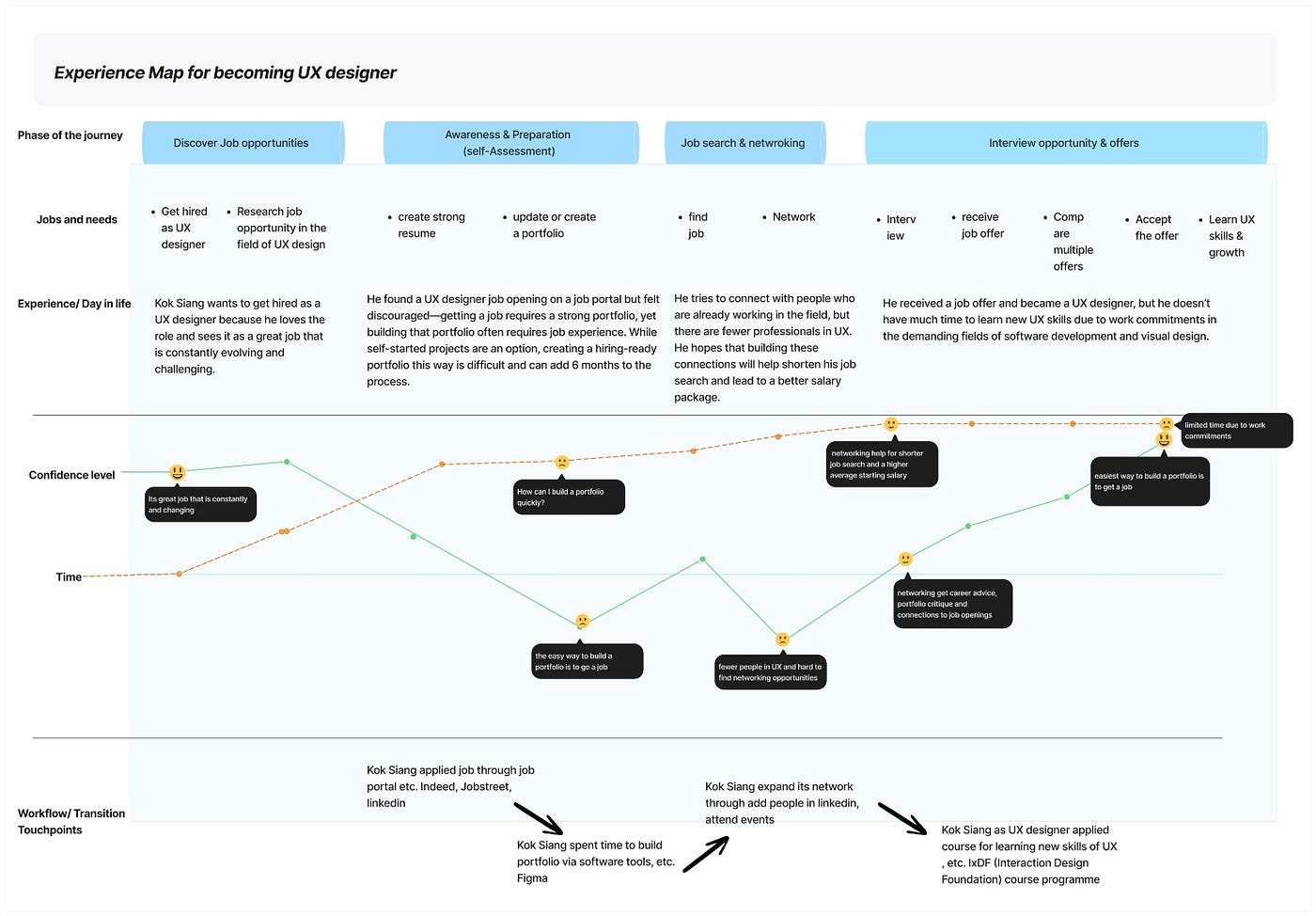
I then used these synthesized insights to develop an experience map, which was then used to support collaborative workshops, helping stakeholders better understand the overall user journey and align on key opportunity areas.

、
Journey Mapping Workshop Plan
The primary objective of this workshop was to identify and prioritize key pain points from the experience map, then collaboratively brainstorm, evaluate, and vote on potential solutions to improve the journey of becoming a UX designer.
To achieve this, stakeholders with different perspectives were invited to participate in the workshop. Establishing a shared understanding of aspiring UX designers’ experiences and challenges was a critical first step.
The workshop was structured into two key phases: Building Shared Understanding and From Insights to Ideas, focusing on guiding participants from understanding the current journey to generating and prioritizing solution opportunities.

[embed]
Building Shared Understanding
To establish a shared understanding among stakeholders, I designed a series of activities that guided participants through the current user journey, highlighting key pain points, needs, and opportunity areas. By aligning on the current experience, participants were better positioned to envision an ideal future state and identify opportunities to bridge the gap between what is and what could be.
Activity 1: Exploring the Experience Map
Participants were invited to complete missing sections of the experience map using narrative clues and qualitative insights provided within the map. They also used emojis to indicate how they believed users might feel at different stages of the journey.
This activity encouraged participants to actively engage with the journey, uncover opportunity areas, and build empathy for aspiring UX designers.
Activity 2: Defining Key User Needs
Based on the pain points identified in Activity 1, participants translated user challenges into Point of View (POV) statements. These statements helped frame the most important user needs and provided a foundation for solution ideation.
Key POV statements included:
- Portfolio Building Aspiring UX designers with demanding full-time jobs need support in building compelling UX portfolios because portfolios are essential for showcasing skills and securing job opportunities.
- Professional Networking Aspiring UX designers need effective ways to connect with industry professionals because networking opportunities can provide referrals, mentorship, career advice, and access to job openings.
- Balancing Career Transition Aspiring UX designers with full-time jobs need ways to balance learning, networking, and job searching because limited time and energy make career transitions challenging.
From Insights to Ideas
Once the key user needs were defined, I facilitated a collaborative ideation session to transform insights into actionable solution concepts.
Participants first reviewed and prioritized the POV statements to determine which challenge should be addressed first. Using the “How Might We” technique, they generated a wide range of ideas before grouping similar concepts through affinity mapping.
The ideas were then evaluated through dot voting and further refined into clearer solution concepts. Finally, participants used Roman Voting to reach consensus on the most promising directions for further exploration.
메타데이터
- post_id
- b7e8dbd13791
- slug
- from-plan-to-practice-using-journey-mapping-to-uncover-user-needs-b7e8dbd13791
- url
- https://medium.com/@kohkoksiang1077/from-plan-to-practice-using-journey-mapping-to-uncover-user-needs-b7e8dbd13791
- canonical_url
- https://medium.com/@kohkoksiang1077/from-plan-to-practice-using-journey-mapping-to-uncover-user-needs-b7e8dbd13791
- author_url
- https://medium.com/@kohkoksiang1077
- status
- ok
- fetched_at
- 2026-07-21 03:54:55