Lybia The Billion-Dollar Promise America Wouldn’t Let Happen
Reparations? pledge an attempt at reparations — and why did the line suddenly become absolute?
Lybia The Billion-Dollar Promise America Wouldn’t Let Happen
Reparations? pledge an attempt at reparations — and why did the line suddenly become absolute?
Photo by Rob on Unsplash
I remember the first time I heard about the one-billion-dollar pledge tied to Black empowerment in America. My first reaction wasn’t political — it was reflective. I kept coming back to one question;
Was this an attempt to provide reparations to Black people in America — and if so, why was it stopped so quickly?
Back in the 1990s, Libyan leader Muammar Gaddafi reportedly pledged $1 billion to Louis Farrakhan and the Nation of Islam. The United States stepped in and blocked it, pointing to sanctions against Libya and its designation at the time as a state sponsor of terrorism (Washington Post, 1996).
On paper, the explanation was legal. Procedural. Clean.
But history rarely feels that simple once you sit with it long enough.
I couldn’t help but laugh at the thought that America might have felt embarrassed if the deal had actually gone through. Because to me, it didn’t just look like foreign policy; it looked like another moment where Black empowerment hit an invisible ceiling.
Not the loud kind of resistance people rally against, but the quiet kind that hides behind legal language and political framing. And maybe that’s why it stayed with me. It made me wonder whether the real tension was never just about Libya, but about the symbolism of Black people gaining economic power outside of traditional systems.
I’m not claiming to have all the answers — but history has taught me to watch the patterns, especially when progress seems to move forward… and then suddenly gets paused.
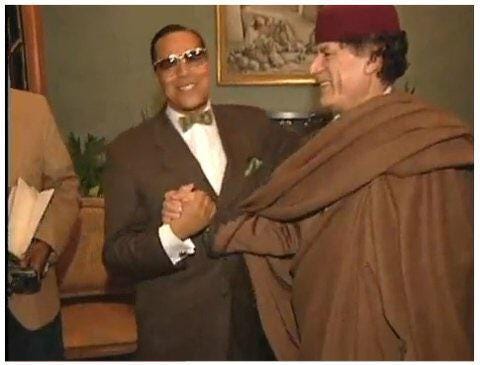
Photo by Reddit.com/r/baneberries/comments/129a3gd/in_1996_general_gaddafi_of_libya_attempted_to/
The Billion-Dollar Question: Reparations or Politics?
Let’s be honest — the word “reparations” carries weight in America. It’s tied to centuries of conversations about slavery, systemic inequality, and the economic gap that still exists today. So when a foreign leader publicly announces a billion-dollar pledge connected to Black empowerment, it naturally raises a deeper question:
Was this framed as charity — or was it perceived as a symbolic form of reparations coming from outside the United States?
There’s no official government document labeling it that way. But perception matters. To some observers, the idea of a massive financial transfer aimed at uplifting Black Americans challenged the traditional narrative around who gets to define — or control — reparative justice.
The U.S. government maintained that sanctions made the transaction illegal under federal law. Legally, that argument held weight, but legality doesn’t always erase the symbolism (U.S. Treasury Libya Sanctions Program — https://home.treasury.gov/policy-issues/financial-sanctions/sanctions-programs-and-country-information/libya-sanctions).
Photo by Vladislav Klapin on Unsplash
The Hypocrisy Debate: When Rules Bend — And When They Don’t
As I dug deeper, something started to bother me. The United States has, at different points in history, negotiated with or maintained limited financial frameworks with countries also labeled state sponsors of terrorism.
Iran negotiations during the nuclear deal era involved billions of dollars moving through diplomatic channels (U.S. Department of State — JCPOA Fact Sheet: https://2009-2017.state.gov/e/eb/tfs/spi/iran/jcpoa/)..)
Sudan engaged in economic discussions tied to sanctions removal https://crsreports.congress.gov/product/pdf/IF/IF10194).
Even Cuba — despite decades of tension — has experienced humanitarian trade and cooperation (GAO Report).
So the question becomes unavoidable:
If diplomacy and financial exceptions can exist in some geopolitical situations, why did this particular pledge become a hard stop?
Was it purely about national security?
Or did the idea of a billion dollars tied to Black empowerment — possibly interpreted by some as reparations — create political discomfort that no one wanted to openly acknowledge?
I don’t claim to have the final answer. But I do believe the question itself deserves space.
Photo by The New York Public Library on Unsplash
Beyond Gaddafi: Who Gets to Define Reparations?
This conversation was never just about one man or one government. It’s about narrative control — about who gets to decide when financial justice is acceptable and when it becomes a threat.
Talking about this doesn’t mean ignoring Libya’s complicated history or defending every action of its leadership. But it does mean asking whether the rules shift depending on who holds the power to give — and who stands to receive.
Because the truth is, reparations in America have always been a contested space. The idea alone makes people uncomfortable. So when a billion-dollar pledge appears from outside the country, it forces a deeper reflection:
Would the reaction have been the same if the money had been framed differently? If it came from a different nation? If it wasn’t tied so directly — even symbolically — to Black economic empowerment?
The billion-dollar promise never landed. But the questions it left behind continue to echo. And maybe the real story isn’t just about sanctions or geopolitics.
Maybe it’s about who gets to decide when justice is allowed to exist — and when it becomes too disruptive to let through the door.
✍🏽 — Dr. Donnell R. Dashiell, Author | Educator | Observer of the Human Condition | Advocate for Human Potential | Exploring consciousness, and the courage to imagine a better world.
References
Associated Press. U.S.–Cuba Law Enforcement Cooperation. https://apnews.com/article/a0dc0eb187b9fcc2fcc1dc5df5a8f75a
Congressional Research Service. Sudan and State Sponsor of Terrorism Status. https://crsreports.congress.gov/product/pdf/IF/IF10194
GAO (U.S. Government Accountability Office). Cuba Sanctions and Trade Policy Analysis. https://www.gao.gov/assets/gao-08-80.pdf
U.S. Department of State. Joint Comprehensive Plan of Action Fact Sheet. https://2009-2017.state.gov/e/eb/tfs/spi/iran/jcpoa/
U.S. Department of the Treasury. Libya Sanctions Program Overview. https://home.treasury.gov/policy-issues/financial-sanctions/sanctions-programs-and-country-information/libya-sanctions
Washington Post (1996). Farrakhan in Libya Praises Gadhafi for Award; U.S. Says He May Not Accept. https://www.washingtonpost.com/archive/politics/1996/08/30/farrakhan-in-libya-praises-gadhafi-for-award-us-says-he-may-not-accept/5ba49d28-d14c-4770-bd51-a98ff0698bc2/
메타데이터
- post_id
- b7f8768ebaf9
- slug
- lybia-the-billion-dollar-promise-america-wouldnt-let-happen-b7f8768ebaf9
- url
- https://medium.com/the-polis/lybia-the-billion-dollar-promise-america-wouldnt-let-happen-b7f8768ebaf9
- canonical_url
- https://medium.com/the-polis/lybia-the-billion-dollar-promise-america-wouldnt-let-happen-b7f8768ebaf9
- author_url
- https://medium.com/@dashiell.dr
- status
- ok
- fetched_at
- 2026-06-27 18:37:17