AMA Recap: DOKDO DAO X TRIA
9th FEB, 8PM (UTC+9) A : ERIC (CMO) Q : DOKDO DAO
AMA Recap: DOKDO DAO X TRIA
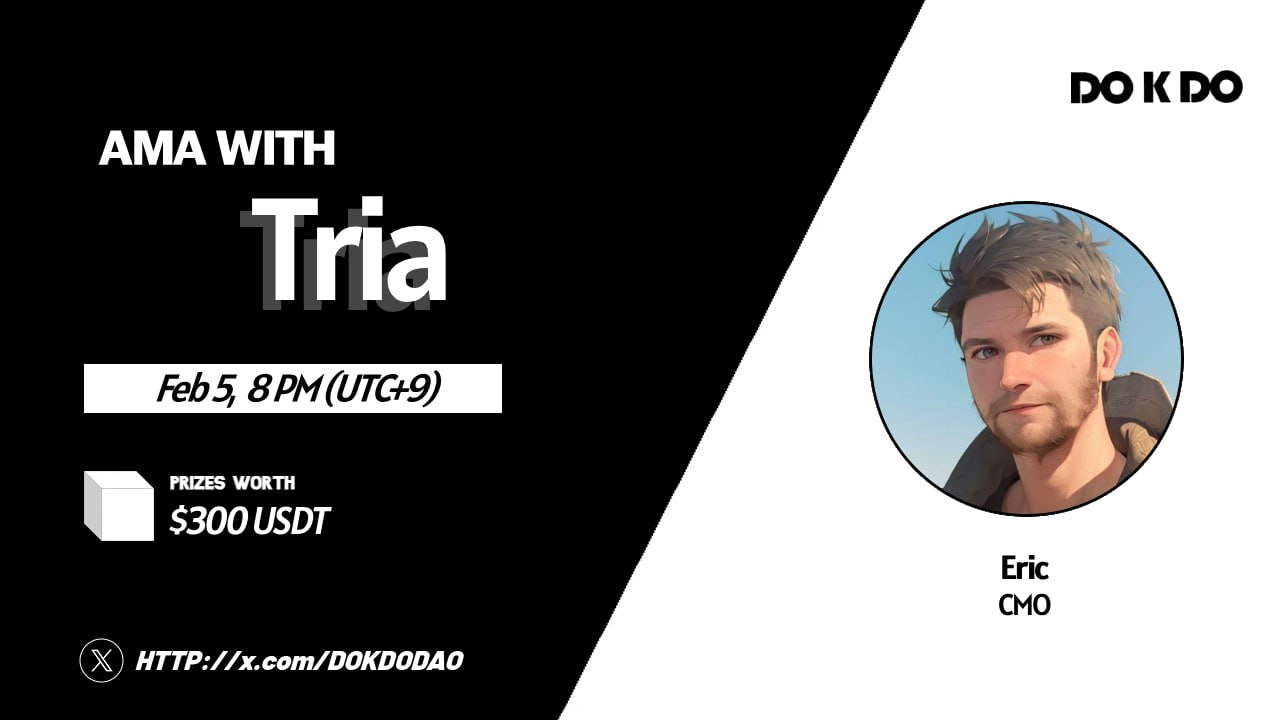
9th FEB, 8PM (UTC+9) A : ERIC (CMO) Q : DOKDO DAO
Tira is an based on its proprietary BestPath technology, Tria is building a peerless tech stack for on-chain payments and Web3 neobanking. BestPath functions as an intent-based marketplace that guarantees the fastest and most cost-effective transactions across any Virtual Machine (VM).
With sub-second swaps, crypto credit cards available in over 150 countries, and deep infrastructural integration, Tria is turning one of the largest untapped frontiers in the crypto market — global consumer Web3 payments — into a reality.
INTRODUCTION ABOUT TRIA
QCan you explain what the Tria project is?
A Traditional finance wasn’t built for the world we live in. Cross-border transfers still take days and cost up to 10% in fees. Your money sits in systems you don’t control, behind intermediaries who profit from the friction they create. And for billions of people in emerging markets, even basic financial access remains out of reach. Crypto rewrites that entirely — programmable, borderless, permissionless money that settles in seconds, runs 24/7, and doesn’t need a bank’s permission to exist. True asset ownership, transparent on-chain accounting, composable yield. It’s not an upgrade to the old system — it’s a fundamentally different architecture for how money works. But crypto built incredible infrastructure and then wrapped it in the worst user experience imaginable. Seed phrases, gas fees, bridging, chain selection — the average person shouldn’t need to understand any of that just to send money or earn yield. That gap between what crypto can do and what normal people can actually use is the single biggest bottleneck to adoption. That’s exactly where Tria sits. Tria is a self-custodial neobank and blockchain infrastructure company. At its core, it’s trying to solve one of crypto’s biggest UX problems — making decentralized finance actually usable for everyday people, without forcing them to give up control of their assets. A few key pieces: The Product — Tria functions as a self-custodial wallet and neobank, meaning users hold their own keys and funds, but the experience feels closer to a traditional fintech app than a typical crypto wallet. Think spending, earning, trading — all from one interface, across multiple chains. BestPath AVS — This is Tria’s infrastructure layer, built on EigenLayer. It’s a permissionless intent marketplace that routes cross-chain transactions across 70+ protocols to find optimal execution. So when a user wants to swap, bridge, or move money, BestPath figures out the best path (hence the name) without the user needing to understand which chain or DEX is involved. The big picture vision is essentially: make crypto feel like normal money — fast, borderless, self-custodial, and usable without a PhD in blockchain.
QThere are many crypto neobank Project already. What is Tria’s biggest competitive edge?
A On the surface, a lot of products look similar. Cards, stablecoins, cashback — those are becoming table stakes. The real difference with Tria is that we’re not building a single product. We’re building a coordinated financial system. Today, Tria offers a full product suite: Spend with up to 6% cashback, Earn, Convert, Futures, Prediction Markets, and Travel — all living in one account, all connected by BestPath. On top of that, everything you do feeds into Tria XP, so usage compounds across products instead of being siloed. We also operate with some of the lowest fees in the market across the entire stack, while offering the best cashback users can get today. That combination is very hard to replicate. Most competitors optimize one feature at a time. Tria is designed so the whole system works together. The card is just the interface. The moat is the coordination layer underneath.
QKorea has a very unique regulatory environment. What is Tria’s long-term vision for sustainability in the Korean market, and how do you plan to navigate it?
A We take this very seriously. Tria is built as global financial infrastructure, not as a country-specific financial institution. That distinction matters. We’re not trying to bypass regulation, but we’re also not pretending that one jurisdiction defines how global money should work. For Korea specifically, we’ve invested heavily in doing things the right way from the start. We work directly with top-tier Korean law firms to obtain formal legal opinions, receive ongoing legal guidance, and structure our operations in full alignment with Korea’s evolving regulatory framework. This isn’t surface-level compliance — these are deep, ongoing engagements that shape how we build, launch, and operate within the market. On the broader regulatory front, Tria has already completed a comprehensive MiCA whitepaper as part of our European regulatory strategy. That process gave us a battle-tested framework for institutional-grade compliance documentation, and we bring that same rigor to every market we enter — Korea included. The standards we hold ourselves to aren’t determined by what’s minimally required; they’re determined by what builds lasting trust with regulators, partners, and users. That’s also why collaborations like 071labs matter so much to us. They help us understand local payment behavior, compliance expectations, and user needs without rushing into fragile structures. Korea’s regulatory landscape rewards patience and precision, and we’d rather move carefully and partner thoughtfully than chase short-term growth at the expense of long-term credibility. Long-term success in Korea doesn’t come from aggressive expansion. It comes from trust, consistency, and systems that work day after day — backed by the legal infrastructure and regulatory discipline to prove it.
QWhat is Tria’s core roadmap for 2026, and what are the most critical growth metrics you are focusing on?
A In 2026, Tria’s roadmap is focused on one goal: making self-custody feel like the default financial system, where you can spend, send, earn, and trade without friction. There are six big priorities for us this year. First is Tria Travel. This is a major push because it brings a high-intent real-world use case directly into the app. Travel is one of the most common times people feel the pain of the traditional system, with foreign exchange fees, payment friction, and complicated booking flows. Tria Travel is about making booking and paying feel effortless, while keeping everything connected to your onchain balance and your overall Tria account. Second is prediction markets. We think prediction markets are evolving from a niche crypto product into real financial infrastructure. In 2026, we’re focused on making access to these markets feel native inside Tria, so users can participate in a simple, self-custodial way without needing multiple apps or complicated setup. Third is expanding trading. Futures and swaps already exist in Tria, and in 2026 we’re making them faster, smoother, and more capital-efficient. The goal is to let users trade directly from the assets they already hold, reduce friction around moving funds, and make trading feel like a connected part of your financial life instead of a separate destination. Fourth is expanding Earn. Earn already exists, and in 2026 we’re increasing vault coverage, improving the experience around clarity and risk, and making Earn feel like a default setting for idle balances, so assets can generate yield in the background while staying liquid and usable. Fifth is expanding spend. The card and payments experience already exists, and in 2026 we’re focused on making it more reliable and more global, with higher approval rates, smoother top-ups, and a better everyday experience so users can confidently use Tria as their default way to spend. Sixth is institutional partnerships and integrations. In 2026, we’re focused on integrating Tria into more ecosystems so users can do more without leaving the app, and so Tria can connect to the platforms, partners, and rails that drive real usage at scale. In terms of growth metrics, we care about real adoption, not temporary spikes. The first metric is active users and retention, meaning daily and weekly active users and how many people come back and use Tria consistently over 30 and 90 days. The second metric is conversion into durable behavior. That includes KYC completion, card booking to activation, repeat spend, repeat trading, and sustained participation in Earn. The third metric is economic throughput, meaning real card spend volume, eligible trading volume, and sustained balances in Earn, measured in a way that filters out wash activity and low-quality volume. And the fourth metric is trust and product quality, like approval rates, failure rates, and how quickly we resolve support issues. Everything we are building in 2026 is meant to drive long-term usage and real utility, because that is what supports a strong network over time.
QGiven that you support Visa cards in 150 countries worldwide, how are you navigating the regulatory hurdles that may arise in the payment process between local fiat currencies and on-chain assets?
A We’re able to operate globally because we take regulation and compliance seriously, and we design Tria so users can access onchain utility while staying within the rules of each market. There are five principles we follow. First is that we work with regulated partners and established payment rails. We don’t try to bypass the existing financial system. We integrate with it in a compliant way so users can reliably spend in local fiat while using Tria as their self-custodial account. Second is that we separate custody from payments. Users hold their assets in self-custody, and payments happen through the card network in a way that is compliant with the card ecosystem. That distinction matters, because it lets us deliver global usability without compromising the core self-custody model. Third is that we adapt flows market by market. Rules are not the same everywhere, so we build region-specific logic around things like KYC requirements, allowed transaction types, limits, and risk controls. The user experience stays simple, but under the hood the system is designed to respect local requirements. Fourth is risk management and monitoring. Payments is a high-trust domain, so we invest heavily in fraud prevention, AML controls, transaction monitoring, and policies that reduce abuse. That’s how you protect users and keep the rails reliable at scale. Fifth is transparency and long-term alignment. Our approach is to build something durable, not something temporary. That means we prioritize clear compliance standards, strong internal controls, and steady expansion into new markets only when the product and regulatory framework are ready. So the short version is: we scale globally by partnering with regulated rails, keeping custody with the user, localizing compliance, and running payments with the level of risk control the ecosystem requires.
QSince you are currently providing the BestPath infrastructure to over 60 top-tier protocols, how do you legally guarantee the security of non-custodial user assets in accordance with the guidelines of local financial authorities when entering new regions?
AWe approach this in a very direct way: in a non-custodial system, the strongest protection is that Tria cannot take possession of user funds in the first place. So our legal and technical design starts from the same principle: user assets stay under user-controlled keys, and Tria provides routing and execution logic without holding customer deposits. There are five layers to how we do this when we enter new regions. First is the legal framework and clear product boundaries. We do not present Tria as a custodian, and we do not create a structure where customer assets become our liabilities. We align our terms, disclosures, and operating model to match what local authorities typically care about: who has control of funds, who can move them, and who bears which risks. Second is architecture. BestPath is infrastructure, not custody. It routes a user’s intent to external venues and smart contracts, and execution happens onchain with the user authorizing the transaction. That means the user remains in control before, during, and after execution. Third is security standards that are verifiable, not just promised. When we expand, we prioritize audited integrations, strict integration review processes, continuous monitoring, and fast response procedures. We treat every new chain, venue, and protocol as a new risk surface, and we only scale what we can secure to a high standard. Fourth is region-by-region compliance readiness. Guidelines differ by market, so we work with local counsel and regulated partners where needed, and we adjust onboarding, disclosures, eligibility, transaction policies, and controls to align with local expectations. The user experience stays simple, but the compliance logic underneath is tailored to the region. Fifth is transparency and user protection. We’re explicit that onchain activity involves smart contract and market risk, and we design the product to reduce preventable risk through safer defaults, clear warnings, and strong controls, rather than hiding complexity. So the honest answer is: we don’t “legally guarantee” outcomes in the way a custodian might claim to, because we don’t take custody at all. What we guarantee is the structure: user-controlled assets, user-authorized execution, rigorous security practices, and a compliance approach that adapts market by market so we can scale globally in a durable way.
Q Compared to traditional neobanks or other Web3 card services, what is the most unique experience that Tria’s ‘6% cashback & 0% fees’ and ‘AI Financial Agent’ features offer to actual users?
A The most unique thing about Tria is that it combines two experiences that usually never exist together: high rewards with no hidden fees, and an intelligence layer that helps you actually use your assets better every day. First, on “6% cashback and 0% fees,” the difference for users is trust and simplicity. Traditional neobanks often give rewards, but they make money back through fees, spreads, restrictions, or category exclusions. Many Web3 cards look attractive on the surface, but users still lose value through conversion costs, hidden routing spreads, or complex steps that make the “headline” benefits hard to realize. With Tria, the experience is that you can just spend normally, get meaningful cashback, and not feel like you’re being quietly taxed every time you move between fiat and onchain assets. It turns crypto value into something that feels usable in real life, without the typical friction. Second, the AI Financial Agent changes the day-to-day experience from “managing money” to “setting intent.” Instead of users thinking in steps like which asset to use, when to swap, how to avoid fees, or how to keep balances organized, the agent helps turn what you want to do into the simplest, most efficient outcome. Over time, it becomes a personal system that helps you stay liquid, keep value productive, and make smarter decisions without needing to watch markets all day. So the combined experience is this: Tria makes self-custody feel like a modern financial system. You get the benefits people want, like high cashback and low friction, and you also get an intelligence layer that helps you use your assets in a smarter way. It feels less like a crypto tool and more like the next version of everyday finance.
Q Having surpassed $100 million in transaction volume just four months after launch, what is your specific expansion roadmap for reaching the $100 million annual revenue target through ‘Season 2’ and rolling out services for institutional clients?
A We’re excited about the early traction, but the way we think about the next phase is not “how do we extract revenue.” It’s “how do we build the most useful financial system for users, and make it sustainable for the long term.” If we do that well, the business outcome follows naturally. Our expansion roadmap has two tracks: making Season 2 genuinely more valuable for users, and rolling out institutional services in a way that increases access and trust. First, Season 2 is about rewarding real usage and long-term participation, not farming. One, we are expanding the Season 2 system so it better reflects the actions that matter most to users: trading, spending, and staying active over time. The design is meant to encourage healthy behavior like repeat usage and long-term retention, not one-time spikes. Two, we are putting strong guardrails in place so rewards go to real people doing real activity. That protects the community, because if a system is easy to game, honest users always lose. The goal is fairness and integrity. Three, we are using Season 2 to improve the actual product experience. Better execution, smoother flows, clearer risk information in Earn, and a more reliable card experience. The incentives are there to accelerate adoption, but the product improvements are what make people stay. Second, institutional services are about distribution and credibility, not “selling to institutions.” Our goal is to bring Tria’s non-custodial model to more users through trusted partners, and to make Tria easier to access inside the platforms people already use. That means integrations that reduce friction, increase reliability, and help users move between ecosystems without giving up control of their assets. It also means building the trust layer institutions require, like monitoring, reporting, and operational controls, so Tria can scale globally without compromising user safety. So the headline is: our roadmap is user-first. Season 2 is about fairness, better rewards design, and a better product. Institutional services are about making Tria more available and more trusted at scale. If we do those things, growth becomes a natural result, not the mission.
[TRIA Official Links] Twitter : **https://x.com/useTria Telegram : [https://t.me/useTriaKR](https://t.me/useTriaKR) Discord : https://discord.com/invite/triah**
메타데이터
- post_id
- b7fa02f254cf
- slug
- ama-recap-dokdo-dao-x-tria-b7fa02f254cf
- url
- https://medium.com/cryptodokdo/ama-recap-dokdo-dao-x-tria-b7fa02f254cf
- canonical_url
- https://medium.com/cryptodokdo/ama-recap-dokdo-dao-x-tria-b7fa02f254cf
- author_url
- https://medium.com/@cryptodokdo
- status
- ok
- fetched_at
- 2026-06-21 19:25:17




