Section 230 is our Generation’s Second Amendment Issue
Let’s talk about two laws.
Section 230 is our Generation’s Second Amendment Issue
Let’s talk about two laws.

The Second Amendment and Section 230 couldn’t be more different and similar
One has 27 words, was written in 1791, and haunts our national dialogue. The other has 26 words, was written in 1996, and governs our every waking moment. Both were born from the best of intentions, designed to solve a specific problem of their time.
And both are now failing us in ways their authors could never have imagined.
The first, of course, is the Second Amendment. Its 27 words: “A well regulated Militia, being necessary to the security of a free State, the right of the people to keep and bear Arms, shall not be infringed,” were written for a world of flintlock muskets that were MAYBE good up to 50 yards, if you were lucky. Think about the “arms” they were protecting. A weapon that a highly trained soldier, on a good day, with the wind at his back, could fire maybe three times in a minute. The framers were brilliant, but they couldn’t possibly have envisioned the AR-15, a weapon that places an unprecedented capacity for mass casualty in civilian hands.
I say this as a gun owner. There is no way James Madison could have predicted that his single-shot pistol, which took an eternity to reload, would evolve into my Glock 19X. Seventeen rounds ready to go, and can reload in seconds.
The disconnect between the 18th-century tool and the 21st-century weapon has created one of the most polarizing and tragic deadlocks in American history. We are trapped, arguing over the intent of a law while the technology it governs has ripped a hole in the fabric of our society.
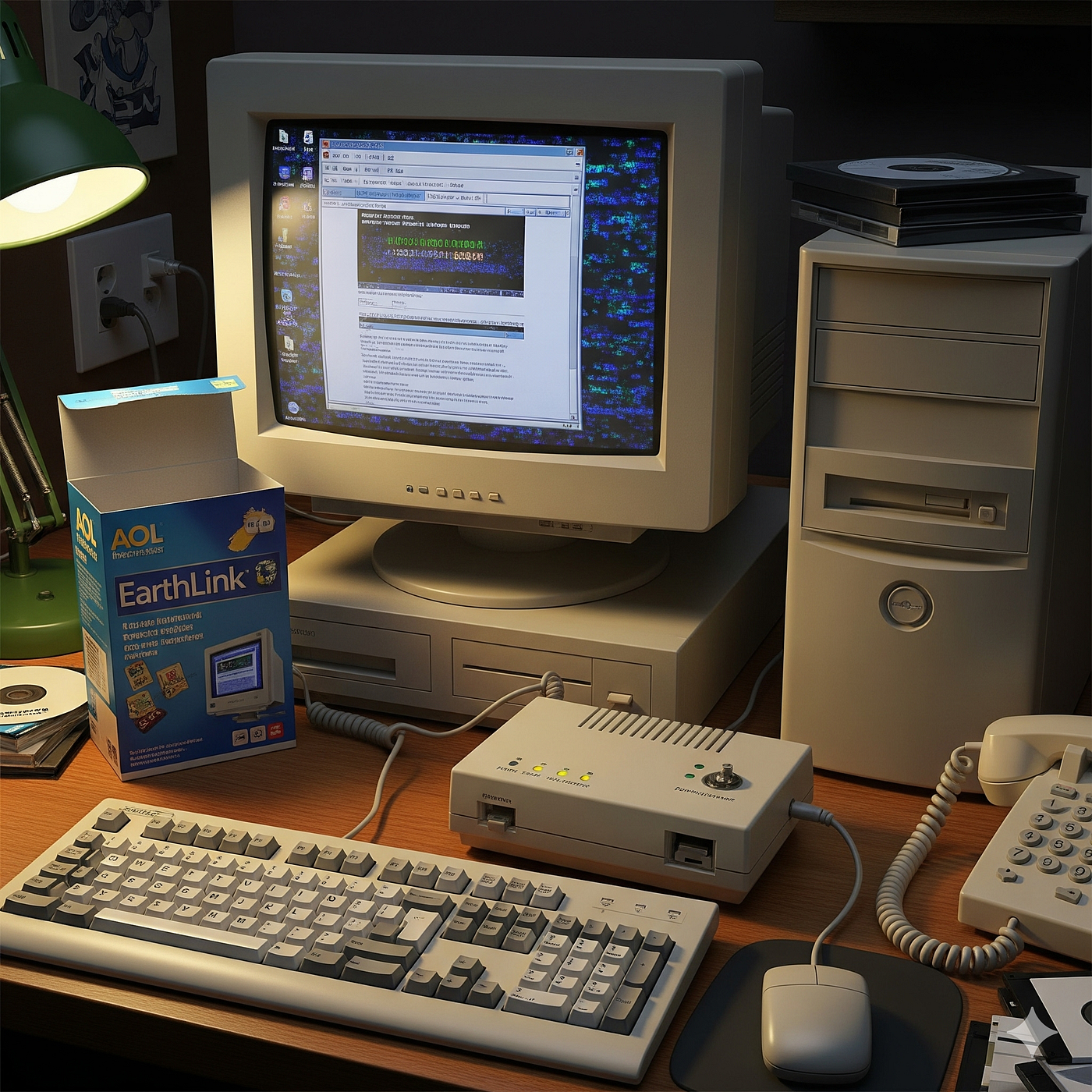
MOM! Billy is using the phone line again and I can’t call Stacy!
And we’re doing it all over again.
In 1996, a bipartisan duo in Congress (I know, bipartisan…crazy, right?) wrote 26 words I argue are more powerful today than any other law on the books. They are the core of Section 230 of the Communications Decency Act:
“No provider or user of an interactive computer service shall be treated as the publisher or speaker of any information provided by another information content provider.”
Those 26 words built the modern internet. They are the reason Google, Facebook, YouTube, TikTok, and every platform you use today could exist. They created a shield, a legal framework that allowed the internet to grow from a wild frontier into the center of our universe.
And what a different universe it was back then. In 1996, I was one of about 16 million people online worldwide. I was hunting for jobs using my CompuServe email address, which was a string of numbers that looked like a prisoner ID. Remember the blood-curdling screech of a 28.8k dial-up modem? That was the sound of the future being born. Downloading a single song took 15 minutes. Today, on my gigabit connection, I could download almost 28,000 songs in that time.
Section 230 was designed for THAT internet. An internet of static web pages, message boards, and AOL chat rooms. The law was a response to a legal paradox: a court ruled that if an online service (CompuServe) didn’t moderate content, it wasn’t liable, like a bookstore. But if another service (Prodigy) did try to moderate content to be “family-friendly,” it was liable, like a publisher.
Section 230 solved this. It said platforms could be Good Samaritans, moderating content without fearing lawsuits for every single post they hosted. It made sense. We thought we were building a global library.

We accidentally built a global weapon
The catastrophic chasm between the flintlock musket of 1791 and the AR-15 of today is the exact same chasm between the dial-up internet of 1996 and the algorithmic reality machine of today.
The architects of Section 230 did not envision global platforms powered by sophisticated algorithms that don’t just host content but actively curate, amplify, and micro-target it to billions of people. They couldn’t have foreseen the weaponization of speech, where misinformation and hate, supercharged by engagement-driven code, can circle the globe in seconds. They didn’t imagine digital echo chambers radicalizing our children or foreign adversaries manipulating our elections.
A post to a forum in 1996 is not the same as a viral post today. Both are user-generated, but their scale, speed, and capacity for societal harm are fundamentally different.
The core of the problem is this: the bookstore analogy is dead.
Section 230 was built on the idea that a platform is like a bookstore, not responsible for the contents of every book on its shelves. That makes sense when I walk into a store and choose a book myself.
The Internet isn’t a bookstore anymore. It’s more like a bookstore that knows everything about you and decides to shove five books in your face. Not the ones you need, but the ones it knows will rile you up, keep you scrolling, and make someone money. That’s not neutral hosting. That’s curation. That’s editorial power. That is influence on a massive scale.

The Internet isn’t a bookstore anymore.
Imagine walking into a bookstore that knows every secret fear you have, every political bias you lean toward, and every single thing you’ve ever looked at. This bookstore doesn’t wait for you to browse. It instantly builds a personalized shelf right in front of you, filled with the five most controversial, sensational, and enraging books it knows you won’t be able to resist. It does this for every single person who walks in the door. It’s not trying to help you learn or grow. It’s scientifically designed to hold your attention for profit.
That’s not a bookstore. That’s an algorithm. And calling it a neutral platform is a lie.
I want to be honest and open. I was part of this. For more than 15 years, I worked at Google, and believed in our mission: “to organize the world’s information and make it universally accessible and useful.” We genuinely thought more information was the answer to everything. Give people access, and they will be empowered. Education will flourish. Poverty will decline.
I grew up in poverty with little access to information. I used to talk about how I didn’t have books or encyclopedias like other kids. I just had the Columbus Library on 51st Street and 10th Ave. I imagined what the world would be like if I had EVERY liberty in the world on a laptop or in my pocket. What would the world be like if every poor kid in the world had access to all the world’s information?
I was, what the historian Yuval Noah Harari calls an “information nativist,” in his powerful book Nexus. A book everyone should read. And he was right. I’m no longer naïve.

A must read for understanding where we are today
The internet can still be the most powerful tool for human advancement ever created. I have ideas on how to make that happen. But to save it, we must fix the broken law that governs it. This isn’t about censorship or abolishing Section 230. It’s about modernizing it for the world we actually live in, not the one that existed when Toy Story was a technological marvel.
I’m not saying we should abolish Section 230. Just like I’m not saying we should abolish the Second Amendment. But pretending either one makes sense in its original form today is dangerous.
The solution starts with ending immunity for algorithmic amplification. We need Section 230 reform that recognizes the difference between hosting content and amplifying it. Hosting should be protected. Algorithmic amplification, especially when it’s designed purely for engagement should carry responsibility. If your algorithm pushes dangerous content into millions of feeds, you’re not a bookstore. You’re a publisher.
Platforms should remain protected for content they merely host or users actively seek out. But the moment their algorithm proactively recommends, promotes, or amplifies content, especially content designed to maximize engagement regardless of the harm it causes, the shield comes off. That’s not hosting; that’s an editorial choice made by code. It’s what I am coining “technical editorism,” and it should come with liability (OK, maybe I’m not coining it…but I just made it up, I swear.)
This would create a powerful incentive for platforms to redesign their algorithms for human well-being, not just infinite engagement. The problem isn’t just that harmful content exists. It’s that platforms choose to amplify it because controversy equals engagement, and engagement equals revenue.
This won’t be easy. You might think it’s harder to revise the Second Amendment because it’s baked into the Constitution. But those of us who want to reform Section 230 are up against something far more powerful than precedent…money. In 2023, the gun rights lobby spent nearly $11 million on federal lobbying. The communications and electronics industry? Well, they spent over $390 million. That’s not counting state and local influence.
But just because it’s hard doesn’t mean we shouldn’t do it. The longer we pretend Section 230 is untouchable, the more the internet becomes a weapon against truth, democracy, and trust itself.
The Second Amendment debate is a tragic lesson in what happens when society fails to adapt its foundational rules to revolutionary technologies. We cannot afford to make the same mistake with Section 230. The digital public square is too vital, the health of our democracy is too fragile, and the cost of inaction is too high.
The time for thoughtful, urgent reform is now. What do you think? Should platforms be held accountable for what their algorithms amplify? Or is that a slippery slope? I’d love to hear your thoughts.
메타데이터
- post_id
- b7fe2dbf3a61
- slug
- section-230-is-our-generations-second-amendment-issue-b7fe2dbf3a61
- url
- https://medium.com/@jcasap/section-230-is-our-generations-second-amendment-issue-b7fe2dbf3a61
- canonical_url
- https://medium.com/@jcasap/section-230-is-our-generations-second-amendment-issue-b7fe2dbf3a61
- author_url
- https://medium.com/@jcasap
- status
- ok
- fetched_at
- 2026-07-19 12:35:33


