Streamlining Java: A Practical Guide to findFirst() and findAny()
In Java programming, stream operations offer powerful tools for processing sequences of elements. Among these, the findFirst() and…
Streamlining Java: A Practical Guide to findFirst() and findAny()
In Java programming, stream operations offer powerful tools for processing sequences of elements. Among these, the findFirst() and findAny() methods are pivotal in retrieving elements from a stream. This article delves into the nuances of these methods, explicating their functionalities, differences, and appropriate use cases. Understanding these methods is crucial for Java developers looking to harness the full potential of stream processing.
Understanding Java Streams
Java Streams represent a significant advancement in the Java programming language, offering a modern approach to processing sequences of data. They were introduced in Java 8 as part of the java.util.stream package, revolutionizing the way Java handles collections and data processing. Streams provide a high-level abstraction for performing complex data processing operations in a clean, readable, and concise manner. They are particularly useful in dealing with collections of objects, enabling developers to perform operations like filtering, mapping, and reduction with ease.
One of the core strengths of Java Streams is their ability to facilitate declarative programming. Unlike traditional imperative programming, which focuses on how to perform operations, declarative programming concentrates on what the outcome should be. This shift in focus leads to code that is easier to read and maintain. Streams allow developers to express complex data processing queries without getting bogged down in the mechanics of iteration, conditionals, and control flow.
Stream operations are divided into two main categories: intermediate and terminal operations. Intermediate operations, such as filter, map, and sorted, transform a stream into another stream. They are lazy, meaning they do not process the data until a terminal operation is invoked. Terminal operations, like collect, forEach, and reduce, produce a result or a side-effect. Once a terminal operation is performed, the stream cannot be used further.
In modern Java applications, Streams are extensively used for data processing tasks. They provide a means to efficiently process large datasets, leverage multi-core architectures, and write code that is both performant and readable. Whether it’s filtering a list of items, transforming data elements, or aggregating values, Streams offer a versatile toolkit for the modern Java developer.
By leveraging the power of Java Streams, developers can write more functional-style code, leading to programs that are not only efficient but also easier to parallelize and maintain. This functional approach aligns with modern software development practices, making Java Streams an essential tool in the Java developer’s arsenal.
Exploring findFirst() Method
The [findFirst()](https://docs.oracle.com/en/java/javase/21/docs/api/java.base/java/util/stream/Stream.html#findFirst()) method in Java Streams is a terminal operation that plays a crucial role in retrieving elements from a stream. It’s designed to return an *Optional<T>* — a container object which may or may not contain a non-null value — representing the first element of the stream. This method becomes particularly useful when you are dealing with ordered streams, where the first element is distinctly identifiable.
Understanding findFirst()
At its core, findFirst() provides a means to fetch the first element from a stream that matches the given criteria, defined by previous intermediate operations like filter. For instance, in a stream of numbers, findFirst() can be used to find the first number that is even. The method is guaranteed to return the first element in the order of the stream, which is especially significant in ordered collections like lists.
Syntax and Behavior
The typical syntax for findFirst() looks like this:
Optional<T> firstElement = stream.findFirst();If the stream is empty or no elements match the criteria, findFirst() returns an empty Optional. This approach avoids the pitfalls of returning *null, thus helping in preventing [NullPointerException](https://docs.oracle.com/en/java/javase/21/docs/api/java.base/java/lang/NullPointerException.html)* in Java applications.
Consider the following code snippet:
Optional<String> firstElement = stream.findFirst();
firstElement.ifPresent(el -> {
    // do stuff
});
In this example, we retrieve the first element from the stream using findFirst() and then perform actions if the element is present. This pattern allows you to handle potentially empty streams gracefully and execute specific logic only when a valid element is found, promoting safer and more robust Java applications.
Use Cases
- Finding Specific Elements: In scenarios where you need to retrieve a specific element from a collection that meets certain criteria, findFirst() is invaluable. For example, finding the first employee in a list who has more than 5 years of experience.
- Conditional Processing: Combined with other stream operations like filter, findFirst() can be used to conditionally process data. For instance, finding the first order from a customer that exceeds a certain amount.
Examples
Consider a list of integers. To find the first even number in the list, you could use findFirst() in combination with filter:
List<Integer> numbers = Arrays.asList(1, 3, 4, 6, 8);
Optional<Integer> firstEven = numbers.stream()
                                     .filter(n -> n % 2 == 0)
                                     .findFirst();
In this case, firstEven would contain the value 4 as it’s the first even number in the given list.
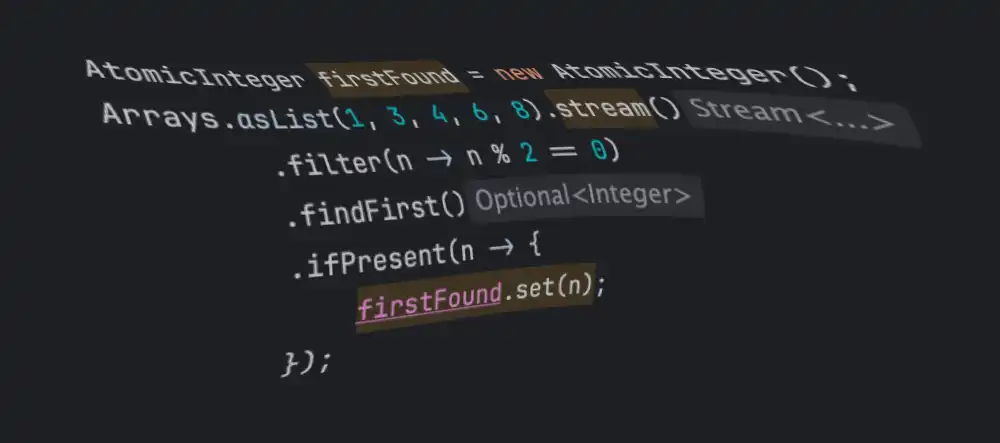
To enhance this code a little further, we can save the found element by:
AtomicInteger firstFound = new AtomicInteger();
Arrays.asList(1, 3, 4, 6, 8).stream()
        .filter(n -> n % 2 == 0)
        .findFirst()
        .ifPresent(n -> {
            firstFound.set(n);
        });
The findFirst() method is a powerful tool in the Java Stream API, enabling developers to efficiently and safely retrieve the first element of a stream that matches certain criteria. Its use in ordered streams, combined with its avoidance of null values, makes it an essential method for data retrieval in Java applications.
Unraveling findAny() Method
The [findAny()](https://docs.oracle.com/en/java/javase/21/docs/api/java.base/java/util/stream/Stream.html#findAny()) method in Java’s Stream API is a terminal operation that serves an interesting purpose. It is designed to return an Optional<T> for some element of the stream, without any specific guarantee about which element it returns. This characteristic makes findAny() especially useful in scenarios where the stream is unordered, or when any matching element is as good as any other.
The Essence of findAny()
Unlike findFirst(), findAny() does not necessarily return the first element in the stream. When dealing with parallel streams, this method can provide better performance, as it doesn’t have to wait for the processing of the entire stream to find the ‘first’ match. In essence, findAny() offers a more flexible and potentially more efficient way to retrieve an element from a stream.
Syntax and Functional Aspects
The syntax for using findAny() is quite straightforward:
Optional<T> anyElement = stream.findAny();As with findFirst(), findAny() returns an Optional<T> which either contains some element from the stream or is empty if the stream has no elements. This approach is also in line with Java’s philosophy of avoiding null where possible.
Use Cases
- Parallel Stream Processing: In multi-threaded stream operations, using findAny() is more efficient than findFirst(), as it allows for more flexibility in the element retrieval process.
- Random Element Retrieval: When the order of elements is not important, or when you need a random element that matches certain criteria, findAny() is the ideal choice.
Examples
Let’s consider a scenario where you have a list of names, and you want to find any name that starts with the letter ‘D’:
List<String> names = List.of("Alice", "Bob", "Charlie", "David",
        "Jessica", "Donald");
Optional<String> anyNameStartingWithD = names.stream()
        .filter(name -> name.startsWith("D"))
        .findAny();
Full details on Converting Strings to Map.
Using a parallel stream with non-deterministic results:
Optional<String> anyNameStartingWithD = names.parallelStream()
      .filter(name -> name.startsWith("D"))
      .findAny();
In this case, anyNameStartingWithD might contain “David” or might contain “Donald”, depending on the stream’s internal operations. The key takeaway is that findAny() provides a non-deterministic approach to element retrieval, which can be quite useful in certain scenarios.
The findAny() method is a versatile and performance-friendly tool in the Java Stream API. It offers a non-deterministic approach to element retrieval which can be advantageous in parallel processing and scenarios where any matching element is acceptable. Its usage underscores Java’s focus on efficiency and safe programming practices, making it a valuable asset in the Java developer’s toolkit.
Key Differences Between findFirst() and findAny()
When working with Java Streams, understanding the subtleties between findFirst() and findAny() is crucial for effective and efficient data processing. While both methods serve a similar purpose — retrieving an element from a stream — their operational nuances and suitable use cases differ significantly.
Operational Differences
- Ordering Guarantees:
- findFirst(): This method guarantees to return the first element in the order of the stream. It is deterministic, meaning that it always returns the same result for a given ordered stream.
- findAny(): This method does not provide such an ordering guarantee. It can return any element from the stream, making it inherently non-deterministic. In parallel streams, it may return different elements when called multiple times under the same conditions.
2. Performance in Parallel Streams:
- findFirst(): When used in parallel streams, findFirst() may lead to reduced performance due to its ordering constraints. All elements of the stream have to be processed to ensure the first element is found.
- findAny(): With fewer constraints on ordering, findAny() can be more efficient in parallel streams. It allows for more flexible partitioning and processing, potentially returning a result as soon as any thread finds a matching element.
Practical Use Cases
Ordered Collections
findFirst() is preferable when working with ordered collections, such as lists, where the order of elements is meaningful. For instance, retrieving the first employee from a sorted list based on their joining date.
Performance-Critical Applications:
In scenarios where performance is a critical factor, especially with parallel streams, findAny() is the better choice. It is ideal for applications where any matching element suffices, and the ordering is not essential.
Random Element Retrieval:
findAny() is suitable for cases where you need a random element that matches certain criteria. For instance, selecting any available worker for an immediate task without a preference for order.
The choice between findFirst() and findAny() in Java Streams depends largely on the context of the application. findFirst() is the go-to method for ordered streams where the first matching element is significant, whereas findAny() is more efficient and suitable for unordered streams or when any matching element is acceptable. Understanding these differences allows Java developers to optimize their stream operations for both correctness and performance.
Comparing findFirst() with anyMatch()
Understanding the difference between findFirst() and anyMatch() in Java Streams is key to effectively utilizing the Stream API. While both methods are used to process elements within a stream, they serve distinct purposes and produce different outcomes.
Distinct Roles
Role of findFirst()
[findFirst()](https://docs.oracle.com/en/java/javase/21/docs/api/java.base/java/util/stream/Stream.html#findFirst()) is a terminal operation that returns an Optional<T> representing the first element of the stream that matches the given criteria. It is primarily used for retrieving a specific element from the stream.
Role of anyMatch()
*anyMatch()*, on the other hand, is a terminal operation that returns a boolean value. It tests whether any elements of the stream match the provided predicate. It is used to check for the presence of a condition within the stream and does not return the actual element.
Behavioral Differences
Return Type
findFirst() returns an Optional<T> which can be either a specific element from the stream or an empty Optional if no element matches.
anyMatch() returns a boolean — true if any element matches the predicate, and false otherwise.
Performance in Large Streams
While findFirst() needs to provide the first matching element, which might require processing a significant portion of the stream, anyMatch() can short-circuit and return as soon as it finds any matching element.
Examples
Using findFirst()
List<String> names = Arrays.asList("Alice", "Bob", "Charlie", "David");
Optional<String> firstLongName = names.stream()
                                      .filter(name -> name.length() > 4)
                                      .findFirst();
// firstLongName might contain "Alice"
Using anyMatch()
List<String> names = Arrays.asList("Alice", "Bob", "Charlie", "David");
boolean hasLongName = names.stream()
                           .anyMatch(name -> name.length() > 4);
// hasLongName would be true, as "Alice" satisfies the condition
While findFirst() is about retrieving an element based on a condition, anyMatch() is about checking the presence of a condition within the stream. findFirst() is used when you need to extract a specific item from the stream, whereas anyMatch() is ideal for quickly determining whether any element in the stream meets a given predicate. Understanding these differences is crucial for implementing effective and efficient data processing logic in Java applications.
Deciphering findAny() and anyMatch()
In Java’s Stream API, both findAny() and anyMatch() are vital methods, but they cater to different needs and scenarios. It is essential to grasp their differences to leverage them effectively in stream operations.
Fundamental Differences
Purpose of findAny()
findAny() is a terminal operation that returns an Optional<T> containing some element of the stream if it exists. The key aspect of findAny() is its non-deterministic nature — it doesn’t guarantee which element of the stream will be returned.
Purpose of anyMatch()
In contrast, anyMatch() is used to evaluate whether any elements of the stream match a given predicate. It returns a boolean value — true if any element satisfies the predicate, or false if none do.
Behavioral Aspects
Return Type and Content
findAny() returns an Optional<T> representing a single element from the stream, which is useful when you need an example of a matching element.
anyMatch() returns a simple boolean, indicating the presence or absence of an element that matches the criteria.
Performance Considerations
findAny() may involve more overhead than anyMatch() in certain scenarios, especially in large streams, as it needs to retrieve an actual element.
anyMatch() can be more efficient, particularly in parallel streams, as it can terminate as soon as a matching element is found, without retrieving the element itself.
Use Case Scenarios
Retrieving an Example Element
Use findAny() when you need to retrieve an actual element from the stream that meets your criteria, and it doesn’t matter which one. For instance, fetching any available product from a category for display purposes.
Condition Checking in Streams
Use anyMatch() when your primary goal is to check whether the stream contains any element that meets a specific condition. This is useful in scenarios like validating input lists or checking for the presence of certain attributes in a collection.
Examples
Using findAny()
List<Integer> numbers = Arrays.asList(1, 2, 3, 4, 5);
Optional<Integer> anyEvenNumber = numbers.stream()
                                         .filter(n -> n % 2 == 0)
                                         .findAny();
// anyEvenNumber could contain 2, 4, or another even number
Using anyMatch()
List<Integer> numbers = Arrays.asList(1, 2, 3, 4, 5);
boolean hasEvenNumber = numbers.stream()
                               .anyMatch(n -> n % 2 == 0);
// hasEvenNumber would be true as there are even numbers in the list
Understanding when to use findAny() versus anyMatch() hinges on whether you need an actual element from the stream or just need to know if such an element exists. findAny() is about retrieving an element, while anyMatch() is focused on condition verification. Choosing the right method based on these distinctions is crucial for writing efficient and effective Java Stream code.
Best Practices for Using findFirst() and findAny()
When working with Java Streams and the findFirst() and findAny() methods, it’s essential to follow best practices to ensure efficient and effective stream processing. Here are some valuable tips to help you make the most out of these methods:
- Choose findFirst() for Deterministic Results: If you need a specific result or the order of elements matters, opt for findFirst(). It guarantees the first element that matches the predicate in the original order, ensuring deterministic outcomes.
- Consider findAny() for Parallel Processing: In parallel stream operations, findAny() can offer better performance due to its ability to work concurrently across multiple threads. Use it when you need any matching element without concerning yourself with order.
- Use Proper Predicates: Ensure your predicates for both methods are accurate and comprehensive. A poorly defined predicate can lead to unexpected results or reduced performance. Test your predicates thoroughly to confirm they meet your criteria.
- Performance Considerations: Be aware that using findFirst() may be slower in parallel streams, especially when dealing with large datasets. In such cases, findAny() can be a faster alternative. Benchmark your code to choose the most efficient method.
- Optimize Stream Operations: Keep an eye on the entire stream processing pipeline. Optimize your code by combining operations or using short-circuiting operations like limit() to reduce the number of elements processed, thus improving performance.
- Avoid Stateful Operations: Be cautious when using stateful operations like sorted() before findFirst() or findAny(). These operations may require buffering the entire stream, potentially impacting performance. Use them only when necessary.
- Use Optional Correctly: Both findFirst() and findAny() return Optional objects to handle potential absence of results. Use methods like orElse() or orElseGet() to provide default values or handle exceptional cases gracefully.
- Testing and Profiling: Thoroughly test and profile your code when deciding between findFirst() and findAny(). Real-world data and scenarios may vary, and profiling can help you identify performance bottlenecks.
By following these best practices, you can make informed choices when using findFirst() and findAny() in your Java stream processing, ensuring that your code is both efficient and reliable.
In Conclusion
We’ve explored the intricacies of Java Stream’s findFirst() and findAny() methods, shedding light on their functionalities and use cases. findFirst() is your go-to choice when you need the first matching element from a stream, making it ideal for scenarios where order matters or you require a specific result. On the other hand, findAny() provides performance advantages in parallel stream processing and is suitable when you need any matching element without regard to order.
Understanding these methods empowers Java developers to make informed decisions in stream processing, ensuring efficient and effective data manipulation. Whether you’re seeking precision with findFirst() or leveraging the flexibility of findAny(), these methods are essential tools in your Java programming arsenal.
In Java programming, mastering stream operations is a valuable skill, and the nuanced use of findFirst() and findAny() adds depth to your expertise. By strategically applying these methods, you can enhance the efficiency and readability of your code, ultimately leading to more robust and maintainable Java applications.
Related Topics on Java Streaming
Dive into key aspects of Java Streaming with these topics: String conversions, stream concatenation, parallel processing, and advanced looping techniques. Each link below offers focused insights to enhance your Java expertise:
메타데이터
- post_id
- b80ad3ce8e4c
- slug
- streamlining-java-a-practical-guide-to-findfirst-and-findany-b80ad3ce8e4c
- url
- https://medium.com/@lagnada/streamlining-java-a-practical-guide-to-findfirst-and-findany-b80ad3ce8e4c
- canonical_url
- https://medium.com/@lagnada/streamlining-java-a-practical-guide-to-findfirst-and-findany-b80ad3ce8e4c
- author_url
- https://medium.com/@lagnada
- status
- ok
- fetched_at
- 2026-06-28 10:39:35